


I lost ₹47,000 on a single Reliance Industries trade in 2018.

Rajesh Sharma
Chuyên gia Phân tích Forex Cao cấp ·  India
India
☕ 11 phút đọc
Bạn sẽ học được:
- 1What Are Renko Charts? (And Why They Work in India)
- 2Setting Up Renko Charts on Indian Trading Platforms
- 3Core Renko Trading Strategies You Can Use Today
- 4risk-management-position-sizing
- 5SEBI, Algorithmic Trading, and Your Renko Bot
- 6Using Renko for Forex & Commodities (via International Brokers)
- 7Common Pitfalls & My Costly Mistakes
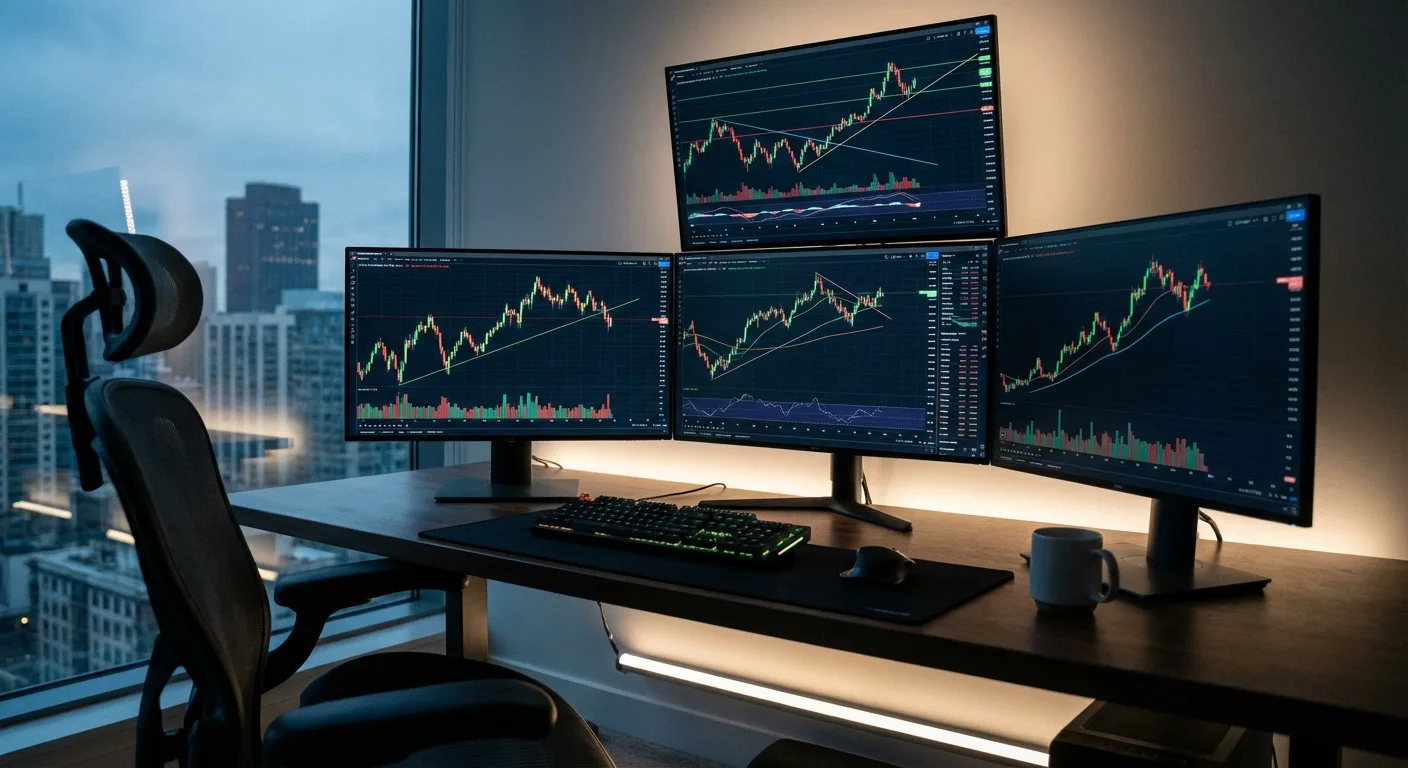
I lost ₹47,000 on a single Reliance Industries trade in 2018. The culprit? Classic candlestick charts showing relentless noise that tricked me into thinking a reversal was happening every other hour. The price was trending up, but the intraday wicks and dojis made it look like a battlefield. That loss, more than any win, convinced me to seriously look at Renko charts. In India's often-volatile markets, Renko's noise-filtering isn't just a fancy trick; it's a survival tool. This guide will show you how to build a real Renko trading strategy in India, from setting up your charts on Kite or Upstox to understanding what SEBI really thinks about your automated Renko bot.
Forget open, high, low, close. Renko charts only care about one thing: price movement that meets a minimum threshold, called the 'box size'. If Reliance moves up by ₹10 (your box size), a new brick is drawn. It needs to move another ₹10 to draw the next one. If it moves down ₹10, a new down brick is drawn. Everything in between? Ignored. No wicks, no dojis, no spinning tops.
This is why they're powerful for Indian markets. Stocks like Tata Motors or Bank Nifty can whip around on 5-minute charts based on news flow, FII data, or just plain sentiment. That noise can trigger your stop-loss on a perfectly good trend. Renko charts filter that out, letting you see the pure trend. It forces discipline. You're not reacting to every ₹2 move; you're waiting for a confirmed ₹10 or ₹20 move.

Example: Let's say you set a Renko box size of ₹15 for HDFC Bank. The price is at ₹1,650. It must hit ₹1,665 to form a new green brick. It dances between ₹1,655 and ₹1,660 for two hours? Nothing happens on the Renko chart. The trend only continues when there's genuine conviction.
The biggest mental shift is accepting that 'time' disappears. A brick could form in 2 minutes or 2 days. It doesn't matter. Only price does. This alone can save you from overtrading, a common pitfall for Indian retail traders glued to their screens.

Good news: you don't need expensive foreign software. Most major Indian brokers have integrated Renko, though sometimes you have to dig for it.
On Zerodha Kite
Kite has solid Renko built-in. On your chart, click the 'candles' icon (or the chart style selector). You'll see 'Renko' in the list. Click the settings gear next to it. Here's the critical part: choosing the box size. You can set it based on:
- Absolute Value: ₹5, ₹10, ₹25. Simple and my preferred method for stocks.
- ATR (Average True Range): A dynamic size, say 0.5 ATR. Better for volatile instruments like Nifty options.
I use ₹10 for large caps (Reliance, Infosys) and ₹5 for mid-caps. For Bank Nifty futures, I might use 50 points.
On Upstox Pro
Similar process. Go to chart settings, select 'Renko' from chart types. Upstox also allows you to choose the source (close, high/low) for brick calculation. I stick with 'close' for consistency.
The Best Tool: TradingView
If your broker's charting feels limited, open TradingView in another tab. Its Renko implementation is superb, with more customization. The paid plans are worth it if you're serious. You can chart Nifty, Bank Nifty, and all Indian stocks there. Just remember, you'll still need your broker's terminal to execute trades.

Warning: A common mistake is setting the box size too small. A ₹2 Renko on a ₹200 stock will still show noise. Too big, and you'll miss every entry. Start with a box size around 0.5% to 1% of the instrument's price. For a ₹2,000 stock, that's a ₹10-20 box.

💡 Mẹo của Winston
A Renko chart doesn't show you what the market is doing. It shows you what the market has done that was significant enough to meet your filter. Trade the confirmation, not the anticipation.
“Renko's clarity can make you overconfident. You see a clean trend and think, 'This is a sure thing.' Nothing is.”
Renko isn't a strategy by itself; it's a lens. You still need rules to know when to buy and sell. Here are two I've used with real money.
1. The Two-Brick Reversal
This is my bread and butter for swing trading Indian equities. The rule is simple:
- Long Entry: After a series of green bricks, a red brick forms, followed immediately by a green brick that exceeds the high of that red brick. Place your buy order above the high of the confirming green brick.
- Short Entry: The opposite after red bricks.
I used this on TCS in October 2023. The stock was in a downtrend (red bricks). A green brick appeared, then a red, then a green that broke above. I entered at ₹3,512. My stop-loss was placed just below the low of the reversal red brick. I rode it for seven consecutive green bricks, exiting at ₹3,650. That was a clean ₹138 per share move, filtered from all the intraday chaos.
2. Support/Resistance with Renko
Because Renko cleans up the chart, horizontal support and resistance levels become glaringly obvious. A price level where multiple bricks have reversed is a strong zone.
Trade Example (Failed): I saw ITC bouncing off a ₹430 support zone three times on Renko. On the fourth touch, I bought, expecting another bounce. The price consolidated, printed a small red brick, then a green. But the next brick was a large red that sliced through the support like butter. I was stopped out. The lesson? Renko confirms breaks more decisively. That clean break of a well-defined Renko support is a powerful signal, often stronger than the bounce play. I should have waited for the break and gone short.
These strategies work with any indicator, but keep it simple. A basic RSI indicator or MACD indicator on a Renko chart can help identify overbought/oversold conditions within the trend. Never use a scalping strategy designed for 1-minute candles on a Renko chart. The timeframes are incompatible.

This is where you make or lose your account. Renko's clarity can make you overconfident. You see a clean trend and think, "This is a sure thing." Nothing is.
Your stop-loss is non-negotiable. On a Renko chart, the logical place is just beyond the brick that would invalidate your setup. For a Two-Brick Reversal long, your stop goes below the low of the reversal red brick. Not below the green brick before it. That specific brick.
Position sizing is everything. I don't care if you see the cleanest Renko setup of the year on HDFC Bank. If risking 5% of your capital on it would wipe out two weeks of profits, you're gambling. Use a position size calculator. Religiously. For Indian stocks, I never risk more than 1% of my trading capital on a single idea. On a ₹500,000 account, that's ₹5,000.
Let's do the math for that TCS trade:
- Account: ₹1,000,000
- Risk per trade (1%): ₹10,000
- Entry: ₹3,512 | Stop-loss: ₹3,485 (below the reversal brick)
- Risk per share: ₹27
- Position size: ₹10,000 / ₹27 = ~370 shares.
That's it. I bought 370 shares. Not 500 because I felt good. The math decided. This discipline prevents one bad Renko trade from causing a margin call scenario.

Pro Tip: Renko bricks can be large. If your calculated stop-loss distance is so big that it blows past your 1% risk, the trade is invalid. Walk away. Find a smaller box size or a different instrument. Forcing a trade is the first step to the loser's corner.
“That loss, more than any win, convinced me to seriously look at Renko charts. In India's often-volatile markets, Renko's noise-filtering isn't just a fancy trick; it's a survival tool.”
Here's the question I get most: "Can I run an automated Renko strategy in India?" The answer is murky, and you need to understand this.
Renko charts are just a chart type. SEBI doesn't regulate charting methods. However, if you build an algorithm that automatically generates orders based on those Renko bricks, you are now in the realm of algorithmic trading, and SEBI has been circling this for years.
The Current Reality (as of 2026): SEBI's big discussion paper from 2021 laid out concerns: market manipulation, system integrity, retail protection. The core idea is that any algo order must go through your broker's system with checks. Brokers would be responsible. While full-blown regulations for retail algo trading aren't fully cemented, the intent is clear: SEBI wants oversight.
What This Means For You:
- Manual Trading with Renko Charts: 100% legal, no issues. You look at the chart, you click the buy/sell button.
- Semi-Automated (Alerts): You use software (like TradingView or AmiBroker) to scan for Renko setups and send you an SMS or alert. You manually execute. This is generally fine.
- Fully Automated Renko Bot: This is the grey zone. If you code a bot that places trades directly to the exchange via a broker's API (like Zerodha's Kite Connect), you are likely subject to future and evolving SEBI rules. Your broker may require approvals or have restrictions.
My advice? If you're a retail trader, stick to manual or alert-based trading. The regulatory risk isn't worth it. The prop firms operating in India have to navigate these rules carefully, often using managed accounts. If you're trading with a prop firm challenge, their rules are your bible, and automated tools for risk management become critical.
The landscape is shifting. Keep an ear to SEBI announcements. Ignorance of the rules will not be an excuse when your fancy Renko bot accidentally spams the exchange with orders.
💡 Mẹo của Winston
If you find yourself constantly adjusting the box size to make yesterday's chart look perfect, you're not trading anymore. You're painting. Stop. Pick a rule and live with its imperfections.

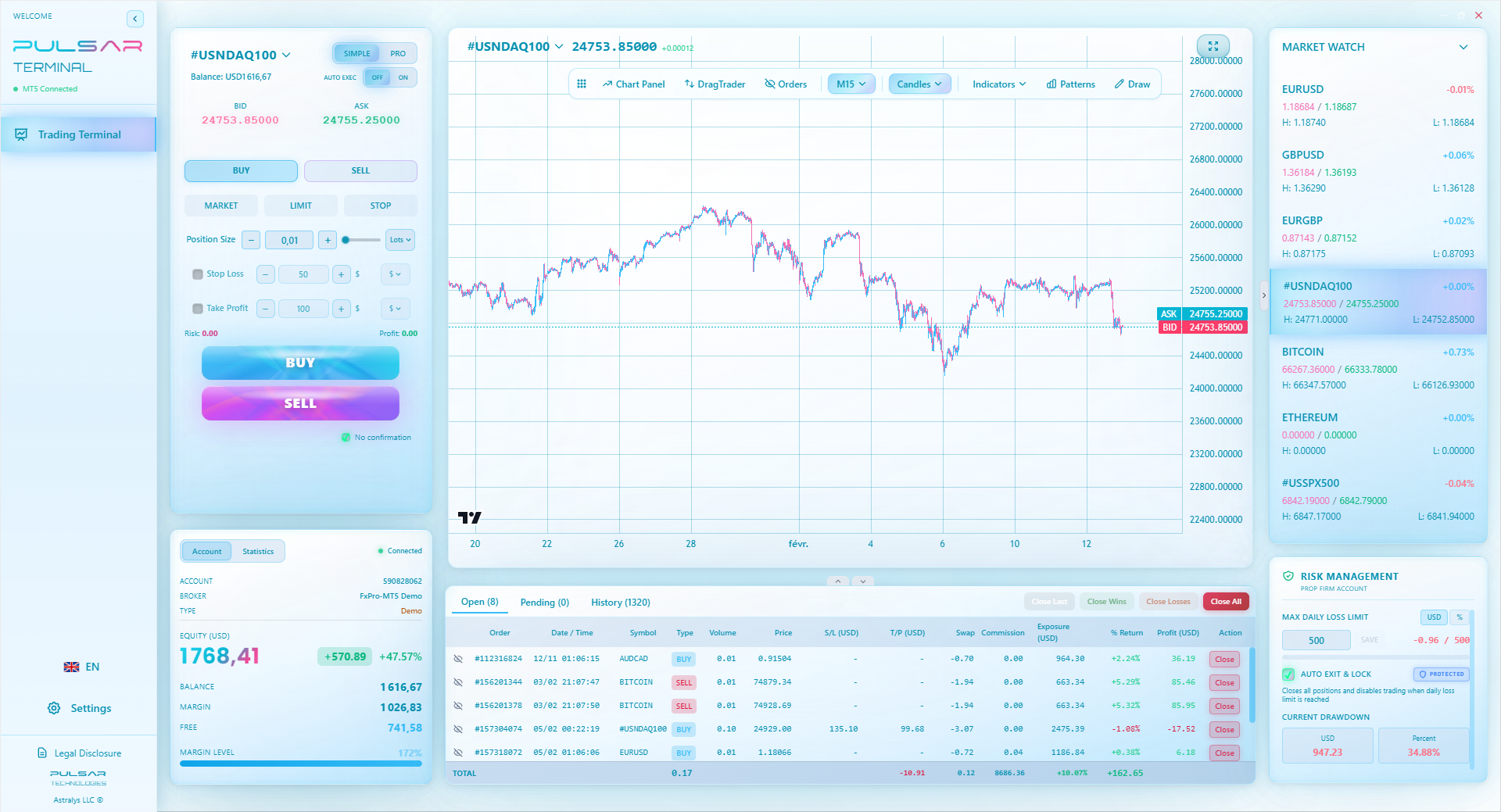
Managing multiple Renko-based trades and their stops manually is a headache; a tool like Pulsar Terminal automates trailing stops, breakeven moves, and multi-level exits directly on your MT5 platform.
Pulsar Terminal
Công cụ MT5 tất-cả-trong-một: đặt lệnh kéo-thả, multi-TP/SL, trailing stop, grid trading, Volume Profile và bảo vệ prop firm. Hơn 1.000 trader sử dụng mỗi ngày.
Many Indian traders also trade global markets like EUR/USD or XAU/USD (Gold) through international brokers registered abroad. Renko is fantastic for these too, but the context changes.
Platforms: You'll likely be on MetaTrader 4/5 (MT5). Most MT5 platforms don't have native Renko. You need to download a custom Renko indicator or use a separate charting tool like TradingView. This adds a layer of complexity.
Box Size in Pips: Instead of rupees, you're working with pips. A 10-pip Renko box on EUR/USD is common. This filters out the microscopic noise of the forex market.
The Spread Problem: In forex, the spread is your cost. If you're using a 5-pip Renko box but the broker's spread on Gold is 40 cents (4 pips), you're at a huge disadvantage. The price needs to move 9 pips just to print your first brick. You must choose brokers known for tight spreads for this to work. I've had good charting experiences with platforms from Exness, IC Markets, and Pepperstone for this purpose, but always check their specific regulatory status for Indian clients.
A trade example: On XAU/USD, I used a 150-point Renko box (that's $1.50). A clear support formed. A two-brick reversal pattern appeared. I went long at $1982. The trend gave me 6 bricks ($9) before a reversal brick warned me out. The clean chart stopped me from exiting during every $5 intraday pullback.

“Ignorance of the rules will not be an excuse when your fancy Renko bot accidentally spams the exchange with orders.”
Let me save you some money by sharing where I've blown it.
1. Chasing the Brick in Real-Time. You see a green brick forming. The price is 80% of the way to completing it. You jump in early, anticipating completion. Then it reverses and prints a red brick. You're now stuck in a losing trade from the start. Wait for the brick to close. Renko is about confirmation, not anticipation.
2. Ignoring the Underlying Trend on Higher Timeframes. Just because you're on a Renko chart doesn't mean you should ignore the weekly trend. I once took a beautiful Two-Brick Reversal long signal in Yes Bank during its perpetual downtrend. The Renko chart on the hourly looked great. The daily chart was a waterfall of red bricks. The "reversal" lasted two bricks before collapsing. Always check the bigger picture.
3. Over-Optimizing the Box Size. This is a career-killer. You'll start tweaking the box size for each stock to make past data look perfect. A ₹8 box gives a perfect backtest for Tata Steel! So does ₹9.5! You're curve-fitting, not developing a strong strategy. Pick a sensible, consistent method (like 0.7% of price) and stick to it across the board for at least 50 trades.
4. Forgetting About Gaps. Indian stocks can gap up or down based on earnings or news. Renko charts, because they only use price, will show this as a series of bricks in the gap direction with no "space" between them. It can look like a super strong trend when it was just a single event. Be aware of the earnings calendar.

FAQ
Q1Is Renko trading profitable in India?
Any trading method can be profitable or unprofitable; it depends entirely on the trader's skill, discipline, and risk management. Renko charts are a tool that can improve clarity by filtering noise, which can help Indian traders avoid emotional decisions during volatile market hours. However, they don't guarantee profits. You still need a solid strategy and strict rules.
Q2Which Indian broker has the best Renko charts?
Zerodha's Kite and Upstox Pro both have reliable, built-in Renko charting that is sufficient for most manual traders. For advanced customization, backtesting, and scanning, using TradingView alongside your broker is the best combination. TradingView's Renko implementation is superior, but you execute trades on your broker's platform.
Q3What is the best Renko box size for Nifty 50 stocks?
There's no single "best" size. A good starting point is 0.5% to 1% of the stock's price. For a ₹1,000 stock, that's a ₹5-10 box. For higher-priced stocks like MRF or Page Industries, you might use a ₹25-50 box. For Nifty Futures, a 20-50 point box is common. Test a size that captures the trend without being so sensitive it shows noise.
Q4Does SEBI allow automated Renko trading strategies?
SEBI regulates algorithmic trading, not Renko charts specifically. If your Renko strategy is fully automated (a bot placing orders), it falls under SEBI's algo trading framework, which is under development and scrutiny. For retail traders, manual trading or using alert-based systems is the safe and recommended approach to avoid regulatory grey areas.
Q5Can I use Renko charts for intraday trading in India?
Yes, absolutely. Many traders use Renko for intraday on stocks and indices. The key is to choose an appropriate box size. For intraday, a smaller box (e.g., ₹5 for liquid large-caps) can capture shorter trends. Remember, Renko ignores time, so you might get fewer signals than on a 5-minute candle chart, which can actually prevent overtrading.
Q6What are the disadvantages of Renko charts?
The main disadvantages are: 1) They remove time and volume data, which some traders find valuable. 2) They can be slow to react to sudden, sharp reversals because they require a full box move to print. 3) During sideways markets, they can produce whipsaw signals. 4) Gaps appear as strong trends, which can be misleading.
Bài học của Prof. Winston
Điểm chính:
- ✓Wait for the Renko brick to CLOSE, don't chase its formation.
- ✓Set your stop-loss below the specific brick that invalidates your setup.
- ✓Never risk more than 1% of capital on a single Renko signal.
- ✓A 0.5-1% box size of the instrument's price is a strong starting point.
Bài viết này hữu ích thế nào?
Nhấp vào ngôi sao để đánh giá
Nhận định giao dịch hàng tuần
Phân tích & chiến lược miễn phí hàng tuần. Không spam.
Về tác giả
Rajesh Sharma
Chuyên gia Phân tích Forex Cao cấp
Hơn 10 năm giao dịch tại thị trường Ấn Độ và Nam Á. Bắt đầu với phái sinh tiền tệ trên NSE trước khi chuyển sang forex quốc tế. Chuyên về cặp USD/INR và các cặp tiền thị trường mới nổi.
Bình luận
Cảnh báo rủi ro
Giao dịch các công cụ tài chính tiềm ẩn rủi ro đáng kể và có thể không phù hợp với tất cả nhà đầu tư. Hiệu suất trong quá khứ không đảm bảo kết quả trong tương lai. Nội dung này chỉ mang tính chất giáo dục và không nên được coi là lời khuyên đầu tư. Hãy luôn tự nghiên cứu trước khi giao dịch.
Bạn cũng có thể thích

Cara Trading Forex Sukses: 7 Prinsip dari Trader Profesional
Cara trading forex sukses dengan 7 prinsip trader pro: manajemen modal, disiplin, journal trading, backtest. Data nyata, bukan janji profit palsu.
Jam Trading Forex Terbaik untuk Trader Indonesia: Panduan Lengkap dengan Tabel Waktu
Panduan jam trading forex untuk trader Indonesia. Tabel 4 sesi dunia, jam emas 20:00-00:00, sesi mana yang harus dihindari. Data akurat + tips dari trader berpengalaman.
Top 5 Sàn Forex Uy Tín Nhất 2026: Review Jujur dari Trader Indonesia
Top 5 sàn forex uy tín 2026 untuk trader Indonesia. Review jujur: spread, deposit, withdraw, dukungan lokal. Exness, XM, IC Markets & lebih.
Tải Pulsar Terminal
Tất cả các công cụ tính này được tích hợp trong Pulsar Terminal với dữ liệu thời gian thực từ tài khoản MT5 của bạn.
Tải Pulsar Terminal