


Let's cut through the noise.

David van der Merwe
Nhà giao dịch Thị trường Mới nổi ·  South Africa
☕ 9 phút đọc
Bạn sẽ học được:
- 1What 'Sandile Forex' Really Means (It's Not What You Think)
- 2The South African Trading Landscape: ZAR, Brokers, and Reality
- 3The 3 Mistakes That Wipe Out South African Traders
- 4Building a Strategy That Works in SA
- 5Psychology: Trading Through Load-Shedding and ZAR Volatility
- 6Essential Tools and Platforms for the SA Trader
- 7Your First Steps: A Realistic Action Plan
Let's cut through the noise. The term 'Sandile Forex' isn't some secret strategy or a guru's system. It's a warning. It's the local nickname for the retail trading scene where hopeful South Africans get eaten alive by volatility, poor planning, and predatory brokers. I've seen it happen too many times. This guide isn't about getting rich quick. It's about teaching you how to navigate the South African forex market without becoming another casualty. I'll show you what works, what absolutely doesn't, and how to build a plan that respects your hard-earned Rand.
If you're searching for 'Sandile Forex', you're probably new and looking for an edge. Here's the truth: it's not a positive term. In local trader circles, it refers to the harsh, often brutal reality of retail forex trading in South Africa. The 'Sandile' (crocodile) metaphor is perfect. The market waits patiently, then snaps. It represents the high failure rate, the emotional wipeouts, and the specific challenges we face here: ZAR volatility, load-shedding disrupting trades, and navigating the FSCA's regulations versus international brokers.
I remember my first major loss, a classic 'Sandile' moment. I was trading USD/ZAR during a SARB announcement, convinced the Rand would weaken. I threw 5% of my account at it without a stop loss. A surprise hawkish comment sent the ZAR soaring. I watched my R15,000 position bleed down to R9,200 in 45 minutes before I finally panicked and closed. That was tuition. The market didn't care about my opinion. 'Sandile Forex' is that feeling.
The goal isn't to avoid the Sandile. You can't. The goal is to learn to swim in the same river. That means understanding the unique pairs you'll trade, like USD/ZAR or EUR/ZAR, and their wicked spreads. It means knowing that your internet might go down, so your risk management must be airtight before you enter. This scene demands respect, not conquest.
Trading from South Africa isn't the same as trading from London or New York. Your base currency is ZAR, and that changes everything. Most international brokers offer accounts in USD, EUR, or GBP. When you deposit Rands, they're converted. When you withdraw, they're converted back. Those conversion fees add up, eating into your profits or amplifying your losses.
The Broker Dilemma: Local vs. International
You have two main choices: a local FSCA-regulated broker or an international one. Local brokers make funding and withdrawing in ZAR easy, but their platforms and spreads can be limited. International brokers like IC Markets or Pepperstone offer better technology and tighter spreads on major pairs, but you'll face those currency conversions and sometimes slower support.
My advice? For serious volume, use a reputable international broker with a proven trackbook for South African clients. The tighter spreads on a pair like EUR/USD will save you more money in the long run than a local broker's convenience. I use an international broker and keep a separate USD account locally to minimize conversion hits.
The Pairs You'll Actually Trade
Forget just EUR/USD. You need to understand the 'ZAR pairs'. USD/ZAR is the big one. It's highly volatile, especially during South African budget speeches or political events. The spread can be 50-100 pips easily. That means the price needs to move 50 pips just for you to break even on a standard lot. This is where new traders get slaughtered. They don't adjust their position size calculator for these massive spreads and get stopped out before the trade even has a chance.

Warning: Never, ever trade USD/ZAR around major SA data releases (CPI, SARB rate decisions) unless you are a seasoned pro with a defined strategy. The slippage can be catastrophic.

💡 Mẹo của Winston
Your first R10,000 profit is the most expensive you'll ever make. It's paid for in mistakes, stress, and lost sleep. Journal each cost.
“'Sandile Forex' is that feeling of watching a trade bleed out, knowing you broke every rule you wrote down.”
I've mentored dozens of local traders. Their blow-ups are almost always variations on the same themes. Let's name them so you can avoid them.
-
Trading ZAR Pairs Like Majors: This is the number one killer. You see USD/ZAR move 200 pips and think 'opportunity'. You use the same lot size you would on EUR/USD. Bad move. A 50-pip spread and a 30-pip stop loss means you're underwater before you start. Your effective risk is not 30 pips, it's 80 pips. Your position size should be a fraction of what you'd use on a major pair.
-
Ignoring Load-Shedding in Your Plan: Your trade plan is useless if Eskom turns off your power. I learned this the hard way. I was in a profitable swing trading position on gold (XAU/USD), up about $400. Load-shedding hit, my UPS died, and I couldn't access my platform to manage the trade. By the time power returned, the market had reversed and I was at a $150 loss. Now, I always set a physical stop-loss order on every single trade. No exceptions. If you can't babysit it, the broker's server will.
-
Chasing 'Tax-Free' Prop Firm Dreams: The allure of prop firms is huge. Trade with 'their' money, keep the profits. But the challenges are designed for you to fail. Their drawdown rules are brutal, often calculated on a daily basis. A string of small losses can trigger a margin call even if your account is still in profit overall. Many local traders blow their own R5,000 trying to pass a challenge, then give up. It's a business model, not a charity.
Your strategy must be built for our conditions. It needs to be simple, executable during load-shedding windows, and account for wider spreads.
Keep Your Technicals Simple
You don't need 10 indicators. Pick two or three that do different jobs. I use a combination of MACD indicator for momentum and trend direction, and horizontal support/resistance lines. That's it for my core analysis. Adding a RSI indicator for overbought/oversold can help, but don't let it confuse you. More lines on the chart = more excuses to ignore your rules.
Time Your Trading Day
Align your active trading with times of high liquidity and low local volatility if you're on majors. The London/New York overlap (3 PM - 5 PM SAST) is ideal. Avoid trading around the SA market open (9 AM SAST) if you're on ZAR pairs, as spreads are widest then. For scalping, this timing is critical. For swing trades, you just need to be around to place the order with a stop, then you can walk away.
The Non-Negotiable: Risk Per Trade
This is your life vest. Decide what percentage of your account you will risk on any single trade. For beginners, 1% is the absolute maximum. For a R10,000 account, that's R100. Use your position size calculator to work backwards from your stop loss distance to find the correct lot size. If the math gives you a position that's too small to even place, then the trade is invalid. Walk away. This discipline alone will save you from the Sandile's jaws.

Pro Tip: Write your strategy down on paper. All the rules. Entry, exit, stop loss, position size formula. If the power goes out, you should know exactly what your plan is for every open trade. No guessing.
💡 Mẹo của Winston
If you can't explain your trade setup in one simple sentence, you don't have a setup. You have a hope.
“A 50-pip spread on USD/ZAR means the price needs to move 50 pips just for you to break even. New traders get slaughtered here.”
The mental game here is tougher than anywhere else. The constant background anxiety of the power going off creates rushed decisions. You'll be tempted to overtrade before a scheduled blackout, or you'll panic when you can't monitor a position.
You have to accept it as a market condition, like volatility. Factor it into your process. If you can't handle the stress of not seeing your screen, then swing trade or invest. Don't scalp. I had to admit to myself that I'm not a good day trader during Stage 4+ load-shedding. I switched to longer timeframes where a 4-hour blackout is irrelevant. My profitability improved because I removed that anxiety.
ZAR volatility also plays tricks on you. Seeing USD/ZAR swing 500 pips in a week can make the 50-pip move you're waiting for on EUR/USD feel boring. Don't fall for it. Boring, consistent trades on liquid majors will build your account. Chasing ZAR volatility will destroy it. Your job is to manage risk, not chase excitement.
Your toolkit needs to be resilient. MetaTrader 5 (MT5) is the industry standard for a reason. It's reliable and most brokers support it. But the native platform lacks advanced order management. This is where companion tools become essential, especially for managing risk around our unique challenges.
Think about trailing stops. Manually dragging a stop loss up as a trade moves in your favor is a hassle, and impossible if you're offline. Automated tools handle this perfectly. Similarly, setting multiple take-profit levels lets you bank partial profits - a key technique for managing volatile ZAR trades - without needing to be at your screen.
For those attempting prop firm challenges, the daily loss limit rules are a nightmare to track manually. A tool that can monitor your equity in real-time and automatically hedge or close positions if you near that limit is the difference between passing and failing. It takes the emotion and human error out of the firm's most brutal rule.
Charting is another area. Having access to Volume Profile or advanced pattern recognition directly within your MT5 can level the playing field, giving you insights that go beyond basic support and resistance. You need every edge you can get, and the right software provides it.
💡 Mẹo của Winston
The market doesn't know you deposited your bonus. It will take that money just as fast as your salary.
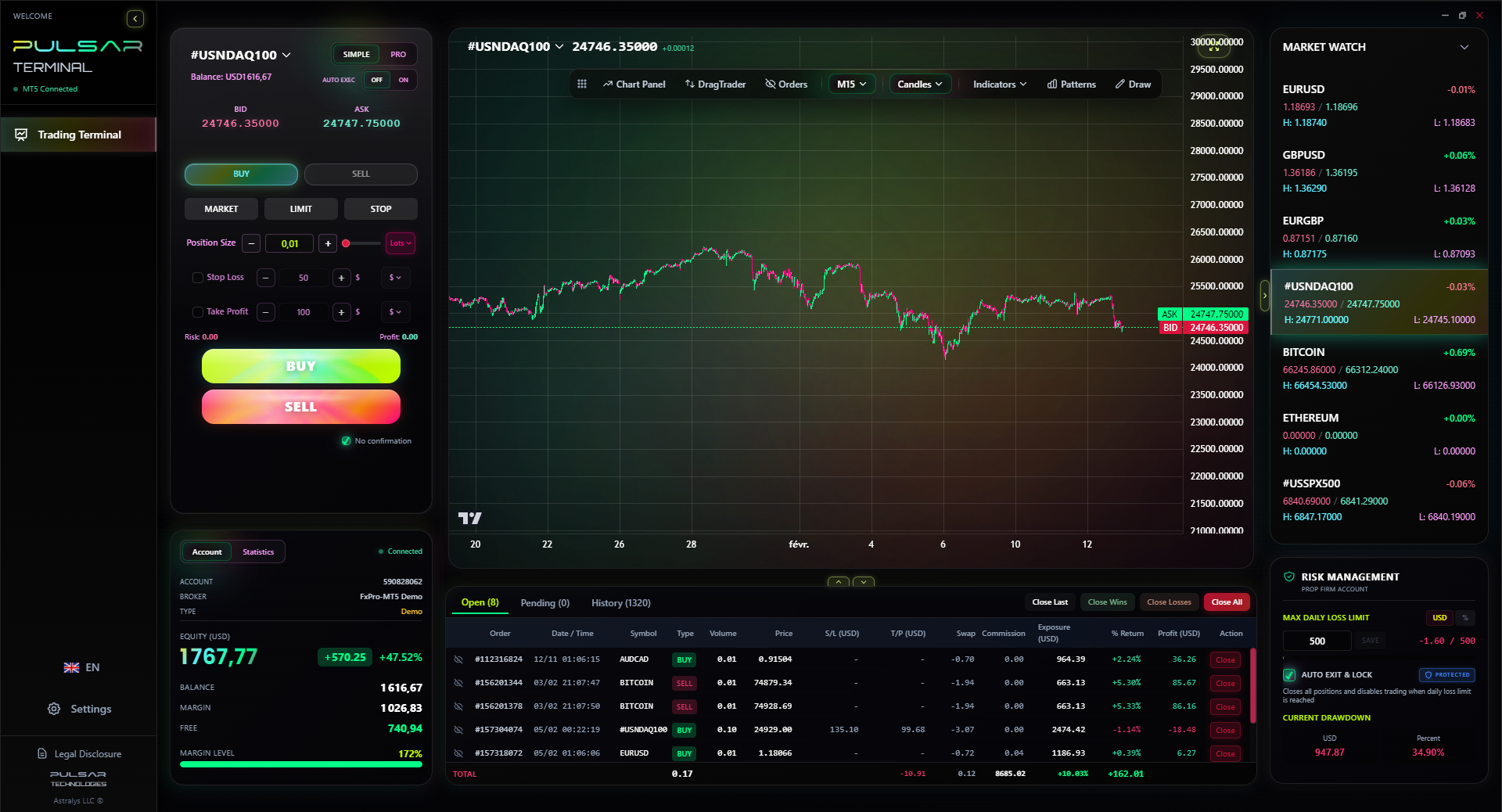
Managing complex orders and prop firm rules manually in MT5 is a headache; Pulsar Terminal automates trailing stops, multi-TP/SL, and daily loss protection directly on your charts.
Pulsar Terminal
Công cụ MT5 tất-cả-trong-một: đặt lệnh kéo-thả, multi-TP/SL, trailing stop, grid trading, Volume Profile và bảo vệ prop firm. Hơn 1.000 trader sử dụng mỗi ngày.
“Your strategy must be simple enough to execute in the dark, because one day, it might have to be.”
Let's get you started without losing your shirt.
- Open a Demo Account: Not for a week. For a minimum of three months. Use it with a broker you're considering, like Exness or XM. Trade your strategy through simulated load-shedding (just close the platform for hours at a time). See if your plan holds up.
- Start Small, Painfully Small: Your first live account should be money you are 100% prepared to lose. R2,000 is plenty. The goal is not to make money. The goal is to execute your plan under real emotional pressure and learn the mechanics of deposits, withdrawals, and live order execution.
- Track Everything: Use a journal. Not just 'bought EUR/USD, won R100'. Log the date, time, pair, entry/exit price, position size, risk (in Rands and %), and most importantly, your emotional state and the reason for the trade. Review it weekly. Your journal will tell you what you're doing wrong long before your account balance does.
- Ignore the Gurus: The local Facebook groups and YouTube channels promising '10% daily returns' are selling a dream. If their system was that good, they'd be trading, not selling courses. Focus on your own process, your own journal, your own small, consistent steps.
This path isn't glamorous. It's slow. But it's the only one that doesn't lead straight into the Sandile's mouth.
FAQ
Q1Is forex trading legal in South Africa?
Yes, it is legal. The Financial Sector Conduct Authority (FSCA) regulates the financial markets. However, you can also use internationally regulated brokers. The key is ensuring your broker is reputable and properly regulated somewhere, not just a fly-by-night operation.
Q2What is the minimum amount I need to start trading forex in South Africa?
Technically, some brokers allow you to start with as little as $10 (roughly R180). But realistically, you need enough to withstand volatility and practice proper risk management. I wouldn't recommend going live with less than R2,000. Even then, expect to treat that as tuition fees, not an investment.
Q3Why are the spreads on USD/ZAR so high?
The South African Rand is an emerging market currency. It's less liquid than majors like the USD or EUR. Higher liquidity risk, political volatility, and lower trading volume all contribute to wider spreads. A 50-pip spread is normal. You must account for this in your risk calculations.
Q4How do I handle trading during load-shedding?
Plan for it. Use guaranteed stop-loss orders (if your broker offers them) or set standard stop-losses on every trade before you enter. Consider longer-term swing trades so a few hours offline doesn't matter. A reliable UPS for your router and computer can buy you time to close positions gracefully.
Q5Should I trade with a South African broker or an international one?
It's a trade-off. South African brokers make ZAR deposits/withdrawals easy and are FSCA-regulated. International brokers often have better trading platforms, tighter spreads on major pairs, and more instruments. For serious traders, the advantages of a top-tier international broker usually outweigh the convenience of a local one.
Q6What is a pip in forex trading?
A pip is a 'percentage in point' and is the standard unit for measuring price movement. For most pairs, it's 0.0001. So if EUR/USD moves from 1.0850 to 1.0851, it moved 1 pip. For USD/ZAR, a pip is typically 0.0001 as well, so a move from 18.5000 to 18.5001. Understanding pips is fundamental to calculating profit, loss, and position size.
Bài học của Prof. Winston
Điểm chính:
- ✓Risk a maximum of 1% of your capital per trade.
- ✓ZAR pair spreads demand fractional position sizes.
- ✓Always set a physical stop-loss order before load-shedding.
- ✓Demo trade for 3 months minimum, through simulated blackouts.
Bài viết này hữu ích thế nào?
Nhấp vào ngôi sao để đánh giá
Nhận định giao dịch hàng tuần
Phân tích & chiến lược miễn phí hàng tuần. Không spam.
Về tác giả
David van der Merwe
Nhà giao dịch Thị trường Mới nổi
Trader tại Johannesburg với 11 năm kinh nghiệm về tiền tệ thị trường mới nổi. Chuyên về cặp ZAR, giao dịch theo quy định FSCA và phân tích thị trường Nam Phi.
Bình luận
Cảnh báo rủi ro
Giao dịch các công cụ tài chính tiềm ẩn rủi ro đáng kể và có thể không phù hợp với tất cả nhà đầu tư. Hiệu suất trong quá khứ không đảm bảo kết quả trong tương lai. Nội dung này chỉ mang tính chất giáo dục và không nên được coi là lời khuyên đầu tư. Hãy luôn tự nghiên cứu trước khi giao dịch.
Bạn cũng có thể thích

Cara Trading Forex Sukses: 7 Prinsip dari Trader Profesional
Cara trading forex sukses dengan 7 prinsip trader pro: manajemen modal, disiplin, journal trading, backtest. Data nyata, bukan janji profit palsu.
Jam Trading Forex Terbaik untuk Trader Indonesia: Panduan Lengkap dengan Tabel Waktu
Panduan jam trading forex untuk trader Indonesia. Tabel 4 sesi dunia, jam emas 20:00-00:00, sesi mana yang harus dihindari. Data akurat + tips dari trader berpengalaman.
Top 5 Sàn Forex Uy Tín Nhất 2026: Review Jujur dari Trader Indonesia
Top 5 sàn forex uy tín 2026 untuk trader Indonesia. Review jujur: spread, deposit, withdraw, dukungan lokal. Exness, XM, IC Markets & lebih.
Tải Pulsar Terminal
Tất cả các công cụ tính này được tích hợp trong Pulsar Terminal với dữ liệu thời gian thực từ tài khoản MT5 của bạn.
Tải Pulsar Terminal