


Let's be straight.

David van der Merwe
Nhà giao dịch Thị trường Mới nổi ·  South Africa
☕ 9 phút đọc
Bạn sẽ học được:
Let's be straight. If you're searching for 'shezi forex' online, you're probably seeing two things: flashy Instagram ads promising quick riches, and warnings from the FSCA about unlicensed operators. The truth is, 'shezi' - slang for making money - and forex trading have become dangerously intertwined here. I've seen too many guys lose their stokvel savings chasing this dream. This isn't about get-rich-quick schemes. It's about understanding the real market, the real risks, and how you can actually participate without getting cleaned out.
In the townships and on social media, 'shezi forex' has become a catch-all term. It often points to unregulated, person-to-person trading groups or 'investment clubs' promising weekly returns. That's not trading. That's often a pyramid scheme dressed in trading charts.
Real forex trading is buying and selling global currencies through a licensed broker. You're speculating on price movements in pairs like EUR/USD or USD/ZAR. The profit (or loss) comes from the difference between your entry and exit price. It's a zero-sum game, and the big banks and institutions are on the other side of most retail trades.
I learned this the hard way early on. I joined a WhatsApp group promising 'guaranteed signals' for R500 a month. The first week, I made R2,000 on a USD/CAD trade they called. I felt like a genius. The next week, I followed their 'sure thing' on GBP/JPY and watched my R5,000 account get hit with a margin call after a sudden spike. The group admin vanished. That was my R5,500 lesson: if it's not your own analysis, it's not your trade.

Warning: Any 'shezi forex' operation that guarantees profits, asks you to send money to a personal bank account (especially FNB or Capitec), or pressures you to recruit friends is almost certainly a scam. The FSCA publishes a list of these unlicensed entities regularly.

💡 Mẹo của Winston
A plan without a stop-loss is a wish, not a trade. Always know your exit before your entry.
South Africa has a strong financial regulator, the Financial Sector Conduct Authority (FSCA). A broker must be licensed by them to legally offer services to South African residents. This is non-negotiable for your protection.
Why a Licensed Broker Matters
Your funds should be held in a segregated client trust account. This means the broker can't use your deposit for their own bills. If the broker goes under (it happens), your money is separate. An unlicensed 'shezi' operation mixes everyone's money together - that's how people lose everything.
Licensed brokers also provide proper reporting for tax purposes (yes, you must pay tax on trading profits). They give you access to real market prices and liquidity, not some manipulated in-house system designed to make you lose.
Broker Options for South Africans
You have two main paths: a local FSCA-licensed broker or a reputable international broker that accepts SA clients. International brokers often have better technology and tighter spreads.
| Broker Type | Pros | Cons | Examples |
|---|---|---|---|
| FSCA-Licensed (Local) | Easy deposits/withdrawals (ZAR), local support, clear on taxes. | Often higher spreads, fewer instruments, platform may be outdated. | Visit FSCA website for current list. |
| International (Reputable) | Lower costs, advanced platforms (MT4/5), vast instrument selection. | Deposits may involve forex conversion fees, support might be overseas. | IC Markets, Pepperstone, XM. |
I use an international broker. The spreads on the EUR/USD guide are typically under 0.1 pips compared to 1.5+ with some local options. That saving adds up fast. I fund it via a global money transfer service. It's an extra step, but the trading conditions are worth it.
“Real 'shezi' from forex comes from a disciplined process, not a WhatsApp signal.”
Forget the 'signals' from gurus. Sustainable shezi comes from a disciplined, repeatable process. You need an edge, and that comes from analysis, not hope.
Start with Price Action
Before you touch an indicator, learn to read the chart itself. Support, resistance, and trend lines. Where does the price keep bouncing from? That's more valuable than any fancy tool. I paper-traded for three months just drawing these levels and it changed everything.
Add Indicators Sparingly
Indicators confirm what price action suggests. Don't clutter your screen.
- RSI indicator: Great for spotting overbought/oversold conditions. I use it on the 4-hour chart to avoid buying when a move is exhausted.
- MACD indicator: Helps identify trend changes and momentum. I look for the MACD line to cross the signal line alongside a break of a key price level.
Define Your Style
Are you checking charts daily or hourly? This decides your strategy.
- Swing trading: Holds trades for days to weeks. My preferred style. Less screen time, aiming for larger moves. I might risk 50 pips to make 150.
- Scalping strategy: In and out in minutes. Requires intense focus, low spreads, and quick execution. It's a grind. I tried it for a month. Made R300 here, lost R250 there. The stress wasn't worth the tiny gains for me.

Pro Tip: Your strategy must include exact entry, stop-loss, and take-profit rules. Before you click buy, know where you'll get out if you're wrong. Always use a stop-loss. Every single time. I set mine at a level that, if hit, proves my trade idea was wrong.
This is where 'shezi forex' dreams go to die. Without strict risk management, you are gambling. Full stop.
Your most important job is to protect your capital. Profits come second. The rule is simple: never risk more than 1-2% of your trading capital on any single trade. On a R10,000 account, that's R100-R200 max risk per trade.
Let me give you a real example from last month. I was trading XAU/USD (gold). My account was at R25,000. My 1% risk was R250. I entered a buy at $2,180 per ounce, placing my stop-loss at $2,168. That's a $12 risk per ounce. Since one standard lot is 100 ounces, that's a $1,200 risk... way too big.
So, I used a position size calculator. To keep my risk at R250 (about $13.50), with a $12 stop, I could only buy 1.12 ounces. That's a micro lot (0.01 lots). I took the small position. The trade went my way and I took profit at $2,205 for a nice gain. The point? I controlled the downside first. The size felt tiny, but it kept me in the game.

Example: Account: R20,000 | Risk per trade: 1% = R200 | Trade: Buy USD/ZAR at 18.50, Stop-loss at 18.45 (50 pip risk). Pip value for USD/ZAR is roughly R1 per pip per standard lot. To risk R200 on a 50-pip stop, you'd calculate: R200 / 50 pips = R4 per pip. So your position size should be 0.04 lots (a micro lot).
💡 Mẹo của Winston
If you can't explain your trade's edge in one simple sentence, you don't have one. Get out.
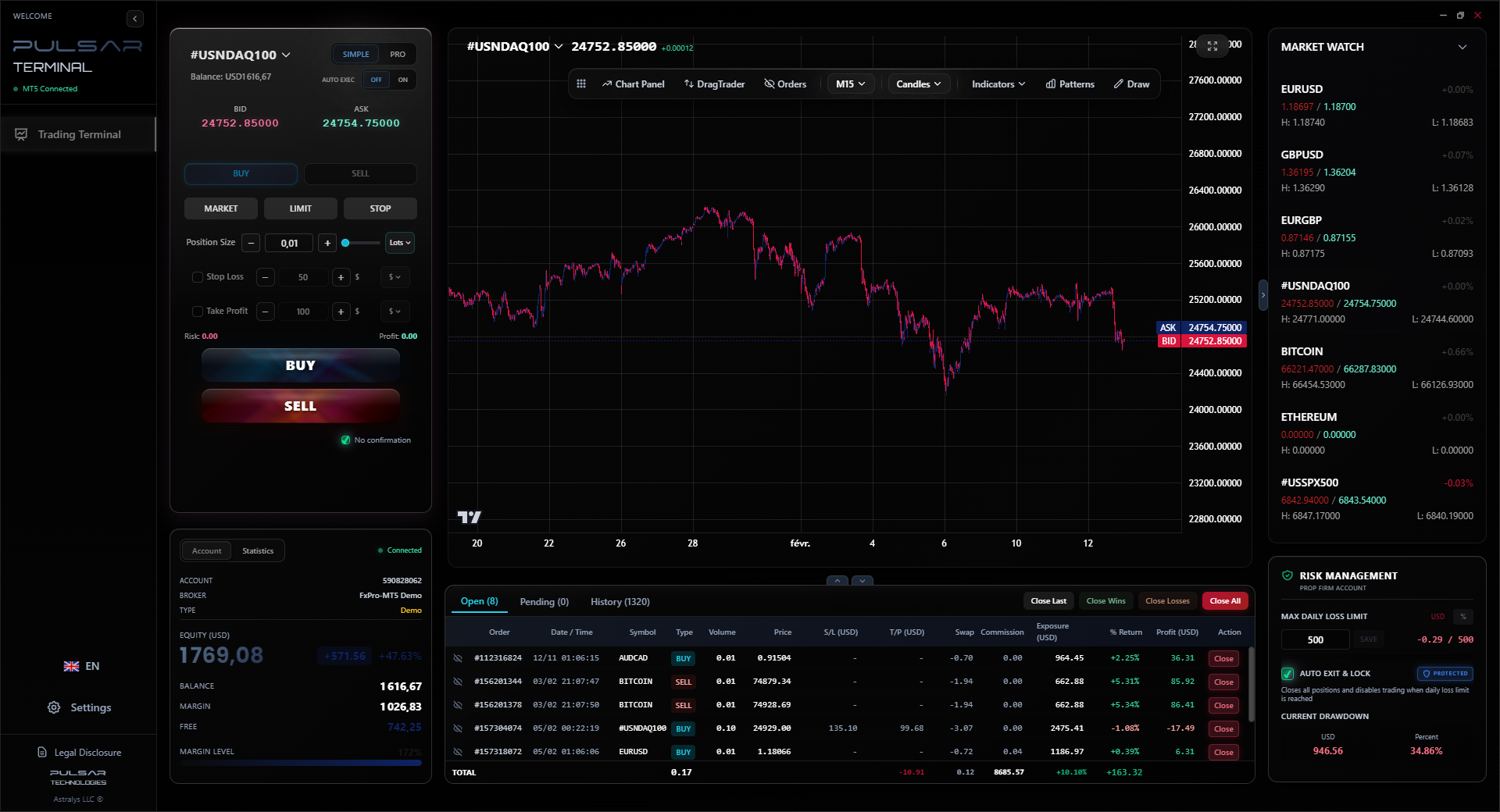
Managing complex trades with multiple take-profit levels and moving stops to breakeven is much simpler with a tool like Pulsar Terminal, which automates these actions directly on your MT5 platform.
Pulsar Terminal
Công cụ MT5 tất-cả-trong-một: đặt lệnh kéo-thả, multi-TP/SL, trailing stop, grid trading, Volume Profile và bảo vệ prop firm. Hơn 1.000 trader sử dụng mỗi ngày.
“Your most important job is to protect your capital. Profits come second.”
You can have the best strategy in the world, but if you can't handle the emotions, you'll lose. Fear and greed are your real opponents.
Fear makes you move your stop-loss wider, turning a small loss into a disaster. It makes you exit winning trades too early. Greed makes you double down on a losing trade ('averaging down'), or risk way too much on a 'sure thing'.
I have a rule written on a sticky note on my monitor: 'The Trade is Not About You.' The market doesn't know you exist. It doesn't care about your rent or your braai plans. A losing trade isn't a personal failure. It's a cost of doing business. You need to detach.
The worst trading month of my life was when I broke my rules. I had three losing trades in a row, totaling a R1,500 loss. I was furious. I saw a setup on the GBP/USD that was 'okay,' not great. I took it anyway, and tripled my position size to 'make back my losses.' I got stopped out in 20 minutes. Another R2,000 gone. I revenge-traded. Another loss. I turned a R1,500 bad day into a R5,000 catastrophe. I had to walk away for two weeks. The market will always be there tomorrow. Your capital won't be if you let emotion spend it.
Let's map out a real, scam-free path to trading.
- Educate First, Deposit Later. Spend at least a month learning. Read the FSCA's consumer guides. Understand basic terms. Don't touch real money yet.
- Open a Demo Account. Pick a reputable broker like Exness or IC Markets and open a demo account. Practice for a minimum of 3 months. Your goal is not to make fake money, but to execute your plan consistently without emotion.
- Develop and Test Your Plan. On demo, define your strategy: What pairs will you trade? What time frame? What are your entry/exit rules? Write it down in a trading journal.
- Start Absurdly Small. When you go live, deposit the absolute minimum you can. For many brokers, that's about $100 (roughly R1,800). Your goal with this first deposit is not to get rich. It is to survive for 6 months. To feel the real emotion of a live trade without significant financial pain.
- Journal Religiously. After every trade, record: entry/exit, why you took it, your emotional state, what you learned. This is how you improve.
This process filters out 95% of people looking for 'shezi forex.' It's slow. It's boring. But it's the only way that leads to a sustainable edge, not just an expensive lesson.
💡 Mẹo của Winston
The market's job is to find the price where the most people will be wrong. Don't be in that crowd.
“A losing trade isn't a personal failure. It's a cost of doing business.”
Let's shortcut some of the pain. Here’s what will blow up your account.
- Trading Without a Stop-Loss: This is account suicide. A 'shezi' guru might tell you to 'just hold, it will come back.' It often doesn't.
- Overleveraging: Brokers offer use like 500:1. That's a trap for new traders. It magnifies losses as fast as gains. Start with 10:1 or less until you're consistently profitable.
- Chasing Losses: That revenge-trading spiral I mentioned. After a loss, close the platform. Go for a walk. The urge to 'get it back now' is a killer.
- Believing in 'Secret Indicators' or 'Holy Grail' Systems: Anyone selling you a guaranteed system is lying. If it worked 100%, they'd be using it to trade, not selling it for R499 on Facebook.
- Ignoring Major News Events: Trading during SA Budget speeches, US Non-Farm Payrolls, or SARB interest rate decisions is like swimming in a storm. The spread widens massively, and prices can gap right through your stop-loss. I have a calendar and I simply don't trade 15 minutes before or after these events.
FAQ
Q1Is 'shezi forex' illegal in South Africa?
The term itself isn't illegal, but most operations advertising under that banner are. Forex trading is legal through FSCA-licensed brokers. What's illegal is operating an unlicensed financial services business, guaranteeing returns, or running a pyramid scheme - all common traits of 'shezi forex' groups.
Q2How much money do I need to start real forex trading?
You can start with as little as $100 (roughly R1,800) at many international brokers. However, with that amount, you must trade very small (micro lots) to properly manage risk. Realistically, a R5,000 - R10,000 starting capital allows more breathing room for sensible position sizing without over-leveraging.
Q3Can I make a living from forex trading in SA?
It's possible, but extremely difficult and statistically unlikely for most. It requires years of disciplined practice, a significant starting capital (think R200,000+ to generate meaningful income), and an iron-clad psychological mindset. Treat it as a serious side business for the first few years, not a primary income source.
Q4What's the difference between a demo and live account?
The platform and prices are identical. The only difference is the psychology. There's no real emotion with virtual money. On a live account, fear and greed directly impact your decisions. That's why you must start small - to train your brain to handle real risk without catastrophic financial consequences.
Q5Do I pay tax on forex trading profits in South Africa?
Yes. Profits from trading are considered income and are taxable by SARS. You must declare them. Keep detailed records of all trades. Losses can be deducted from future profits. Using a licensed broker makes getting the necessary tax certificates much easier.
Q6What is the safest way to fund a trading account?
Always use the official deposit methods listed on your broker's website, such as credit/debit card or electronic bank transfer (EFT) to the broker's official client trust account. Never send money to a personal account or via instant EFT to a person, no matter what a 'group admin' tells you.
Bài học của Prof. Winston
Điểm chính:
- ✓Risk max 1-2% of capital per trade.
- ✓Demo trade for 3+ months first.
- ✓Use only FSCA or reputable international brokers.
- ✓Never send money to a personal account.
Bài viết này hữu ích thế nào?
Nhấp vào ngôi sao để đánh giá
Nhận định giao dịch hàng tuần
Phân tích & chiến lược miễn phí hàng tuần. Không spam.
Về tác giả
David van der Merwe
Nhà giao dịch Thị trường Mới nổi
Trader tại Johannesburg với 11 năm kinh nghiệm về tiền tệ thị trường mới nổi. Chuyên về cặp ZAR, giao dịch theo quy định FSCA và phân tích thị trường Nam Phi.
Bình luận
Cảnh báo rủi ro
Giao dịch các công cụ tài chính tiềm ẩn rủi ro đáng kể và có thể không phù hợp với tất cả nhà đầu tư. Hiệu suất trong quá khứ không đảm bảo kết quả trong tương lai. Nội dung này chỉ mang tính chất giáo dục và không nên được coi là lời khuyên đầu tư. Hãy luôn tự nghiên cứu trước khi giao dịch.
Bạn cũng có thể thích

Cara Trading Forex Sukses: 7 Prinsip dari Trader Profesional
Cara trading forex sukses dengan 7 prinsip trader pro: manajemen modal, disiplin, journal trading, backtest. Data nyata, bukan janji profit palsu.
Jam Trading Forex Terbaik untuk Trader Indonesia: Panduan Lengkap dengan Tabel Waktu
Panduan jam trading forex untuk trader Indonesia. Tabel 4 sesi dunia, jam emas 20:00-00:00, sesi mana yang harus dihindari. Data akurat + tips dari trader berpengalaman.
Top 5 Sàn Forex Uy Tín Nhất 2026: Review Jujur dari Trader Indonesia
Top 5 sàn forex uy tín 2026 untuk trader Indonesia. Review jujur: spread, deposit, withdraw, dukungan lokal. Exness, XM, IC Markets & lebih.
Tải Pulsar Terminal
Tất cả các công cụ tính này được tích hợp trong Pulsar Terminal với dữ liệu thời gian thực từ tài khoản MT5 của bạn.
Tải Pulsar Terminal