


Most traders see a shooting star and think they've found a guaranteed jackpot.

David van der Merwe
Nhà giao dịch Thị trường Mới nổi ·  South Africa
☕ 12 phút đọc
Bạn sẽ học được:
- 1What Exactly Is a Shooting Star?
- 2Why This Pattern Matters for Us in South Africa
- 3How to Spot a Real Shooting Star (And Avoid the Fakes)
- 4Trading the Pattern: Entry, Stop Loss, and Take Profit
- 5Don't Be Lazy: Confirming with Other Tools
- 6Mistakes I've Made (So You Don't Have To)
- 7Shooting Star vs. The Lookalikes
- 8Putting It All Together: A South African Trading Plan
Most traders see a shooting star and think they've found a guaranteed jackpot. They pile in short, convinced the market is about to crash. Then it rips higher, taking their account with it. I've been that guy, more than once. The truth is, a shooting star candlestick in forex isn't a signal to trade. It's a signal to pay attention. Let's strip away the nonsense and talk about how to use this pattern properly, with a healthy dose of South African context.
Forget the fancy names for a second. A shooting star is just a price bar that tells a specific story. It forms during an uptrend. The market opens, rallies hard (creating a long upper wick or 'shadow'), but then sellers step in and smash the price back down to close near the open, leaving a tiny real body at the bottom.
That long upper wick is the whole point. It represents failed buying pressure. The bulls had their shot, pushed price up, but couldn't hold the ground. The bears defended their territory and won the battle for that period. The smaller the real body, the better. A perfect shooting star has little to no lower wick, showing the close was at the session's lows.

Warning: Don't confuse it with its bullish cousin, the inverted hammer. They look identical, but context is king. An inverted hammer appears in a downtrend and can signal a potential bottom. A shooting star only matters in an uptrend. Getting this wrong is a classic, expensive mistake.
I remember spotting a textbook shooting star on the USD/ZAR daily chart back in 2021. Price had run from around R14.20 to R14.80. The candle had a massive 50-pip upper wick and closed basically flat. I got excited. I ignored everything else and went short. The next day, the pair gapped higher and didn't look back for another 150 pips. That trade taught me to never trust a single candle, no matter how pretty it looks.
Trading from South Africa adds unique layers. Our market hours, the liquidity of the Rand pairs, and our broker offerings all change how you should view a pattern like this.
Liquidity and Volatility
Major pairs like EUR/USD have deep, smooth liquidity. Our beloved ZAR pairs (EUR/ZAR, USD/ZAR, GBP/ZAR) can be wild. A long upper wick on the USD/ZAR might just be standard afternoon volatility when London and US markets overlap, not a genuine reversal signal. You have to filter the noise. A shooting star on the 1-hour chart during high liquidity (8am-5pm SAST) carries more weight than one that forms at 2am.
Broker Spreads and Execution
That long wick? Its high point is your potential entry for a short trade if you're using a sell stop order. With wider spreads on exotic pairs, your entry gets worse. If the shooting star's high was at R18.500 and the spread is 25 pips, you're selling at R18.475. That immediately puts you in a hole. You must account for this in your position size calculator. A pattern that gives you a 50-pip profit target on a major pair might only give you 30 pips of viable room on a ZAR pair after accounting for spread and slippage.
The Psychological Edge
South African traders often have a natural bias towards the Rand. We watch the news, we feel the load-shedding, we know the political headlines. Seeing a shooting star after a strong ZAR weakening move can trigger an emotional "I knew it!" reaction. The pattern confirms your pre-existing bias. This is dangerous. The market doesn't care about your opinion. Trade the price action, not the patriotism.

💡 Mẹo của Winston
A shooting star without a story is just a wick. It needs to be rejecting something meaningful - a prior high, a trendline, a big round number. Otherwise, it's just market noise.
“Trading a shooting star candlestick in forex solo is like going on a safari with a butter knife. You need backup.”
Anyone can draw a candlestick on a chart. Finding one that actually means something is the skill. Here’s my checklist.
1. The Uptrend is Non-Negotiable. This isn't a suggestion. The price must be clearly making higher highs and higher lows for several bars before the pattern. If you're looking at a sideways mess, it's not a shooting star, it's just a candle with a wick.
2. The Gap (Optional but Powerful). In an ideal world, there's a gap up between the previous candle's close and the shooting star's open. This shows a surge of bullish excitement that immediately gets rejected. It's like a classic 'bull trap.' You see this more on indices and certain forex pairs than others.
3. Wick-to-Body Ratio. The upper wick should be at least twice the length of the real body. Three times is better. A wick that's only slightly longer is weak sauce. Ignore it.
4. Little to No Lower Wick. The close should be at or near the low of the candle. A lower wick shows the bulls managed a tiny recovery before the close, which dilutes the bearish message.

Example: Let's say on the GBP/ZAR daily chart, the candle opens at R23.100, rallies to a high of R23.350, then sells off to close at R23.095. The real body is 0.005 (tiny). The upper wick is 0.250. That's a 50:1 wick-to-body ratio. Now you have my attention.
I use tools in my trading platform to scan for these conditions automatically. Manually scrolling charts for them will drive you mad.
This is where you make or lose money. A pattern is just a picture. Your plan is what cashes the cheque.
The Conservative Entry (My Preferred Method)
I don't sell at the shooting star. I wait for confirmation. Enter a short trade only after the next candle closes below the shooting star's real body. This filters out false signals. Yes, you miss some of the move. You also miss the majority of the losers. Your entry becomes the break of that confirmation candle's low.
The Aggressive Entry
Place a sell stop order a few pips below the low of the shooting star candle. The logic is that breaking the candle's low confirms the sellers are in control. This gets you in earlier for a better reward-to-risk, but you'll get stopped out more often by false breaks.
Where to Place Your Stop Loss
This is critical. Your stop loss must be placed above the high of the shooting star's wick. That's the level the bulls failed at. If price rallies back above it, the rejection story is invalidated, and you're wrong. Period. Don't try to be clever and place it inside the wick. That's just asking for a stop hunt.
Setting a Take Profit Target
There are two main methods:
- Measured Move: Look at the uptrend leg that preceded the pattern. A common target is a 50% retracement of that move.
- Support Level: Look for the nearest clear support level below. This could be a previous swing low, a key psychological number, or a moving average like the 50-period EMA.
I often use a multi-tier approach, taking partial profit at the 50% retracement and letting the rest run to the next support zone. Managing multiple targets manually is a pain, which is why automation helps. For a deeper dive on managing trades with partial closures, our guide on swing trading covers similar principles.
Let's use a real example from my log. On EUR/USD in 2023, I spotted a confirmed shooting star after a 120-pip rally. Entry on confirmation: 1.0945. Stop above the wick: 1.0990 (45-pip risk). First target at 50% retrace: 1.0885 (60 pips). Second target at prior support: 1.0850. Hit the first target, moved stop to breakeven, and caught another 65 pips on the runner. That's the blueprint.
💡 Mẹo của Winston
The most important candle is the one *after* the shooting star. That's the one that tells you if the bears have actually arrived for work, or if they just called in sick.
“It's just one candle. Even with confirmation, it's not a sure thing. Never risk more than 1-2% of your capital.”
Trading a shooting star candlestick in forex solo is like going on a safari with a butter knife. You need backup.
Volume: This is a big one. The shooting star candle should ideally have higher-than-average volume. High volume on the rejection shows real selling interest, not just a few weak hands. Most forex brokers don't show true volume (it's tick volume), but it's still a useful gauge.
Momentum Indicators: Look for bearish divergence on the RSI indicator. Was price making a new high on the shooting star, but the RSI was making a lower high? That's a screaming warning sign of weakening momentum. A bearish crossover on the MACD indicator histogram can add another layer of confirmation.
Key Resistance Levels: Is the shooting star forming right at a major historical resistance level, or a key Fibonacci extension (like the 161.8%)? If yes, the pattern's significance is magnified tenfold. It's not just any rejection; it's a rejection at a level the market has already decided is important.
The Next Candle (The Follow-Through) The candle after your confirmation candle is telling. You want to see continued selling pressure - a strong bearish candle that closes near its low. If you get a small doji or a bullish candle, the selling pressure might already be exhausted. Be ready to get out.
Combining these tools turns a 'maybe' into a high-probability setup. I once ignored an RSI divergence on a USD/ZAR shooting star because the candle was so perfect. The reversal lasted all of two hours before the uptrend resumed. That cost me 1.5% of my account. Lesson learned.
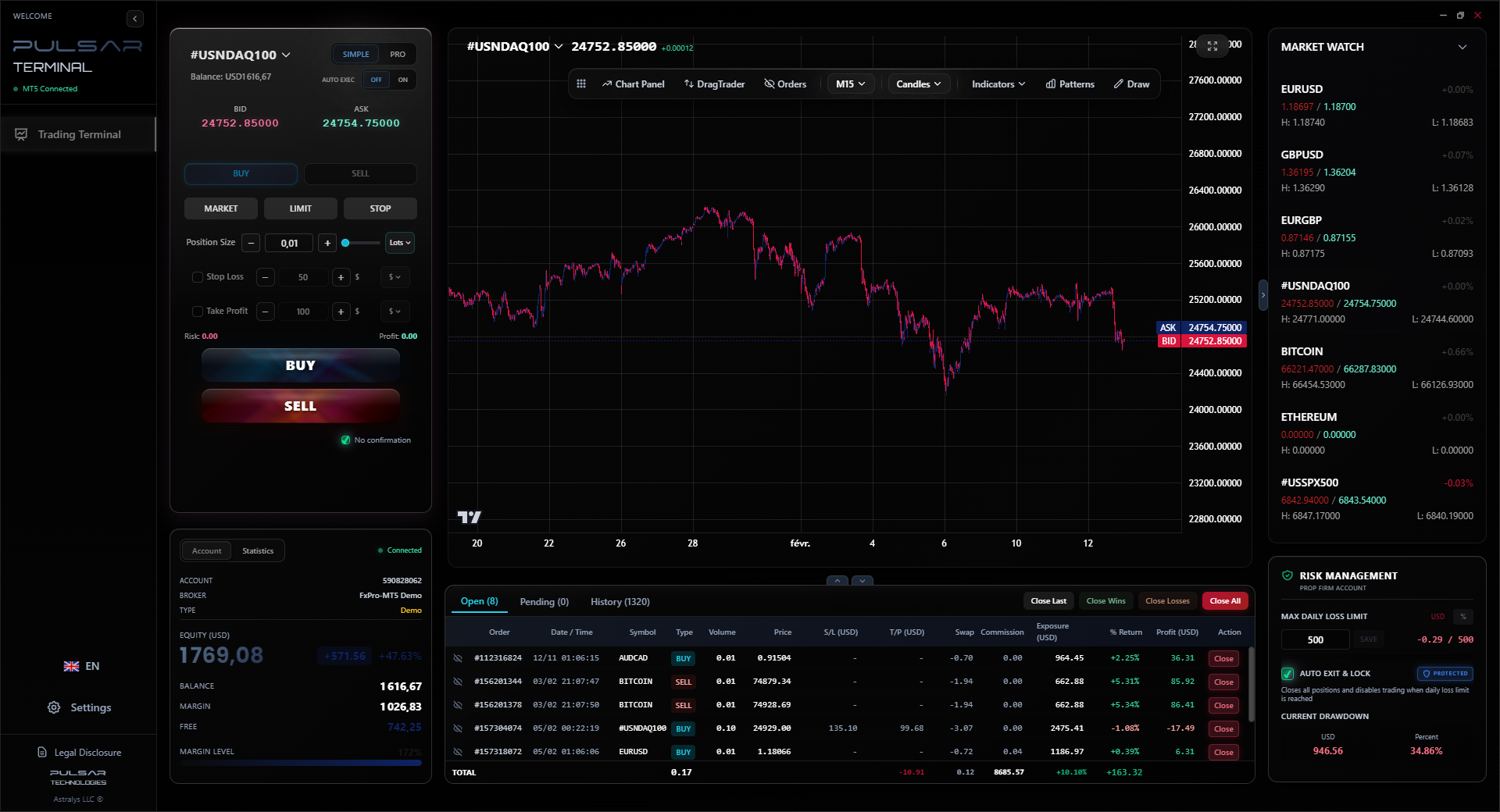
Managing a multi-tier profit target and a trailing stop on a shooting star trade is complex, but tools like Pulsar Terminal automate this directly on your MT5 chart, removing emotion and execution error.
Pulsar Terminal
Công cụ MT5 tất-cả-trong-một: đặt lệnh kéo-thả, multi-TP/SL, trailing stop, grid trading, Volume Profile và bảo vệ prop firm. Hơn 1.000 trader sử dụng mỗi ngày.
Let's get honest about where this goes wrong.
Mistake 1: Trading It in a Range. This is the #1 killer. The market is chopping sideways between clear support and resistance. A candle with a long wick appears at the top of the range. It's not a shooting star; it's just price reacting to a resistance level. The pattern requires a prior uptrend. In a range, it's meaningless.
Mistake 2: Ignoring the Higher Timeframe. You see a gorgeous shooting star on the 15-minute chart and go all in. Meanwhile, on the 4-hour chart, price is in a roaring bull trend that's barely paused. The higher timeframe trend will almost always win. Always zoom out. A shooting star on a 1-hour chart is far more powerful if the 4-hour chart is also showing signs of exhaustion.
Mistake 3: Risking Too Much on One Pattern. It's just one candle. Even with confirmation, it's not a sure thing. Never risk more than 1-2% of your capital on a single shooting star setup. The market is full of head fakes. Use a position size calculator every single time to keep your ego in check.
Mistake 4: Forgetting About the Spread. Especially on our local pairs. That beautiful wick's high might be your theoretical entry, but by the time your order fills through the spread, you're already in a worse position. Factor it into your risk calculation from the start. If the spread eats up half your potential profit, the trade isn't worth taking.

Pro Tip: Write your rules down. 'I will only trade a shooting star if: 1) There's a clear 4-hour uptrend, 2) It's at a known resistance level, 3) The next candle confirms, and 4) My risk is 1% or less.' Stick that note on your monitor.
💡 Mẹo của Winston
If you're constantly seeing 'perfect' shooting stars on low timeframes, you're probably trading in a range. Switch to a higher timeframe to find the real trend.
“The higher timeframe trend will almost always win. A shooting star on a 1-hour chart is far more powerful if the 4-hour chart is also showing signs of exhaustion.”
Don't get caught out by imitations. Here’s a quick cheat sheet.
| Pattern | Looks Like | Key Difference | What It Means |
|---|---|---|---|
| Shooting Star | Long upper wick, small lower body. | Forms after an uptrend. | Potential bearish reversal. |
| Inverted Hammer | Long upper wick, small lower body. | Forms after a downtrend. | Potential bullish reversal. |
| Gravestone Doji | Long upper wick, NO real body (open=close). | Can form in uptrend or downtrend. Extreme rejection. More neutral-bearish. | |
| Hanging Man | Long lower wick, small body at top. | Forms after an uptrend. | Potential bearish reversal (shows selling was absorbed). |
See the problem? A single candle can be two different patterns depending on context. I've celebrated an 'inverted hammer' bottom, only to realize I was looking at an uptrend on a smaller timeframe. It was actually a shooting star. The trade went south fast. Always, always confirm the trend direction on the timeframe you're trading from.
Let's build a complete, realistic scenario for trading the USD/ZAR.
Step 1: The Setup. You're watching the daily chart. USD/ZAR has rallied from R18.00 to R18.80 over two weeks. The move is looking tired. A candle forms: it gaps up slightly at the open to R18.82, rallies to a high of R19.00, then sells off sharply to close at R18.81. Classic shooting star shape. High volume on the day.
Step 2: The Confirmation Wait. You do nothing. You wait for the next daily candle to close. It closes at R18.75, below the shooting star's real body. Confirmation is in.
Step 3: The Trade Plan.
- Entry: Sell at the break of the confirmation candle's low (let's say R18.74).
- Stop Loss: Place at R19.05 (above the shooting star wick high of R19.00, plus a small buffer for spread).
- Risk: 31 cents (R19.05 - R18.74). You decide to risk 0.5% of your account.
- Take Profit 1: At 50% retracement of the prior up move (R18.40 area).
- Take Profit 2: At the prior swing low support near R18.20.
Step 4: The Management. You get filled at R18.74. Price moves down to R18.50. You move your stop loss to breakeven (R18.74) to eliminate risk. Price hits your first target at R18.40. You close half your position for a profit. You trail the stop on the remaining half below recent minor swing highs, getting stopped out near R18.25 for more profit on the runner.
This is a disciplined approach. It's boring. It misses the absolute top. But it makes money consistently, and it keeps you from being one of the 90% who blow up their accounts chasing perfect entries. For executing a plan with multiple targets and trailing stops efficiently, having the right tools on your MT5 platform is non-negotiable. Manual management under pressure is where most plans fail.
FAQ
Q1Can a shooting star be a bullish signal?
No, never. By definition, a shooting star is a bearish reversal pattern that forms specifically in an uptrend. If you see the same shape in a downtrend, it's called an inverted hammer and can be a bullish signal. Context is everything.
Q2What's the best timeframe to trade shooting stars?
They're most reliable on higher timeframes where market noise is filtered out. I focus on the 1-hour, 4-hour, and daily charts. On lower timeframes like 5 or 15 minutes, you'll see them constantly, but most are meaningless false signals whipped up by minor liquidity shifts.
Q3How reliable is the shooting star pattern alone?
On its own, not very. I'd give it a 50/50 shot at best - a coin flip. Its power comes from confluence. When combined with trendline resistance, a key Fibonacci level, overbought RSI indicator readings, and high volume, its reliability can increase significantly. Never trade it in isolation.
Q4Do I need to wait for the candle to close?
Absolutely. The pattern isn't valid until the candle completes. That close is crucial information. Trading while the candle is still forming is pure gambling. You have no idea if that long wick will get bought up and turn into a bullish marubozu by the close.
Q5How does trading ZAR pairs affect this pattern?
It adds complexity. Wider spreads mean your entry and exit are less efficient. Higher volatility can create longer, more dramatic wicks that aren't necessarily true reversals but just normal market swings. You must be stricter with your confirmation rules and always account for the spread in your risk-to-reward calculation.
Q6What's the difference between a shooting star and a gravestone doji?
The real body. A shooting star has a small real body (can be bullish or bearish). A gravestone doji has NO real body - the open and close are exactly the same, leaving just a long upper wick. The gravestone is a more extreme form of rejection and is generally considered more bearish, but the same confirmation rules apply.
Bài học của Prof. Winston
Điểm chính:
- ✓Always confirm the trend: A shooting star requires a clear prior uptrend.
- ✓Wait for the next candle to close below the body for confirmation.
- ✓Place your stop loss above the wick's high, no exceptions.
- ✓Seek confluence with RSI divergence or key resistance levels.
- ✓Factor in wider spreads on ZAR pairs before entering.
Bài viết này hữu ích thế nào?
Nhấp vào ngôi sao để đánh giá
Nhận định giao dịch hàng tuần
Phân tích & chiến lược miễn phí hàng tuần. Không spam.
Về tác giả
David van der Merwe
Nhà giao dịch Thị trường Mới nổi
Trader tại Johannesburg với 11 năm kinh nghiệm về tiền tệ thị trường mới nổi. Chuyên về cặp ZAR, giao dịch theo quy định FSCA và phân tích thị trường Nam Phi.
Bình luận
Cảnh báo rủi ro
Giao dịch các công cụ tài chính tiềm ẩn rủi ro đáng kể và có thể không phù hợp với tất cả nhà đầu tư. Hiệu suất trong quá khứ không đảm bảo kết quả trong tương lai. Nội dung này chỉ mang tính chất giáo dục và không nên được coi là lời khuyên đầu tư. Hãy luôn tự nghiên cứu trước khi giao dịch.
Bạn cũng có thể thích

Cara Trading Forex Sukses: 7 Prinsip dari Trader Profesional
Cara trading forex sukses dengan 7 prinsip trader pro: manajemen modal, disiplin, journal trading, backtest. Data nyata, bukan janji profit palsu.
Jam Trading Forex Terbaik untuk Trader Indonesia: Panduan Lengkap dengan Tabel Waktu
Panduan jam trading forex untuk trader Indonesia. Tabel 4 sesi dunia, jam emas 20:00-00:00, sesi mana yang harus dihindari. Data akurat + tips dari trader berpengalaman.
Top 5 Sàn Forex Uy Tín Nhất 2026: Review Jujur dari Trader Indonesia
Top 5 sàn forex uy tín 2026 untuk trader Indonesia. Review jujur: spread, deposit, withdraw, dukungan lokal. Exness, XM, IC Markets & lebih.
Tải Pulsar Terminal
Tất cả các công cụ tính này được tích hợp trong Pulsar Terminal với dữ liệu thời gian thực từ tài khoản MT5 của bạn.
Tải Pulsar Terminal