


I once tried to explain the difference between a money transfer service and a forex broker to a friend, and it cost him R2,500.

David van der Merwe
Nhà giao dịch Thị trường Mới nổi ·  South Africa
☕ 10 phút đọc
Bạn sẽ học được:
- 1What Exactly Is Sikhona Forex? (Hint: It's Not a Broker)
- 2The Rules: SARB Licenses and FSCA Oversight
- 3The Real Costs: Fees, Exchange Rate Margins, and Limits
- 4How to Actually Use It (For Sending Money)
- 5Sikhona vs. Real Forex Trading: The Critical Difference
- 6Scam Alerts and Red Flags to Watch For
- 7Alternatives for Sending Money From South Africa
- 8The Final Verdict: A Tool, Not a Weapon
I once tried to explain the difference between a money transfer service and a forex broker to a friend, and it cost him R2,500. He saw 'Sikhona Forex' and thought he'd found a local platform to trade the Rand. He sent money, expecting to place a leveraged trade on USD/ZAR. Instead, he'd simply initiated an international transfer to a relative's account at a hefty fee and poor exchange rate. The confusion is real. Let's clear it up: Sikhona Forex is not for speculative trading. It's a licensed money transfer operator, now part of Ria Money Transfer. If you're looking to trade currencies for profit, you need a proper broker. If you need to send money home, that's a different game. Here’s everything you need to know, straight from the trenches.
Let's get this out of the way first. When you hear 'Sikhona Forex,' you're not hearing about a trading platform like MetaTrader 4 or 5. You're hearing about a money transfer business. Specifically, Sikhona Money Transfers (Pty) Ltd.
In late 2022, the company was bought by Ria Money Transfer, a massive global player. So now, it operates as 'Ria Money Transfer, powered by Sikhona Forex.' Their core job? Helping people in South Africa send Rand (ZAR) abroad, and helping people abroad send foreign currency back to SA for conversion into Rand.
They have physical shops (over 20,000 partner retailers nationwide), an app, and an online platform. You walk in, hand over your cash or make an EFT, and they help the transfer to a bank account, mobile wallet, or cash pickup point in another country. That's it. No charts, no stop-loss orders, no margin calls. It's a utility service, not a speculative instrument.

Warning: If you're searching for a local forex broker to trade with use, Sikhona Forex is not it. You'll want to look at internationally regulated brokers with a local presence, like Pepperstone or IC Markets, which offer the platforms and tools for actual trading.

💡 Mẹo của Winston
A tool is only as good as its purpose. Using a money transfer service to trade is like using a spoon to cut steak. It creates a mess before you even start.
This is where it gets important for your peace of mind. Sikhona Forex operates under a specific license from the South African Reserve Bank (SARB) called an Authorised Dealer with Limited Authority (ADLA).
What an ADLA License Means
An ADLA is allowed to deal in limited foreign exchange transactions. Think travel allowances, remittances, and certain commercial payments. They are not licensed to offer leveraged, speculative forex trading accounts to the public. That activity falls under the Financial Sector Conduct Authority (FSCA), which regulates actual brokers.
The SARB holds ADLAs to strict standards, mainly around anti-money laundering (AML) and knowing their customers (KYC). This brings us to a critical point.
The 2023 Sanction: A Reality Check
On 2 November 2023, the SARB imposed an administrative sanction on Sikhona Forex (Pty) Ltd. Why? The bank found weaknesses in their control measures for identifying and verifying corporate clients. To be clear, the SARB stated this was about the weakness of controls that could hinder crime detection, not for actually facilitating crime. They'd also been fined R130,000 back in 2018 for a similar KYC issue.
What does this mean for you? It's a reminder that regulation is active and serious. When you use their service, expect thorough KYC checks - they have to ask for your ID, proof of address, and details about your transaction. It's a hassle, but it's the law. If a service doesn't ask, that's a bigger red flag.
For trading, you'd be looking for FSCA regulation (or equivalent top-tier global regulation) on a broker's website. The oversight bodies are completely different.
“The silent killer isn't the flat fee; it's the exchange rate margin that can quietly take 5% or more of your money.”
Here's the meat of it. Money transfer services make money in two ways: a stated fee and a hidden margin on the exchange rate. You need to understand both.
The Fee: This is the upfront charge. With Ria (Sikhona), it's often advertised as low, sometimes even a flat fee like R24.99. That looks cheap.
The Exchange Rate Margin: This is the silent killer. They don't give you the real mid-market rate (the rate you see on Google or XE.com). They add a markup. For Sikhona-powered transfers, this markup has been observed to range from 0.26% to over 5%. On a large transfer, that 5% is where they make their real money.
Let me give you a real example from recent data:
- Sending ZAR 1,370 to Zambia (as Zambian Kwacha to a bank account): Fee of R24.99 + an exchange rate margin of 5.08%. Total cost: 6.9% of your money.
- Sending ZAR 3,410 to Zimbabwe (as USD for cash pickup): Fee of R25.00 + a margin of 4.93%. Total cost: 5.66%.
You send R3,410, your recipient gets the equivalent of about R3,215 after all costs. That R195 disappears.
Transfer Limits
There are caps on how much you can send:
- Bank account transfers: Up to R300,000 per day or per month.
- Cash pickup: Max R5,000 per day, R25,000 per month.

Example: Want to see how fees eat into a trade? Imagine a 5% 'spread' on your entry. You'd need a massive move just to break even. That's why using a proper broker with tight spreads, like those covered in our XM review, is crucial for trading. A 5% cost is a trading strategy killer.
💡 Mẹo của Winston
The real cost of a transfer isn't the fee. It's the gap between the mid-market rate and the rate they give you. That's where they make their money. Always calculate the total cost in percentage terms.
So you need to send money to family in Malawi or pay for something in Botswana. Here’s the typical process.
- Choose Your Channel: You can use their app (updated as recently as March 2025), their website, or walk into a partner retail shop like a Flash store.
- Prepare Your Details: You'll need your full ID, proof of residence, and the recipient's full name, location, and bank/mobile wallet details. For larger amounts, be prepared to explain the source of funds.
- Pay: Options include EFT from your bank, cash deposit at an ATM, or cash/card at a retailer.
- Recipient Gets Funds: They can receive via direct bank deposit, mobile wallet (hugely popular across Africa), or cash pickup from one of 500,000+ global locations.
It's relatively straightforward. The convenience is the main selling point - especially the massive physical network for people who aren't comfortable online.

Pro Tip: Always, always compare the total received amount after all costs across different services. Check Wise (TransferWise), WorldRemit, and even your own bank. The one with the lowest fee often has the worst exchange rate margin. The true cost is in the total your recipient gets.
“Confusing a money transfer service with a trading platform is how people lose money before they even place a trade.”
I can't stress this enough. Confusing these two worlds is how people lose money before they even start.
Let's break it down in a table:
| Feature | Sikhona Forex (Ria Money Transfer) | Real Forex Trading (e.g., with a Broker) |
|---|---|---|
| Purpose | Send money across borders. Utility. | Speculate on currency price movements for profit. |
| Regulator | South African Reserve Bank (SARB) as an ADLA. | Financial Sector Conduct Authority (FSCA) or other global bodies (ASIC, FCA). |
| Platform | Mobile app, website, retail shop. | MT4, MT5, cTrader – with charts, orders, indicators. |
| Costs | Transfer fee + exchange rate margin (0.26%-5%+). | Spread, commission, overnight swap fees. Spreads can be less than 0.1% on majors like EUR/USD. |
| use | None. You send the full amount. | Available (e.g., 1:30, 1:100, 1:500). Amplifies gains & losses. |
| Risk | Low (mainly fraud or poor exchange rate). | Very High. You can lose more than your deposit. |
| Timeframe | One-off transaction, completed in days. | Continuous, positions held for seconds to months. |
My friend's R2,500 mistake was trying to use a screwdriver to hammer a nail. He needed a trading platform with order types and risk management tools. What he used was a payment rail.
If you want to trade, you need a broker account, a strategy (maybe start with swing trading), and a solid grasp of risk. Your first tool should be a position size calculator, not a money transfer app.
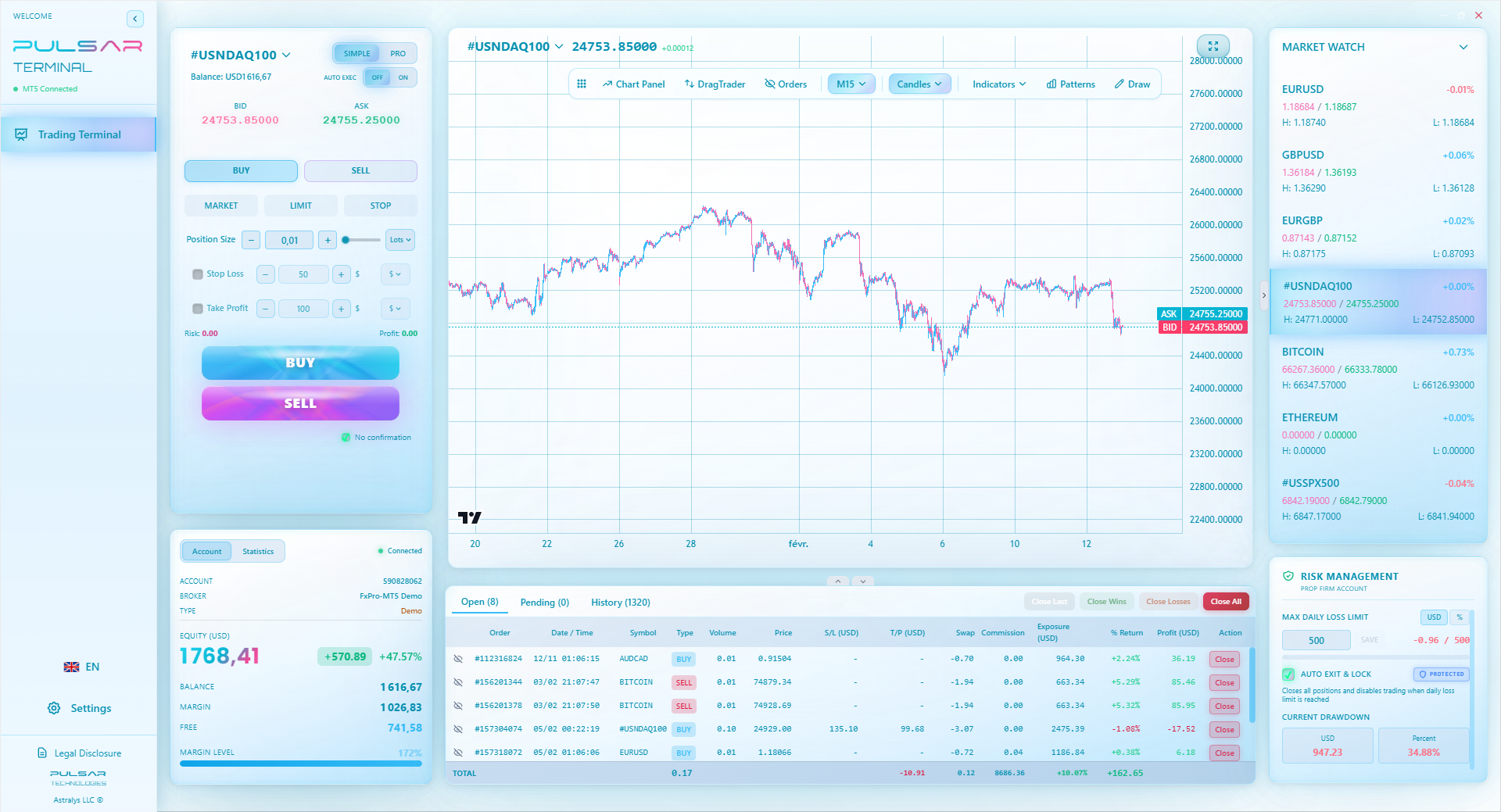
Managing multiple take-profit and stop-loss levels on a single trade is a core skill that separates amateurs from professionals, and Pulsar Terminal makes executing these advanced strategies simple and visual.
Pulsar Terminal
Công cụ MT5 tất-cả-trong-một: đặt lệnh kéo-thả, multi-TP/SL, trailing stop, grid trading, Volume Profile và bảo vệ prop firm. Hơn 1.000 trader sử dụng mỗi ngày.
The financial space is a magnet for scammers. Here’s what to watch out for, specifically around the Sikhona name.
The Fake SMS/Phishing Scam: In late 2024, there were reports of scam SMS messages pretending to be from 'Sikhona Money Transfers.' The message claimed there was an issue with your transfer and provided a link to 'verify details.' This is classic phishing. Never click links in unsolicited SMSes. Log in directly through the official app or website.
'Investment' or 'Trading' Schemes Using the Name: If anyone contacts you (via WhatsApp, Facebook, Telegram) offering 'Sikhona Forex trading' with guaranteed returns, it's a scam. Full stop. Sikhona does not offer this. These schemes often use reputable names to lure people in before stealing deposits.
Pressure to Bypass KYC: If an agent or website says they can 'make it faster' by skipping ID verification, run. Legitimate, regulated entities cannot and will not do this. It's illegal.
Too-Good-To-Be-True Exchange Rates: If their offered rate is significantly better than the mid-market rate, it's a trap. They might take your money and vanish, or the rate will change dramatically at the final step.
Protecting yourself starts with knowing what the real service is. For trading, the red flags are similar: promises of guaranteed profits, unsolicited contact, and brokers not properly regulated. Always do your homework, like reading our deep Exness review, before funding any account.
💡 Mẹo của Winston
Regulatory sanctions aren't always a sign to flee. Sometimes they're a sign the system is working. But they are always a sign to look closer and understand why.
“Your trading capital belongs in a regulated brokerage account. Use money transfer services for what they're designed for.”
Sikhona (Ria) has a great network, but it's not your only option. The market is competitive, which is good for you. Here’s a quick rundown of other major players:
- Wise (formerly TransferWise): Often the cheapest for online transfers, especially for major currencies. They use the real mid-market rate and charge a clear, low fee. Better for tech-savvy users.
- WorldRemit: Very similar to Ria, strong in Africa, offers bank deposit, cash pickup, and airtime top-up.
- Mukuru: A giant in the African diaspora space. Extremely trusted, with a huge physical footprint.
- Traditional Banks (Standard Bank, Bidvest Bank): Convenient if you bank with them, but often have the highest total costs (high fees + poor rates).
- Digital Wallets like PayPal: Good for online purchases, but currency conversion costs are high for person-to-person transfers.
The choice depends on destination country, payment method, and whether your recipient needs cash or a bank deposit. Always compare the final delivery amount. A R50 fee with a 6% margin is worse than a R100 fee with a 1% margin.
Here’s my take after 12 years of seeing all sorts of financial products come and go.
Sikhona Forex, as Ria Money Transfer, is a solid, regulated tool for a specific job: moving money across borders. Its physical network is its superpower, serving communities that rely on cash and face-to-face service. The SARB sanctions show the regulator is watching, which is good for consumer protection. The costs are in line with the industry, though you can often find better deals if you shop around digitally.
But for you, as someone interested in the markets, it holds a different lesson. It’s a case study in understanding what you’re actually dealing with. The word 'Forex' in its name is about the foreign exchange transaction of remittance, not the foreign exchange market of speculation.
Your journey as a trader is about precision. Knowing the exact pip value of your trade, setting a precise stop-loss, and using indicators like the MACD to inform your decisions. Sending money home is an act of support. Trading is a business of calculated risk. Don't mix the two.
Keep your trading capital in a regulated brokerage account. Use money transfer services for what they're designed for. And always, always know the difference before you hit 'send' or 'buy.'
FAQ
Q1Can I trade forex or CFDs with Sikhona Forex?
No, absolutely not. Sikhona Forex (now Ria Money Transfer) is a money transfer service, not a brokerage. They are licensed by the SARB to send remittances, not to offer leveraged trading accounts. You need an FSCA-regulated or internationally regulated broker for that.
Q2Is Sikhona Forex safe and legal to use for sending money?
Yes, it is a legal and licensed entity (an ADLA) under the South African Reserve Bank. Its acquisition by Ria Money Transfer, a large global company, adds to its legitimacy. Always use their official app, website, or authorized partners to avoid phishing scams.
Q3Why did the SARB sanction Sikhona Forex in 2023?
The SARB imposed administrative sanctions due to identified weaknesses in their control measures for verifying corporate client details (KYC). Importantly, the SARB clarified this was about the weakness of controls that could hinder detecting financial crime, not for actually facilitating illegal transactions. It underscores the regulatory scrutiny they are under.
Q4What is the cheapest way to send money from South Africa?
There's no single answer, as it depends on the destination, amount, and delivery method. Generally, digital-first services like Wise often offer the best total cost (fee + exchange rate) for bank transfers. Always compare the final amount the recipient will get across 2-3 services like Wise, WorldRemit, and Ria (Sikhona) before deciding.
Q5I want to trade forex from South Africa. What should I use?
You need a reputable online broker. Look for brokers regulated by the FSCA or top-tier global regulators like ASIC (Australia) or FCA (UK). Many offer excellent platforms like MetaTrader. Do your research on brokers like IC Markets or Pepperstone, start with a demo account, and never trade with money you can't afford to lose.
Q6What are the transfer limits for Sikhona/Ria?
For bank account transfers, you can send up to R300,000 per day or per month. For cash pickup, the limit is much lower: R5,000 per day and R25,000 per month. These are in place for regulatory compliance.
Q7How do I avoid Sikhona Forex scams?
Ignore any SMS or email with links asking you to 'verify' your transfer or account details. Never click. Log in only through the official app or website. Be wary of anyone offering 'Sikhona Forex trading' or investment plans - it's a scam. Legitimate money transfers never involve guaranteed investment returns.
Bài học của Prof. Winston
Điểm chính:
- ✓Sikhona Forex is an ADLA for transfers, not an FSCA broker for trading.
- ✓Total transfer cost includes a fee + a 0.26%-5%+ exchange rate margin.
- ✓SARB sanctions in 2023 were for control weaknesses, not active crime.
- ✓Never click links in unsolicited 'Sikhona' SMS messages.
- ✓Compare final recipient amounts across services to find the best rate.
Bài viết này hữu ích thế nào?
Nhấp vào ngôi sao để đánh giá
Nhận định giao dịch hàng tuần
Phân tích & chiến lược miễn phí hàng tuần. Không spam.
Về tác giả
David van der Merwe
Nhà giao dịch Thị trường Mới nổi
Trader tại Johannesburg với 11 năm kinh nghiệm về tiền tệ thị trường mới nổi. Chuyên về cặp ZAR, giao dịch theo quy định FSCA và phân tích thị trường Nam Phi.
Bình luận
Cảnh báo rủi ro
Giao dịch các công cụ tài chính tiềm ẩn rủi ro đáng kể và có thể không phù hợp với tất cả nhà đầu tư. Hiệu suất trong quá khứ không đảm bảo kết quả trong tương lai. Nội dung này chỉ mang tính chất giáo dục và không nên được coi là lời khuyên đầu tư. Hãy luôn tự nghiên cứu trước khi giao dịch.
Bạn cũng có thể thích

Cara Trading Forex Sukses: 7 Prinsip dari Trader Profesional
Cara trading forex sukses dengan 7 prinsip trader pro: manajemen modal, disiplin, journal trading, backtest. Data nyata, bukan janji profit palsu.
Jam Trading Forex Terbaik untuk Trader Indonesia: Panduan Lengkap dengan Tabel Waktu
Panduan jam trading forex untuk trader Indonesia. Tabel 4 sesi dunia, jam emas 20:00-00:00, sesi mana yang harus dihindari. Data akurat + tips dari trader berpengalaman.
Top 5 Sàn Forex Uy Tín Nhất 2026: Review Jujur dari Trader Indonesia
Top 5 sàn forex uy tín 2026 untuk trader Indonesia. Review jujur: spread, deposit, withdraw, dukungan lokal. Exness, XM, IC Markets & lebih.
Tải Pulsar Terminal
Tất cả các công cụ tính này được tích hợp trong Pulsar Terminal với dữ liệu thời gian thực từ tài khoản MT5 của bạn.
Tải Pulsar Terminal