


You're probably searching for 'Standard Bank forex branches near me' because you need to exchange currency or send money overseas.

David van der Merwe
Nhà giao dịch Thị trường Mới nổi ·  South Africa
☕ 9 phút đọc
Bạn sẽ học được:
- 1What Standard Bank Forex Branches Actually Do (And Don't Do)
- 2How to Find a Branch and What to Expect When You Get There
- 3The Real Costs: Fees, Spreads, and Hidden Margins
- 4Why Active Traders Use Online Forex Brokers Instead
- 5Step-by-Step: Using Standard Bank to Fund a Trading Account
- 6Common Pitfalls and How to Avoid Them
- 7When to Use Standard Bank Forex vs. Alternatives
- 8Final Verdict for South African Traders
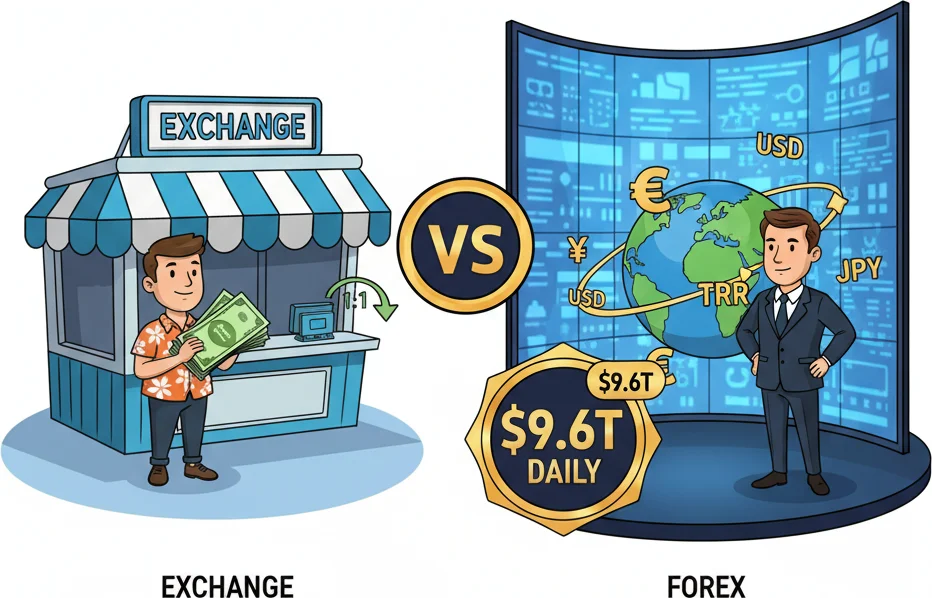
You're probably searching for 'Standard Bank forex branches near me' because you need to exchange currency or send money overseas. Maybe you're planning a trip, paying for an import, or even thinking about getting into trading. I get it. I've stood in those queues too. But after 12 years trading from Johannesburg to Cape Town, I need to tell you something straight: if you're looking to trade forex for profit, a Standard Bank branch is the last place you should be. This guide will show you exactly what they offer, what it really costs, and where you should actually go to grow your money.
Let's clear this up first. When you walk into a Standard Bank branch for forex, you're not walking into a trading floor. You're accessing a retail banking service. Their primary function is to help international payments and physical currency exchange for individuals and businesses. Think sending money to a university abroad, paying for imported goods, or getting Euros for a holiday.
They do not offer leveraged spot forex trading - the kind where you speculate on price movements of EUR/USD or GBP/ZAR with a broker. That's a completely different world, regulated by the FSCA for conduct and requiring a specific license. I made this mistake early on, confusing a bank's currency service with active trading. I wasted a good six months trying to understand how to 'trade' through my bank's online portal, only to realize I was just doing expensive international transfers.

Warning: If a bank employee starts talking to you about 'trading forex,' clarify if they mean facilitating a payment/transfer or actual speculative trading on a platform. They are almost always referring to the former.
The services you can get include: Foreign Cash Exchange (buying/selling notes), International Telegraphic Transfers (SWIFT), Travel Cards (pre-paid multi-currency cards), and Drafts. Not every branch offers all these. Larger, flagship branches in business districts (like Sandton in Johannesburg or the CBD in Cape Town) are your best bet for full services, especially for larger amounts or less common currencies.
Using the Standard Bank Locator
Don't just drive around. Use their official branch locator tool online. Filter for 'Forex Services' or 'International Services.' Call the branch ahead of time, especially if you need a large amount or a specific currency. I once drove 45 minutes to a branch in Pretoria for USD, only to find they only had a few hundred dollars on hand. A two-minute call would have saved me the trip.
The In-Branch Experience
Prepare for paperwork. Due to South African Reserve Bank (SARB) exchange control regulations, you'll need your SA ID book/passport and proof of residence. For larger transfers, you may need additional documentation like invoices or university acceptance letters. The process isn't fast. It's a bank, after all.
Expect to discuss your foreign investment allowance (currently R10 million per calendar year for individuals, with a R1 million single discretionary allowance requiring a tax clearance certificate). The teller or forex consultant will guide you through the forms (like the A01 for travel). This isn't trading; it's administrative compliance. If your goal is to move money to fund an actual forex trading account with a broker, this is the step you'd use, but the trading happens elsewhere.

💡 Mẹo của Winston
A bank's currency service is for moving money. A broker's platform is for making it grow. Confuse the two, and the fees will eat you alive.
“If you're looking to trade forex for profit, a Standard Bank branch is the last place you should be.”
This is where it gets painful for anyone thinking of frequent transactions. Banks don't make money from the R100 fee they charge you. They make it from the spread.
Let me give you a real example from last year. I needed to convert R100,000 to USD for a business payment. The interbank mid-rate (the real market rate) was around 18.50 ZAR/USD.
- Standard Bank's offered rate: 19.10 ZAR/USD.
- My effective cost: That's a 60-cent (about 3.24%) margin built into the rate.
- USD I received: $5,235.60 (R100,000 / 19.10)
- USD at interbank rate: $5,405.41 (R100,000 / 18.50)
- My hidden loss: $169.81 (over R3,100 at the time).
On top of that, there was a R250 telegraphic transfer fee. So my total cost to send that money was nearly R3,350, most of it invisible. Compare that to the typical 1-1.5 spread on a major pair like EUR/USD with a good broker, and you see the difference. For a retail trader, these bank margins would destroy any potential profit from short-term moves. It's designed for necessity, not profit generation.

Example: Sending R50,000 abroad.
- Bank Margin (3%): ~R1,500
- Transfer Fee: R200
- Total Cost: R1,700 That's a 3.4% loss before your money even arrives.
For cash, the margins are even worse, often 5-8% off the interbank rate. Always ask for the 'all-in' rate including all charges before you confirm.

If your goal is to profit from currency movements, you need a dedicated forex broker. The contrast is night and day.
| Feature | Standard Bank (Forex Service) | FSCA-Regulated Forex Broker (e.g., Pepperstone) |
|---|---|---|
| Primary Purpose | International Payments & Cash | Speculative Trading for Profit |
| use | None (1:1) | Up to 1:30 for retail (FSCA limit) |
| Pricing | Large built-in margin (3%+) | Tight spreads (e.g., 0.1 pips on EUR/USD) |
| Speed | Hours/Days for transfers | Milliseconds for trade execution |
| Platform | Banking portal | MT4, MT5, cTrader |
| Cost Structure | Hidden margin + fees | Clear spread/commission |
Brokers like IC Markets or Exness provide platforms where you can buy and sell currencies in real-time. You're trading contracts for difference (CFDs) on the price, not physically taking delivery of the USD. This allows for strategies like scalping or swing trading that are impossible at a bank. The regulation is different too (FSCA for brokers vs. SARB exchange controls for banks), focused on market conduct and client fund safety.
My biggest leap in performance came when I stopped seeing forex as a 'bank thing' and started treating it as a 'market thing' with the right tools. The ability to use a proper chart, set stop-losses, and analyze the market with tools like the RSI indicator is fundamental.
💡 Mẹo của Winston
Always calculate the 'all-in' rate: (ZAR Paid / Foreign Currency Received). Compare this number across providers, not just the headline 'rate' they quote.
“The bank is for moving money. The broker is for making it grow.”
So, you've found a good FSCA-regulated broker. How do you get your ZAR to them? This is where Standard Bank does play a role for traders.
- Open Your Broker Account: Get approved with your chosen broker.
- Get Broker Banking Details: The broker will provide local South African bank details (often with a partner like Bidvest Bank) or instructions for an international SWIFT transfer.
- Initiate EFT or SWIFT from Standard Bank: Log into your Standard Bank online banking or visit a branch.
- For a local EFT, it's like paying any local beneficiary. Use the broker's provided SA account details. This is usually the cheapest and fastest method (1-2 days).
- For an international SWIFT, you'll need the broker's overseas bank details. You'll use your single discretionary allowance or provide supporting docs for larger amounts. This costs more (the R250+ fee and margin) and takes 2-5 days.
- Monitor and Trade: Once the broker confirms funds, they appear in your trading platform.
Crucial Tip: Always send a small test amount first (like R1,000) to confirm the process works smoothly before moving larger sums. I learned this after a payment got stuck for a week due to a minor beneficiary name mismatch. Also, factor the transfer time and cost into your position size calculator. That R250 fee is part of your starting capital loss.

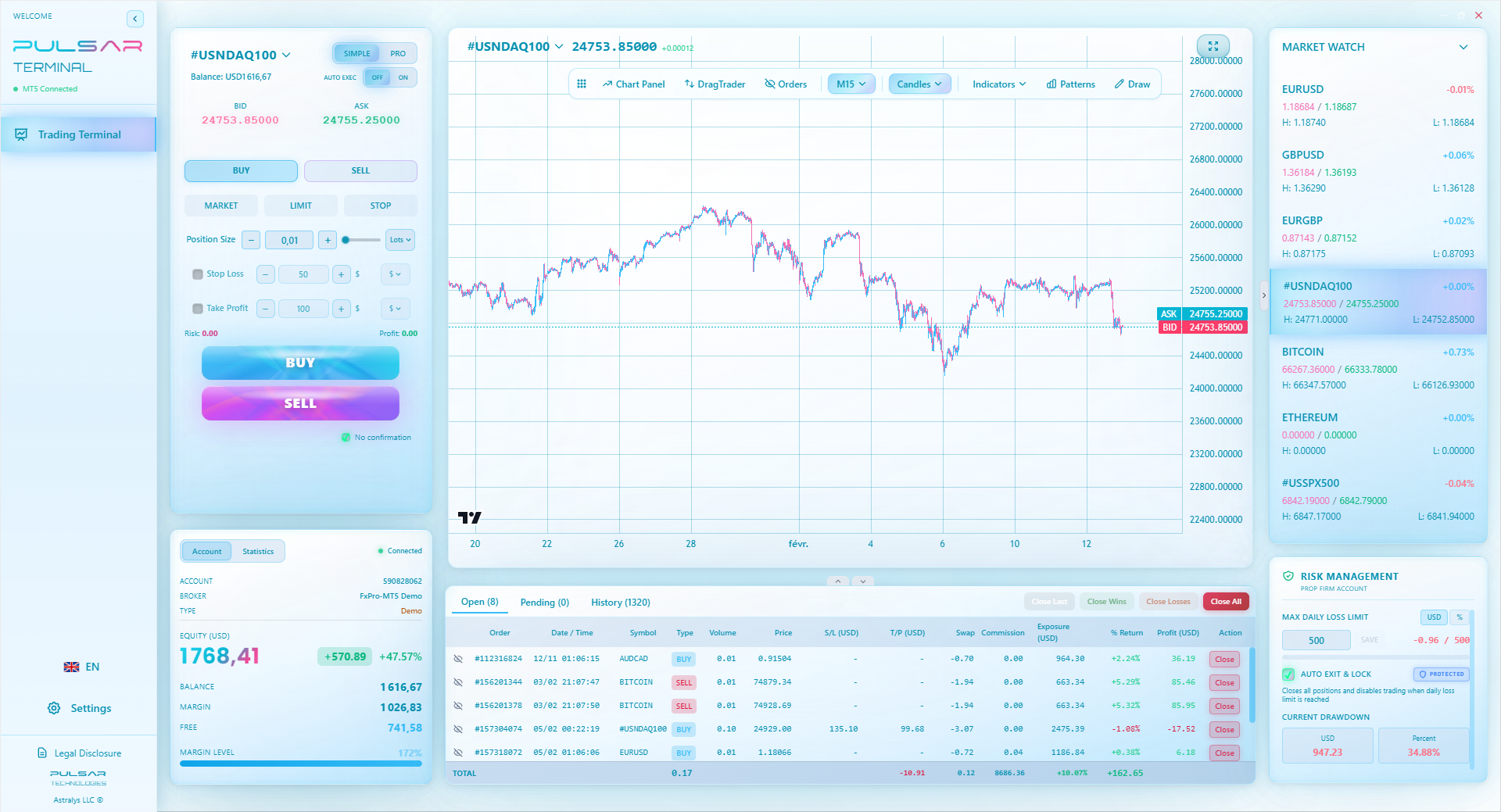
Once your funds are with a broker on MT5, managing trades efficiently is key, and Pulsar Terminal adds advanced order types and risk tools directly to your charts.
Pulsar Terminal
Công cụ MT5 tất-cả-trong-một: đặt lệnh kéo-thả, multi-TP/SL, trailing stop, grid trading, Volume Profile và bảo vệ prop firm. Hơn 1.000 trader sử dụng mỗi ngày.
Pitfall 1: Using a Bank's 'Trading Platform'. Some banks offer a share/CFD trading platform. The spreads are usually terrible, and the platforms are clunky. It's not their core business. I tried Absa's platform years ago; the 10-pip spread on EUR/USD made any short-term strategy impossible.
Pitfall 2: Not Shopping for Rates. Even for simple travel cash, compare. Check the rate at Standard Bank, ABSA, and a dedicated forex dealer like Bidvest or Master Currency. The difference can be 50 cents to the dollar or more.
Pitfall 3: Ignoring SARB Limits. Don't try to circumvent the annual allowances by using friends/family. SARS and SARB are getting sophisticated at linking transactions. A tax clearance certificate for larger investments is a hassle but non-negotiable.
Pitfall 4: Thinking Bank = Safe for Trading. Your funds in a bank are safe from bank failure (up to limits). But 'safe' doesn't mean 'good for generating returns.' The high costs guarantee a slow loss for active trading. Safety for trading capital comes from using a well-regulated broker, proper risk management, and avoiding a margin call.

“I wasted six months trying to 'trade' through my bank's portal, only to realize I was just doing expensive international transfers.”
Use Standard Bank (or any major bank) when:
- You need physical foreign cash notes urgently.
- You are making a large, documented international payment (e.g., property, tuition) where the bank's compliance process is helpful.
- You value the integrated relationship (all your finances in one place) over absolute cost for occasional transactions.
- You need a travel card loaded with multiple currencies.
Use a Dedicated Forex Dealer (Bidvest, Master Currency) when:
- You want better cash exchange rates or travel money rates.
- You need larger amounts of foreign cash with potentially better rates.
Use an FSCA-Regulated Online Forex Broker when:
- Your goal is to profit from currency price movements.
- You want to use use, advanced platforms, and real trading tools.
- You plan to trade frequently (cost efficiency is critical).
For me, Standard Bank is now just a conduit. It's the pipe that connects my ZAR in South Africa to the global markets via my broker. The trading itself happens on a platform like MT5, where I can manage my risk and analysis properly.
💡 Mẹo của Winston
Your first transfer to a new broker should be a tiny test amount. The peace of mind is worth more than the day's potential profit.
Searching for 'Standard Bank forex branches near me' is a logical first step, but it's likely not your final destination. For buying holiday dollars or sending money home, it's a standard option - just be sharp about the true cost. For trading, it's a non-starter.
Your journey should look like this: Use the bank's services to help moving funds under SARB rules. Then, do your actual trading with a reputable, FSCA-licensed broker on a professional platform. The skills you need - understanding the MACD indicator, managing a trade, reading price action - are learned in that broker's environment, not at a bank teller.
I wish someone had sat me down early on and said, 'You're looking in the wrong building.' It would have saved me time, money, and frustration. Know the purpose of each tool. The bank is for moving money. The broker is for making it grow. Keep those functions separate in your mind, and you'll be on a much clearer path.
FAQ
Q1Can I trade forex through my Standard Bank account?
Not in the way active traders mean. Standard Bank offers currency exchange and international payment services. They do not provide a leveraged trading platform for speculating on forex price movements with tight spreads. For that, you need an account with an FSCA-regulated forex broker.
Q2What documents do I need for forex at a Standard Bank branch?
Always bring your valid South African ID book or passport and recent proof of residence (like a utility bill). For transactions over your single discretionary allowance (R1 million), you will need a Tax Clearance Certificate from SARS confirming you are in good standing. For specific payments (like tuition), have the supporting invoice ready.
Q3Are Standard Bank's forex rates good?
Typically, no. Banks build a significant margin (often 3% or more) into their exchange rates. This is their primary profit on the service. For a better rate on cash or transfers, compare with dedicated forex dealers like Bidvest or Master Currency. For trading, broker spreads (often below 0.1%) are infinitely better.
Q4How do I find a Standard Bank branch that does forex?
Use the 'Branch Locator' on the Standard Bank website. Use the filter options to search for branches offering 'Foreign Exchange' or 'International Services.' Always call the specific branch ahead to confirm they have the service you need and the currency/amount available.
Q5What's the difference between SARB and FSCA in forex?
The South African Reserve Bank (SARB) manages exchange controls - the rules on how much ZAR you can convert and send abroad. The Financial Sector Conduct Authority (FSCA) regulates the conduct of financial firms, like forex brokers, to ensure they are fair and solvent. A broker needs FSCA authorization; your bank helps you comply with SARB rules.
Q6Can I use Standard Bank to fund an international forex broker?
Yes, this is a common use. You would perform an EFT (if the broker has a local South African account) or a SWIFT transfer (if they don't) from your Standard Bank account to your broker's bank details. This utilizes your foreign investment allowance. Remember to do a small test transfer first.
Q7What are the limits for taking forex out of South Africa?
Individuals have a R10 million annual foreign investment allowance. Within that, a R1 million single discretionary allowance can be used without a Tax Clearance Certificate (TCC). Any amount over R1 million in a year requires a TCC from SARS. Travel allowances for cash are much lower (currently R50,000 for travel to SADC countries, R100,000 for elsewhere).
Bài học của Prof. Winston
Điểm chính:
- ✓Bank forex margins cost 3%+; broker spreads are under 0.1%.
- ✓Use bank branches for cash & compliance, not for trading.
- ✓Always call ahead to confirm branch currency availability.
- ✓Test fund new broker accounts with a small amount first.
Bài viết này hữu ích thế nào?
Nhấp vào ngôi sao để đánh giá
Nhận định giao dịch hàng tuần
Phân tích & chiến lược miễn phí hàng tuần. Không spam.
Về tác giả
David van der Merwe
Nhà giao dịch Thị trường Mới nổi
Trader tại Johannesburg với 11 năm kinh nghiệm về tiền tệ thị trường mới nổi. Chuyên về cặp ZAR, giao dịch theo quy định FSCA và phân tích thị trường Nam Phi.
Bình luận
Cảnh báo rủi ro
Giao dịch các công cụ tài chính tiềm ẩn rủi ro đáng kể và có thể không phù hợp với tất cả nhà đầu tư. Hiệu suất trong quá khứ không đảm bảo kết quả trong tương lai. Nội dung này chỉ mang tính chất giáo dục và không nên được coi là lời khuyên đầu tư. Hãy luôn tự nghiên cứu trước khi giao dịch.
Bạn cũng có thể thích

Cara Trading Forex Sukses: 7 Prinsip dari Trader Profesional
Cara trading forex sukses dengan 7 prinsip trader pro: manajemen modal, disiplin, journal trading, backtest. Data nyata, bukan janji profit palsu.
Jam Trading Forex Terbaik untuk Trader Indonesia: Panduan Lengkap dengan Tabel Waktu
Panduan jam trading forex untuk trader Indonesia. Tabel 4 sesi dunia, jam emas 20:00-00:00, sesi mana yang harus dihindari. Data akurat + tips dari trader berpengalaman.
Top 5 Sàn Forex Uy Tín Nhất 2026: Review Jujur dari Trader Indonesia
Top 5 sàn forex uy tín 2026 untuk trader Indonesia. Review jujur: spread, deposit, withdraw, dukungan lokal. Exness, XM, IC Markets & lebih.
Tải Pulsar Terminal
Tất cả các công cụ tính này được tích hợp trong Pulsar Terminal với dữ liệu thời gian thực từ tài khoản MT5 của bạn.
Tải Pulsar Terminal