


Here's a common South African trading mistake: thinking your retail bank is the best place to trade forex.

David van der Merwe
Nhà giao dịch Thị trường Mới nổi ·  South Africa
☕ 11 phút đọc
Bạn sẽ học được:
- 1Contact Details & What They're Actually For
- 2The Real Cost: Bank Forex vs. A Broker
- 3What Standard Bank Is Actually Good For
- 4The South African Regulatory Landscape: Your Safety Net
- 5Practical Steps for SA Traders: A Hybrid Approach
- 6Common Pitfalls & How to Avoid Them
- 7The Future of Forex in South Africa
Here's a common South African trading mistake: thinking your retail bank is the best place to trade forex. You'll hear things like 'it's safer' or 'the rates are fine.' I'm here to tell you that's usually wrong. Using Standard Bank's forex services for active trading is like trying to win a Formula 1 race in a family sedan. In this guide, I'll give you the direct contact details you need, like the standard bank forex email address, but more importantly, I'll show you the real numbers, the hidden costs, and why nearly every serious trader I've mentored uses a dedicated broker instead.
Let's get the admin out of the way first. You need to know who to talk to, but you also need to know what you can realistically expect from them. Standard Bank has different channels for different problems. Don't waste your time emailing the general forex address about a complex commercial hedging strategy.
Here are the key contacts, straight from their 2026 pricing guides:
- General Forex Customer Service:
forex@standardbank.co.za/ 0860 123 006 - Use this for: Checking on a specific international payment status, asking about documentation for your Single Discretionary Allowance (that ZAR 1 million limit), or basic platform queries. Don't expect trading advice here.
- Business & Corporate Forex:
businessforex@standardbank.co.za/ 0800 222 050 - Use this for: If you're moving serious volume for a company, need structured products, or are dealing with commercial invoices. This isn't for your personal ZAR/USD swing trade.
- Fraud Reporting:
Reportfraud@standardbank.co.za - Self-explanatory, but crucial. If anything looks off with a transaction, use this immediately.
- International/Offshore Enquiries:
personalbanking@standardbank.comorOffshoreSA@standardbank.com/ +27 11 299 4701 - For when you're outside SA and need help with your accounts.

Warning: Email response times can be slow, especially for non-urgent queries. For time-sensitive payment issues, calling is almost always faster. Have your reference numbers ready.
Now, here's the critical distinction most people miss. These services are designed for moving money and managing foreign currency accounts, not for speculative trading. The person answering forex@standardbank.co.za is a customer service agent, not a market analyst. Their job is to execute your transfer instruction, not to discuss whether the Rand is oversold against the Dollar.

💡 Mẹo của Winston
Your bank is for storing money. Your broker is for working with it. Confuse the two, and the fees will eat you alive.
“Using Standard Bank for active trading is like trying to win a Formula 1 race in a family sedan.”
This is where the rubber meets the road. Let's talk numbers, because this is what kills your profits before you even start. I've seen too many new traders blow their accounts on spreads and fees they never fully understood.
Standard Bank's Fee Structure (2026)
When you make an international payment (a Telegraphic Transfer) with Standard Bank, you're not just paying the exchange rate. You're paying a buffet of fees:
- Commission: 0.5% of the amount if you do it online/app, 0.6% at a branch.
- SWIFT Fee: A fixed fee for using the network.
- Telecommunication Fee: R122 (as of 2026).
- Beneficiary Bank Fee: Unknown, charged by the receiving bank. Could be $15, £20, €25.
- Their Exchange Rate Mark-up: This is the silent killer. Banks don't give you the interbank rate. They add a margin, often 1-3% or more, which is pure profit for them. You never see this as a separate line item; it's baked into the rate they quote you.
Let's do a real example. Say you want to send $10,000 abroad from your ZAR account.
- You're quoted a rate of, say, 18.50 ZAR/USD, while the real interbank rate is 18.20. That's a 1.6% hidden cost right there: ZAR 3,000 gone.
- Add the 0.5% commission on ~ZAR 185,000: ZAR 925.
- Add the R122 telecom fee.
- The receiving bank takes another $15.
Your effective cost is massive before the money even lands.
How a Broker Compares
Now, let's look at a typical FSCA-licensed broker like IC Markets or Pepperstone.
- Commission: Often a small fixed fee per lot (e.g., $7 per 100k traded) or built into a slightly wider spread.
- Spread on EUR/USD: Can be as low as 0.0 pips on a Raw account. Let's be conservative and say 0.6 pips during active hours. On a $10,000 position (0.1 lot), that's a cost of $0.60 to open the trade.
- No SWIFT/Telecom Fees: You deposit ZAR via EFT (often free) into the broker's local trust account.
- Transparent Pricing: You see the bid/ask directly on the platform.
I once made the mistake of using my bank's platform to 'try a quick trade' on GBP/ZAR. The spread was over 150 pips. I needed the pair to move 1.5% just to break even. On my broker's platform, the spread was 12 pips. The difference is night and day, and it directly determines whether a scalping strategy is even possible.

Example: Trading 1 standard lot (100,000 units) of EUR/USD.
- Bank (estimated): Hidden mark-up of 1% = $1,000 cost on the transaction.
- ECN Broker: Spread of 0.1 pips + $7 commission = $7 + $1 = $8 total cost.
That's not a difference. That's a different universe.
“The 0.5% commission is the fee you see. The 1-3% hidden exchange rate mark-up is the fee that kills you.”
I'm not here to just bash the banks. They have a vital role, just not in active trading. You need to use the right tool for the job.
Standard Bank's forex services are excellent for:
- Moving Real Money for Life Purposes: Sending money to your kid studying in the UK, paying for an overseas supplier, or buying property abroad. The process is structured, secure, and handles all the SARB compliance for you (like using your Single Discretionary Allowance). For this, email
forex@standardbank.co.za. - Hedging Real Business Exposure: If you own an import business and need to lock in a USD/ZAR rate for a future container shipment, their corporate desk (
businessforex@standardbank.co.za) can provide forward contracts. This is risk management, not speculation. - Holding Foreign Currency: Their Foreign Currency Accounts (CFCs) are useful if you receive income in USD or EUR and want to hold it without converting to Rand immediately. Just know the R220 monthly management fee will eat small balances.
- The Shyft App: For small, frequent transfers (like paying a freelancer overseas), Shyft can be more cost-effective than a full telegraphic transfer, despite its 2.5% card top-up fee.
The common thread? These are banking and payment solutions. They are designed for certainty and compliance. Trading is about exploiting tiny, frequent price movements for profit. The infrastructure, pricing, and mindset required are completely opposite.
Think of it this way: You use a bank to store and transfer your wealth. You use a broker as a tool to try and grow it. Confusing the two is a fundamental error.
“The 0.5% commission is the fee you see. The 1-3% hidden exchange rate mark-up is the fee that kills you.”
Trading in SA isn't the wild west. We have strong regulators, and you should use them to your advantage. Ignoring this is how people get scammed.
- Financial Sector Conduct Authority (FSCA): This is your number one watchdog. Never, ever deposit money with a 'broker' that isn't licensed by the FSCA. You can verify any license on their website in minutes. This is non-negotiable. Brokers like Exness and XM have FSCA licensing for their South African clients.
- South African Reserve Bank (SARB): They control the flow of capital. The ZAR 1 million annual Single Discretionary Allowance is their rule. When you fund a broker, you're using this allowance. Reputable brokers understand this and will have a local South African bank account for EFT deposits, keeping everything above board.
- South African Revenue Service (SARS): Yes, you have to pay tax on your trading profits. It's income. Keep a detailed log of all your trades. I learned this the hard way early on with a messy tax bill. The simplicity of a broker's trade history report is a lifesaver here.
Because Standard Bank is a registered credit provider (NCR CP15) and operates under SARB, using them for payments feels safe. But that safety for transfers doesn't translate to cost-effectiveness for trading. A broker regulated by the FSCA offers a different kind of safety: client money protection, segregated accounts, and a regulated dispute resolution process.

Pro Tip: When choosing a broker, FSCA regulation is the baseline. Then, look at other factors like spreads, the platform (MT5 is industry standard), and whether they offer a reliable position size calculator. Don't get dazzled by bonuses.
💡 Mẹo của Winston
The spread isn't just a cost; it's the first opponent you have to beat in every single trade. Choose your battlefield wisely.
“FSCA regulation is your non-negotiable baseline. Everything else is a feature.”
So, what's the smart play? The most successful traders I know use a hybrid model. They use the strengths of both their bank and their broker.
Here’s your action plan:
- Keep Your Bank for Administration: Use your Standard Bank account as your central hub. Receive your salary here, pay your bills from here. When you need to move real money internationally for life expenses, use
forex@standardbank.co.zaand their telegraphic transfer service. - Choose an FSCA-Licensed Broker for Trading: Do your research. Compare raw spreads, commissions, and platforms. Fund your trading account via EFT from your Standard Bank account to the broker's local South African trust account. This uses your SARB allowance and is usually fee-free.
- Withdraw Profits Back to Your Bank: When you take profits, withdraw them from the broker back to your Standard Bank account. You now have clean, auditable records for SARS.
- Use the Right Communication Channel:
- Broker issue? Contact your broker's support.
- International payment for a car? Email
forex@standardbank.co.za. - Suspicious activity on your bank account?
Reportfraud@standardbank.co.zaimmediately.
I set this system up years ago after losing money on terrible bank spreads. My trading capital sits with my broker. My life savings and emergency fund stay in the bank. Each entity does what it's best at. It simplifies everything, from tracking performance to doing my taxes.
This separation also provides a psychological barrier that prevents you from over-trading your entire savings. It turns trading from a gambling-adjacent activity into a managed business operation.
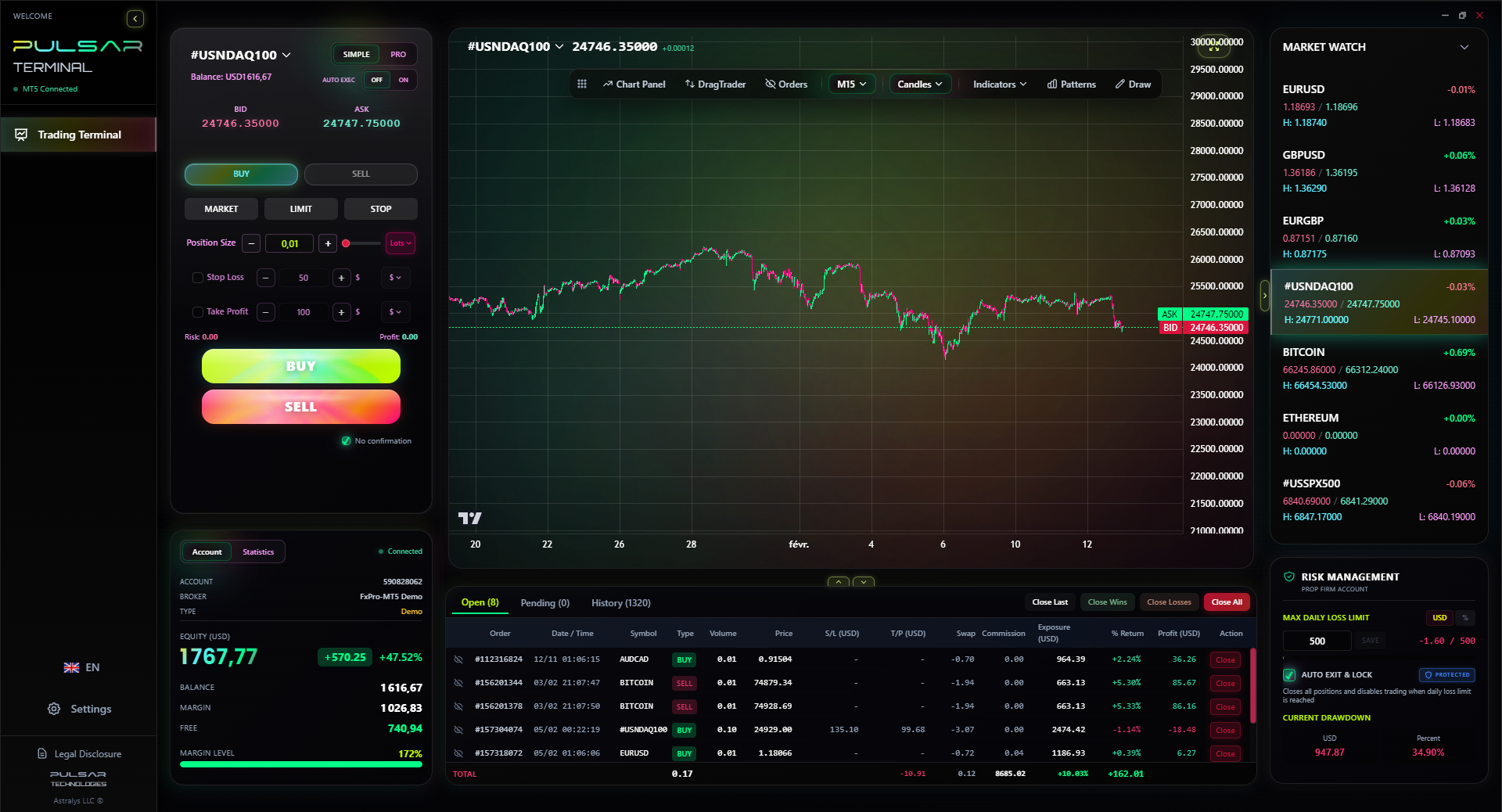
Managing multiple trades and risk across ZAR pairs and global markets is complex, but tools like Pulsar Terminal automate advanced order types and risk management directly on your MT5 platform.
Pulsar Terminal
Công cụ MT5 tất-cả-trong-một: đặt lệnh kéo-thả, multi-TP/SL, trailing stop, grid trading, Volume Profile và bảo vệ prop firm. Hơn 1.000 trader sử dụng mỗi ngày.
“FSCA regulation is your non-negotiable baseline. Everything else is a feature.”
Let's look at some classic errors I've seen (and made) so you can skip them.
Pitfall 1: Trading the ZAR Pairs on a Bank Platform. The spreads on USD/ZAR, EUR/ZAR, and GBP/ZAR on retail banking platforms are criminal for active trading. They're designed for large, infrequent transfers, not for catching 50-pip moves. You'll be fighting an enormous cost hurdle. If you want to trade Rand pairs, use a broker that offers competitive spreads on them.
Pitfall 2: Not Understanding Total Cost. People see the 0.5% commission and think that's the fee. They completely miss the hidden exchange rate mark-up, which is almost always the larger cost. Always ask for the total amount in ZAR you will pay (including all fees) and compare it to the interbank mid-rate. The difference is your real cost.
Pitfall 3: Using a Bank's 'Trading Platform' for CFDs. Some banks offer CFD trading. Avoid it. The spreads are wider, use is lower, and the platforms are clunky compared to dedicated MT4/MT5 from a specialist broker. It's a side business for them, not a core focus.
Pitfall 4: Ignoring the Impact on Strategy. A 150-pip spread on GBP/ZAR makes day trading impossible. It forces you into a long-term swing trading mindset by default, which may not be your strength. Your broker's costs should enable your strategy, not dictate it. If you're trying to use indicators like the RSI or MACD on a bank chart with huge spreads, the signals are often meaningless by the time you factor in your entry cost.
Pitfall 5: Not Planning for SARB Allowances.
Remember that ZAR 1 million annual limit. If you're a successful trader and withdraw more than that in profits in a year, you'll need to apply for approval from SARB through your bank. It's a process. Talk to forex@standardbank.co.za early if you think you'll hit this limit.
💡 Mẹo của Winston
SARS doesn't care if you used a bank or a broker. They care about the number at the bottom of your P&L statement. Keep clean records from day one.
“Your bank is your financial home base. Your broker is your trading workshop.”
The market is changing fast, and that's good news for you as a trader.
- Electronic Trading is Booming: The shift to Electronic Communication Networks (ECNs) and algorithmic trading is driving costs down and liquidity up. This trend benefits broker clients directly through tighter spreads. The days of calling a bank dealer for a quote are dead for active traders.
- Rand Volatility is a Given: Our currency is a proxy for global risk sentiment and commodity prices. Gold, platinum, coal – when these move, the Rand moves. This creates opportunity, but you need a platform that can execute orders quickly when news hits. In March 2026, USD/ZAR fell to 16.33 after a US-Iran ceasefire. On a slow bank platform, you'd miss that move.
- Regulation is Maturing: The upcoming Conduct of Financial Institutions (COFI) Bill will further clean up the industry. Stick with FSCA-licensed brokers, and you'll be on the right side of this evolution.
- Tools are Getting Smarter: It's not just about the trade anymore. It's about managing the trade. Advanced tools that automate risk management are becoming standard for serious traders.
The bottom line? The infrastructure for professional, cost-effective trading exists in South Africa right now. But it's not found in your online banking login. It's with the specialist brokers who have invested in technology and pass the liquidity savings on to you. Your bank remains your financial home base, but your broker is your trading workshop. Knowing the difference, and knowing when to use the standard bank forex email address versus your broker's live chat, is a sign of a trader who's got their basics sorted.
FAQ
Q1What is the Standard Bank forex email address for general queries?
For general international payment questions, transaction status, or help with your Single Discretionary Allowance, use forex@standardbank.co.za. Remember, this is for banking services, not for getting trading advice or market analysis.
Q2Is it illegal to trade forex with international brokers in South Africa?
No, it's perfectly legal as long as the broker is licensed by the Financial Sector Conduct Authority (FSCA). You fund your account using your annual Single Discretionary Allowance (ZAR 1 million) via a normal EFT to the broker's local South African trust account. Always verify the FSCA license first.
Q3Why are the spreads so much worse at Standard Bank than at my broker?
Banks add a large mark-up to the interbank exchange rate as a hidden fee. This is their primary profit on forex transactions. A broker like IC Markets or Pepperstone connects you directly to interbank liquidity, so you get spreads as low as 0.0 pips on major pairs, plus a small transparent commission. Their business model is different.
Q4Can I use Standard Bank's Shyft app for trading?
Absolutely not. Shyft is a digital wallet for holding and sending small amounts of foreign currency. It's not a trading platform. The fees (like the 2.5% card top-up fee) and lack of real-time order execution make it completely unsuitable for any form of active trading.
Q5What happens if my trading profits exceed the ZAR 1 million SARB allowance?
If you withdraw more than ZAR 1 million in a calendar year from your broker to your bank, you'll need to apply for additional approval from the South African Reserve Bank (SARB). You would start this process by contacting Standard Bank's forex desk (forex@standardbank.co.za). It involves additional documentation to prove the source of funds.
Q6Do I pay tax on forex trading profits in South Africa?
Yes. Profits from trading are considered income by the South African Revenue Service (SARS) and are taxable. You must declare them. This is another reason to use a proper broker – they provide detailed trade history reports that make tax calculation much easier.
Q7What's the minimum amount needed to open a Standard Bank foreign currency account?
For an Optimum foreign currency account, the minimum opening deposit is substantial – around $7,000 (roughly ZAR 132,718). This highlights that these accounts are for holding significant foreign balances, not for seeding a speculative trading account. Most brokers have minimum deposits starting from ZAR 500 or less.
Bài học của Prof. Winston
Điểm chính:
- ✓Bank forex spreads are 10-100x wider than broker spreads.
- ✓Always verify your broker's FSCA license before depositing.
- ✓Use your SARB ZAR 1m allowance to fund a broker via EFT.
- ✓Separate trading capital from life savings psychologically.
- ✓Taxable profits require detailed, broker-provided records.
Bài viết này hữu ích thế nào?
Nhấp vào ngôi sao để đánh giá
Nhận định giao dịch hàng tuần
Phân tích & chiến lược miễn phí hàng tuần. Không spam.
Về tác giả
David van der Merwe
Nhà giao dịch Thị trường Mới nổi
Trader tại Johannesburg với 11 năm kinh nghiệm về tiền tệ thị trường mới nổi. Chuyên về cặp ZAR, giao dịch theo quy định FSCA và phân tích thị trường Nam Phi.
Bình luận
Cảnh báo rủi ro
Giao dịch các công cụ tài chính tiềm ẩn rủi ro đáng kể và có thể không phù hợp với tất cả nhà đầu tư. Hiệu suất trong quá khứ không đảm bảo kết quả trong tương lai. Nội dung này chỉ mang tính chất giáo dục và không nên được coi là lời khuyên đầu tư. Hãy luôn tự nghiên cứu trước khi giao dịch.
Bạn cũng có thể thích

Cara Trading Forex Sukses: 7 Prinsip dari Trader Profesional
Cara trading forex sukses dengan 7 prinsip trader pro: manajemen modal, disiplin, journal trading, backtest. Data nyata, bukan janji profit palsu.
Jam Trading Forex Terbaik untuk Trader Indonesia: Panduan Lengkap dengan Tabel Waktu
Panduan jam trading forex untuk trader Indonesia. Tabel 4 sesi dunia, jam emas 20:00-00:00, sesi mana yang harus dihindari. Data akurat + tips dari trader berpengalaman.
Top 5 Sàn Forex Uy Tín Nhất 2026: Review Jujur dari Trader Indonesia
Top 5 sàn forex uy tín 2026 untuk trader Indonesia. Review jujur: spread, deposit, withdraw, dukungan lokal. Exness, XM, IC Markets & lebih.
Tải Pulsar Terminal
Tất cả các công cụ tính này được tích hợp trong Pulsar Terminal với dữ liệu thời gian thực từ tài khoản MT5 của bạn.
Tải Pulsar Terminal