


Let's get one thing straight: most of what you hear about successful forex traders is pure fantasy.

Olumide Adeyemi
Nhà tiên phong Giao dịch Tây Phi ·  Nigeria
☕ 10 phút đọc
Bạn sẽ học được:
- 1The Mindset Gap: Why 95% of Nigerian Traders Fail Before They Start
- 2Realistic Numbers: What 'Success' Actually Looks Like
- 3Building a Simple, Boring (and Profitable) System
- 4Navigating Nigerian-Specific Challenges
- 5It's a Marathon, Not a Sprint: The Long-Term Journey
- 6Essential Tools That Will Save Your Sanity (and Your Account)
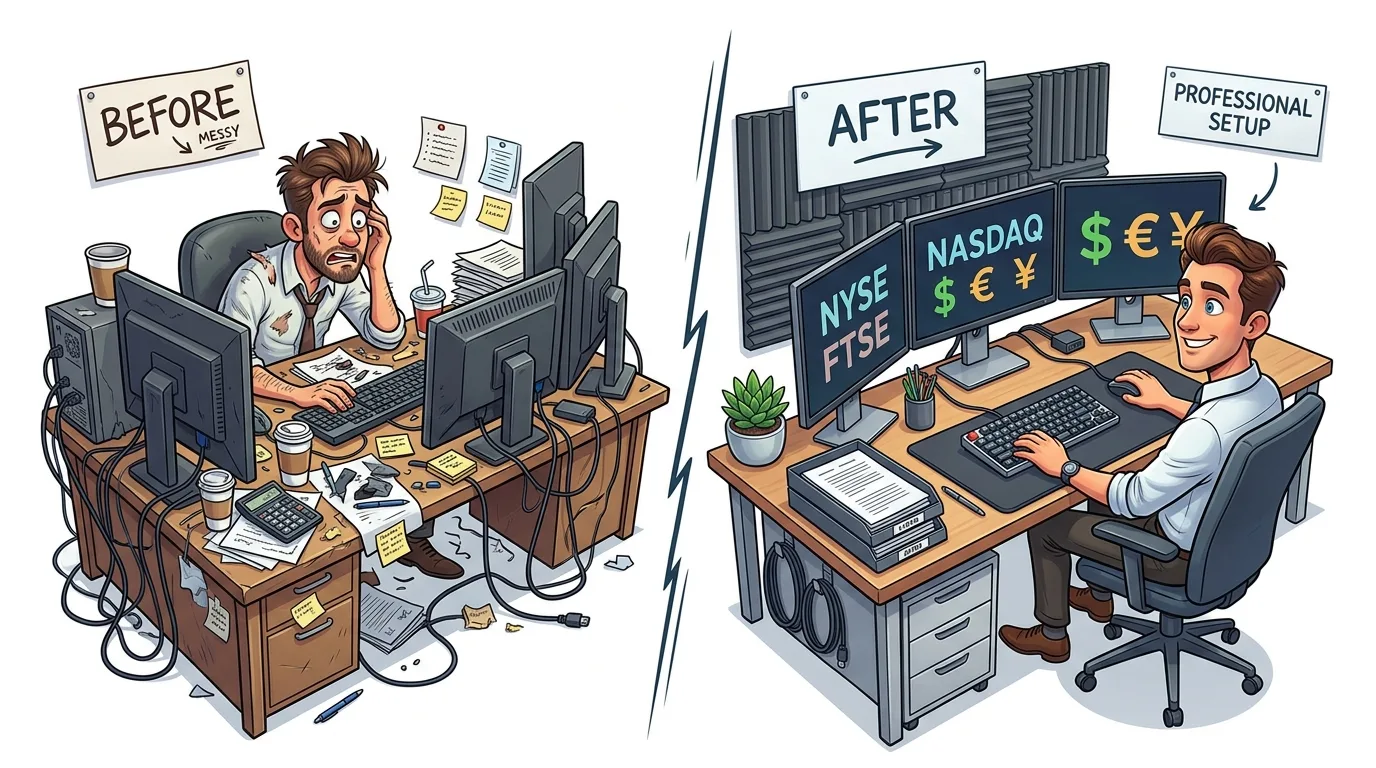
Let's get one thing straight: most of what you hear about successful forex traders is pure fantasy. The Instagram gurus with rented Lambos and the YouTube 'mentors' selling courses are selling a dream, not a reality. The real picture is far less glamorous and a thousand times more difficult. I've been in this game for over a decade, and I've seen more accounts blown than I can count. In this guide, I'll show you what the real, sustainable path looks like for a trader in Nigeria, from the mindset you need to the cold, hard numbers that actually matter.
The biggest barrier to becoming one of the successful forex traders isn't a secret indicator. It's your head. In Nigeria, we're surrounded by a 'get-rich-quick' culture that's poison for trading. Forex isn't a side hustle you do after checking your football bets. It's a professional skill that takes years to build.
I made this mistake myself early on. I funded an account with 50,000 Naira, convinced I'd double it in a week. I was chasing the big win, the story I could tell my friends. I took a massive, poorly planned position on GBP/JPY because it 'looked' like it was moving. I was wiped out in two days. That loss wasn't about the market; it was about my mindset. I was a gambler with a trading platform.
The successful trader's mindset is boring. It's about consistency over excitement, process over profit. Your goal isn't to make 1,000,000 Naira on one trade. Your goal is to execute your plan correctly, day after day, whether you make 5,000 Naira or lose 3,000 Naira. The profit is a byproduct of discipline, not the target. You have to kill the 'Big Boy' mentality. The market doesn't care about your ego.

Warning: If you're trading to prove something to your friends, family, or yourself, you will lose. The market is the ultimate humbler. Trade to follow a plan, not to feed your ego.
This shift is non-negotiable. You must view yourself as a business owner, not a speculator. Your trading capital is your business capital. Every trade is an business decision with a calculated risk, not a roll of the dice.

💡 Mẹo của Winston
The market's job is to find the price where the most people will be wrong. Your job is to not be one of them.

“Aiming for 5-10% per month is a high-risk strategy that usually ends in ruin.”
Let's talk numbers, because the fantasy ones are destroying people. You see claims of 50%, 100%, 200% returns per month. That's a straight path to a margin call. For a professional, sustainable trader, the numbers are much smaller and far more powerful.
Monthly Returns: The Truth
A consistently successful retail trader is doing exceptionally well to average 5-15% return on their account per year. Yes, year. Some very good months might see 5-10%, but you will also have flat months and losing months. Aiming for 5-10% per month is a high-risk strategy that usually ends in ruin. I target a 2-4% monthly return on my core account. It sounds small, but compounded over time, it's life-changing. 3% per month is over 42% per year.
Risk Per Trade: The Golden Rule
This is the most important number you will ever use. You should never, ever risk more than 1-2% of your total account capital on a single trade. Most pros I know risk 0.5-1%. Let's do the math with a 200,000 Naira account.
- Risking 1% means your maximum loss on any trade is 2,000 Naira.
- If your stop loss is 50 pips away, you can only take a position size where 50 pips = 2,000 Naira loss. This rule alone will keep you in the game. I use a position size calculator for every single trade, no exceptions. It removes emotion.

Example: Your 200,000 Naira account. You see a setup on EUR/USD. Your stop loss is 30 pips away. At 1% risk, you can lose 2,000 Naira. If the pip value for a standard lot is roughly $10 (varies by pair), you work backwards to find your lot size. A calculator does this instantly, ensuring you're always within your risk limit.
Win Rate vs. Risk/Reward
You don't need to win most of your trades. I have a strategy where my win rate is about 45%. That sounds bad, right? But my average winning trade makes 2.5 times what my average losing trade loses (a 1:2.5 risk/reward ratio). So, if I risk 2,000 Naira to make 5,000 Naira, I can be wrong more than half the time and still be profitable. Chasing a 90% win rate often means taking tiny profits and huge losses, which is a disaster.
“Your trading capital is your business capital. Every trade is a business decision.”
Complexity is the enemy of execution. Your trading system should be so simple you can explain it to a secondary school student. It needs three clear parts: an entry trigger, a stop loss, and a take profit. No vagueness.
1. The Entry Trigger: This is your signal to get in. It must be objective. For example: 'I will buy EUR/USD only if the price pulls back to the 50-period moving average on the 1-hour chart AND the RSI indicator is above 30 and turning up.' Not: 'It looks like it's going up.'
2. The Stop Loss: You place this the moment you enter the trade. It's non-negotiable. It should be based on market structure, not on how much you're willing to lose. Place it beyond a recent swing low (for a buy) or swing high (for a sell). If the trade requires a stop loss larger than your 1% risk allows, you don't take the trade. Period.
3. The Take Profit: Have a target. You can use a previous resistance level, a Fibonacci extension, or a fixed risk/reward ratio (like 1:2). Some traders use a multi-target approach, closing part of the position at one target and letting the rest run. The key is to have a plan before you enter.
I spent years adding more and more indicators - Bollinger Bands, Stochastics, Ichimoku Clouds. My charts looked like a rainbow explosion. My results were terrible. I was paralyzed by conflicting signals. I stripped it all back. Now, I might just use price action, one or two moving averages, and the MACD indicator for confirmation. Clarity leads to confidence.

Pro Tip: Paper trade your simple system for at least 100 trades. Log every single one in a journal: entry, exit, reason, emotion. Don't skip this. The goal isn't to make fake money; it's to prove to yourself that you can follow your own rules consistently, even when it's boring or scary.
💡 Mẹo của Winston
If you can't articulate your trade's thesis in one sentence, you don't have a trade. You have a hope.

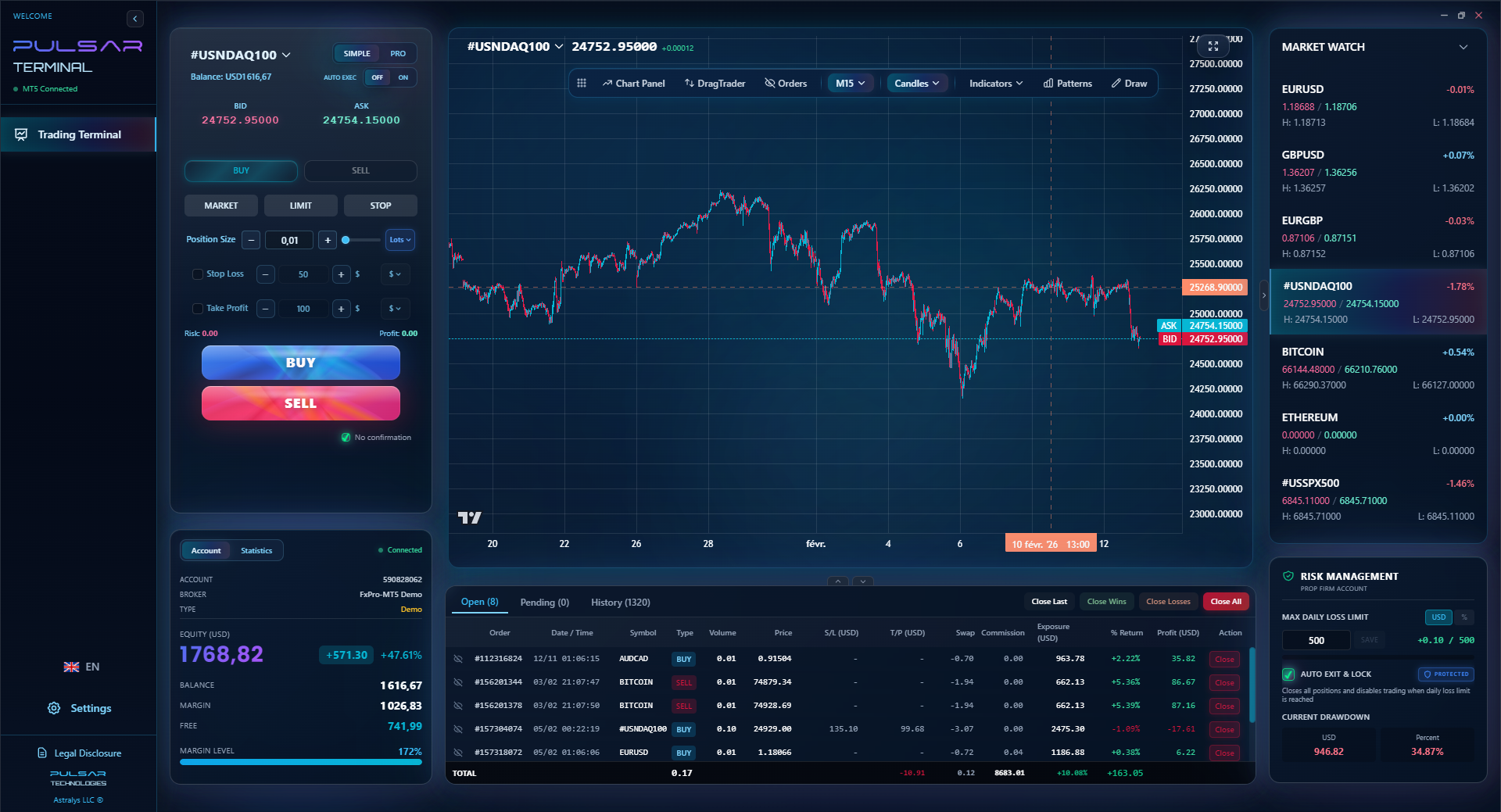
When you have a clear system with defined stop losses and take profits, a tool like Pulsar Terminal lets you set and manage those orders with drag-and-drop ease directly on your MT5 charts, removing manual errors and emotional hesitation.
Pulsar Terminal
Công cụ MT5 tất-cả-trong-một: đặt lệnh kéo-thả, multi-TP/SL, trailing stop, grid trading, Volume Profile và bảo vệ prop firm. Hơn 1.000 trader sử dụng mỗi ngày.
“Complexity is the enemy of execution. Your system should be so simple you can explain it to a child.”
Trading from Nigeria comes with its own unique set of headaches. Ignoring them is a sure way to join the 95% who fail.
Internet & Power: This is your biggest operational risk. A power cut during a volatile news event can wipe you out. Solution: A reliable inverter/solar system is not a luxury, it's a business expense. Have a mobile data hotspot as a backup. Never hold a high-risk trade if your power or internet is unstable.
Broker Choice: This is critical. You need a broker that reliably accepts deposits and withdrawals in Naira, has low spreads on the majors, and is properly regulated. High spreads eat directly into your profit. I've had good execution experiences with brokers like Exness and IC Markets for their raw spreads, but always do your own due diligence. Avoid any 'broker' that calls you unsolicited or promises bonuses that are too good to be true.
Psychology & Community: The pressure from family and friends who don't understand trading is real. 'When are you going to get a real job?' 'Show me the money you've made.' This pressure can force you into taking reckless trades just to 'prove' something. Keep your trading private. Don't discuss your P&L. Find a community of serious traders (not signal beggars) for support, but make your own decisions.
Taxes & Regulation: Keep clear records. While forex trading income tax is a complex and evolving area in Nigeria, being able to show a professional record of your activity is crucial for your own legitimacy and future planning. Treat it like a business from day one.
“Complexity is the enemy of execution. Your system should be so simple you can explain it to a child.”
You won't be a successful forex trader in six months. It might take 2-3 years of dedicated, focused work before you see consistent profitability. The journey has distinct phases, and most people quit in the second one.
Phase 1: The Ignorant Bliss (Months 0-6). You deposit, you trade, you might even get lucky. You think it's easy. This is the most dangerous phase.
Phase 2: The Painful Education (Months 6-24). You start losing. You blow an account (or two). You realize how much you don't know. This is where 80% of people give up. This is where you must commit to learning, journaling, and building discipline. You switch from trying to 'predict' the market to 'reacting' to it with a plan. This is where you learn about swing trading or scalping strategy frameworks and find what suits your personality.
Phase 3: The Break-Even Grind (Months 24-36). Your losses get smaller. You stop blowing accounts. You're roughly breaking even over quarters. This is massive progress! You have discipline, but you're still refining your edge.
Phase 4: Consistent Profitability (Year 3+). Your business is now generating a steady, modest return. You're no longer emotional about individual trades. You have a process you trust. You are now part of the small minority.
My own journey followed this almost exactly. It took me nearly three years to get to a point where I could confidently pay my bills from trading. The second year was the hardest - I was so close to quitting. I was break-even for almost 9 painful months. But sticking with the process through that grind was what made all the difference.
💡 Mẹo của Winston
Your first loss is often your smallest loss. The refusal to accept a small, planned loss is what creates the catastrophic one.


“You won't be a successful forex trader in six months. It might take 2-3 years.”
You don't need expensive software, but you do need the right basic tools.
1. A Trading Journal: This is your #1 tool for improvement. Use a spreadsheet or a dedicated app. Record: Date, Pair, Long/Short, Entry, Stop Loss, Take Profit, Exit, P&L, Screenshot, Reason for Entry, Reason for Exit, Emotional State. Review it weekly. Your journal will show you your fatal patterns.
2. An Economic Calendar: Know when high-impact news (like US Non-Farm Payrolls, ECB decisions) is coming. Either avoid trading during these events or have a specific strategy for them. Volatility spikes can trigger your stop loss instantly.
3. Reliable Charting Platform: MT4/MT5 is the standard. Learn it inside out. Understand what a pip definition and spread definition mean in real cost on your platform.
4. A Position Size Calculator: I've said it before, I'll say it again. This is non-negotiable. Never guess your lot size.
5. A Routine: Your trading is a job. Have set hours for analysis, trading, and review. Don't sit glued to the screen all day. Overtrading is a killer disease.
These tools enforce the discipline that your emotions will constantly try to break. They are the guardrails on your journey.
FAQ
Q1How much money do I need to start forex trading in Nigeria?
Technically, you can start with as little as $10 (about 15,000 Naira) with some brokers. But realistically, to properly implement risk management (the 1% rule) and not get wiped out by a few losses, a more practical starting amount is at least $200-$500 (300k-750k Naira). This allows you to trade micro or mini lots and actually learn without the pressure of every pip movement being catastrophic.
Q2Can I become a full-time forex trader in Nigeria?
Yes, but it should be a goal, not a starting point. Go full-time only after you have at least 2-3 years of consistent, documented profitability on a live account, and you have trading capital that can generate enough income to cover 2+ years of living expenses. Most successful forex traders start part-time while having another income source.
Q3What is the best time to trade forex in Nigeria?
The most liquid and volatile sessions are the London session (1 PM - 10 PM Nigerian Time) and the overlap with the New York session (2 PM - 5 PM Nigerian Time). This is when spreads are tightest and you get the cleanest moves on pairs like EUR/USD and GBP/USD. The Asian session (late night/early morning) is typically slower.
Q4Are forex trading signals worth it?
Almost never. Relying on signals teaches you nothing and puts your money in someone else's hands with zero accountability. If the signal provider was so consistently profitable, they'd be trading their own large account, not selling signals for small change. Your goal is to learn to fish, not to buy a fish every day.
Q5How do I handle a string of losses?
First, check if your system is broken (has market conditions changed?). If not, this is normal. Even with a 50% win rate, 5-7 losses in a row is statistically possible. Stick to your 1% risk rule. A string of losses is a test of discipline. If you react by doubling your risk to 'make it back,' you've failed the test and will likely cause a margin call. Sometimes the best action is to stop trading for a few days to reset emotionally.
Q6Is technical analysis or fundamental analysis more important?
For most retail traders, technical analysis provides the structure for entries and exits. Fundamental analysis (news, interest rates) tells you the why and the long-term direction. You need to be aware of fundamentals to avoid trading against a major trend, but techs give you the actionable levels. Start with mastering technicals and price action, then layer in fundamental awareness.
Bài học của Prof. Winston
Điểm chính:
- ✓Risk a maximum of 1% of capital per trade.
- ✓Aim for realistic 2-4% monthly returns, not YouTube fantasies.
- ✓A trading journal is your most important tool.
- ✓Success takes 2-3 years of disciplined work.
Bài viết này hữu ích thế nào?
Nhấp vào ngôi sao để đánh giá
Nhận định giao dịch hàng tuần
Phân tích & chiến lược miễn phí hàng tuần. Không spam.
Về tác giả
Olumide Adeyemi
Nhà tiên phong Giao dịch Tây Phi
Một trong những nhà đào tạo forex tích cực nhất tại Nigeria. 8 năm kinh nghiệm giao dịch từ Lagos. Chuyên về chiến lược vốn thấp và thử thách prop firm dành cho trader châu Phi.
Bình luận
Cảnh báo rủi ro
Giao dịch các công cụ tài chính tiềm ẩn rủi ro đáng kể và có thể không phù hợp với tất cả nhà đầu tư. Hiệu suất trong quá khứ không đảm bảo kết quả trong tương lai. Nội dung này chỉ mang tính chất giáo dục và không nên được coi là lời khuyên đầu tư. Hãy luôn tự nghiên cứu trước khi giao dịch.
Bạn cũng có thể thích

Cara Trading Forex Sukses: 7 Prinsip dari Trader Profesional
Cara trading forex sukses dengan 7 prinsip trader pro: manajemen modal, disiplin, journal trading, backtest. Data nyata, bukan janji profit palsu.
Jam Trading Forex Terbaik untuk Trader Indonesia: Panduan Lengkap dengan Tabel Waktu
Panduan jam trading forex untuk trader Indonesia. Tabel 4 sesi dunia, jam emas 20:00-00:00, sesi mana yang harus dihindari. Data akurat + tips dari trader berpengalaman.
Top 5 Sàn Forex Uy Tín Nhất 2026: Review Jujur dari Trader Indonesia
Top 5 sàn forex uy tín 2026 untuk trader Indonesia. Review jujur: spread, deposit, withdraw, dukungan lokal. Exness, XM, IC Markets & lebih.
Tải Pulsar Terminal
Tất cả các công cụ tính này được tích hợp trong Pulsar Terminal với dữ liệu thời gian thực từ tài khoản MT5 của bạn.
Tải Pulsar Terminal