


Ever sat staring at a chart, watching the price squeeze into a tighter and tighter range, and wondered, 'What happens next?' That feeling of coiled tension is exactly what a symmetrical triangle pattern is all about.

David van der Merwe
Nhà giao dịch Thị trường Mới nổi ·  South Africa
☕ 10 phút đọc
Bạn sẽ học được:

Ever sat staring at a chart, watching the price squeeze into a tighter and tighter range, and wondered, 'What happens next?' That feeling of coiled tension is exactly what a symmetrical triangle pattern is all about. It's one of the most common and, frankly, most frustrating patterns you'll encounter. Everyone sees it, everyone's waiting for the breakout, and the big question is which way it'll go. I've traded these patterns for over a decade, from my flat in Sandton to my home office in Cape Town, and I've learned the hard way that spotting the triangle is the easy part. The real skill is in knowing how to trade it without getting chopped to pieces.
Let's break it down simply. A symmetrical triangle is a chart pattern where the price makes lower highs and higher lows. If you draw lines connecting these points, they converge, forming a triangle that looks, well, symmetrical. It's a visual representation of a market in balance. The bulls and bears are basically in a stalemate, with neither side able to push the price decisively in their direction. The volume typically dries up as the pattern develops, which makes sense - fewer people are willing to place big bets when the market is stuck in a rut.
This isn't a trend continuation pattern or a reversal pattern by itself. That's a common misconception. It's a continuation pattern most of the time, but the key word is 'most'. The pattern itself is neutral; it just tells you that volatility is compressing and a big move is brewing. The direction of that move is decided by the breakout. I remember a classic one on the USD/ZAR chart back in 2021. The pair had been in a wild uptrend, then it started coiling for about three weeks. Everyone at the JSE was talking about it. The breakout, when it came, was a vicious continuation higher, catching a lot of short-sellers off guard.

Warning: Don't assume direction. Just because the prior trend was up doesn't guarantee an upward breakout. I've been burned assuming that. Always wait for the price to close convincingly outside the triangle boundary.

You'll see potential triangles everywhere once you start looking. The trick is filtering out the junk. A valid symmetrical triangle needs at least two distinct lower highs and two distinct higher lows. I like to see four to six touches total (two on each trendline) before I take it seriously. The lines should have a clear, converging angle. If the lines are almost parallel, you're looking at a channel, not a triangle.
Timeframe Matters
This pattern works across all timeframes, but its significance changes. A triangle on a 5-minute chart might resolve in an hour. A triangle on a daily chart, like the one I traded on the EUR/USD that lasted 22 days, can lead to a move that runs for weeks. For us trading from SA, considering the time difference with London and New York, I find the 4-hour and daily charts give the most reliable signals that don't require you to be up at 3 AM.
The Volume Clue
This is a big one. Volume should noticeably decline as the pattern forms. It's the market getting quieter, holding its breath. Then, on the actual breakout, you want to see a significant spike in volume. That's the confirmation that the move has real energy behind it. No volume spike? Be skeptical. It might be a false breakout. I use a simple volume indicator right on my MT5 platform to check this. A quiet breakout often sucks you in only to reverse. I learned this lesson with a nasty loss on GBP/JPY a few years back; the breakout looked perfect on the chart, but the volume was pathetic. It reversed and took out my stop loss within the hour.

💡 Mẹo của Winston
A triangle without shrinking volume is like a spring without tension. It might not snap. Always confirm the volume profile.

“The pattern itself is neutral; it just tells you that volatility is compressing and a big move is brewing.”
This is where the rubber meets the road. Patience is your greatest asset here. The most common mistake is jumping in as soon as the price tickles the trendline.
Entry: I wait for a candle close outside the triangle's boundary. Not a wick, a full-bodied close. For an extra layer of confirmation, I sometimes wait for the price to retest the broken trendline from the other side. That retest is a beautiful, low-risk entry point. For example, in a long trade, after an upward breakout, the price might dip back to touch the former resistance line (now support) before rocketing higher.
Stop Loss: Your stop loss should be placed on the opposite side of the triangle. For a long trade, put it just below the most recent higher low within the pattern, or just below the lower trendline. This protects you if the breakout fails and the price collapses back into the pattern.
Take Profit: The most common method is to measure the height of the triangle at its widest part (the first swing from a high to a low) and then project that distance upward from the breakout point. It's not a guarantee, but it gives you a realistic profit target.

Example: Say the triangle starts with a high at 1.0850 and a low at 1.0750. That's a 100-pip height. If the price breaks upward at 1.0820, your initial profit target would be around 1.0920 (1.0820 + 100 pips).
Managing the trade is crucial. I often use a trailing stop once the price moves in my favor by about half the projected target. Tools that automate this, like a trailing stop feature, are useful because they lock in profits without you having to babysit the screen. I wish I had that automation years ago; I can't tell you how many times I've watched a 70-pip profit turn into a 10-pip win because I got greedy and didn't move my stop.
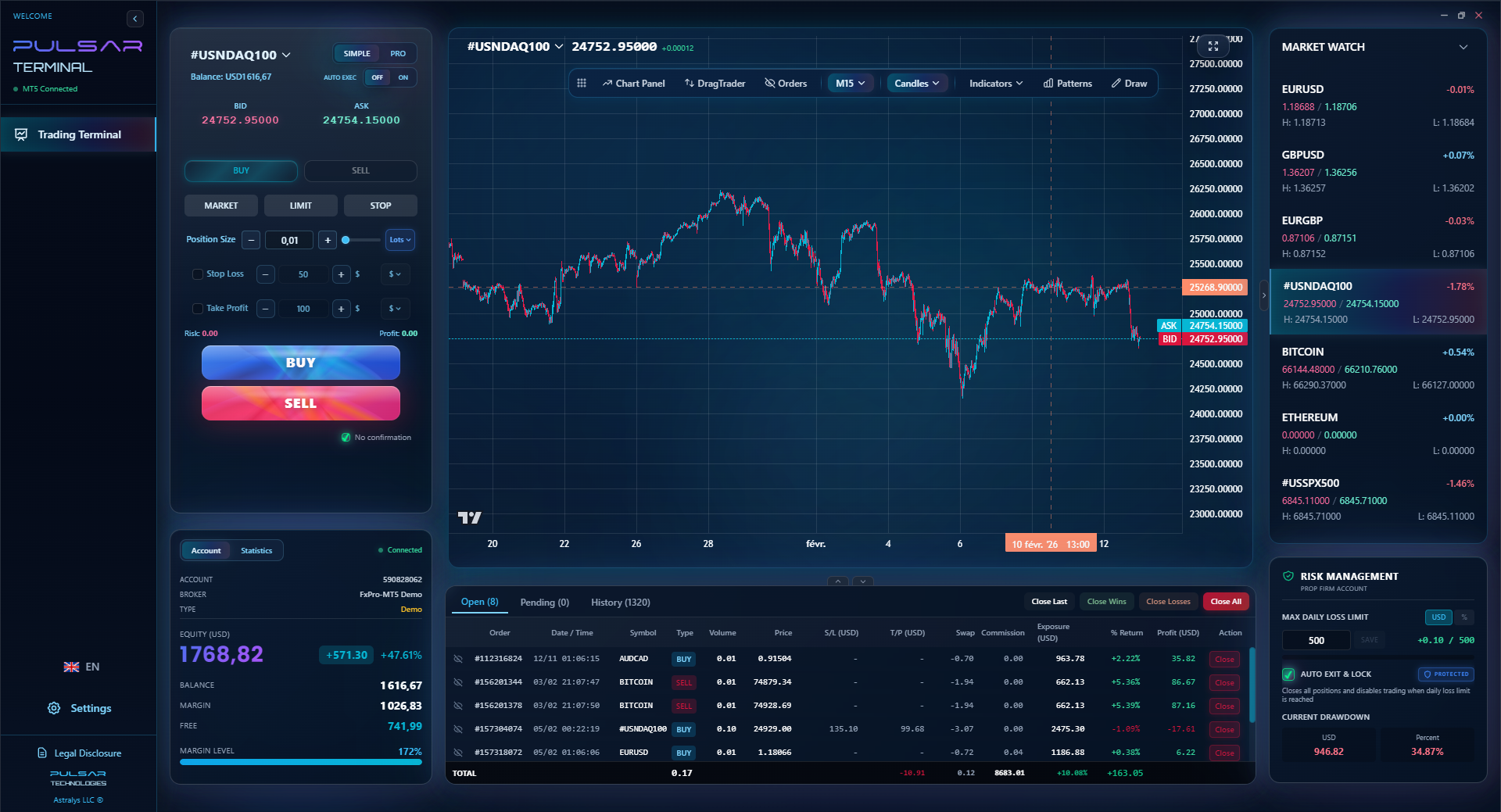
Managing multiple take-profit levels on a triangle breakout trade is much simpler with a tool that lets you set and trail them all from one order ticket.
Pulsar Terminal
Công cụ MT5 tất-cả-trong-một: đặt lệnh kéo-thả, multi-TP/SL, trailing stop, grid trading, Volume Profile và bảo vệ prop firm. Hơn 1.000 trader sử dụng mỗi ngày.
Let's get real about where you can go wrong. I've made all these errors.
-
Trading the Coil, Not the Breakout: This is the big one. You see the pattern forming and try to buy the lows and sell the highs inside the triangle. It's tempting, but it's a great way to get whipsawed. The ranges get too tight, and spreads will eat you alive. I tried this scalping strategy inside triangles early in my career and my broker's spread on EUR/GBP turned what looked like a profit into a loss.
-
Ignoring the Overall Trend: While triangles are neutral, context matters. A symmetrical triangle that forms in a strong, established uptrend has a higher probability of breaking upward. It's not a rule, but it's a useful bias. Always zoom out.
-
Setting Profit Targets Too Close: If you're trading a daily chart triangle with a 150-pip height, taking profit at 30 pips is leaving money on the table. Use the measured move target as a guide. Conversely, if you're in a swing trading setup, be prepared to ride the move.
-
No Plan for a False Breakout: Sometimes the price breaks out, you enter, and then it slams back inside the triangle. This is a fakeout. Your stop loss should save you, but you need to mentally prepare for it. It happens. The best thing to do is wait and see if a new breakout attempt forms. Re-entering immediately after being stopped out is a recipe for revenge trading.

Pro Tip: Before you enter, always check the economic calendar. A major news event (like SARB interest rate decisions or US Non-Farm Payrolls) can erupt right during your triangle pattern, causing a chaotic, volume-spike breakout that's impossible to read. It's often better to wait until after the news has passed to see if the pattern is still valid.
💡 Mẹo của Winston
The best entry is often on the retest. Let the breakout prove itself, then buy the pullback to the broken line. It saves you from most fakeouts.
“Patience is your greatest asset. The most common mistake is jumping in as soon as the price tickles the trendline.”
Talking about patterns is fun, but without proper risk management, you're just gambling. This is doubly important for us in South Africa, where currency fluctuations can affect your real buying power.
Position Sizing is Non-Negotiable. Never risk more than 1-2% of your trading capital on a single trade. I use a simple position size calculator for every single entry. If my account is R100,000 and my stop loss is 50 pips away on USD/ZAR, the calculator tells me exactly how many lots I can trade to risk only R1,000 (1%). This removes all emotion.
Understand the Costs. Trading USD/ZAR or EUR/ZAR? Be hyper-aware of the spread, especially around market opens. The spread can be several pips wide, which directly eats into your potential profit and affects where you place your stop. A broker with consistently tight spreads, like IC Markets or Pepperstone, can make a tangible difference over hundreds of trades.
Beware of the Margin Call Monster. A false breakout that reverses violently can hit your stop loss. But if you're over-leveraged, it can trigger a margin call before your stop is even reached. This is how accounts blow up. Use use cautiously. The low margin requirements brokers offer are a tool, not a mandate. I treat high use like a powerful sports car - fun on a clear track, deadly if you don't know how to handle it.
Let's walk through a recent trade I took. In early 2023, Gold formed a beautiful 11-day symmetrical triangle on the 4-hour chart. The prior trend had been strongly bullish. I identified two lower highs and three higher lows. Volume was shrinking.
The Setup:
- Asset: XAU/USD (Gold)
- Pattern Height: From high of $1950 to low of $1905 = $45.
- Breakout Point: A 4-hour candle closed above the upper trendline at $1932.
The Trade:
- Entry: I entered on a slight pullback to $1930.50.
- Stop Loss: Placed at $1919, just below the most recent higher low inside the triangle.
- Take Profit 1: Initial target at $1977 ($1932 + $45). I closed half my position here.
- Take Profit 2: I moved my stop loss to breakeven and let the other half run with a trailing stop. It eventually rode the trend up to just above $1985.
The Result: A solid win. The key was waiting for the close, using the measured move, and managing the trade in two parts. This approach takes the pressure off. You bank some profit at a logical target and give the rest room to run. This is where having a platform that allows for easy multi-TP management is a game-saver. Manually calculating and moving stops on multiple positions is a hassle.
Contrast this with a failed trade on the EUR/USD I took. The triangle was messier, the breakout lacked volume, and I ignored my own rule about a candle close. I entered on a spike that immediately reversed. The loss was small because my position size was correct, but it was a clear lesson in discipline.
💡 Mẹo của Winston
If you're trading from SA, a triangle on USD/ZAR around 11 AM your time is often just the London lunchtime lull. Wait for the New York session to confirm the move.

“Talking about patterns is fun, but without proper risk management, you're just gambling.”
The symmetrical triangle pattern forex is a foundational tool. It's not a magic bullet, but a reliable way to identify periods of consolidation and anticipate volatility expansions. It teaches you patience and discipline - two qualities that separate consistent traders from the rest.
For South African traders, incorporate this pattern into your analysis, but always filter it through our market realities. Pay attention to USD/ZAR liquidity, be mindful of your broker's spreads on exotic pairs, and always, always calculate your risk in Rands first.
Start by just identifying them on historical charts. Then, move to a demo account and practice the entry, stop loss, and profit target rules. Record your results. Once you're consistently profitable in simulation, then apply it with real capital, starting small.
The market is a brutal teacher. It doesn't care about your analysis. But with a solid pattern like this, a strict risk management plan, and the patience to wait for the right setup, you're stacking the odds in your favor. Now, go look at some charts. You'll see triangles everywhere.

FAQ
Q1Is a symmetrical triangle bullish or bearish?
Neither, by itself. It's a neutral consolidation pattern. The pattern shows a balance between buyers and sellers. The direction is determined by the subsequent breakout. While it acts as a continuation pattern more often than not, you should never assume the direction beforehand.
Q2What's the difference between a symmetrical triangle and a wedge?
Great question. Both have converging lines, but the slope is key. A symmetrical triangle has a horizontal-ish convergence (one down-sloping, one up-sloping). A rising wedge has both trendlines sloping up, with the lower line steeper. A falling wedge has both sloping down. Wedges often have stronger reversal implications.
Q3How reliable is the measured move target?
It's a guideline, not a guarantee. In my experience, the price reaches the measured move target about 60-70% of the time in a clean breakout. Sometimes it overshoots, sometimes it falls short. Use it as your primary profit target, but be ready to manage the trade actively if the momentum is exceptionally strong or weak.
Q4Which timeframe is best for trading triangles?
There's no single 'best.' Higher timeframes (4-hour, daily) offer more reliable signals with larger profit potential but require more patience. Lower timeframes (15-min, 1-hour) offer more frequent setups but are noisier and more prone to false breakouts. I recommend South African traders start with the 4-hour chart to align with major session overlaps.
Q5Can I use indicators with this pattern?
Absolutely, but as confirmation, not as the primary signal. I often glance at the RSI indicator or MACD indicator on the higher timeframe to see if there's any hidden momentum or divergence as the triangle forms. However, the breakout of the trendline is your main signal. Don't wait for an indicator to give you permission if the price has already broken out convincingly.
Q6What's the biggest risk when trading this pattern?
The false breakout. This is when the price breaks out of the triangle, triggers all the orders (including yours), and then reverses sharply back inside the pattern, stopping you out. The only defense is a properly placed stop loss on the opposite side of the triangle and the discipline to not re-enter immediately out of frustration.
Q7How many touches on the trendline are needed for a valid triangle?
At a minimum, you need two distinct lower highs and two distinct higher lows (four touches total). Ideally, I like to see at least five or six touches (e.g., three on the top line, three on the bottom) for a more defined and reliable pattern. More touches often mean a stronger breakout when it finally happens.
Bài học của Prof. Winston
Điểm chính:
- ✓Wait for the candle close outside the trendline, not just a wick.
- ✓Always use the measured move (pattern height) for your initial profit target.
- ✓Risk a maximum of 1-2% of your capital per trade, no exceptions.
- ✓A breakout without a volume spike is highly suspect.
Bài viết này hữu ích thế nào?
Nhấp vào ngôi sao để đánh giá
Nhận định giao dịch hàng tuần
Phân tích & chiến lược miễn phí hàng tuần. Không spam.
Về tác giả
David van der Merwe
Nhà giao dịch Thị trường Mới nổi
Trader tại Johannesburg với 11 năm kinh nghiệm về tiền tệ thị trường mới nổi. Chuyên về cặp ZAR, giao dịch theo quy định FSCA và phân tích thị trường Nam Phi.
Bình luận
Cảnh báo rủi ro
Giao dịch các công cụ tài chính tiềm ẩn rủi ro đáng kể và có thể không phù hợp với tất cả nhà đầu tư. Hiệu suất trong quá khứ không đảm bảo kết quả trong tương lai. Nội dung này chỉ mang tính chất giáo dục và không nên được coi là lời khuyên đầu tư. Hãy luôn tự nghiên cứu trước khi giao dịch.
Bạn cũng có thể thích

Cara Trading Forex Sukses: 7 Prinsip dari Trader Profesional
Cara trading forex sukses dengan 7 prinsip trader pro: manajemen modal, disiplin, journal trading, backtest. Data nyata, bukan janji profit palsu.
Jam Trading Forex Terbaik untuk Trader Indonesia: Panduan Lengkap dengan Tabel Waktu
Panduan jam trading forex untuk trader Indonesia. Tabel 4 sesi dunia, jam emas 20:00-00:00, sesi mana yang harus dihindari. Data akurat + tips dari trader berpengalaman.
Top 5 Sàn Forex Uy Tín Nhất 2026: Review Jujur dari Trader Indonesia
Top 5 sàn forex uy tín 2026 untuk trader Indonesia. Review jujur: spread, deposit, withdraw, dukungan lokal. Exness, XM, IC Markets & lebih.
Tải Pulsar Terminal
Tất cả các công cụ tính này được tích hợp trong Pulsar Terminal với dữ liệu thời gian thực từ tài khoản MT5 của bạn.
Tải Pulsar Terminal