


Everyone wants to know the secret of the top SA forex traders.

David van der Merwe
Nhà giao dịch Thị trường Mới nổi ·  South Africa
☕ 12 phút đọc
Bạn sẽ học được:
- 1The Myth vs. The Market: What You're Really Up Against
- 2FSCA Rules and Your Money: Safety Isn't Boring
- 3The Real Costs of Trading in SA (Beyond the Spread)
- 4Building a SA-Specific Edge
- 5Psychology: The SA Context Makes It Harder
- 6The Roadmap: From Beginner to Consistent
- 7Tools & Resources That Actually Matter
- 8Final Word: It's a Marathon, Not a Sprint
Everyone wants to know the secret of the top SA forex traders. The truth is, you're looking in the wrong places. It's not about the flashy cars on social media or the 'guaranteed' signals. I spent years chasing that illusion myself. The real path is built on understanding the unique South African market, respecting the FSCA's 30:1 use rule, and mastering your own psychology. This guide strips away the hype. I'll show you the actual framework, costs, and mindset shifts that separate the consistent performers from the perpetual dreamers.
Let's get this out of the way first. The 'top trader' persona sold online is a marketing product. The real top SA forex traders I've met (the ones who've lasted more than a decade) are quiet, disciplined, and treat trading like a business. Their edge doesn't come from a secret indicator. It comes from understanding the specific landscape they operate in.
South Africa's market is unique. We're the biggest forex hub on the continent, with a daily turnover pushing $21 billion. But our currency, the Rand, is an emerging market currency. That means USD/ZAR and EUR/ZAR moves can be explosive, driven by local politics, load-shedding news, and global commodity prices. The spreads reflect that risk – you might get 0.1 pips on EUR/USD, but expect 5 pips or more on USD/ZAR. Trading ZAR pairs requires a different approach, one that accounts for wider spreads and sudden gaps.

Warning: Trading ZAR exotics like USD/ZAR without adjusting your position size for the wider spread is a classic beginner mistake. A 5-pip spread means you're already R500 in the hole on a standard lot before the market even moves.
The regulatory environment is also a key differentiator. The FSCA's 30:1 use cap for retail traders, introduced in 2021, is a blessing in disguise. It forces proper risk management. I used to curse it when I traded with international brokers offering 500:1. In hindsight, that rule probably saved my account several times over. It makes reckless over-leveraging much harder. A top trader here works with these constraints, not against them.
My own painful lesson? In 2018, I blew a R40,000 account trading GBP/ZAR during the Brexit chaos. I used maximum use from an offshore broker, got margin called on a wild swing, and lost it all in two days. The FSCA's rules would have physically prevented that size of a bet. Sometimes, limits are your best friend.

💡 Mẹo của Winston
The FSCA's 30:1 use isn't a limit on your potential, it's a governor on your stupidity. The fastest way to compound wealth is to not blow up your account.
Your first filter for everything – brokers, education, signals – should be the FSCA. Trading with an FSCA-licensed broker isn't just a recommendation; it's your primary layer of protection. It means client funds are segregated, the firm has local presence and capital requirements, and you have a local recourse if things go wrong.
What FSCA Regulation Actually Means for You
When a broker is licensed here, they have to play by our rules. The 30:1 use is the big one. They must also have strong AML and KYC procedures. This isn't red tape. It's what keeps the outright scammers at bay. You can still use international brokers (many top traders do for specific platforms or instruments), but understand the FSCA can't help you if that broker decides to freeze your withdrawals. I keep my main, long-term capital with an FSCA broker like IG or AvaTrade, and use a smaller portion with an international broker like IC Markets for specific strategies.
The Tax Reality
Here’s a non-negotiable for any serious trader: your net profits are taxable income. The South African Revenue Service (SARS) views trading as a business. You need to keep careful records of every trade – entries, exits, fees. You can deduct certain expenses (data fees, platform costs, a portion of home office expenses if you qualify). I learned this the hard way after my first profitable year. I hadn't kept clean records, and reconciling a year of trades was a nightmare. Now, I use a simple spreadsheet updated weekly. It’s boring, but it’s business.

Pro Tip: Open a separate business banking account for your trading capital. Deposit your starting bankroll once, and only ever withdraw profits to your personal account. This makes tracking performance and tax calculations infinitely easier.
“Sometimes, limits are your best friend.”
If you think your only cost is the spread, you're setting up to fail. The top SA forex traders account for every cent that leaves their account. Let's break down where your money really goes.
1. The Obvious Costs: Spreads & Commissions On a major pair like EUR/USD, costs are low. A Raw account at Tickmill might show a 0.11 pip spread, but add the $4 commission per lot (round turn), and your effective cost is around 0.5 pips. On a standard account at XM, you might pay no commission but have a 0.8 pip spread. For a standard lot (100,000 units), that's $8 vs $10 on the entry alone. The difference seems small, but over hundreds of trades, it adds up.
2. The Silent Killer: Swap Fees Holding positions overnight? You pay or receive swap. If you're swing trading a carry trade (buying a high-interest currency, selling a low-interest one), this can work for you. But if you're constantly on the wrong side of the interest rate differential, it bleeds your account. I once held a short AUD/JPY position for three weeks in 2022. The trade was slightly profitable, but the negative swap fees ate over 60% of the gains. I now check the swap rates on my platform's specification sheet before entering any trade I plan to hold more than a day.
3. The Hidden Tax: Currency Conversion This one catches many South Africans. If your trading account is in USD but your bank account is in ZAR, every deposit and withdrawal involves a conversion. Your bank or payment processor might charge 1.5% or more above the interbank rate. On a R50,000 deposit and withdrawal, that's R1,500 gone before you even trade. The solution? Use brokers that offer ZAR-denominated accounts, or use efficient e-wallets. Some local brokers like Khwezi Trade are built for this.
📊 Example: Let's say you trade 10 standard lots of EUR/USD in a month on a standard account with a 1 pip average spread.
- Spread Cost: 10 lots * $10 per pip = $100
- Swap Fees (est.): -$15
- Inactivity Fee (if applicable): $0 (you traded)
- Currency Conversion on R20k deposit/withdrawal (1.5%): R300 (~$16) Total Estimated Costs: ~$131 That's R2,400+ per month just in costs. Your trading edge must overcome this just to break even.
💡 Mẹo của Winston
Your trading edge isn't a secret. It's the sum of your discipline minus your costs. If you can't articulate your exact costs per trade in rands and cents, you don't have an edge, you have a hope.
You can't just copy a strategy from a trader in New York and expect it to work perfectly here. Our market hours, liquidity patterns, and the behavior of ZAR pairs demand local adaptation.
Session Trading is Your Friend
Our time zone (SAST) is a massive advantage. The London session opens at 10:00 AM our time, and the New York session overlaps from 3:00 PM to 5:00 PM. This is when liquidity is highest and spreads are tightest on majors. Many top SA forex traders I know are strictly session traders. They're active during these windows and avoid the thin, volatile Asian session overnight. It creates discipline and aligns with the highest probability market conditions.
Trading ZAR Pairs: A Different Beast
USD/ZAR isn't just another pair. It's a sentiment gauge for the country. You need to be aware of local events: SARB interest rate announcements, budget speeches, even Eskom news. Technical analysis still works, but fundamental catalysts are stronger. Because of the wider spreads (5-15 pips), scalping is very difficult. These are better suited for swing trades where you aim for 150-300 pip moves to justify the entry cost. Always, always use a position size calculator and account for the wider spread in your risk.
The Platform Choice
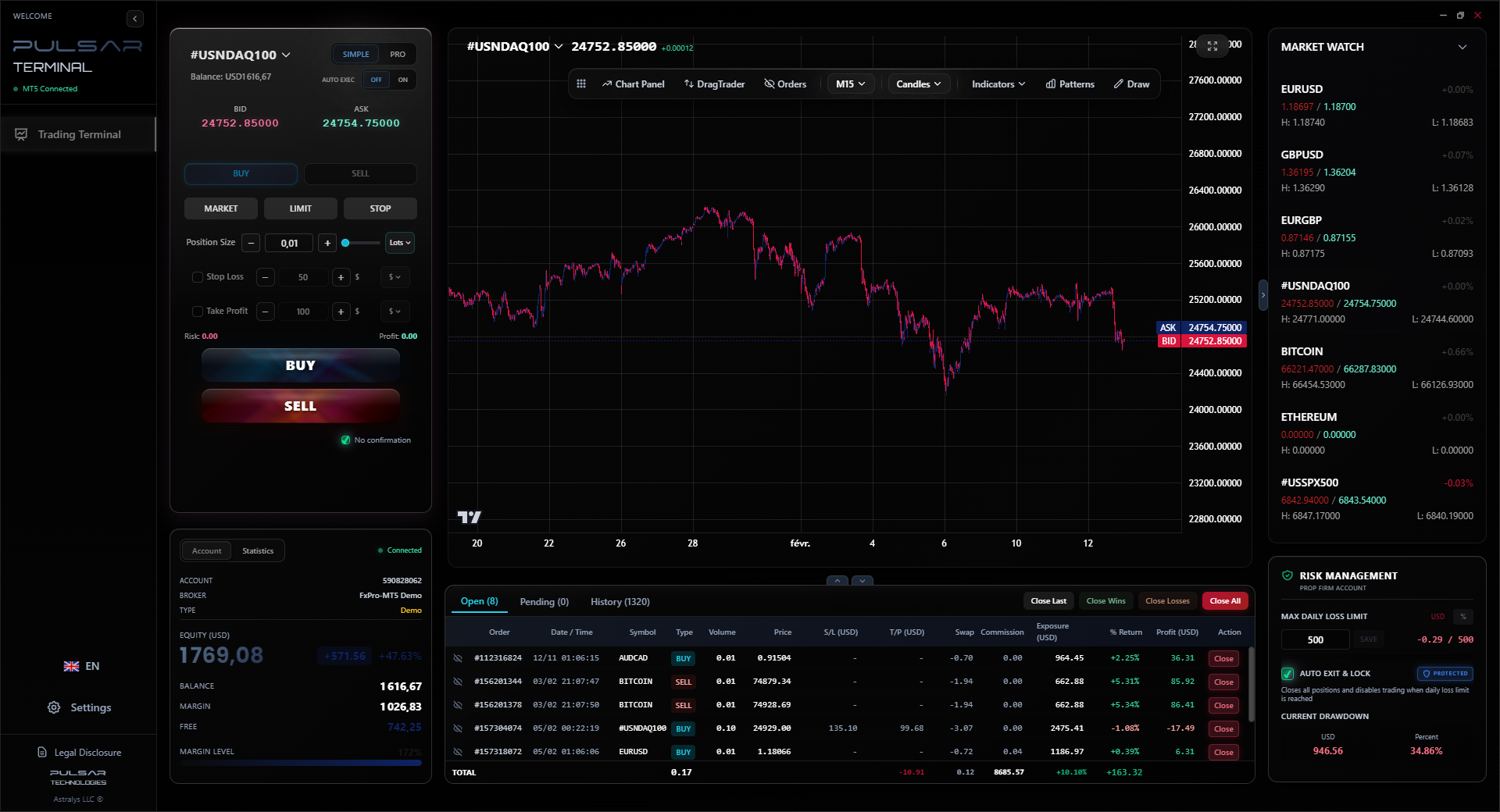
MT4 and MT5 are ubiquitous for a reason. They're strong and support automated trading. But the real edge often comes from the tools around them. This is where a platform like Pulsar Terminal, which integrates directly with MT5, changes the game for managing trades efficiently on our local brokers.
“Demo trading lacks emotional stakes. You need to learn to lose with very small money.”
Trading psychology is universal, but I believe it's tested more severely in South Africa. Economic pressure is real. The temptation to turn a R10,000 account into a R100,000 account overnight to solve financial problems is immense. This leads to over-trading and ignoring stops.
I've been there. In 2019, with a tax bill looming, I tried to force profits. I took three oversized trades on XAU/USD (gold) in one week, ignoring my own rules. I lost R15,000 – the exact amount of the tax bill. The irony was painful. The top traders have separated their trading capital from their life expenses. Their trading account is not an ATM; it's a business fund.
Another local psychological trap is 'FOMO' driven by social media. Seeing someone post a screenshot of a massive USD/ZAR win can trigger you to jump into a trade you haven't analyzed. You must create a bubble. Mute the noise, focus on your plan, and understand that for every posted win, there are ten unposted losses.
Warning: The 'prop firm challenge' trend is huge here. While it can be a path to larger capital, the psychology is brutal. The daily loss limits force extreme pressure. If you go this route, treat the challenge phase as a paid-for education. The goal isn't just to pass, it's to build a process that works after you pass. Tools that automate daily loss protection are useful here.
There's no shortcut, but there is a sensible path. Here’s the phased approach I wish I had followed.
Phase 1: Education & Simulation (Months 1-6)
- Goal: Learn to lose without losing money.
- Action: Open a demo account with an FSCA broker. Don't chase profit. Practice executing a simple plan. Learn how to place stops, limits, and calculate position size. Understand what the MACD indicator or RSI indicator actually tells you, don't just guess.
- Mistake to Avoid: Jumping to live trading because you had 3 good demo weeks. Demo trading lacks emotional stakes.
Phase 2: Micro-Live Trading (Months 6-12)
- Goal: Learn to lose with very small money.
- Action: Open a live account with the minimum deposit (e.g., $5 with XM, R500 with Khwezi). Trade the smallest possible position size (0.01 lots, or micro lots). Your goal is to make 100 trades with strict adherence to a 1% risk rule. The P&L is irrelevant; the process is everything.
- My Experience: I funded an account with R1,000 at Pepperstone. I only traded 0.01 lots on EUR/USD. For 6 months, my account bounced between R900 and R1,100. It felt pointless, but it drilled in the habit of checking the economic calendar and setting stops without fear.
Phase 3: Scaling the Process (Year 2+)
- Goal: Scale your proven process, not your confidence.
- Action: Only add capital to your account in increments (e.g., add another R10,000) after a defined period of consistent, small profits. Keep a trading journal. Review not just losing trades, but winning trades that broke your rules.
This progression controls for the two biggest destroyers of accounts: ignorance and emotion.
💡 Mẹo của Winston
The market doesn't know your margin. A 100-pip move in USD/ZAR doesn't care if you're trading 0.01 lots or 10 lots. Your job is to ensure you're still in the game after it happens.
“Your net worth is not your trading account balance. Your net worth is your knowledge, your process, and your ability to execute under pressure.”
Forget the flashy "AI" signal services. Build your toolkit around reliability and execution.
| Tool Category | What to Look For | Why It Matters for SA Traders |
|---|---|---|
| Trading Journal | Detailed, with space for screenshots & emotion log. (Spreadsheet or dedicated software). | Objectivity. You'll see if you're better on ZAR pairs or Majors, during London or NY session. |
| Economic Calendar | One that highlights ZAR & SARB events. (TradingView, Forex Factory). | Avoids being caught in volatile local news. |
| Reliable Internet & Power | A good UPS/Inverter is a trading cost, not an optional extra. | Load-shedding during a live trade is an unacceptable risk. |
| Advanced Trade Management | Tools that work on MT4/MT5 for partial closes, trailing stops, breakeven. | Manages risk actively. Manually moving stops is slow and emotional. |
On that last point, this is where modern tools separate themselves. Manually calculating and moving a trailing stop on three different positions while the market moves is a recipe for a mistake. Automation here isn't cheating; it's professional grade risk management. Having a tool that lets you set a multi-level take-profit or a breakeven trigger with one click saves mental capital and locks in profits systematically.
The best resource is a community of serious traders, not cheerleaders. Find a group (even a small one) where people post their losses and analyses, not just their wins.
Managing complex trades on volatile pairs like USD/ZAR requires precision; Pulsar Terminal's drag-and-drop order and multi-TP/SL tools let you execute advanced risk management directly on MT5 without the panic.
Pulsar Terminal
Công cụ MT5 tất-cả-trong-một: đặt lệnh kéo-thả, multi-TP/SL, trailing stop, grid trading, Volume Profile và bảo vệ prop firm. Hơn 1.000 trader sử dụng mỗi ngày.
The image of the top SA forex trader isn't someone staring at charts 18 hours a day. It's someone who has a clear, boring process, protects their capital at all costs, and understands that survival is the first step to success.
They respect the FSCA rules. They've calculated their true costs. They've adapted global strategies to our timezone and our currency's quirks. Most importantly, they've made peace with the fact that this is a probabilistic business. You will have losing months. The goal is to have a system where the winning months outweigh them over time.
I lost a lot of money and time trying to be a hero, trying to find the perfect setup. My turnaround started when I focused on being a good risk manager first, and a 'trader' second. Start there. Manage your spread costs, respect your margin call level, and trade small until your process is ironclad. That's the real, unsexy path to the top.
Pro Tip: Your net worth is not your trading account balance. Your net worth is your knowledge, your process, and your ability to execute under pressure. Focus on growing that, and the account balance will follow.
FAQ
Q1Can I become a full-time forex trader in South Africa?
Yes, it's possible, but it's a terrible initial goal. Aim first to be a consistently profitable part-time trader. The income should be stable and reliable enough over 2-3 years to replace your salary before you even consider going full-time. The tax and administrative burden also increases as it becomes your primary income.
Q2What's the minimum amount I need to start trading forex in SA?
You can technically start with as little as $5 (R90-ish) with some international brokers. But realistically, to trade properly with sensible position sizing and absorb costs, a minimum of R5,000 - R10,000 is more practical. Remember, with a R5,000 account risking 1% per trade, your risk is only R50. This forces discipline.
Q3Are prop trading firms a good way to start in South Africa?
They are a double-edged sword. They offer a path to trade larger capital without risking your own savings upfront. However, their challenge phases have strict rules (daily loss limits, time limits) that can encourage bad, high-pressure trading habits. Only consider them after you have a proven, disciplined strategy on your own live account.
Q4How do I know if a broker is legitimately FSCA regulated?
Don't just trust the broker's website. Go directly to the FSCA's official website (www.fsca.co.za) and use their 'Search for an authorised Financial Services Provider' tool. Enter the broker's name or FSP number. Verify the license category includes 'Over-the-Counter Derivative Provider' (ODP).
Q5Which is better for SA traders, MT4 or MT5?
For pure forex, MT4 is simpler and perfectly adequate. MT5 offers more timeframes, more order types, and built-in economic calendar features. Most local FSCA brokers now offer MT5. If you plan to trade other instruments like stocks or commodities offered by your broker in the future, MT5 is the more future-proof choice.
Q6Why are spreads on USD/ZAR so much wider than on EUR/USD?
USD/ZAR is an exotic currency pair with lower liquidity and higher volatility. Fewer banks and institutions make a market in it compared to a major like EUR/USD. The wider spread (e.g., 5 pips vs. 0.8 pips) is the broker's compensation for taking on the higher risk of facilitating that trade.
Q7How do top SA traders handle load-shedding?
They treat it as a critical business risk. Solutions include: a reliable UPS for short gaps, an inverter/battery system for longer periods, a mobile internet router (LTE/5G) as a backup, and most importantly, they avoid holding sensitive positions during known load-shedding schedules. Some use guaranteed stop-loss orders during these times (if offered by their broker).
Bài học của Prof. Winston
Điểm chính:
- ✓FSCA 30:1 use is a risk-management tool, not a barrier.
- ✓True costs include swap, conversion fees, and spread.
- ✓Trade ZAR pairs for swing moves, not scalps.
- ✓Separate trading capital from life expenses absolutely.
- ✓Scale your process, never your confidence.
Bài viết này hữu ích thế nào?
Nhấp vào ngôi sao để đánh giá
Nhận định giao dịch hàng tuần
Phân tích & chiến lược miễn phí hàng tuần. Không spam.
Về tác giả
David van der Merwe
Nhà giao dịch Thị trường Mới nổi
Trader tại Johannesburg với 11 năm kinh nghiệm về tiền tệ thị trường mới nổi. Chuyên về cặp ZAR, giao dịch theo quy định FSCA và phân tích thị trường Nam Phi.
Bình luận
Cảnh báo rủi ro
Giao dịch các công cụ tài chính tiềm ẩn rủi ro đáng kể và có thể không phù hợp với tất cả nhà đầu tư. Hiệu suất trong quá khứ không đảm bảo kết quả trong tương lai. Nội dung này chỉ mang tính chất giáo dục và không nên được coi là lời khuyên đầu tư. Hãy luôn tự nghiên cứu trước khi giao dịch.
Bạn cũng có thể thích

Cara Trading Forex Sukses: 7 Prinsip dari Trader Profesional
Cara trading forex sukses dengan 7 prinsip trader pro: manajemen modal, disiplin, journal trading, backtest. Data nyata, bukan janji profit palsu.
Jam Trading Forex Terbaik untuk Trader Indonesia: Panduan Lengkap dengan Tabel Waktu
Panduan jam trading forex untuk trader Indonesia. Tabel 4 sesi dunia, jam emas 20:00-00:00, sesi mana yang harus dihindari. Data akurat + tips dari trader berpengalaman.
Top 5 Sàn Forex Uy Tín Nhất 2026: Review Jujur dari Trader Indonesia
Top 5 sàn forex uy tín 2026 untuk trader Indonesia. Review jujur: spread, deposit, withdraw, dukungan lokal. Exness, XM, IC Markets & lebih.
Tải Pulsar Terminal
Tất cả các công cụ tính này được tích hợp trong Pulsar Terminal với dữ liệu thời gian thực từ tài khoản MT5 của bạn.
Tải Pulsar Terminal