


You're looking at TradeLocker prop firms and wondering if this is your ticket to trading with serious capital.

James Mitchell
Chuyên gia Phân tích Giao dịch Cao cấp
☕ 9 phút đọc
Bạn sẽ học được:
- 1What Exactly is a TradeLocker Prop Firm?
- 2How the Funding Challenge Actually Works (The Math)
- 3The 3 Rules That Blow Up Most Traders
- 4Realistic Strategies for Passing the Challenge
- 5How to Vet a TradeLocker Prop Firm (Checklist)
- 6What Happens After You Get Funded?
- 7Is This The Only Path? Honest Alternatives.
- 8The Final Verdict: Should You Do It?

You're looking at TradeLocker prop firms and wondering if this is your ticket to trading with serious capital. Maybe you've seen the ads: "Pass our challenge, get a $100k account." It sounds like a dream, right? I thought so too, back in the day. After 12 years and watching hundreds of traders try this path, I can tell you the dream is real for a tiny few and a very expensive lesson for most. Let's cut through the hype. This isn't about getting rich quick. It's about understanding a specific, high-stakes game with its own rulebook.
First, let's clear up the confusion. A "TradeLocker prop firm" isn't one single company. It's a category. These are proprietary trading firms that use the TradeLocker platform as their designated trading terminal. Instead of giving you MetaTrader 4 or 5, they require you to trade exclusively on TradeLocker.
Think of TradeLocker as the playing field. The prop firm owns the field, sets the rules, and provides the capital. You're the player trying to score without getting penalized. Firms like The5ers, BluFX, and others have built their evaluation and funded account programs directly on this platform. Their entire rule set - profit targets, drawdown limits, restricted instruments - is enforced through the TradeLocker interface.
Why does this matter? Because your entire trading experience is filtered through this one platform. Your strategy, your order execution, even how you manage risk, must work within TradeLocker's specific tools and quirks. It's not better or worse than MT5 inherently, but it's different. And in trading, unfamiliarity is a risk you pay for.

Warning: Don't assume skills from MT4/5 directly transfer. Spend a week on a TradeLocker demo just learning where buttons are before you risk a cent on an evaluation.
The standard model is a two-phase evaluation. You pay a one-time fee - let's say $299 for a $50,000 account challenge. This fee is your buy-in, and you don't get it back. It's gone, whether you pass or fail.
Phase 1: The Profit Hurdle
Your goal is to hit a profit target, usually 8-10%, without violating the daily or maximum drawdown rules. For a $50k account, that's $4,000 to $5,000. Sounds achievable? It is, technically. But the drawdown is the killer. It's often calculated as a trailing drawdown from your account's highest equity point. If you hit $52,000, your drawdown line might trail up to $50,800. One bad trade can wipe out days of work.
Phase 2: The Consistency Test
After passing Phase 1, you enter a second, usually shorter, phase with another smaller profit target (e.g., 5%). The rules are similar, but the pressure is immense because you're so close.
Here's the brutal truth most firms don't highlight: Their business model is profitable because most traders fail. The challenge fees from failures fund the payouts to the few winners. It's a statistical game, and you're the variable. I failed my first two challenges years ago, blowing $550 in fees, because I treated it like my personal account. I didn't respect the unique, rigid rules.

Example: A $50k challenge with 10% target ($5k profit) and 5% max drawdown ($2,500). If your equity peaks at $52,000, your max loss point is now $49,400 ($52,000 - $2,500). That trailing rule silently tightens your leash.

💡 Mẹo của Winston
The challenge fee is a sunk cost. The moment you pay it, that money is gone. Trade the account as if it's already a funded $50k, not as if you're trying to win back your $299.
“You can be in profit overall but still get a margin call because your drawdown limit trailed into your open trades.”
Forget the profit target for a second. These are the real assassins.
-
Trailing Drawdown: This is the #1 account killer. It's a sneaky risk manager that creeps up behind you. Every time your balance hits a new high, the floor for your maximum loss rises. It actively punishes you for being successful by reducing your available risk buffer. You can be in profit overall but still get a margin call because your drawdown limit trailed into your open trades.
-
Daily Loss Limits: Many firms have a separate, smaller daily drawdown (e.g., 2-3%). Have two bad trades in a day? You're out, even if you're miles from your overall max drawdown. This forces hyper-conservative trading after any loss, which can lead to missing good setups.
-
Time Limits: Some challenges must be completed within 30 days. This creates psychological pressure to "make things happen," which is the exact opposite of disciplined trading. You start forcing trades that aren't there.
I learned about trailing drawdown the hard way. On a $100k sim challenge, I was up $3,200. Got cocky, took a large position on GBP/USD without a tight stop. The trade went south 15 pips, but because my equity high had moved, that loss violated the trailing drawdown. I was "liquidated" while still being $2,100 in the green on the overall account. The platform doesn't care about your net profit, only its rule. That lesson was cheaper in sim than with real fee money. Understanding your margin call mechanics is non-negotiable here.

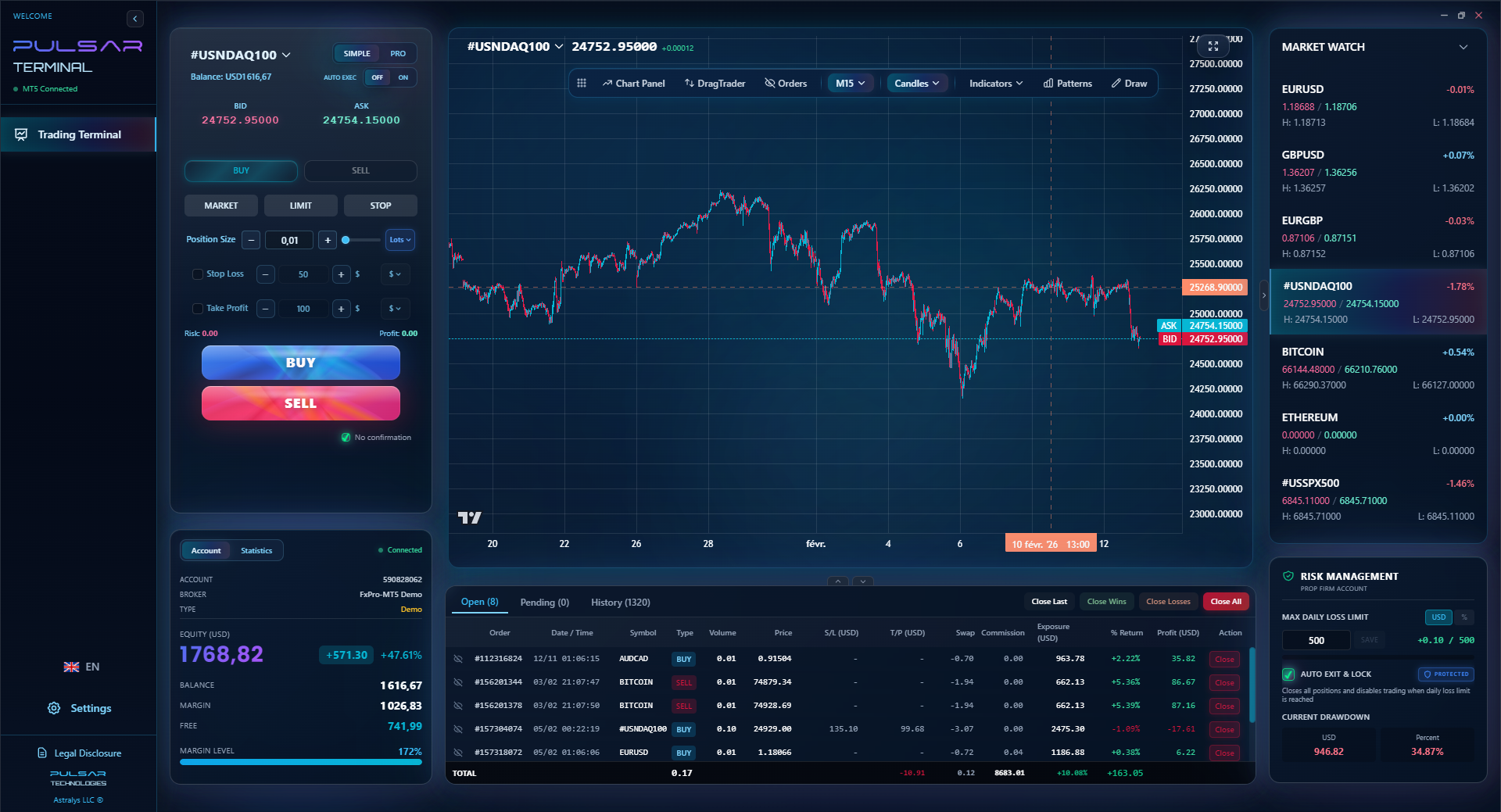
Managing a prop firm's trailing drawdown and daily loss limits manually is a nightmare; Pulsar Terminal automates these protections directly on your MT5, so you can focus on trading, not rule-keeping.
Pulsar Terminal
Công cụ MT5 tất-cả-trong-một: đặt lệnh kéo-thả, multi-TP/SL, trailing stop, grid trading, Volume Profile và bảo vệ prop firm. Hơn 1.000 trader sử dụng mỗi ngày.
You need a strategy built for survival, not heroics. Forget scalping 20 times a day. The spread costs and volatility will eat you alive with the tight drawdowns.
Focus on Higher Timeframe Swing Trades. This is the most consistent path I've seen work. Look for 1-3 high-probability setups per week on the 4-hour or daily charts. Use the MACD indicator or RSI indicator for confluence, but keep it simple. The goal is to catch moves of 50-100 pips, not 10.
Risk Management is Your Strategy. Your position size is everything. You should never risk more than 0.5% of the account's starting balance on a single trade. For a $50k account, that's $250. With a 20-pip stop loss, that dictates your lot size. Use a position size calculator religiously. Every. Single. Time.
Instrument Selection: Stick to major forex pairs like EUR/USD or indices. Avoid exotic pairs, crypto, and even XAU/USD (gold) unless you're exceptionally experienced with it. The spreads and gaps are challenge-killers.

Pro Tip: Your first 5 trades in a challenge should be half your normal size. You need to build a buffer of profit first to raise your trailing drawdown floor. Only then can you breathe slightly.
💡 Mẹo của Winston
Your best edge in a prop challenge is patience. The market doesn't owe you a trade today. Wait for the 2-3 A+ setups per week that align perfectly with your plan. Forcing B- setups is the fastest path to failure.

“The prop firm challenge is a high-pressure filter. It's excellent for traders who thrive under strict, external constraints.”
Not all firms are created equal. Your due diligence is critical.
| Feature | What to Look For | Red Flag |
|---|---|---|
| Profit Split | 80% or higher to you once funded. | Anything below 70%. |
| Payout Frequency | Monthly or bi-weekly. Reliable history. | "Upon request" or vague terms. |
| Drawdown Type | Clearly stated. Static (from starting balance) is best. | Hidden trailing rules or "from equity peak" without clarity. |
| Scaling Plan | Clear rules for growing your account after consistent profits. | No scaling plan mentioned. |
| Reviews | Independent reviews on sites like Trustpilot, not just testimonials. | All reviews on their own site. |
Also, check their supported brokers for execution. Some firms use Exness or IC Markets for their raw spreads, while others have in-house liquidity. Test their customer support with a question before you buy. If they're slow or unhelpful now, imagine when you have a withdrawal question.
I made the mistake of jumping on a firm with a "cheap" challenge fee without checking payout reviews. Colleague of mine passed, made $8k in profit, and then waited 11 weeks for his first payout due to "processing delays." The fee is irrelevant if you never get paid.

You passed. Congrats. Now the real work begins, and the psychology shifts dramatically.
You're no longer trading to hit a target. You're trading to earn a consistent income without losing the golden ticket. The pressure can be worse. The firm's rules still apply, but now real money is on the line - well, their money, your share of it.
The first month is critical. I'd advise trading at 50% of the risk you used in the challenge. Your goal is not to maximize returns but to prove consistency and get that first payout in your bank account. That first payout is a massive psychological win. It transforms the model from a theoretical promise to a real business.
Remember, most firms have a first-payout threshold (e.g., you must reach $1,000 in profit to request a withdrawal). Plan your trading to reach that efficiently but safely. This is where a true swing trading mindset pays off. You're managing a business, not chasing adrenaline.
💡 Mẹo của Winston
Before you even look at a chart for a challenge, know your exact exit points. Your stop-loss and take-profit should be defined by the chart, not by how much you 'need' to make to hit the target.

“Most traders blow up because they forget they're playing a game with someone else's rulebook.”
TradeLocker prop firms are one route. Before you commit, ask yourself if it's the right one for your personality.
The Alternative: Build Your Own Capital. This is slower but has zero external rules. If you have a $10,000 account and can consistently make 3-5% per month, you're building real wealth with 100% of the profits. It requires extreme discipline, but you are the sole master of your rules. Many top traders I know skipped prop firms entirely and just grew their own accounts slowly, using brokers like Pepperstone or XM for execution.
The Alternative: Different Prop Models. Some firms use more traditional platforms like MT5 with simpler, static drawdown rules. Others offer instant funding with no challenge but take a larger profit cut. These might suit a different trading style better.
The prop firm challenge is a high-pressure filter. It's excellent for traders who thrive under strict, external constraints. It's a nightmare for undisciplined or emotionally-driven traders. Be brutally honest with yourself about which category you're in.

Here's my straight take after over a decade: TradeLocker prop firms are a legitimate tool, but they are a test, not a funding solution.
Do the challenge IF:
- You have a proven, documented strategy with at least 6 months of profitable demo/small live results.
- You are psychologically cool under rule-based pressure.
- You can afford to lose the challenge fee without it affecting your life.
- You've practiced extensively on a TradeLocker demo.
Avoid it IF:
- You're using it as a last-ditch effort to "make it big."
- You don't understand the math of trailing drawdown.
- You can't control your position sizing.
- You think passing the challenge is the finish line (it's the starting line).
It's a business arrangement. Treat it like one. Do the math, manage the risk, and have a plan for both passing and failing. The firms have their edge built into the rules. Your only counter is stricter discipline. Most traders blow up because they forget they're playing a game with someone else's rulebook. Don't be one of them.
FAQ
Q1Can US traders join TradeLocker prop firms?
Yes, but your options are more limited due to US regulations. You must carefully check each firm's terms to see if they explicitly accept US residents. Do not assume. The legal entity offering the service and their supported brokers must be compliant with US rules, which many international firms are not.
Q2What's the main advantage of TradeLocker over MT5 for prop firms?
Control. TradeLocker allows the prop firm to deeply embed their specific rules (drawdown, daily loss, restricted symbols) directly into the trading interface. It's harder for a trader to "game" or misunderstand the rules because the platform can enforce them in real-time, sometimes automatically closing trades.
Q3How much do I need to start?
You need the cost of the evaluation fee, which typically ranges from $200 for a $25k account challenge to $600+ for a $200k challenge. You do not need additional trading capital - the firm provides the simulated capital for the challenge. Just be prepared to lose the fee.
Q4Is the profit from a funded account considered taxable income?
Yes. In the United States, any profit share you receive is considered ordinary income. You will receive a 1099 form from the prop firm (if they are US-based) or must report the income yourself if international. Consult a tax professional.
Q5Can I use Expert Advisors (EAs) or copy trading?
Almost always, no. Most TradeLocker prop firm challenges explicitly forbid the use of automated systems, copy trading, or any form of trade duplication. They are evaluating your discretionary skill. Using an EA is grounds for immediate failure and forfeiture of your fee.
Q6What happens if I break a rule by accident?
The platform or firm's compliance team will usually close your challenge account immediately. There is typically no warning, reset, or refund. The rules are automated and binary. This is why understanding every single rule before you place your first trade is non-negotiable.
Q7Are there any hidden fees?
Read the terms. Some firms charge a small monthly platform fee for the funded account (e.g., $20-$30). Others might have withdrawal fees. The reputable ones are transparent about all costs upfront. The "hidden" cost is often the spread; some firms use wider spreads as part of their revenue model, which silently hurts your performance.
Bài học của Prof. Winston
Điểm chính:
- ✓Trailing drawdown is the #1 account killer (punishes success).
- ✓Never risk >0.5% of starting balance per trade.
- ✓The challenge fee is a sunk cost, not an investment.
- ✓Passing the challenge is just the starting line.
Bài viết này hữu ích thế nào?
Nhấp vào ngôi sao để đánh giá
Nhận định giao dịch hàng tuần
Phân tích & chiến lược miễn phí hàng tuần. Không spam.
Về tác giả
James Mitchell
Chuyên gia Phân tích Giao dịch Cao cấp
Hoạt động tại New York với hơn 9 năm kinh nghiệm giao dịch. Tập trung vào các cặp USD chính, thử thách prop firm và bối cảnh pháp lý tại Mỹ.
Bình luận
Cảnh báo rủi ro
Giao dịch các công cụ tài chính tiềm ẩn rủi ro đáng kể và có thể không phù hợp với tất cả nhà đầu tư. Hiệu suất trong quá khứ không đảm bảo kết quả trong tương lai. Nội dung này chỉ mang tính chất giáo dục và không nên được coi là lời khuyên đầu tư. Hãy luôn tự nghiên cứu trước khi giao dịch.
Bạn cũng có thể thích

Cara Trading Forex Sukses: 7 Prinsip dari Trader Profesional
Cara trading forex sukses dengan 7 prinsip trader pro: manajemen modal, disiplin, journal trading, backtest. Data nyata, bukan janji profit palsu.
Jam Trading Forex Terbaik untuk Trader Indonesia: Panduan Lengkap dengan Tabel Waktu
Panduan jam trading forex untuk trader Indonesia. Tabel 4 sesi dunia, jam emas 20:00-00:00, sesi mana yang harus dihindari. Data akurat + tips dari trader berpengalaman.
Top 5 Sàn Forex Uy Tín Nhất 2026: Review Jujur dari Trader Indonesia
Top 5 sàn forex uy tín 2026 untuk trader Indonesia. Review jujur: spread, deposit, withdraw, dukungan lokal. Exness, XM, IC Markets & lebih.
Tải Pulsar Terminal
Tất cả các công cụ tính này được tích hợp trong Pulsar Terminal với dữ liệu thời gian thực từ tài khoản MT5 của bạn.
Tải Pulsar Terminal