


Most articles about types of forex traders are useless fluff written by people who've never placed a real trade.

Olumide Adeyemi
Nhà tiên phong Giao dịch Tây Phi ·  Nigeria
☕ 9 phút đọc
Bạn sẽ học được:
- 1The Myth of the 'Perfect' Style
- 2The Scalper (The Nigerian Reality)
- 3The Day Trader (The Most Common Mislabel)
- 4The Swing Trader (The Nigerian Sweet Spot?)
- 5The Position Trader (The Capital King)
- 6The Algo/Copy Trader (The Local Trap)
- 7How to Find Your *Actual* Style (A Practical Test)
- 8The Only Type That Consistently Wins: The Adaptive Hybrid

Most articles about types of forex traders are useless fluff written by people who've never placed a real trade. They'll tell you about 'scalpers' and 'swing traders' like it's a personality quiz, completely ignoring the brutal reality of trading with a Nigerian broker, Naira volatility, and power outages. I've trained hundreds of traders from Lagos to Abuja, and I can tell you most of you are picking the wrong style for your personality and bankroll. This isn't about labels, it's about survival. Let's cut the nonsense and look at what these styles actually mean when your profit is in Naira and your spread is 3 pips on a good day.
The first mistake I see every new Nigerian trader make is obsessing over finding the 'right' type of trading. They watch a YouTube video about a London scalper and try to copy it with a $100 account and a 2-second delay on their Glo mobile data. It's a recipe for blowing up. Your trading style isn't a fashion choice, it's a forced marriage between your capital, your psychology, your schedule, and your local market conditions.
For instance, trying to be a pure news trader when your broker's economic calendar is on GMT and your execution slows to a crawl during CBN announcements? That's not trading, that's donating. I learned this the hard way early on. I tried to scalping strategy EUR/NGN during European open, only to get slaughtered by insane spreads and requotes from my local broker. I lost over 40,000 Naira in two days before I admitted my style didn't fit my tools.
The truth is, the classic 'types of forex traders' framework needs a Nigerian reality check. Let's break down what these categories mean when you're trading from here.
What They Say It Is
Quick, small trades held for seconds to minutes, aiming for 5-10 pips. It's high-frequency, requires intense focus.
What It Actually Is in Nigeria
A battle against your broker's infrastructure. If you're with a broker that has a local office but terrible execution (you know the ones), scalping is nearly impossible. You need a razor-thin spread definition, instant execution, and rock-solid internet. That means using a top-tier international broker like IC Markets review or Pepperstone review with a true ECN account. Even then, factor in the cost of a dedicated, uninterrupted power supply (UPS/inverter) and premium fibre internet. Your profit target isn't just 5 pips, it's 5 pips after covering the higher spread and accounting for potential slippage.

Warning: Trying to scalp with a standard account from a broker with wide spreads is a guaranteed way to turn your capital into brokerage fees. I've seen traders lose more on spreads than on losing trades.
Who It's Really For
The disciplined, well-funded trader with excellent tech setup who can sit for hours without distraction. Not for the guy trading on his phone between meetings at work.

💡 Mẹo của Winston
Your trading style is a pair of shoes. If it doesn't fit perfectly, you'll get blisters with every step. Don't wear the fancy ones just for show.

“Trying to scalp with a standard account from a broker with wide spreads is a guaranteed way to turn your capital into brokerage fees.”
This is where I find most Nigerian traders think they are, but they're actually just impatient swing traders. A true day trader closes all positions before the session ends, taking no overnight risk. This avoids swap charges, which can be unpredictable on exotics involving Naira.
You need a clear session focus. Are you trading the London overlap (1 pm - 4 pm Nigerian time)? That's often the best volatility for majors like EUR/USD guide. Your tools are intraday charts (1-hour, 15-minute), and momentum indicators like the RSI indicator and MACD indicator.
The biggest pitfall here is turning a day trade into a 'hope trade' that you hold for days because it's against you. I once bought GBP/USD at 1.3050 aiming for a 30-pip day trade. It dropped 20 pips, I didn't cut it, and I held it for a week trying to break even, eventually taking a 45-pip loss. That's not day trading, that's failed day trading. Use a strict daily loss limit.

Pro Tip: If you're day trading, set a physical alarm for 30 minutes before your session closes. That's your 'close out' warning. No exceptions.

Swing trading, holding trades for days to weeks, is often touted as the ideal style for those with full-time jobs. There's some truth to that. You don't need to stare at screens all day. You analyse on weekends or evenings, set your orders, and manage them with stop losses.
For the Nigerian trader, the huge advantage is sidestepping the intraday execution woes. A 2-pip spread matters less when you're aiming for a 150-pip move. You can focus on higher timeframes (4-hour, Daily) where chart patterns are clearer and less noisy.
However, it requires immense patience and a larger stop-loss buffer, which means proper position size calculator use is non-negotiable. You also must understand carry trade and swap rates, especially if you're holding over weekends. A long position on a high-interest rate currency pair could actually earn you a small daily credit.
I find this style works well for trading instruments like XAU/USD guide (Gold), which often has clearer multi-day trends than major forex pairs. The psychological challenge is sitting through drawdown. Your trade will go red before it goes green, and you can't panic and close it because you checked it on your phone at lunch.
swing trading is a marathon, not a sprint. It fits many Nigerian lifestyles, but not all Nigerian temperaments.
“The most consistently profitable traders I know in Nigeria don't fit neatly into one box. They are Hybrids.”
This is the big leagues. Trades last for months, even years, based on long-term fundamental trends. Think: trading the multi-year trend of a strong USD against a commodity currency.
Let's be blunt: This style is almost impossible for the average Nigerian retail trader with a small account. Why? Margin requirements. Holding a position for months requires you to have enough capital not to get wiped out by a 500-pip counter-trend move. The use that makes short-term trading possible here becomes a deadly enemy in position trading. A margin call is almost a certainty if you're over-leveraged on a long-term view.
It also requires a deep understanding of global macroeconomics, interest rate cycles, and geopolitics. Are you genuinely analysing Federal Reserve meeting minutes, or are you just following a Twitter guru? This style is less about technical chart patterns and more about fundamental conviction. Unless you have a six-figure dollar account (not Naira), I'd advise you to admire this style from afar but not try to live in it.
💡 Mẹo của Winston
The market doesn't care what type of trader you call yourself. It only cares if your buy and sell orders are in the right place.

This has exploded in popularity. The promise is simple: set up an Expert Advisor (EA) or copy a 'master trader' and let the money roll in while you sleep.
Here's the Nigerian catch: Most profitable EAs are built for specific, stable market conditions and low-latency execution. Our power fluctuations and internet instability can cause the EA to freeze, miss orders, or go haywire. I had a student run a grid trading EA on a USD/NGN pair. It worked for two weeks, then a sudden CBN announcement caused a massive gap. The EA kept placing orders into the void, and he woke up to a margin call on his Exness review account. Loss: $1,200.
Copy trading is another minefield. You're often copying someone trading with different capital, different risk tolerance, and in a different time zone. The 'master' might close a trade at breakeven, but due to your slippage and spread, you close at a loss. You have zero control or understanding. It's the ultimate 'lazy trader' fantasy, and the market loves taking money from the lazy.

Example: You copy a trader with a $10,000 account who risks 2% ($200) per trade. You have a $500 account. When they enter a trade, your platform copies the position size proportionally. But if the trade has a 20-pip stop loss, the master can withstand the noise. On your Nigerian broker connection, a 25-pip spike due to poor liquidity can knock you out first, even though the 'master' trade goes on to win.
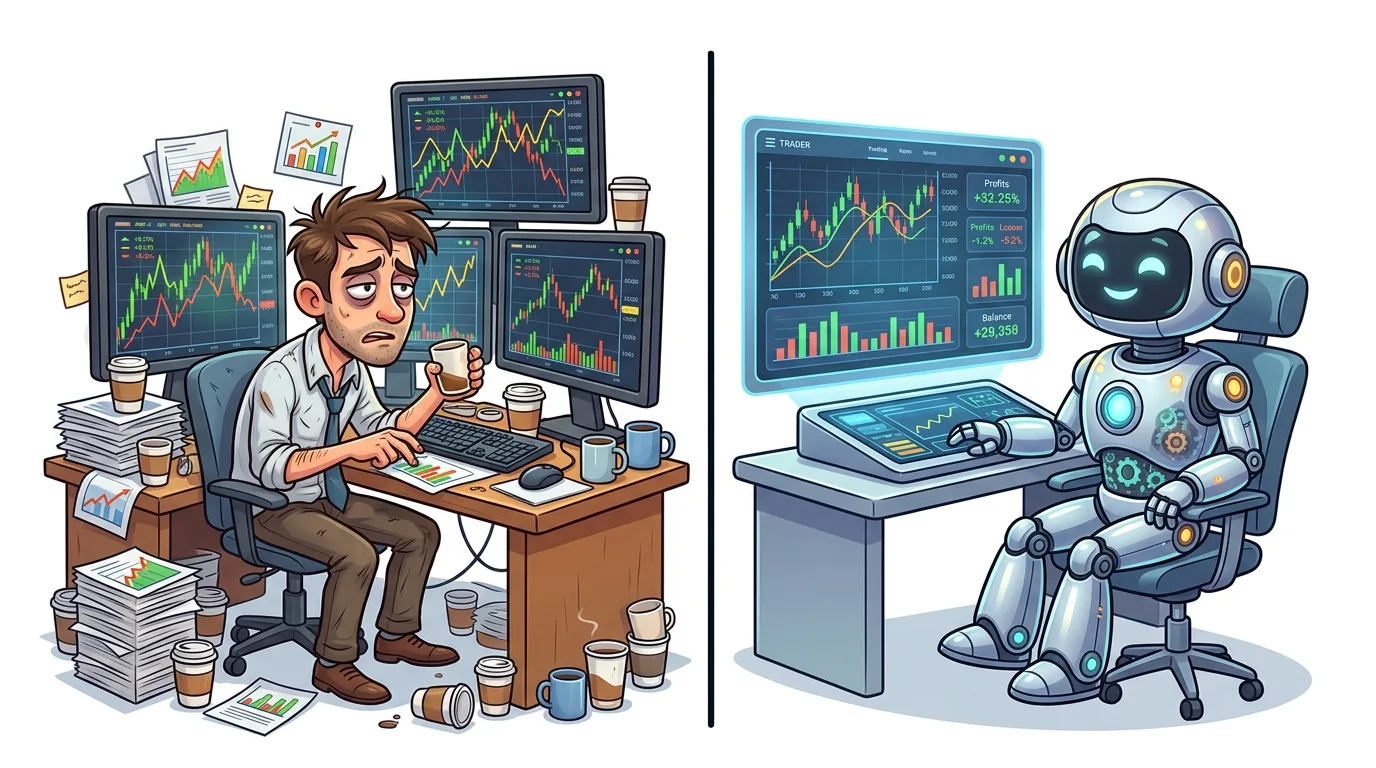
“If you're constantly fighting your own instincts, the style is wrong.”
Forget quizzes. Do this instead for the next month:
- Track Your Natural Patience: On a demo account, place 10 trades with a pre-defined plan. Note how many times you itch to close the trade before your target or stop is hit. If it's more than 7 times, you're not a swing trader.
- Audit Your Tech & Time: Be brutally honest. Do you have 2 hours of uninterrupted, high-speed internet time daily? Yes -> Consider day trading. No -> Swing trading is your only viable path.
- Test Your Risk Tolerance: Risk a real, but small, amount of money you can afford to lose (e.g., 5,000 Naira). Use a strict 1% risk rule. The physical feeling in your gut when that trade goes 1% against you will tell you everything. If you feel sick, you need a lower-frequency style with wider stops.
- Match Style to Instrument: Don't force one style on all pairs. Maybe you scalp EUR/USD guide during London open, but you swing trade gold (XAU/USD guide). That's perfectly fine. You are not a scalper. You are a trader who uses scalping sometimes.
The goal is to build a style that feels less like a struggle and more like a disciplined process. It should fit you so well that following your rules is easier than breaking them.
After 12 years, I'll tell you the dirty secret: the most consistently profitable traders I know in Nigeria don't fit neatly into one box. They are Hybrids.
They have a core, default style - usually swing or day trading - that makes up 70-80% of their activity. This is their bread and butter, their disciplined process. But they leave a 20-30% bandwidth for opportunistic trades that fall outside this style.
For example:
- Core Style: 4-hour chart swing trading, 2-3 trades per week.
- Opportunistic Play: They see a perfect, tight setup on the 5-minute chart during high liquidity. They'll take a quick scalp, risking a tiny 0.5% of capital, for a fast 15-pip gain. Then they go back to waiting for their swing setups.
The key is that the opportunistic trades are defined by rule, not by emotion. They have a specific, written-down criteria for when they can 'break' their main style. This prevents them from becoming reckless gamblers. They use tools that allow them to switch contexts quickly, managing different timeframes and order types without confusion.
This adaptability is what allows you to survive when the market changes character, which it does constantly. The rigid scalper gets wiped out in a low-volatility range. The rigid position trader gets shredded in a choppy, news-driven market. The Hybrid survives, because they have more than one tool in the box. They understand all the [types of forex traders] approaches, but are enslaved by none.
💡 Mẹo của Winston
A 'Hybrid' trader isn't confused. They're multilingual. They can speak the language of the 1-minute chart and the weekly chart. That's a powerful skill.
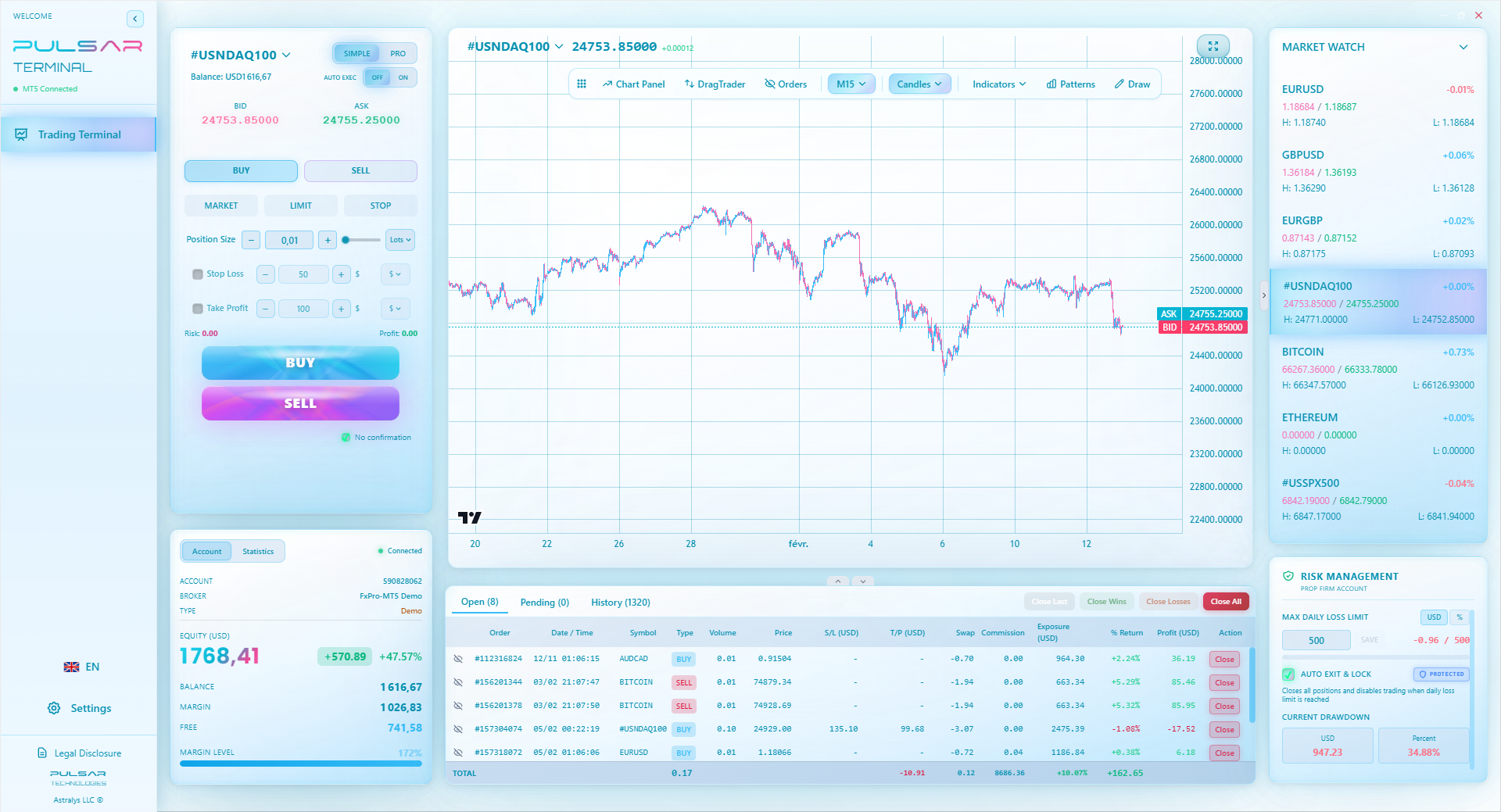
Managing multiple trade types and timeframes like a true Hybrid trader requires a terminal that can keep up, which is where tools like Pulsar Terminal for MT5 excel.
Pulsar Terminal
Công cụ MT5 tất-cả-trong-một: đặt lệnh kéo-thả, multi-TP/SL, trailing stop, grid trading, Volume Profile và bảo vệ prop firm. Hơn 1.000 trader sử dụng mỗi ngày.
FAQ
Q1I have a full-time job in Lagos, which type of forex trader should I be?
Almost certainly a swing trader. Day trading and scalping require screen time you likely don't have. Focus on the 4-hour and daily charts. Do your analysis on Sunday evening, set your entry orders, stop-loss, and take-profit for the week, and then just monitor briefly in the evenings. Trying to trade during work breaks with poor internet is a guaranteed path to losses.
Q2What is the best trading style for a small account (under $500)?
You have no room for error. Scalping is out - spreads will eat you. Position trading is out - you lack the margin. Your best bet is higher-timeframe swing trading (4H/Daily) on a major pair with tight spreads, aiming for larger moves (50+ pips) so the spread cost is minimal relative to profit. You must use a position size calculator religiously. Risk no more than 1% ($5) per trade. This style requires patience, which is the one free asset you have.
Q3Is copy trading a good way to start for a Nigerian beginner?
It's one of the worst ways. You learn nothing and give up all control. The performance you see is rarely what you get due to slippage, different account sizes, and time delays. You're better off losing a small amount of your own money while actually learning, than losing a larger amount by blindly following someone else. Start with a demo, then a very small live account where you make every decision yourself.
Q4How do I know if my trading style is wrong?
You'll feel constant stress and frustration. You'll break your own rules regularly because they 'don't feel right.' Your trading journal (you are keeping one, right?) will show a string of losses from the same mistakes: closing winners too early if you're impatient, or letting losers run if you're too passive. If you're constantly fighting your own instincts, the style is wrong. Your style should be a framework that channels your natural tendencies productively.
Q5Can I be a profitable scalper in Nigeria with our internet?
Yes, but the barrier to entry is high. You need: 1) A true ECN/RAW account from a top-tier international broker like IC Markets or Pepperstone. 2) Fibre-to-the-home internet (not just 'broadband') with a UPS backup. 3) A powerful computer, not a phone. 4) The discipline to trade only during peak liquidity hours (London/New York overlap). If you can't check all these boxes, scalping will be an uphill battle you'll probably lose.
Q6What's the biggest mistake when choosing a trading style?
Choosing based on greed or a fantasy. Picking scalping because you want to get rich quick. Picking position trading because it seems 'easier' (it's not). Your choice must be a cold, hard assessment of your real-life resources: time, capital, technology, and emotional temperament. Ignore the YouTube 'gurus' selling a dream. Be brutally honest with yourself.
Bài học của Prof. Winston
Điểm chính:
- ✓Match style to your real tech & time, not your fantasy.
- ✓Swing trading fits most Nigerian job schedules best.
- ✓Scalping requires elite execution; most local brokers fail.
- ✓Always use a position size calculator, no exceptions.
- ✓Profitable traders are adaptive, not rigid.
Bài viết này hữu ích thế nào?
Nhấp vào ngôi sao để đánh giá
Nhận định giao dịch hàng tuần
Phân tích & chiến lược miễn phí hàng tuần. Không spam.
Về tác giả
Olumide Adeyemi
Nhà tiên phong Giao dịch Tây Phi
Một trong những nhà đào tạo forex tích cực nhất tại Nigeria. 8 năm kinh nghiệm giao dịch từ Lagos. Chuyên về chiến lược vốn thấp và thử thách prop firm dành cho trader châu Phi.
Bình luận
Cảnh báo rủi ro
Giao dịch các công cụ tài chính tiềm ẩn rủi ro đáng kể và có thể không phù hợp với tất cả nhà đầu tư. Hiệu suất trong quá khứ không đảm bảo kết quả trong tương lai. Nội dung này chỉ mang tính chất giáo dục và không nên được coi là lời khuyên đầu tư. Hãy luôn tự nghiên cứu trước khi giao dịch.
Bạn cũng có thể thích

Cara Trading Forex Sukses: 7 Prinsip dari Trader Profesional
Cara trading forex sukses dengan 7 prinsip trader pro: manajemen modal, disiplin, journal trading, backtest. Data nyata, bukan janji profit palsu.
Jam Trading Forex Terbaik untuk Trader Indonesia: Panduan Lengkap dengan Tabel Waktu
Panduan jam trading forex untuk trader Indonesia. Tabel 4 sesi dunia, jam emas 20:00-00:00, sesi mana yang harus dihindari. Data akurat + tips dari trader berpengalaman.
Top 5 Sàn Forex Uy Tín Nhất 2026: Review Jujur dari Trader Indonesia
Top 5 sàn forex uy tín 2026 untuk trader Indonesia. Review jujur: spread, deposit, withdraw, dukungan lokal. Exness, XM, IC Markets & lebih.
Tải Pulsar Terminal
Tất cả các công cụ tính này được tích hợp trong Pulsar Terminal với dữ liệu thời gian thực từ tài khoản MT5 của bạn.
Tải Pulsar Terminal