


You've learned the indicators, you can read a chart, maybe you've even placed a few trades.

Olumide Adeyemi
Nhà tiên phong Giao dịch Tây Phi ·  Nigeria
☕ 8 phút đọc
Bạn sẽ học được:
You've learned the indicators, you can read a chart, maybe you've even placed a few trades. So why is your account still stuck or, worse, blown? If you're a Nigerian trader asking yourself that, I've been there. The brutal truth is that the charts are only half the battle. The real fight, the one that separates the consistent winners from the perpetual 'demo champions,' happens between your ears. To truly unlock your potential with forex trading psychology, you need to understand the unique pressures we face here - from Naira volatility to CBN policies - and build a mindset that can handle it.
Let's get real. The market doesn't care about your rent, your 'side hustle' dreams, or the pressure from your family. It's a cold, impersonal machine. Your psychology is the filter through which you interpret its movements, and that filter gets dirty fast with fear and greed.
I remember my first 'real' trade with $500. EUR/USD was ticking up, my analysis was sound, but the moment it retraced 5 pips, I panicked and closed for a loss. It then rallied 50 pips exactly where I'd planned. That wasn't a market failure; it was a psychological one. I let the sight of a few dollars disappearing override my plan.
Here's the kicker for us in Nigeria: our environment adds extra layers of stress. Seeing the Naira swing wildly on the news (we hit over ₦1,900/$ in 2024!) creates an underlying anxiety about currency value that can bleed into your trading decisions. You might overtrade trying to 'beat' the parallel market rate, or hold losing positions hoping a miracle will solve both your trade and your personal FX problems. That's a dangerous mix.

Warning: Trading to solve urgent financial pressure is a guaranteed path to ruin. The market smells desperation and will take your money. Trade only with risk capital you can truly afford to lose.
The stats don't lie. Globally, a huge majority of retail traders lose - often quoted between 70-90%. The primary cause isn't bad strategy; it's bad psychology. Revenge trading after a loss, fear of missing out (FOMO) on a pump, overriding stops because 'this time it's different.' To unlock your potential with forex trading psychology, you must first admit that you are the most important variable in your trading equation.

💡 Mẹo của Winston
A trader who blames the market, their broker, or 'manipulation' for losses has surrendered control. The first step to improvement is taking 100% responsibility for every outcome.
“The brutal truth is that the charts are only half the battle. The real fight happens between your ears.”
Building a trader's mindset isn't about being a robot. It's about having a system for your emotions before you even log into your platform. Think of this as your pre-flight check.
1. The Reality Check on Costs & Capital
First, know your numbers cold. Trading with a $50 account and 1:500 use isn't a strategy; it's a lottery ticket with a 99% losing rate. Let's use real broker data from our market. On a standard account, the spread on EUR/USD might be 0.9 pips. On a $50 account, that spread cost eats a significant chunk of your margin before the trade even moves. Brokers like XM or Exness offer low minimum deposits, but that doesn't mean it's wise to start there.
My rule? Don't trade a live account with less than $200-300, and even that is tight. Your first goal isn't to buy a car; it's to preserve capital and practice consistency. Always, always use a position size calculator. If you're risking more than 1-2% of your account on a single trade, you're gambling, not trading.
2. The Plan is Your Anchor
Your trading plan is your constitution. It must define:
- Your preferred session (London-New York overlap is great for volatility).
- Your maximum daily loss (e.g., 3%). Hit it? Stop. Full stop.
- Your entry/exit rules. Is it based on a MACD indicator crossover? A support bounce?
Write it down. I keep a physical journal. On days the Naira news is crazy and I feel edgy, I read my plan aloud. It grounds me.

Pro Tip: Your plan should include a 'cool-off' period after a significant loss. Take 24 hours away from the charts. Go for a walk, watch a movie. This breaks the emotional cycle of revenge trading.
3. Embrace the BDC & CBN News Cycle
Recent developments, like the CBN re-admitting BDCs in 2026, affect liquidity and sentiment. Don't ignore this news, but don't let it trigger impulsive trades. See it as context, not a signal. The market's job is to price in this information; your job is to trade the price action that results.
“Trading to solve urgent financial pressure is a guaranteed path to ruin. The market smells desperation.”
Fear and greed aren't abstract concepts. They show up in specific, costly behaviors.
Fear manifests as:
- Moving your stop-loss further away because you're scared of being stopped out. (This turns a small loss into a catastrophic one).
- Closing a winning trade too early because you're terrified the profit will vanish.
- Paralysis: seeing a perfect setup but being unable to pull the trigger.
Greed manifests as:
- Adding to a losing position (averaging down) hoping to break even.
- Letting a winner run into a loss because you got greedy for 'just 10 more pips.'
- Overtrading - taking low-probability setups just to be in the action.
Here's a personal confession: In 2023, I had a beautiful scalping strategy setup on Gold (XAU/USD). I entered at $1815, target $1820. It hit $1819.5 and stalled. Greed whispered, 'It's going to $1825!' I moved my target. It reversed and stopped me out at $1814. I turned a +4.5 pip win into a -1 pip loss. That was 100% greed. I broke my rule for a fantasy.
The antidote? Mechanical rules. Decide your profit target and stop-loss BEFORE you enter. Once set, don't move them unless you're trailing a stop to lock in profit on a strong trend. Tools exist to help with this discipline. For instance, managing multiple take-profit levels manually is stressful; some platforms offer automation for that, letting you stick to the plan.
💡 Mẹo của Winston
Your pre-trade ritual is more important than your analysis. If you start the session emotionally cluttered, you will see patterns that aren't there.
“Discipline sounds boring. It's not. It's freedom from constant stress and regret.”
Discipline sounds boring. It's not. It's freedom. It's the freedom from constant stress and regret. Here’s how to build it in our context.
1. Start with a Ritual: Don't just jump on the PC. Check the economic calendar. Check the Naira rate on the official and parallel markets for context. Do 5 minutes of deep breathing. This signals to your brain that 'trading mode' is starting.
2. Use Technology as a Crutch: You are weak. I am weak. We will break our rules. Use technology to enforce them. Set your stop-loss and take-profit orders EVERY. SINGLE. TIME. No 'mental stops.' They don't work. If you're a swing trading fan, this is non-negotiable.
3. The Weekly Review: Every Sunday, review your trades. Not just the P&L, but why you took them. Did you follow your plan? What emotion was present? This is more important than backtesting. I found 80% of my losses came from trades that deviated from my plan, not from plan failures.
4. Community Wisely: Nigerian trading WhatsApp groups and Telegram channels can be toxic echo chambers of pump-and-dump schemes or endless complaints. Find one focused on psychology and review, not signals. Or better yet, limit your exposure.

Example: Let's say your account is $1,000. Your risk per trade is 1% ($10). On a EUR/USD trade with a 1.5 pip spread and a 15-pip stop-loss, your total risk is 16.5 pips. Your position size should be: $10 / (16.5 pips * $0.10 per pip for a micro lot) = ~6 micro lots. This precise calculation removes emotion.
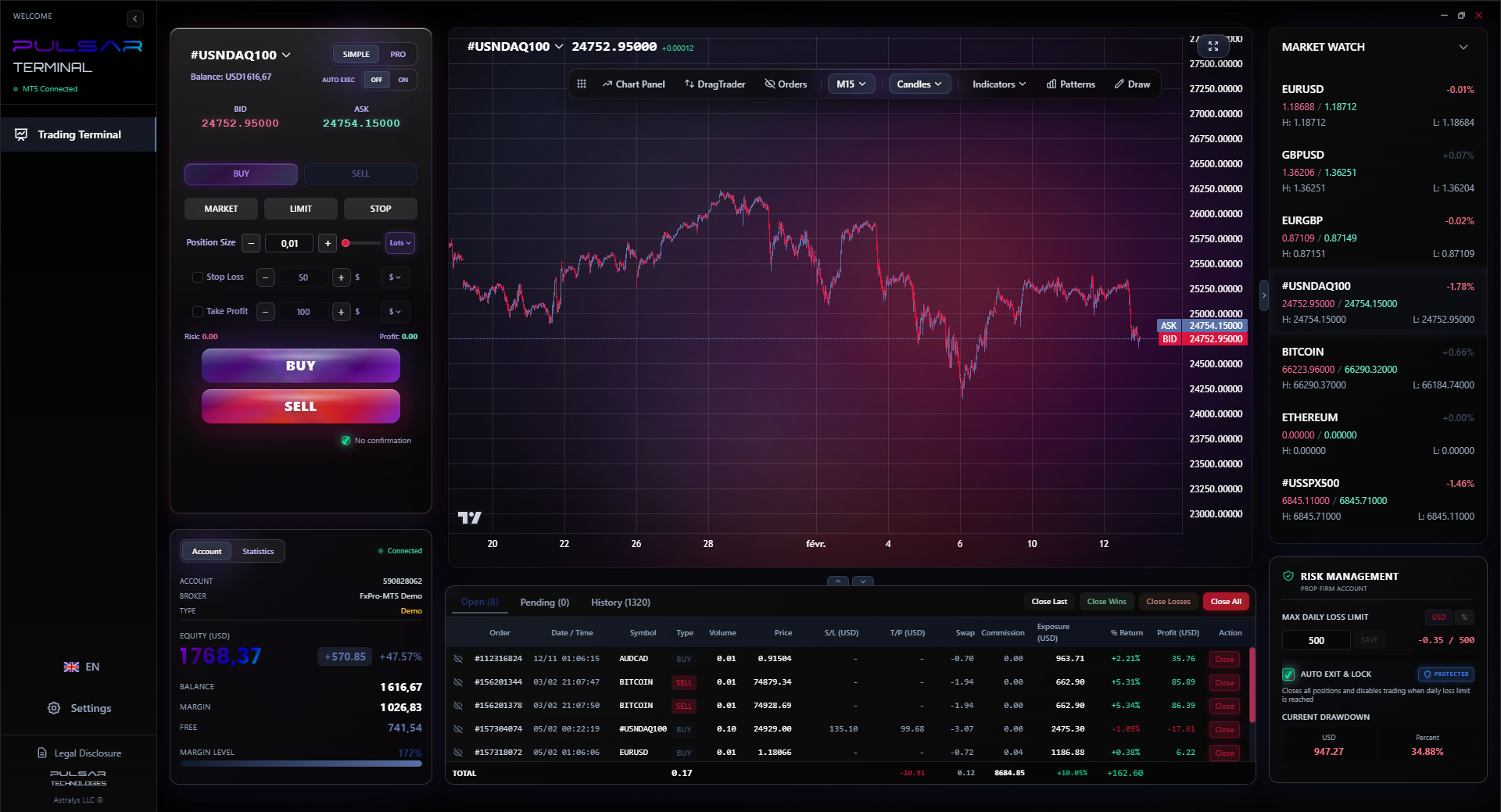
Sticking to pre-defined profit targets and stop-losses is a core psychological discipline, and tools like Pulsar Terminal for MT5 let you set multi-level take-profits and trailing stops automatically, removing emotional interference.
Pulsar Terminal
Công cụ MT5 tất-cả-trong-một: đặt lệnh kéo-thả, multi-TP/SL, trailing stop, grid trading, Volume Profile và bảo vệ prop firm. Hơn 1.000 trader sử dụng mỗi ngày.
“Discipline sounds boring. It's not. It's freedom from constant stress and regret.”
Nothing disrupts your trading psychology like legal or financial uncertainty. Let's clear this up, because I see confusion all the time.
It's legal to trade forex with international brokers as a Nigerian individual. The key is you cannot source your trading dollars from the CBN's official window. That's a no-go. You fund your account through your domiciliary account, cards, or crypto.
You must pay taxes. Profits are subject to a 10% Capital Gains Tax. The FIRS doesn't play. Set aside 10% of your net profits quarterly in a separate account. Trying to hide it will cause subconscious stress that will affect your trading decisions. Knowing you're compliant brings a peace of mind that lets you focus on the charts.
Choose your broker for safety, not just bonuses. A broker's regulation protects you from outright fraud and offers negative balance protection. I prefer brokers with strong international licenses. Doing your due diligence by reading reviews, like our IC Markets review or Pepperstone review, is part of risk management. A secure foundation is crucial for a calm mind.
💡 Mẹo của Winston
The 10% you set aside for taxes is not a loss. It's the cost of operating a legitimate, stress-free business. Factor it into your profit targets from the start.
“Unlocking your potential isn't about one massive trade. It's about stringing together months of small, disciplined actions.”
Unlocking your potential isn't about one massive, life-changing trade. It's about stringing together months of small, disciplined actions. Your psychology is the glue.
The Final Shift: Start measuring success by how well you followed your process, not by your daily P&L. Had a losing day but stuck to your 2% max loss rule? That's a win. You survived to trade another day. The market will always be there tomorrow.
Embrace boredom. The most psychologically profitable trading is often boring. You wait for your A+ setup, you execute, you manage, you exit. Repeat. The excitement seekers blow up. The patient, disciplined ones compound.
Remember, the Naira's volatility, the broker's spread, the global news - these are all part of the environment. You can't control them. The only thing you have 100% control over is your response. Master that, and you've mastered the real game. That's how you truly unlock your potential with forex trading psychology. It's a slow, often frustrating journey of self-improvement, but it's the only one that leads to lasting success in the Naija market and beyond.
FAQ
Q1Is forex trading actually legal for Nigerians?
Yes, it is legal for individuals. The key rule is you cannot source the foreign currency for your trading account from the Central Bank of Nigeria's (CBN) official exchange window. You must use your personal domiciliary account, international cards, or approved payment channels. Always trade with internationally regulated brokers for safety.
Q2How much money do I really need to start forex trading in Nigeria?
While some brokers allow deposits as low as $1, it's practically useless. The spreads and volatility will likely wipe out a tiny account. For serious practice, I recommend a minimum of $200-300. This allows for proper position sizing and breathing room. Never trade with money meant for bills or rent.
Q3How do I handle the 10% capital gains tax on forex profits?
You are responsible for declaring and paying it to the Federal Inland Revenue Service (FIRS). The simplest method is to set aside 10% of your net profits (total profits minus total losses) in a separate savings account every quarter. Keep detailed records of all your trades, deposits, and withdrawals. Consult a local accountant for formal advice.
Q4What's the biggest psychological mistake Nigerian traders make?
Trading to solve immediate financial pressure. When you're trading to pay rent or 'get rich quick,' you're not trading - you're gambling with heightened emotions. This leads to overtrading, ignoring stop-losses, and blowing accounts. Trade only with disposable risk capital.
Q5How can I stop myself from moving my stop-loss?
Use technology to enforce your discipline. Place your stop-loss order immediately when you enter the trade. If your platform allows it, use a 'hard' stop that can't be modified without canceling the order. Even better, use a trading journal and make a rule: if you move a stop-loss without a pre-defined, logical reason from your plan, you must close the platform for the day.
Q6Are local Nigerian brokers or international brokers better?
For retail forex trading, international brokers regulated by top-tier authorities (like FCA, ASIC, CySEC) are generally the safer choice. They offer stronger client fund protection, negative balance protection, and access to global liquidity. Many, like Exness or XM, actively serve the Nigerian market with local payment options.
Q7How do I deal with the fear of missing out (FOMO) on a big move?
Accept that you will miss moves. The market provides thousands of opportunities. Chasing a move out of FOMO almost guarantees entering at the worst price. Have a checklist for entries. If the current move doesn't meet your criteria, let it go. Watch it pass and say, 'That wasn't my trade.' This strengthens your discipline for the next one.
Bài học của Prof. Winston
Điểm chính:
- ✓Risk only 1-2% of capital per trade.
- ✓Predefine every stop-loss and take-profit.
- ✓Set aside 10% of net profits for tax immediately.
- ✓Measure success by process, not daily P&L.
- ✓Never trade with money needed for essentials.
Bài viết này hữu ích thế nào?
Nhấp vào ngôi sao để đánh giá
Nhận định giao dịch hàng tuần
Phân tích & chiến lược miễn phí hàng tuần. Không spam.
Về tác giả
Olumide Adeyemi
Nhà tiên phong Giao dịch Tây Phi
Một trong những nhà đào tạo forex tích cực nhất tại Nigeria. 8 năm kinh nghiệm giao dịch từ Lagos. Chuyên về chiến lược vốn thấp và thử thách prop firm dành cho trader châu Phi.
Bình luận
Cảnh báo rủi ro
Giao dịch các công cụ tài chính tiềm ẩn rủi ro đáng kể và có thể không phù hợp với tất cả nhà đầu tư. Hiệu suất trong quá khứ không đảm bảo kết quả trong tương lai. Nội dung này chỉ mang tính chất giáo dục và không nên được coi là lời khuyên đầu tư. Hãy luôn tự nghiên cứu trước khi giao dịch.
Bạn cũng có thể thích

Cara Trading Forex Sukses: 7 Prinsip dari Trader Profesional
Cara trading forex sukses dengan 7 prinsip trader pro: manajemen modal, disiplin, journal trading, backtest. Data nyata, bukan janji profit palsu.
Jam Trading Forex Terbaik untuk Trader Indonesia: Panduan Lengkap dengan Tabel Waktu
Panduan jam trading forex untuk trader Indonesia. Tabel 4 sesi dunia, jam emas 20:00-00:00, sesi mana yang harus dihindari. Data akurat + tips dari trader berpengalaman.
Top 5 Sàn Forex Uy Tín Nhất 2026: Review Jujur dari Trader Indonesia
Top 5 sàn forex uy tín 2026 untuk trader Indonesia. Review jujur: spread, deposit, withdraw, dukungan lokal. Exness, XM, IC Markets & lebih.
Tải Pulsar Terminal
Tất cả các công cụ tính này được tích hợp trong Pulsar Terminal với dữ liệu thời gian thực từ tài khoản MT5 của bạn.
Tải Pulsar Terminal