


I stared at the screen, my stomach in knots.

James Mitchell
Chuyên gia Phân tích Giao dịch Cao cấp
☕ 9 phút đọc
Bạn sẽ học được:
- 1What Are Prop Firms, Really? (Spoiler: It's Not Free Money)
- 2The Major US Players: A Side-by-Side Breakdown
- 3The Golden Rules: How to Actually Pass the Evaluation
- 4Getting Paid: The Good, The Bad, and The Tax Man
- 5Mistakes I Made (So You Don't Have To)
- 6Essential Tools and the Final Mindset
- 7So, Are US Prop Firms Right For You?
I stared at the screen, my stomach in knots. It was March 2023, and I'd just blown my third prop firm challenge in a row. The $1,000 in evaluation fees felt like a stupid tax. My ego was shredded, but that failure forced me to get real. I stopped chasing the dream and started analyzing the game. Over the next year, I cracked the code, securing over $500,000 in funded capital across several top US prop firms. This isn't a hype story. It's a map of the minefield, drawn from blown accounts, successful passes, and the hard lessons in between.
Let's cut through the marketing. A proprietary trading firm (prop firm) isn't a charity giving you a magic account. It's a performance filter with a business model. You pay an evaluation fee (anywhere from $50 to $1,000+) to prove you can trade their rules. Pass, and they allocate you a simulated account where you keep a large chunk of the profits (typically 70-90%). Fail, and you lose your fee.
Here's the critical part most beginners miss: you're almost never trading real market risk for the firm initially. You're in a simulation. Your payouts come from the pool of evaluation fees paid by all the traders who failed. The firm's profit is the spread/markup on your trades plus the failed challenge fees. It's a brilliant, low-risk model for them. For you, it's a performance-based gateway to trade larger sizes than your personal capital allows.

Warning: Never think of the evaluation fee as an 'investment.' It's the cost of a very strict audition. If your personal trading isn't already consistently profitable, you're just donating.
I learned this the hard way. Back in 2020, I thought a $500 challenge was my ticket. I hadn't even tracked my personal account for six months. I blew the daily loss limit in two days. That $500 was the most expensive reminder to get my own house in order first.

💡 Mẹo của Winston
The evaluation's profit target is a finish line, not a daily quota. Trying to sprint the entire marathon on day one is a guaranteed collapse.
“Stricter rules from a reputable firm often mean safer, faster payouts. The lax rules are usually a red flag.”
The landscape changes, but a few firms have established themselves. Your choice depends on your trading style - scalping, swing trading, or something in between.
| Firm | Key Strength | Best For | Biggest Catch |
|---|---|---|---|
| FTMO | Longest track record, clear rules, excellent reputation. | Disciplined swing traders who avoid news. | Higher evaluation costs, stricter consistency rules. |
| The5%ers | Unique growth model ("Bootcamp"), lower starting costs. | Traders wanting to grow an account size over time. | Profit targets are relative to your growing account, which changes the math. |
| Topstep | Very popular with futures traders, great educational content. | Index and commodity futures traders. | Their "Trading Combine" has specific volume requirements that can trip you up. |
| Apex Trader Funding | Cheap evaluation fees, simple rules, huge payout splits. | Scalpers and high-frequency traders. | The sheer number of traders can sometimes lead to slower support responses. |
My Experience with Two Extremes
I passed a $100k FTMO challenge in 2022. The rules were ironclad: 10% profit target, 5% max loss, no holding over high-impact news. It forced a level of discipline my personal account lacked. The payout was smooth, 80% to me.
Contrast that with a smaller firm I tried in 2021 (now defunct). The rules seemed "easier" - no daily loss limit! I passed quickly, but my first payout request was met with delays and excuses. I lost that account. The lesson? Stricter rules from a reputable firm often mean safer, faster payouts. The lax rules are usually a red flag.
Your broker matters too. Most prop firms use large, regulated brokers to execute trades. I've had good experiences with the platforms used by firms like FTMO and Topstep, which often resemble what you'd get from a retail broker like IC Markets or Pepperstone.
“The daily loss limit isn't a suggestion; it's the law. Your job is to build a prison of discipline around it.”
This is the make-or-break. I've passed over a dozen challenges, and the formula is always the same. It has nothing to do with a secret indicator.
1. Treat It Like a Job, Not a Lottery Ticket. You have a profit target and loss limits. Your goal is not to "get rich this week." It's to hit the target without violating a single rule. This is a mindset shift. I use a position size calculator religiously now. On my early fails, I'd size up after a win, guaranteeing a blow-up when the reversal came.
2. The Daily Loss Limit is Your Boss. This is the most important rule. If your max daily loss is 5%, you should mentally set your own limit at 2-3%. Once you hit that, you stop. No exceptions. I set hard stops for every trade. Letting a loser run "just a little more" is what triggers a margin call mentality and blows the entire account.
3. Consistency Over Home Runs. Most firms check your trading consistency. They don't want one 10% gain and nine 0.1% losses. They want steady, manageable wins. This is where a swing trading approach often beats aggressive scalping in evaluations.

Pro Tip: Your first trade after a significant loss should be half your normal size. Your judgment is impaired. I have a note taped to my monitor that says "SCALED DOWN" after a loss. It saved my last FTMO challenge.
4. Know the Instrument Rules. Some firms don't allow holding certain pairs over the weekend. Others ban crypto or have specific rules around news events. Read the manual. Twice.
💡 Mẹo của Winston
Your trading system must be 'prop-firm compliant' by design. Build your risk parameters around their daily loss limit, not the other way around.
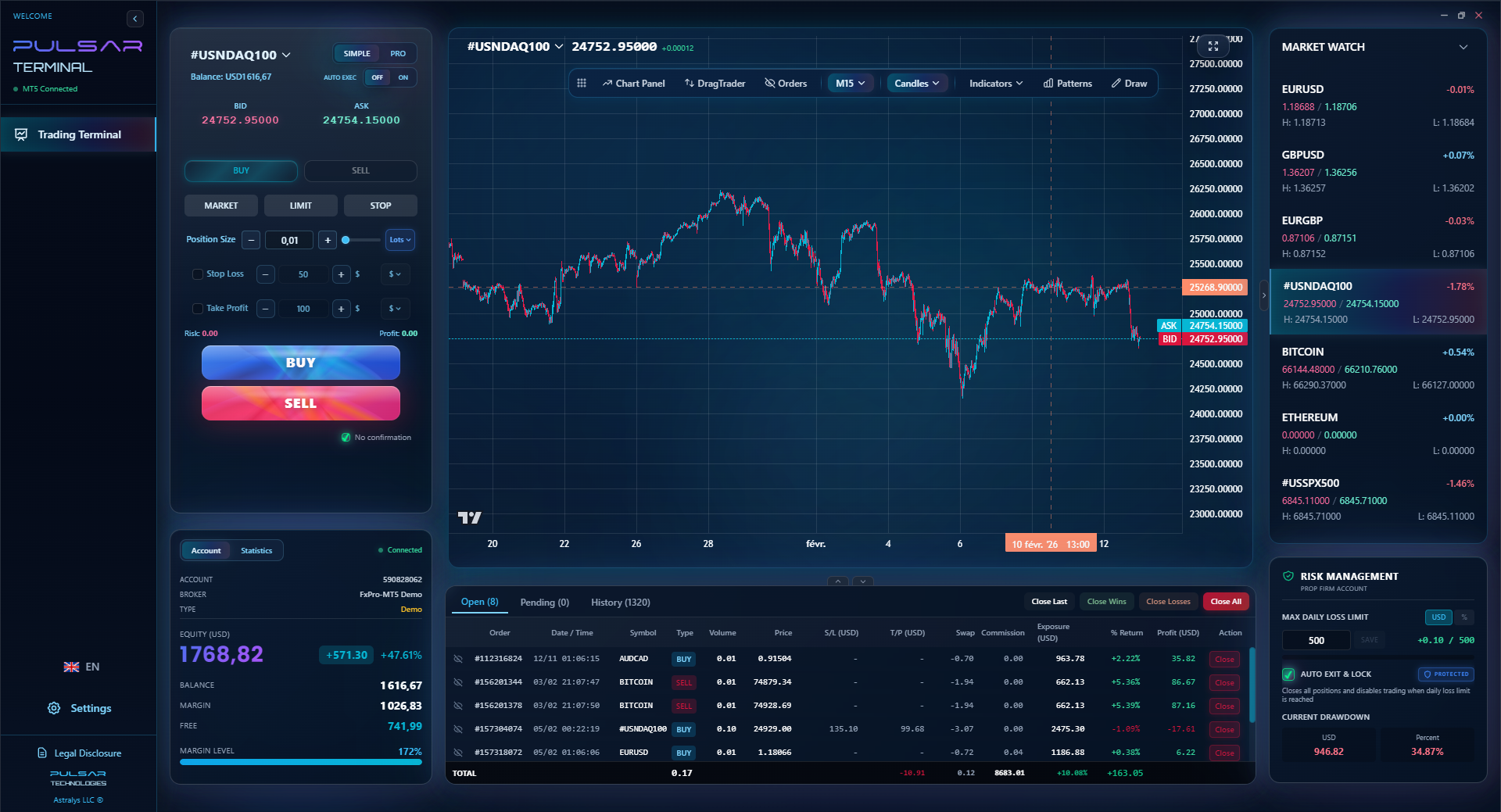
Managing multiple partial take-profits and a trailing stop within a prop firm's strict rules is complex, but tools like Pulsar Terminal automate it directly on your MT5 platform.
Pulsar Terminal
Công cụ MT5 tất-cả-trong-một: đặt lệnh kéo-thả, multi-TP/SL, trailing stop, grid trading, Volume Profile và bảo vệ prop firm. Hơn 1.000 trader sử dụng mỗi ngày.
“The daily loss limit isn't a suggestion; it's the law. Your job is to build a prison of discipline around it.”
You passed. Congrats. Now, how do you turn simulated profits into real cash?
The Payout Process: Reputable firms offer bi-weekly or monthly payout requests. You request a withdrawal, they process it, and it hits your bank account via wire or ACH in a few days. FTMO has been flawless for me. The first payout is the sweetest validation.
The Tax Reality (USA Specific): This is huge. In the US, prop firm payouts are typically treated as ordinary income, not capital gains. You'll receive a 1099-MISC or 1099-NEC. You must report this. I set aside 30-35% of every payout immediately for taxes. Do not get caught off guard. Talk to a tax professional familiar with trading income.
Scaling Plans: Many firms offer scaling plans. Hit your targets consistently, and they'll increase your funded capital. This is how you grow. My first FTMO account was $50k. After two profit cycles, it was scaled to $80k. This is the real long-term game.
The Psychological Shift: Trading a funded account feels different. The fear of losing "the firm's money" can creep in. You have to mentally treat it as your own capital from day one. The rules are the same as the challenge. If you changed your strategy now, you'd be admitting your challenge pass was luck.
“Prop firms are a performance filter, not a magic money tree. You're being audited, not funded.”
Let's get vulnerable. Here's my hall of shame.
Pitfall 1: Over-Trading to Reach Profit Target. In a $100k challenge, the target was $10,000. After making $8k, I got impatient. I started taking low-probability setups just to "get it over with." I gave back $4k in two days and nearly hit the max drawdown. I had to walk away for a week. Patience isn't a virtue here; it's a requirement.
Pitfall 2: Ignoring the Consistency Rule. One firm had a rule where your largest winning day couldn't be more than 30% of your total profit. I didn't track it. I had a monster day on a XAU/USD move, making $7k. I passed the profit target but failed the evaluation because that one day was 50% of my profit. I read the rules but didn't internalize them.
Pitfall 3: Chasing Lost Fees. After failing a $250 challenge, I immediately bought a $500 one, thinking "I got this now." I was emotional and revenge trading. I blew it faster. The correct move is to go back to your personal account, review your journal, and trade calmly for at least two weeks before trying again.
Pitfall 4: Not Accounting for Costs. The profit target is usually net of trading costs. If you're a scalper, the spread and commissions eat you alive. On a major pair like EUR/USD, it's manageable. On exotic pairs or during a prop firm's marked-up spread, it can make your strategy unprofitable. Test your strategy with their demo first!
💡 Mẹo của Winston
View the evaluation fee as a tuition payment for a masterclass in discipline. If you learn the lessons, even from a fail, it's worth far more than the cost.
“Prop firms are a performance filter, not a magic money tree. You're being audited, not funded.”
You can't white-knuckle your way through this. You need systems.
Trading Journal: Non-negotiable. Every trade, screenshot, reason, and emotional note. I review mine every Sunday.
Risk Calculator: I use mine before every single trade. It tells me my position size based on my stop loss and my max risk per trade (which is a fraction of my daily loss limit).
Simple Technical Stack: Don't overcomplicate. I use price action, support/resistance, and maybe one or two indicators like the RSI or MACD for confluence. In an evaluation, complexity is your enemy.
The Prop Firm Mindset: This is a marathon of sprints. Each evaluation is a sprint with specific rules. Your career as a funded trader is the marathon. Your goal isn't to pass one challenge. It's to build a sustainable income stream across multiple funded accounts. That requires treating it like a business from day one: with planning, risk management, and emotional detachment.

Example: Let's say you have a $100k account with a 5% max loss ($5,000). Your personal rule is to risk only 1% of that per day ($100). If your stop loss on a EUR/USD trade is 20 pips, your position size must be calculated so that a 20-pip loss equals $100 or less. That's the discipline.
“Set aside 30% of every payout for taxes before you even think about spending it. The IRS doesn't care about your trading genius.”
Let's be brutally honest. Prop firms are NOT for:
- Beginners still learning what a pip is.
- Traders with no proven, documented profitability in their personal account.
- People looking for a quick, easy loan.
- Anyone who can't control their emotions after a losing trade.
Prop firms ARE for:
- Disciplined traders with a solid edge but limited personal capital.
- Traders who thrive under clear rules and structure.
- Professionals who want to separate their personal finances from their trading capital.
- Those willing to pay for an audition to access larger capital.
My final advice? Before you spend a dime on an evaluation, prove you can be profitable for 3-6 months in a personal account. Track every trade. Then, start with the smallest, cheapest challenge a reputable firm offers. Get the feel of their platform and rules. The goal of that first challenge isn't to pass (though that would be nice). The goal is to learn the process without a huge financial sting. Then, and only then, go for the larger account sizes. This is a professional path. Walk it like one.
FAQ
Q1Are US prop firms legit, or are they all scams?
Many are legitimate businesses with transparent rules and timely payouts, like FTMO, Topstep, and The5%ers. However, the low barrier to entry has led to scammy copycats. Always research extensively: look for a long track record, transparent testimonials (not just YouTube shills), and clear, consistent terms and conditions. If the rules seem too good to be true, they are.
Q2How much money can I realistically make with a prop firm?
It depends entirely on your skill and risk management. A top-tier trader with multiple $200k+ accounts might clear $15k-$30k per month consistently after profit splits. But that's the 1%. A more realistic starting goal for a skilled trader might be 2-5% monthly return on the funded capital, net of fees. Remember, your first goal is to keep the account, not maximize returns.
Q3What's the single biggest reason people fail prop firm challenges?
Lack of discipline around the daily loss limit. Traders take a loss, get emotional, and try to win it back immediately with larger positions. This leads to violating the max loss rule and instant failure. The second biggest reason is over-trading to hit the profit target too quickly.
Q4Do I need a special license to trade with a US prop firm?
No. As a funded trader receiving a profit split, you are typically considered an independent contractor of the firm. The firm itself holds the necessary brokerage licenses. You are responsible for reporting your income (via the 1099 they provide) and paying your taxes.
Q5Can I use Expert Advisors (EAs) or automated trading in challenges?
You MUST check each firm's policy. Most allow it, but many have specific rules: the EA must be your own (not a purchased "pass-guaranteed" bot), and you are still fully responsible for all trades it executes, including any rule violations. Some firms ban them entirely. Never assume it's allowed.
Q6What happens if I lose money on the funded account?
You lose the account. That's it. You don't owe the firm money (true for reputable firms - this is a major red flag if they say you do). Your loss is limited to the drawdown limit of the account. Most firms will then offer you a discounted re-evaluation fee to try again.
Bài học của Prof. Winston
Điểm chính:
- ✓Treat the daily loss limit as your absolute, non-negotiable boss.
- ✓Passing requires consistency, not one heroic trade.
- ✓Research firm reputations more than their profit splits.
- ✓Always account for trading costs and taxes in your net profit.
- ✓Start with the smallest challenge to learn the process.
Bài viết này hữu ích thế nào?
Nhấp vào ngôi sao để đánh giá
Nhận định giao dịch hàng tuần
Phân tích & chiến lược miễn phí hàng tuần. Không spam.
Về tác giả
James Mitchell
Chuyên gia Phân tích Giao dịch Cao cấp
Hoạt động tại New York với hơn 9 năm kinh nghiệm giao dịch. Tập trung vào các cặp USD chính, thử thách prop firm và bối cảnh pháp lý tại Mỹ.
Bình luận
Cảnh báo rủi ro
Giao dịch các công cụ tài chính tiềm ẩn rủi ro đáng kể và có thể không phù hợp với tất cả nhà đầu tư. Hiệu suất trong quá khứ không đảm bảo kết quả trong tương lai. Nội dung này chỉ mang tính chất giáo dục và không nên được coi là lời khuyên đầu tư. Hãy luôn tự nghiên cứu trước khi giao dịch.
Bạn cũng có thể thích

Cara Trading Forex Sukses: 7 Prinsip dari Trader Profesional
Cara trading forex sukses dengan 7 prinsip trader pro: manajemen modal, disiplin, journal trading, backtest. Data nyata, bukan janji profit palsu.
Jam Trading Forex Terbaik untuk Trader Indonesia: Panduan Lengkap dengan Tabel Waktu
Panduan jam trading forex untuk trader Indonesia. Tabel 4 sesi dunia, jam emas 20:00-00:00, sesi mana yang harus dihindari. Data akurat + tips dari trader berpengalaman.
Top 5 Sàn Forex Uy Tín Nhất 2026: Review Jujur dari Trader Indonesia
Top 5 sàn forex uy tín 2026 untuk trader Indonesia. Review jujur: spread, deposit, withdraw, dukungan lokal. Exness, XM, IC Markets & lebih.
Tải Pulsar Terminal
Tất cả các công cụ tính này được tích hợp trong Pulsar Terminal với dữ liệu thời gian thực từ tài khoản MT5 của bạn.
Tải Pulsar Terminal