


Ever placed a trade on USD/ZAR, watched it move 200 pips against you in an hour, and thought 'what just happened?' You're not alone.

David van der Merwe
Nhà giao dịch Thị trường Mới nổi ·  South Africa
☕ 13 phút đọc
Bạn sẽ học được:
- 1What Exactly Is a Forex Volatility Calculator?
- 2Why South African Traders Can't Ignore This Tool
- 3The Numbers You Need to Understand (ATR, Pip Range, %)
- 4Putting It Into Practice: A Step-by-Step Trading Routine
- 5Where to Find Reliable Calculators & Tools
- 6Pitfalls & Common Mistakes to Sidestep
- 7Making It Work with the South African Market
Ever placed a trade on USD/ZAR, watched it move 200 pips against you in an hour, and thought 'what just happened?' You're not alone. That's volatility, my friend, and in the South African market, it's not just a concept, it's a daily reality. A forex volatility calculator isn't some magic crystal ball, but it's the closest thing we have to measuring the market's heartbeat before we risk our hard-earned Rand. I've been trading through ZAR crashes, rallies, and everything in between for over a decade, and learning to quantify volatility was the single biggest upgrade to my risk management. Let's break down how you can use this tool to stop guessing and start calculating your way to safer trades.
Think of it as a speedometer for the market. While your charts show you the price's location, a volatility calculator tells you how fast it's moving and how far it's likely to go. In simple terms, it translates past price movements into a single, understandable number - usually in pips or as a percentage.
Most calculators work by measuring the Average True Range (ATR). This indicator doesn't care if the market is going up or down, it just measures the size of the candles over a specific period (like 14 days). The output? The average trading range for that pair, right now. For a pair like EUR/USD, that might be 70 pips. For USD/ZAR? It could easily be 400-500 pips on a volatile day. Knowing that number changes everything.

Example: Let's say your volatility calculator shows the current 14-day ATR for USD/ZAR is 450 pips. That means, on average, the pair has been moving 450 pips from its daily low to its daily high. If you're placing a trade with a 100-pip stop loss, you're betting against the market's recent average daily energy. That's a dangerous game.
Why is this so crucial for us in South Africa? Because our home currency, the Rand, is classified as an exotic. It's less liquid than majors like the Euro or Dollar, which makes it prone to sharper, less predictable swings. News about load-shedding, a platinum mine strike, or shifts in global risk sentiment can send USD/ZAR flying. A volatility calculator gives you a data-backed reality check before you hit 'buy' or 'sell'.

💡 Mẹo của Winston
A rising ATR line is the market clearing its throat before it shouts. When volatility starts increasing, reduce your size by half. It's better to win small than lose big trying to catch a runaway train.
“A volatility calculator gives you a data-backed reality check before you hit 'buy' or 'sell'.”
Trading from SA comes with a unique set of challenges. We're trading a volatile local currency, often with smaller account sizes starting in the R1,500 to R5,000 range, and we're up against global market forces. A volatility calculator directly addresses three core SA trading problems.
Managing the ZAR Rollercoaster
USD/ZAR and EUR/ZAR aren't for the faint-hearted. I remember in early 2026, the pair moved nearly 16% in 12 months. On a single day, a 500-pip move isn't even front-page news. If you're using a standard 50-pip stop loss you found in a generic trading guide, you'll get wiped out. The calculator shows you the actual noise level. You then set your stop loss outside that normal noise. If the ATR is 450 pips, maybe your stop needs to be 550 pips away. That means trading smaller, but it means surviving.
Protecting Smaller Accounts
With our typical account sizes, a single bad trade can do serious damage. Let's get real with numbers. Say you deposit R5,000 with a broker like XM or IC Markets. Using maximum FSCA-allowed use of 30:1, you control R150,000. A 500-pip move against you on USD/ZAR (where a pip is roughly R0.65 on a standard lot) could mean a loss of over R3,000 - more than half your account. A volatility calculator forces you to see that potential move and adjust your position size calculator accordingly. It's the voice of reason saying, 'Maybe just trade 0.05 lots today.'
Navigating Wider Spreads
Exotic pairs have wider spreads. It's a fact. While EUR/USD can have spreads under 1 pip, USD/ZAR can be 5 pips or more, and EUR/ZAR can hit 14 pips. That's not just a cost; it's a volatility signal. A suddenly widening spread often precedes or accompanies a spike in volatility. Your calculator, by showing you the underlying ATR, helps you distinguish between normal expensive spreads and dangerous, expanding ones. You learn not to enter a trade just as the market is gearing up for a massive jump.

Warning: I learned this the hard way. I once shorted EUR/ZAR during a quiet Asian session, lured in by what seemed like a clear resistance level. I didn't check the volatility. The London open hit, volatility spiked, and my 150-pip stop was taken out in minutes. The pair moved 300 pips against me before reversing. The setup was right, but my risk parameters were blind to the market's engine temperature.
“The stop loss that worked on USD/ZAR last month will get vaporised this month during a commodity price surge.”
Don't just glance at the number. You need to know what it's telling you. Here are the key outputs from any good volatility calculator forex tool.
1. Average True Range (ATR) in Pips: This is your bread and butter. It's the raw distance. A 14-period ATR of 120 on EUR/USD means the average daily range is 120 pips. You use this directly for setting stops and profit targets. If you're a scalping strategy trader looking for 10-pip gains, a 120-pip ATR market is probably too chaotic for your style.
2. Percentage Volatility: This is the ATR expressed as a percentage of the current price. For USD/ZAR at 18.50 with a 450-pip ATR, the calculation is (0.0450 / 18.50) * 100 = ~0.24%. This helps compare volatility across different priced pairs. A 70-pip ATR on EUR/USD at 1.0800 is a 0.65% move. Suddenly, you see that EUR/USD, in percentage terms, can be just as 'volatile' as some exotic moves.
3. Expected Daily/Weekly Range: Many calculators extrapolate the ATR to give probable ranges. They might say, 'Based on current volatility, there's a 68% chance the daily range will be between X and Y pips.' This is gold for swing trading where you hold for days. It tells you if your weekly 200-pip target is realistic or a pipe dream.
| Metric | What It Tells You | How a South African Trader Uses It |
|---|---|---|
| ATR (Pips) | The average price movement distance. | Set stop-losses BEYOND this value. Adjust position size for ZAR pairs. |
| ATR (%) | Volatility relative to price. | Compare risk between EUR/USD and USD/ZAR apples-to-apples. |
| Daily Range | Probable high-low for the session. | Avoid buying at the top of the expected range or selling at the bottom. |
Here's a real example from my journal: On April 8, 2026, USD/ZAR was near 16.30. The 14-day ATR was sitting at about 380 pips. That percentage volatility was roughly 0.23%. My trade plan that day was for a long swing trade. Knowing the average daily noise was 380 pips, I placed my stop loss 450 pips away (below 15.85). I used a position size calculator to ensure that 450-pip risk was only 1% of my account. The trade worked, but even if it hadn't, the loss was predefined and survivable.
“The stop loss that worked on USD/ZAR last month will get vaporised this month during a commodity price surge.”
Theory is useless without action. Here’s exactly how I weave volatility calculation into my pre-market routine, every single day.
Step 1: The Morning Check (Before 8 AM SAST) I open my platforms (I use MT5, but this works on MT4 too). I pull up the ATR indicator on my main pairs: USD/ZAR, EUR/ZAR, and then majors like EUR/USD and XAU/USD (gold). I note the current 14-period ATR value. I don't just look at the number, I look at its direction. Is it rising? Falling? A rising ATR on USD/ZAR as the US market opens is a red flag for potential chaos.
Step 2: Position Sizing – The Non-Negotiable This is where you save your account. Let's say my account is R20,000. My rule is to risk a maximum of 1% per trade (R200). The USD/ZAR ATR is 400 pips. I decide my stop loss needs to be 500 pips away to account for the volatility.
My risk per pip? R200 / 500 pips = R0.40 per pip. On USD/ZAR, 1 standard lot (100,000 units) has a pip value of roughly R0.65 at current prices. So, to risk R0.40 per pip, I need to trade: 0.40 / 0.65 = 0.61 lots. I'd round down to 0.60 lots.
Without the volatility check, I might have used a 150-pip stop and traded 2 lots, risking the same R200. But in a 400-pip volatile market, that 150-pip stop is almost guaranteed to fail. The calculator forced me to trade a smaller, smarter size.
Step 3: Setting Targets & Managing the Trade If the daily ATR is 400 pips, a profit target of 1000 pips for a day trade is pure fantasy. I align my expectations. For a swing trade, I might look for a target of 1.5x to 2x the ATR (600-800 pips). It keeps me realistic.

Pro Tip: Combine your volatility reading with other indicators. If the ATR is high and the price is pressing against a key level on the chart, or the RSI indicator is showing extreme overbought/oversold conditions, the probability of a violent breakout or reversal is high. That's not the time to be figuring out your position size. That's the time to be patient.
💡 Mẹo của Winston
Your stop-loss should be placed where the market would have to prove you fundamentally wrong, not where it can knock you out with its normal daily jitters. The ATR defines those jitters.
“High volatility + high use = an express ticket to a margin call.”
You don't need to pay for this. Some of the best tools are free and built into the platforms you already use.
1. Built-in Platform Indicators (The Easiest Way) Both MetaTrader 4 and 5 have the ATR indicator pre-installed. Just click Insert > Indicators > Oscillators > Average True Range. Set the period to 14. The line that appears on a separate window below your chart is the ATR value in pips. That's your core volatility calculator, right there.
2. Broker Trading Calculators Most reputable FSCA-regulated brokers like Pepperstone, Exness, and IC Markets have advanced trading calculators on their websites. These often include a 'volatility' tab or integrate ATR into their margin and profit calculators. They're handy for quick checks without opening your platform.
3. Standalone Forex Volatility Websites Sites like Myfxbook or Investing.com have market analysis sections that show current volatility percentages for all major and exotic pairs. It's a good way to get a broad snapshot. Just google 'forex volatility table'.
4. The Manual Method (Good for Understanding) Sometimes, I do it old-school to stay sharp. I look at the last 14 daily candles on USD/ZAR. For each day, I calculate the range (High - Low). I add all 14 ranges together and divide by 14. The number I get is my manual ATR. It always matches the indicator closely, and doing it once really cements what the tool is measuring.
The key is consistency. Pick one method - I use the MT5 ATR indicator - and make checking it the first step of your analysis, before you even look for a trade setup.
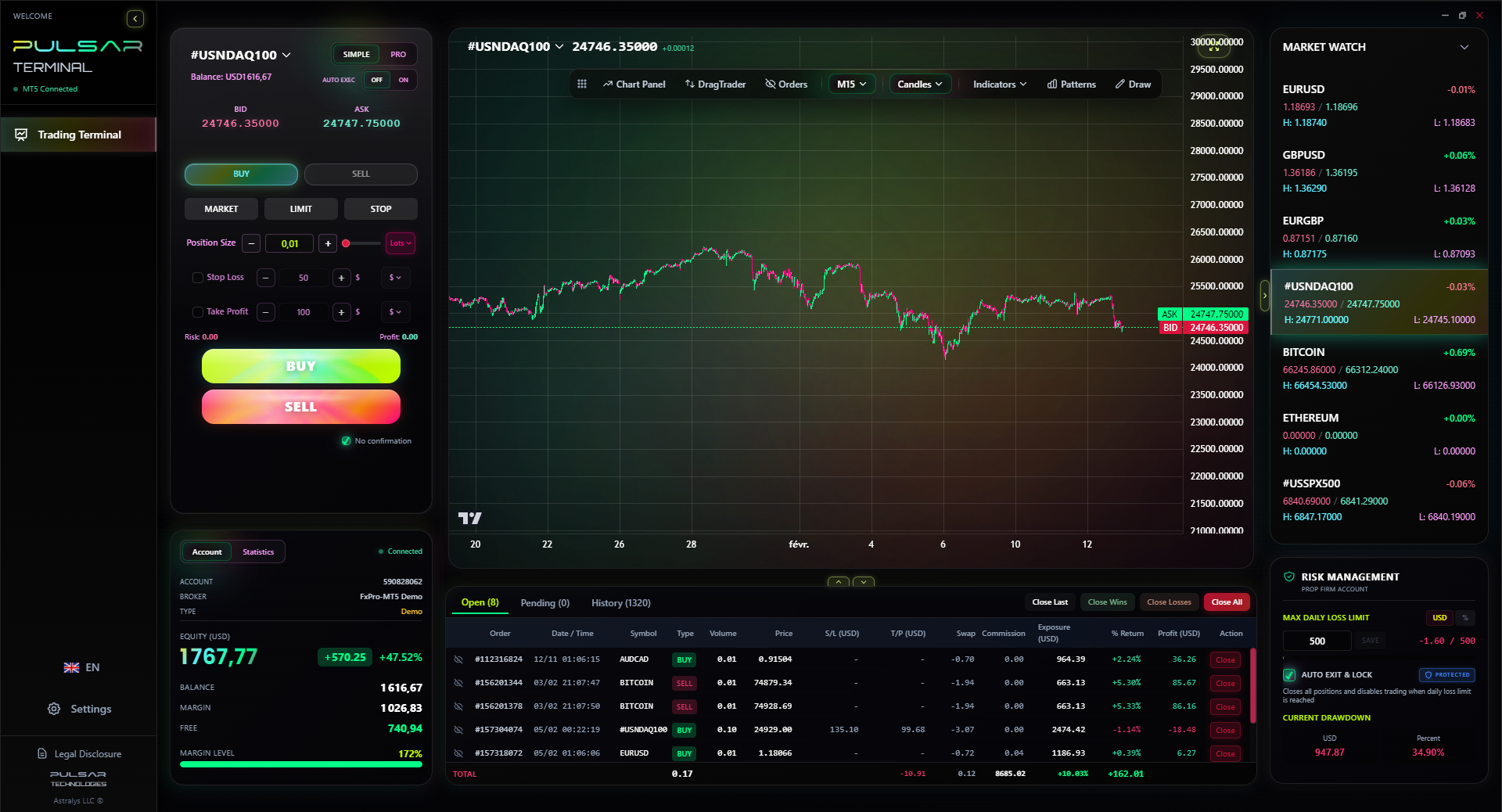
Manually adjusting stops for volatile pairs is a chore; Pulsar Terminal lets you set dynamic, ATR-based trailing stops and breakeven points automatically on your MT5 charts.
Pulsar Terminal
Công cụ MT5 tất-cả-trong-một: đặt lệnh kéo-thả, multi-TP/SL, trailing stop, grid trading, Volume Profile và bảo vệ prop firm. Hơn 1.000 trader sử dụng mỗi ngày.
“High volatility + high use = an express ticket to a margin call.”
I've made most of these errors so you don't have to. Here's what to watch out for.
Mistake 1: Using Static Stop Losses. This is the biggest killer. Setting a 50-pip stop on everything because a YouTube guru said so. Volatility isn't static. The stop loss that worked on USD/ZAR last month during a quiet period will get vaporised this month during a commodity price surge. Your stops must be dynamic, based on the current ATR, not last year's trading book.
Mistake 2: Ignoring Volatility Breakouts. A sharp, sustained rise in the ATR line itself is a major signal. It's not just a number to adjust your stop to, it's telling you the market regime is changing from quiet to trending or chaotic. In these periods, classic support and resistance levels often break easily. I've been stopped out of perfectly good trades because I didn't respect that an increasing ATR meant my technical levels were less reliable.
Mistake 3: Overleveraging in High Volatility. High volatility + high use = an express ticket to a margin call. When the ATR spikes, your correct reaction should be to reduce your position size, not get excited and increase it because 'big moves mean big profits.' The math is cruel. A 500-pip move against you with a 0.5-lot position hurts. The same move with 3 lots can blow up your account. Let the calculator dictate your size, not your greed.
Mistake 4: Forgetting About News. No calculator can predict the volatility from a surprise SARB interest rate decision or a major political announcement. The ATR shows you historical volatility. Always cross-reference your volatility reading with an economic calendar. If the ATR is low but a huge news event is due in an hour, the calm is an illusion. The spread definition on your broker's platform will often give you the first clue, as spreads widen dramatically pre-news.
“The best trade is sometimes no trade at all. Preserving your capital during random, high-volatility periods is a skill.”
To make this tool truly effective, you have to tailor it to our local context.
Focus on ZAR Pairs First: Start by applying the volatility calculator to USD/ZAR and EUR/ZAR religiously. Get a feel for their 'normal' ATR. You'll notice it's consistently multiples higher than something like EUR/USD guide. This alone will teach you to respect these pairs. A good local broker like Khwezi Trade, which is FSCA-licensed, will give you direct access to these pairs with local support.
Account for SA Session Overlaps: Our most volatile times are during the Johannesburg/London overlap (10:00 - 13:00 SAST) and the Johannesburg/New York overlap (15:00 - 17:00 SAST). Check the ATR at 9:30 AM, and then again at 2:30 PM. You'll often see it start to creep up. Adjust your position sizes for trades you enter during these windows. A trade entered at 10:05 AM might need a wider stop than one entered at 3:00 AM.
Link Volatility to Commodity Prices: The Rand is a commodity currency. When gold or platinum makes a big move, USD/ZAR volatility will increase, often with a slight lag. If you see XAU/USD guide (gold) breaking out, go check the USD/ZAR ATR. It's probably rising. This contextual understanding turns you from a passive calculator-user into an active market analyst.
Finally, remember that a volatility calculator forex tool gives you permission to sit out. If the ATR on your preferred pair is at a 3-month high and looks like a jagged mountain peak on your chart, that's the market screaming 'UNCERTAINTY.' The best trade is sometimes no trade at all. Preserving your capital during random, high-volatility periods is a skill that separates long-term survivors from short-term statistics.
💡 Mẹo của Winston
If the ATR value for USD/ZAR is larger than the total pips you hope to make on your trade, you're not trading, you're gambling. Recalculate your position or find a calmer pair.
FAQ
Q1Is a high volatility reading good or bad for trading?
It's neither good nor bad, it's just information. High volatility means larger potential profits and larger potential losses. It's bad if you're using tight stop losses and large position sizes. It's good if you're a swing trader with wide stops looking for big trends. The mistake is not adjusting your strategy to match the volatility environment.
Q2What's a 'normal' ATR for USD/ZAR?
There's no single 'normal,' as it changes with market conditions. However, in relatively stable periods, a 14-day ATR for USD/ZAR can range from 250 to 400 pips. During times of local political uncertainty or sharp moves in commodity prices, it can easily spike above 600-800 pips. You must check it daily, not assume a number.
Q3Can I use a volatility calculator for crypto or other CFDs?
Absolutely. The ATR indicator works on any price chart. In fact, it's even more critical for assets like Bitcoin or single-stock CFDs, which can be far more volatile than even exotic forex pairs. The same principles apply: use the ATR to define the market's noise level and set your risk parameters outside of it.
Q4My broker's spreads are already wide on USD/ZAR. Does volatility make them worse?
Yes, almost always. Volatility and spreads are directly linked. In times of high volatility or low liquidity (like around SA public holidays), brokers widen their spreads to manage their own risk. A volatility calculator warning you of high ATR is also an indirect warning that your trade entry and exit costs (the spread) are likely to be higher than usual.
Q5How does this help with prop firm challenges?
It's essential. Prop firms have strict daily loss limits (e.g., 5%). A single volatile move can breach that if you're not careful. Using a volatility calculator to set ultra-wide stops and tiny position sizes in high ATR environments is a key tactic for surviving the evaluation phase. It forces the discipline the firms are testing you on.
Q6Do I need to calculate volatility differently for scalping?
Yes. As a scalper, you care about very short-term volatility. Instead of the 14-day ATR, use a 1-hour or 15-minute chart with a 20-period ATR. This will show you the average range of the last 20 candles on that timeframe, giving you a better sense of the immediate noise you're trading within.
Bài học của Prof. Winston
Điểm chính:
- ✓Never set a stop-loss smaller than the current 14-period ATR.
- ✓If the ATR spikes, cut your position size by at least 50%.
- ✓Compare % volatility, not just pip ATR, across different pairs.
- ✓Check volatility at session overlaps: 10:00 SAST and 15:00 SAST.
Bài viết này hữu ích thế nào?
Nhấp vào ngôi sao để đánh giá
Nhận định giao dịch hàng tuần
Phân tích & chiến lược miễn phí hàng tuần. Không spam.
Về tác giả
David van der Merwe
Nhà giao dịch Thị trường Mới nổi
Trader tại Johannesburg với 11 năm kinh nghiệm về tiền tệ thị trường mới nổi. Chuyên về cặp ZAR, giao dịch theo quy định FSCA và phân tích thị trường Nam Phi.
Bình luận
Cảnh báo rủi ro
Giao dịch các công cụ tài chính tiềm ẩn rủi ro đáng kể và có thể không phù hợp với tất cả nhà đầu tư. Hiệu suất trong quá khứ không đảm bảo kết quả trong tương lai. Nội dung này chỉ mang tính chất giáo dục và không nên được coi là lời khuyên đầu tư. Hãy luôn tự nghiên cứu trước khi giao dịch.
Bạn cũng có thể thích

Cara Trading Forex Sukses: 7 Prinsip dari Trader Profesional
Cara trading forex sukses dengan 7 prinsip trader pro: manajemen modal, disiplin, journal trading, backtest. Data nyata, bukan janji profit palsu.
Jam Trading Forex Terbaik untuk Trader Indonesia: Panduan Lengkap dengan Tabel Waktu
Panduan jam trading forex untuk trader Indonesia. Tabel 4 sesi dunia, jam emas 20:00-00:00, sesi mana yang harus dihindari. Data akurat + tips dari trader berpengalaman.
Top 5 Sàn Forex Uy Tín Nhất 2026: Review Jujur dari Trader Indonesia
Top 5 sàn forex uy tín 2026 untuk trader Indonesia. Review jujur: spread, deposit, withdraw, dukungan lokal. Exness, XM, IC Markets & lebih.
Tải Pulsar Terminal
Tất cả các công cụ tính này được tích hợp trong Pulsar Terminal với dữ liệu thời gian thực từ tài khoản MT5 của bạn.
Tải Pulsar Terminal