


Most new traders think a forex broker is just a fancy app where you click 'buy' and 'sell'.

David van der Merwe
Nhà giao dịch Thị trường Mới nổi ·  South Africa
☕ 9 phút đọc
Bạn sẽ học được:
- 1The Basic Job: Your Gateway to the Market
- 2The South African Regulatory Landscape: The FSCA is Your Friend
- 3How Brokers Make Money: Spreads, Commissions & The Hidden Stuff
- 4Key Services Beyond the Trade
- 5Choosing the Right Broker in South Africa: A Practical Checklist
- 6Recent Changes (2024-2026) & What They Mean for You
Most new traders think a forex broker is just a fancy app where you click 'buy' and 'sell'. That's like saying a car is just a steering wheel. The reality is, your broker is your gateway, your risk manager, and sometimes your biggest obstacle. If you don't understand exactly what they do and how they make money, you're trading with one hand tied behind your back. Let's break down the real role of a forex broker, specifically for us trading from South Africa, so you can stop guessing and start making informed choices.
At its core, a forex broker's primary job is to give you, the retail trader, access to the interbank market where the big players (banks, hedge funds) trade. You can't just call up Standard Bank and ask for a mini-lot on USD/ZAR. The broker acts as the middleman.
They do this by providing two key things: a trading platform (like MT4 or MT5) and liquidity. Liquidity is just a fancy word for ensuring there's always someone on the other side of your trade. When you hit 'sell' on EUR/USD, the broker matches you with a 'buy' order from another client or, more commonly, passes your order to a larger liquidity provider.
Think of it like a massive, global auction. The broker gives you a seat and a bidding paddle. Without them, you're just watching from the outside. This access isn't free, of course. They make money through the spread (the difference between the buy and sell price) and sometimes commissions. I made the mistake early on of only looking at the advertised spread. I got burned on a scalping strategy because the '0.1 pip' spread would widen to 3 pips the second news hit. The broker wasn't cheating; they were just reflecting the real, thin liquidity available at that volatile moment. That's part of their job, too.

💡 Mẹo của Winston
Your broker's customer service number is a risk management tool. Test it *before* you have a real problem with a live trade.
“A forex broker isn't just an app; it's your gateway, your risk manager, and sometimes your biggest obstacle.”
This is the most critical section for any South African trader. The local regulator is the Financial Sector Conduct Authority (FSCA). A broker operating here legally must have an FSCA license (an FSP number). This isn't just bureaucratic red tape; it's your first layer of protection.
Why Local Regulation Matters
Trading with an FSCA-regulated broker means a few crucial things for you. First, they are required to keep your money in a segregated bank account. This means if the broker goes bust (it happens), your trading capital is separate from their company funds and should, in theory, be safe. Second, they have to follow strict conduct rules. They can't just manipulate prices or refuse your withdrawals without cause.
I learned this the hard way years ago with an unregulated 'bucket shop' that offered insane use. Made a nice profit on a gold trade, went to withdraw... and the process took months of fighting. With my current FSCA-regulated broker, withdrawals hit my FNB account in 24 hours.
The Offshore Question
Can you use brokers regulated elsewhere, like in Cyprus or Australia? Technically, yes. Many do. But you lose the direct recourse to the FSCA if something goes wrong. You also complicate your banking. Depositing and withdrawing in ZAR is seamless with a local broker. With an offshore one, your bank might charge international transfer fees, and you're at the mercy of exchange rates twice. For peace of mind and simplicity, starting with an FSCA broker is a no-brainer. You can check our deep dives on brokers like Exness or IC Markets to see how their local operations stack up.
“Trading with an FSCA-regulated broker isn't about bureaucracy, it's about having a local safety net for your money.”
Brokers aren't charities. Understanding their revenue model helps you pick the right account type for your strategy. There are two main models, and sometimes a hybrid.
The Spread-Only Model: This is the most common for standard accounts. The broker makes money from the difference between the bid and ask price. For example, if EUR/USD is quoted at 1.0850/1.0852, the spread is 2 pips. You buy at 1.0852, and the market only needs to move 2 pips in your favor for you to break even (excluding other costs). The broker pockets that spread. These spreads can be fixed or variable (floating).

Example: On a standard account with a 1.5 pip spread on EUR/USD, trading 1 standard lot (100,000 units), that spread costs you $15 on entry (1.5 pips * $10 per pip). That's the broker's take.
The Commission Model (ECN/Raw Accounts): Here, you get access to raw spreads from liquidity providers, often as low as 0.0 pips. But you pay a separate commission per lot traded. This is often cheaper for high-volume traders. A common structure is $7 per round turn (in and out) per 100k lot.
Other Costs to Watch:
- Swap Fees (Overnight Funding): If you hold a position past the daily rollover time (usually 10pm SAST), you'll pay or receive interest. This isn't pure broker profit; it's based on interbank interest rate differentials, but the broker adds a small markup. For a swing trading strategy, these can add up.
- Inactivity Fees: Some brokers charge if you don't trade for 3-6 months.
- Currency Conversion Fees: If your ZAR account trades a USD pair, the broker converts your margin and P&L at their rate, which often includes a 0.5-1% fee.
My rule? If you're a scalper or high-volume day trader, look hard at commission-based ECN accounts. The tighter spreads save you money on every trade. If you're a casual or longer-term trader, a simple spread-based account is fine. Always use a position size calculator that includes spread cost to see your true break-even point.
💡 Mẹo của Winston
The 'minimum deposit' is often a marketing tool. Your real focus should be the minimum trade size (0.01 lots/micro-lots) so you can size positions correctly for your account.
“If you don't understand how your broker makes money, you're paying for a service without knowing the price.”
A good broker does more than just execute orders. The quality of these services separates the pros from the amateurs.
use & Margin: Brokers provide use, which is a loan to increase your trading size. In South Africa, the FSCA caps use for major forex pairs at 1:30 for retail clients. This is a protective measure. They calculate your margin requirement and will issue a margin call if your equity falls below the required level. Managing this is your job, but the broker's systems enforce it.
Execution Quality: This is huge. Does your broker have frequent requotes (where the price changes before your order is filled)? Do they have significant slippage (your order filling at a worse price than expected) during news events? A good broker invests in technology and liquidity to provide fast, reliable execution. Slippage can work for or against you, but consistent negative slippage is a red flag.
Platforms & Tools: Most offer MT4/MT5, which is industry standard. But some go further with advanced charting tools, economic calendars, and market analysis. This is where third-party tools like Pulsar Terminal that plug into MT5 become useful for serious traders.
Customer Support: Try calling them. Are they reachable? Do they know what they're talking about? When I had a platform glitch during a live trade on a Sunday evening, a local broker's 24/5 support line was a lifesaver. An offshore broker's email-only support wouldn't have cut it.
“If you don't understand how your broker makes money, you're paying for a service without knowing the price.”
Forget the flashy ads with sports cars. Here’s my down-to-earth checklist, honed from 12 years and a few costly mistakes.
- FSCA License (Non-negotiable): Verify the FSP number on the FSCA's website. Don't just trust the broker's homepage.
- ZAR Accounts & Local Banking: Can you deposit via EFT from your South African bank without crazy fees? Does the broker offer a ZAR-denominated account to avoid constant conversion? This saves you a small fortune over time.
- Cost Structure: Match it to your style. As I said, high frequency = look at ECN/commission. Compare real spreads during your trading hours (London open, US open), not just the marketing 'average'.
- Minimum Deposit: This should fit your risk capital. If a broker demands R20,000 minimum and you only have R5,000 to start, walk away. There are plenty of good options like XM or Pepperstone with low barriers to entry.
- Platform & Tools: You need MT4/MT5 as a baseline. Test their mobile app. Is it stable?

Warning: Be extremely wary of 'signal providers' or 'investment managers' who demand you open an account with a specific, obscure broker. This is a classic scam setup. You should always choose the broker yourself based on solid criteria.
Here’s a quick comparison based on common needs:
| Your Profile | Priority | Broker Type to Look For |
|---|---|---|
| Beginner | Education, Support, Simplicity | FSCA-regulated, good local support, demo account, user-friendly platform. |
| Active Day Trader | Lowest Costs, Fast Execution | FSCA-regulated ECN/RAW account, tight spreads, reliable MT4/MT5 connection. |
| Swing/Position Trader | Swap Rates, Reliability | FSCA-regulated, check long-term swap fees, strong reputation for security. |
My personal journey? I started with a big international name, frustrated by slow ZAR withdrawals. Switched to a dedicated FSCA broker, and the difference in everyday convenience was night and day. It let me focus on trading, not on logistics.
💡 Mẹo của Winston
Keep a simple log: note the time, trade, and quoted spread at entry. Do this for a week. You'll learn your broker's true cost structure better than any brochure.
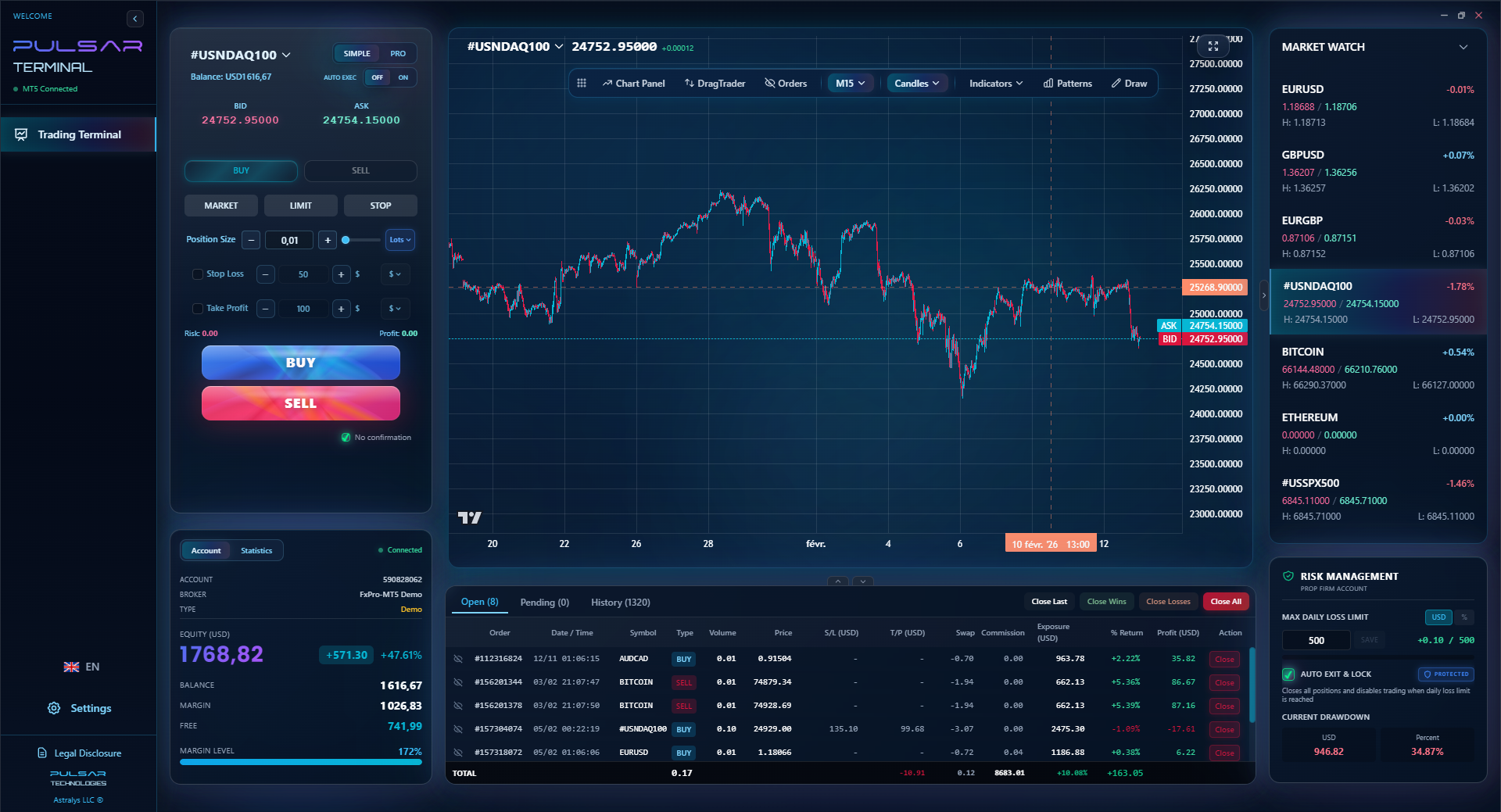
Once you've chosen a reliable broker with MT5, tools like Pulsar Terminal supercharge your trading with advanced order types and charting directly on your platform.
Pulsar Terminal
Công cụ MT5 tất-cả-trong-một: đặt lệnh kéo-thả, multi-TP/SL, trailing stop, grid trading, Volume Profile và bảo vệ prop firm. Hơn 1.000 trader sử dụng mỗi ngày.
“The recent increase to a R2 million offshore allowance gives South African traders more choice than ever before.”
The landscape isn't static. Some big shifts have happened that directly affect how you interact with brokers.
The Single Discretionary Allowance (SDA) Increase (Feb 2026): This is massive. The annual limit for taking money offshore for investment (like funding an international broker) doubled from R1 million to R2 million per person. You also don't need a Tax Compliance PIN from SARS for amounts under this limit. This makes it easier and more attractive for experienced traders to consider well-regulated offshore brokers if they wish, for access to specific markets or tools. It's a liberalization that gives you more choice.
FSCA Crypto Regulation: Since late 2022, crypto is a regulated financial product. Many forex brokers now offer crypto CFDs. This means if you trade Bitcoin through an FSCA-licensed broker, you have the same protections as with forex. It's no longer the wild west.
Tightened Controls for Non-Residents (Oct 2025): This works the other way. If you're a South African broker sending profits to a client overseas, the bank now has to check their SARS tax status. This doesn't directly impact most local retail traders, but it shows the regulator is tightening the system's integrity.
The takeaway? The trend is towards more formalization and more options. Your broker needs to be on top of these rules, and so should you. It's a sign of a maturing market where the serious trader can thrive.
FAQ
Q1Is it safe to use a forex broker not regulated by the FSCA?
It's riskier. While many offshore brokers are legitimate and regulated in other jurisdictions (like ASIC in Australia or CySEC in Cyprus), if you have a dispute, you must deal with a foreign regulator. With an FSCA broker, you have local recourse. For beginners, I always recommend starting with an FSCA-licensed broker for simplicity and protection.
Q2What's the difference between a market maker and an ECN/STP broker?
A market maker may take the other side of your trade internally (they 'make the market'), while an ECN/STP broker routes your order directly to other participants in an electronic network or to a liquidity provider. In practice, most modern brokers use a hybrid model. The key for you is the outcome: look at the execution quality, spreads, and whether there's a conflict of interest. FSCA regulation helps ensure fair treatment regardless of their model.
Q3Why does my broker's spread change, especially during news?
Because the actual market spread in the interbank market widens during high volatility. Your broker is reflecting that real-time liquidity. A fixed-spread account might not widen, but the broker may increase other risks like requotes or minimum distance for stops. Variable spreads are generally more transparent.
Q4Can I trade USD/ZAR with any forex broker?
Most international brokers offer USD/ZAR as a CFD (Contract for Difference). However, for direct access to the South African bond/forex market, you'd need a broker with a specific JSE license, which is different from a standard forex broker. For most retail forex trading, the CFD on USD/ZAR is the standard instrument.
Q5What happens if my South African forex broker goes bankrupt?
If they are properly FSCA-regulated, your client funds should be held in segregated accounts with a reputable bank. This means they are not part of the broker's assets and should be returned to you. This is a core reason why regulation is so important - it's your safety net.
Q6How do I verify a broker's FSCA license?
Go directly to the FSCA's official website (www.fsca.co.za) and use their 'Search for an FSP' function. Enter the broker's company name or the FSP number they provide. Don't rely on a certificate posted on the broker's site alone.
Bài học của Prof. Winston
Điểm chính:
- ✓Always verify FSCA license first - it's your primary shield.
- ✓Match the broker's cost model (spread vs. commission) to your trading frequency.
- ✓Use a ZAR account with local EFT to avoid hidden conversion fees.
- ✓Test execution and support before depositing real money.
Bài viết này hữu ích thế nào?
Nhấp vào ngôi sao để đánh giá
Nhận định giao dịch hàng tuần
Phân tích & chiến lược miễn phí hàng tuần. Không spam.
Về tác giả
David van der Merwe
Nhà giao dịch Thị trường Mới nổi
Trader tại Johannesburg với 11 năm kinh nghiệm về tiền tệ thị trường mới nổi. Chuyên về cặp ZAR, giao dịch theo quy định FSCA và phân tích thị trường Nam Phi.
Bình luận
Cảnh báo rủi ro
Giao dịch các công cụ tài chính tiềm ẩn rủi ro đáng kể và có thể không phù hợp với tất cả nhà đầu tư. Hiệu suất trong quá khứ không đảm bảo kết quả trong tương lai. Nội dung này chỉ mang tính chất giáo dục và không nên được coi là lời khuyên đầu tư. Hãy luôn tự nghiên cứu trước khi giao dịch.
Bạn cũng có thể thích

Cara Trading Forex Sukses: 7 Prinsip dari Trader Profesional
Cara trading forex sukses dengan 7 prinsip trader pro: manajemen modal, disiplin, journal trading, backtest. Data nyata, bukan janji profit palsu.
Jam Trading Forex Terbaik untuk Trader Indonesia: Panduan Lengkap dengan Tabel Waktu
Panduan jam trading forex untuk trader Indonesia. Tabel 4 sesi dunia, jam emas 20:00-00:00, sesi mana yang harus dihindari. Data akurat + tips dari trader berpengalaman.
Top 5 Sàn Forex Uy Tín Nhất 2026: Review Jujur dari Trader Indonesia
Top 5 sàn forex uy tín 2026 untuk trader Indonesia. Review jujur: spread, deposit, withdraw, dukungan lokal. Exness, XM, IC Markets & lebih.
Tải Pulsar Terminal
Tất cả các công cụ tính này được tích hợp trong Pulsar Terminal với dữ liệu thời gian thực từ tài khoản MT5 của bạn.
Tải Pulsar Terminal