


Most traders I've met here in SA think the FOMC is just another news event.

David van der Merwe
Nhà giao dịch Thị trường Mới nổi ·  South Africa
☕ 11 phút đọc
Bạn sẽ học được:
- 1FOMC Explained: It's Not Just About Interest Rates
- 2Why the FOMC Moves Every Market (Including ZAR)
- 3FOMC Trading Strategies: What Actually Works
- 4FOMC Lingo Decoded: Hawk, Dove, Dot Plot
- 5Your FOMC Day Checklist: A Step-by-Step Plan
- 6The Top 3 FOMC Mistakes (And How to Avoid Them)
- 7Essential Tools & Resources for South African Traders
Most traders I've met here in SA think the FOMC is just another news event. They treat it like a CPI print or an employment report, maybe setting a wider stop and calling it a day. That's a fantastic way to get your account shredded. The Federal Open Market Committee isn't just news, it's the single most potent volatility catalyst in the forex market. If you're trading USD/ZAR, EUR/USD, or gold, and you don't have a specific plan for FOMC days, you're gambling. I've seen it wipe out weeks of gains in minutes. Let's set the record straight on what is FOMC in forex and, more importantly, how you can trade it without losing your shirt.
Alright, let's break this down without the finance-speak. The FOMC, or Federal Open Market Committee, is the crew at the US Federal Reserve that decides monetary policy. They meet eight times a year, roughly every six weeks. Their main job? To steer the US economy by controlling the price of money.
Now, here's where most new traders get it wrong. They think the only thing that matters is whether they hike, cut, or hold interest rates. That's part of it, but it's often the least surprising part. The market usually prices in the rate decision weeks in advance. The real fireworks come from two other things: the FOMC Statement and the Press Conference.
The Statement is the official release. Traders rip through it word by word, looking for changes from the last one. A single altered phrase like "additional policy firming may be appropriate" versus "the Committee will proceed carefully" can send the Dollar Index flying or crashing. Then, about 30 minutes later, the Fed Chair (currently Jerome Powell) holds a live press conference. This is where unscripted questions lead to off-the-cuff answers that can completely redefine the market's understanding. He might downplay inflation concerns or hint at future pain, and the market reacts in real-time. For a full breakdown of how this impacts major pairs, our EUR/USD guide covers the dynamics in detail.

Warning: Don't just watch the rate decision ticker. If you're not reading the statement and listening to the presser, you're trading blind. The initial spike on the headline is often a trap that reverses violently minutes later.

💡 Mẹo của Winston
The market's expectation is the true benchmark. A ‘dovish hike' (hiking but hinting it's the last one) can make the dollar fall. It's all about the surprise relative to what's priced in.
“The Federal Open Market Committee isn't just news, it's the single most potent volatility catalyst in the forex market.”
You might be sitting in Johannesburg or Cape Town wondering why a committee in Washington dictates the fate of your USD/ZAR trade. The answer is simple: the US Dollar is the world's reserve currency. When the Fed changes the cost of borrowing the world's most important money, it sends shockwaves everywhere.
The Dollar's Domino Effect
Higher US interest rates make dollar-denominated assets more attractive. Global capital flows out of emerging markets (like South Africa) and into US Treasuries seeking better, safer yields. This creates a double-whammy for USD/ZAR: 1) Increased demand for USD, and 2) Selling pressure on ZAR and other EM currencies. I've seen USD/ZAR rip 150-200 pips in the 30 minutes after a hawkish Fed surprise. It's brutal.
The Global Risk Gauge
The Fed's tone directly sets the market's "risk-on" or "risk-off" mood. A dovish Fed (hinting at cuts or pause) encourages risk-taking. Money flows into stocks, commodities, and higher-yielding currencies. A hawkish Fed (threatening more hikes) triggers risk-off. Everyone runs for the exits, buying dollars and selling everything else, including gold and the Rand. This is why instruments like XAU/USD are so sensitive to these events.
The Local Impact Here in SA
Our own SARB decisions are often seen through the lens of the Fed. If the Fed is hiking, the SARB has less room to cut rates to stimulate our economy, even if we need it. Traders price this in ahead of time. So, you're not just trading the US story, you're trading the implied constraint on our own central bank. Understanding this interconnectedness is key for any swing trading plan involving ZAR pairs.
“If you're not reading the statement and listening to the presser, you're trading blind.”
I've tried every FOMC strategy under the sun over 12 years. Most of them lose money. Let me save you the trouble and tell you what has a fighting chance.
The Pre-News Squeeze (My Preferred Approach)
This isn't about trading the news itself. It's about trading the calm before the storm. In the 4-12 hours before the FOMC, volatility often compresses. Price gets stuck in a painfully tight range as everyone waits. I look to place trades at the very edges of this range, before the news hits.
Here's a real example from September 2023: EUR/USD was coiled between 1.0680 and 1.0720 for 8 hours pre-FOMC. I sold at 1.0715, just 5 pips below the high, with a stop 20 pips above. My target wasn't some grand move, it was just a return to the middle of the range at 1.0700. I banked 15 pips and closed the trade 30 minutes before the announcement. No stress, no drama. The key is using a tight stop and a modest target. You're not trying to catch the news move, you're harvesting the nervous energy of the market.
The Post-News Trend Follow (For the Brave)
This is higher risk. You wait for the initial madness to settle. The first 2-5 minutes after the statement are pure chaos - ignore them. Then, watch for a clear, sustained break in one direction with heavy volume. The trick is to wait for the first pullback and then enter in the direction of the break.
Crucial Rule: Your stop must be on the other side of the pre-news range, not just the recent swing low/high. The market often tries to fake everyone out. This strategy requires a cool head and a reliable broker with fast execution during high volatility, like IC Markets or Pepperstone.
What DOESN'T Work (From Painful Experience)
- Trying to ‘guess' the outcome and placing a huge order just before. This is gambling. I lost R8,000 in 2017 on one such ‘clever' bet on GBP/USD.
- Trading the immediate spike. The first move is often a liquidity grab that reverses. It's like trying to catch a falling knife.
- Holding through the event without a plan. This is how you get a margin call.

Pro Tip: However you trade it, reduce your position size to 25-50% of your normal lot size. The volatility is 5-10x normal. This isn't the time for heroics. Use a position size calculator to be precise.
“If you're not reading the statement and listening to the presser, you're trading blind.”
The Fed has its own language. If you don't speak it, you'll misinterpret everything. Here's your cheat sheet.
| Term | What It Means | Market Reaction (Typically) |
|---|---|---|
| Hawkish | Focused on fighting inflation, willing to hike rates. | USD STRENGTHENS. Bonds sell off, yields rise. ZAR weakens. |
| Dovish | Focused on supporting growth/jobs, leaning towards rate cuts or pause. | USD WEAKENS. Stocks & gold may rally. Risk-on helps EMs. |
| Dot Plot | A chart showing each FOMC member's forecast for future rates. | The median dot is key. A shift higher = hawkish surprise. |
| Quantitative Tightening (QT) | The Fed reducing its balance sheet (unprinting money). | A hawkish tool. Faster QT = stronger USD. Slowing QT = can be dovish. |
| Data Dependent | They'll decide meeting-to-meeting based on incoming data. | This phrase introduces uncertainty, often increasing volatility. |
| Transitory | (Infamous word) Means inflation is temporary. | If they use it when inflation is high, market sees it as out of touch = volatility. |
The ‘Dot Plot' is Your Best Friend: This is the Fed's own forward guidance. Don't just look at the current rate decision. Look at where the dots are for the end of the year and next year. If in June the median dot for December jumps from 4.5% to 5.0%, that's a massively hawkish signal, even if they paused that day.
💡 Mẹo của Winston
On FOMC day, your first job is capital preservation, not profit maximisation. Getting flat and watching is a valid, professional strategy.
“The initial spike on the headline is often a trap that reverses violently minutes later.”
Winging it is not a strategy. Here's exactly what I do on FOMC days, from waking up to closing my charts.
1. Morning (SA Time):
- Close or hedge existing USD/ZAR, EUR/USD, gold positions. I'm serious. Unless it's a multi-week swing trade miles away from price, just get flat. The random noise can hit your stop for no good reason.
- Check the consensus forecast. What is the market expecting? A 0.25% hike? A pause? This sets the baseline.
- Identify key technical levels on the 1-hour and 15-minute charts for your chosen pair. Draw clear support and resistance lines.
2. 1 Hour Before (19:00 SA Time):
- Stop trading. No new entries. Let the market squeeze.
- Have your broker's economic calendar open for the live feed. Have the Fed's website ready for the statement PDF.
- Decide your game plan. Are you sitting out? Trading the pre-squeeze? Waiting for post-news? Write it down.
3. At the Release (19:30 SA Time):
- READ THE STATEMENT. Compare it line-by-line to the previous one on a site like ForexLive. Look for the keywords (hawkish/dovish) from our table.
- Ignore the first 90-second price spike. It's nonsense.
- Listen to Powell. Watch the US 2-Year Treasury yield. It's the fastest-reacting gauge of Fed expectations. If yields jump, the USD is going up.
4. After the Chaos (From 20:15 SA Time):
- Look for the established trend. Use a simple indicator like the MACD indicator on a 5-minute chart to confirm momentum.
- Enter only if your pre-defined setup triggers. If it doesn't, you live to trade another day. There's no prize for forcing a trade.

Example: Let's say the Fed is expected to pause. The statement comes out and says "inflation remains elevated and the labor market is tight" (hawkish) but they paused (as expected). The market will focus on the hawkish language. USD starts to rise. I wait for the initial USD spike, then a pullback to a minor support level on the 5-min chart. If it holds and the RSI indicator shows the pullback is over, I might enter a USD-long trade on EUR/USD.
“The initial spike on the headline is often a trap that reverses violently minutes later.”
Let's be blunt. These are the account killers I see every single time.
1. Chasing the Initial Spike. The headline flashes ‘FED HIKES RATES 0.25%'. USD/JPY rockets 40 pips in 10 seconds. You FOMO buy, thinking the move will continue. Then, traders actually read the statement, find a dovish hint, and the pair reverses, taking out your tight stop. You're down 50 pips in two minutes. The Fix: Wait. For. The. Pullback. The real trend establishes after the emotional overreaction.
2. Not Accounting for Increased Spreads. Your broker isn't stupid. During FOMC, the spread definition on EUR/USD can widen from 0.8 pips to 10 pips or more. If you're trying a scalping strategy, you're instantly in a huge hole. I got caught by this early on with a broker that wasn't great on news events. The Fix: Trade with a broker known for stable spreads during news, like Exness or XM, and always assume your entry cost will be worse than expected.
3. Letting a Winner Turn into a Loser. You get lucky and catch a 60-pip move post-FOMC. Greed sets in. ‘This is the new trend!‘ you think. You move your stop to breakeven and let it ride. Then, the next day, Asian session profit-taking reverses the entire move. You get stopped at breakeven after being up big. The Fix: Have a profit-taking plan. Take 50-70% off the table when you have a decent gain (say, 40-50 pips). Move your stop to lock in some profit on the remainder. Don't give it all back.
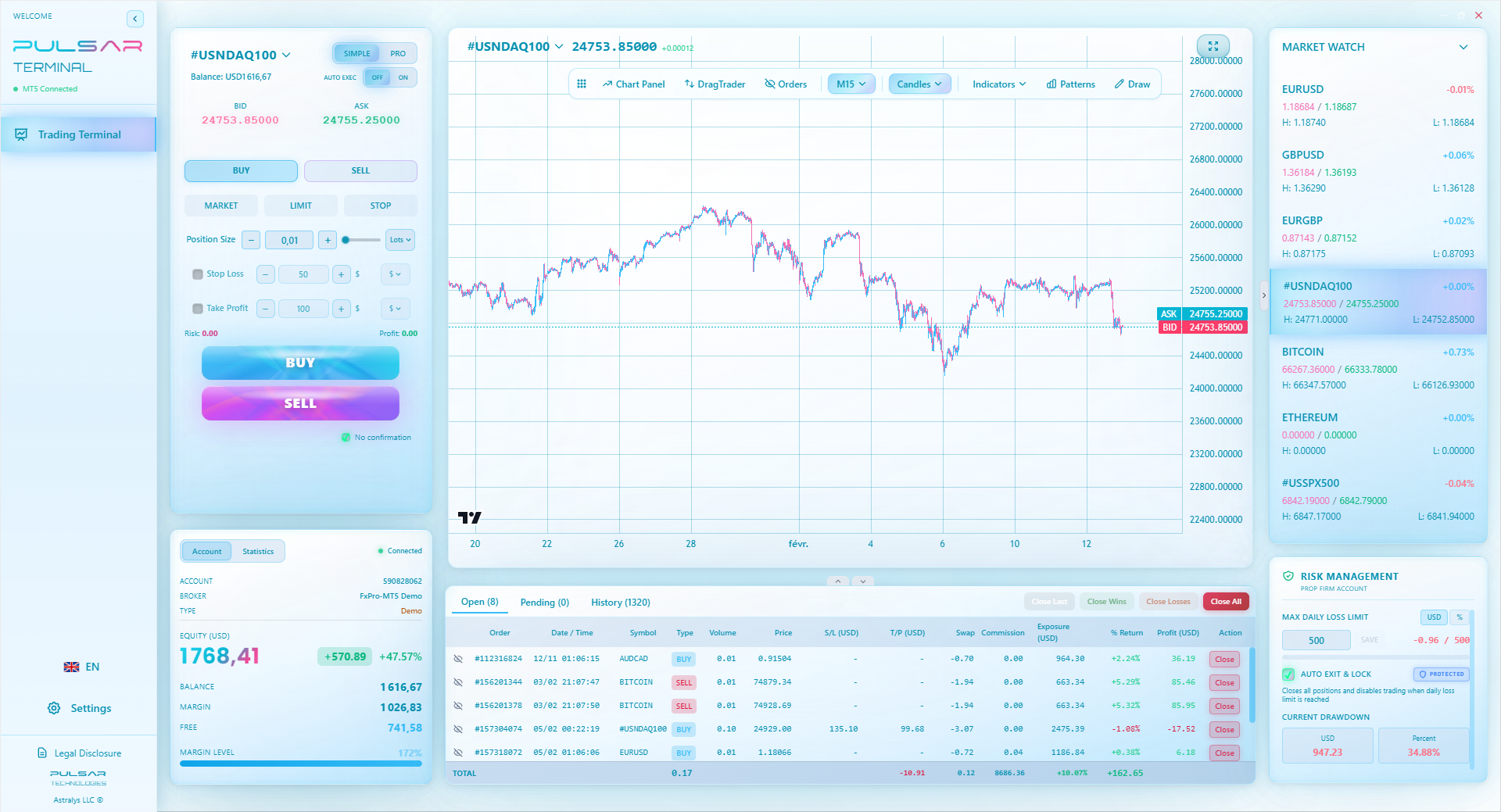
Managing multiple trades and protecting profits during FOMC chaos is nearly impossible manually, which is why tools like Pulsar Terminal that automate trailing stops and partial closures on MT5 are essential.
Pulsar Terminal
Công cụ MT5 tất-cả-trong-một: đặt lệnh kéo-thả, multi-TP/SL, trailing stop, grid trading, Volume Profile và bảo vệ prop firm. Hơn 1.000 trader sử dụng mỗi ngày.
“Sometimes the best trade on FOMC day is no trade at all.”
You don't need a Bloomberg terminal. Here are the free/cheap resources I actually use.
Economic Calendars:
- ForexFactory.com: The classic. Set your timezone to GMT+2 (SAST). The volatility meter is useful.
- Investing.com: Good for a quick consensus vs. actual read.
Live Analysis & Commentary:
- Fed's Official Website: For the pristine statement PDF and live video of the presser.
- ZeroHedge or ForexLive: For real-time textual analysis of the statement as it drops. Take ZeroHedge's dramatic tone with a grain of salt, but their speed is good.
Charting & Execution:
- Your Broker's Platform: Ensure it's stable. Test it on a minor news day first.
- A Reliable VPS: If your home internet is flaky (load-shedding, anyone?), a Virtual Private Server keeps your trades running. It's non-negotiable for serious news trading.
- Pips Calculator: Know your risk in Rands, not just pips. A 50-pip stop on USD/ZAR is a very different amount of money than 50 pips on EUR/USD.
The bottom line? Treat the FOMC with the respect it demands. Have a plan, trade small, and remember that sometimes the best trade is no trade at all. There will always be another opportunity next month.

FAQ
Q1What time is the FOMC announcement in South Africa?
The FOMC statement is almost always released at 20:00 South African Standard Time (SAST). The press conference with the Fed Chair follows at 20:30 SAST. This is 2:00 PM Eastern Time in the US. Mark it in your calendar.
Q2Should I trade USD/ZAR during the FOMC?
Only if you have significant experience and a crystal-clear plan. USD/ZAR is already a volatile pair, and FOMC volatility can be extreme. The spreads will widen dramatically. For most retail traders, it's safer to observe or trade less volatile majors like EUR/USD if you must trade during the event.
Q3How long does the FOMC volatility last?
The most intense, chaotic volatility lasts about 10-15 minutes after the statement. However, the new trend or direction can take 1-2 hours to properly establish during and after the press conference. Elevated volatility often continues into the next trading day.
Q4What's more important, the rate decision or the Fed Chair's press conference?
For market movement, the press conference is almost always more important. The rate decision is usually anticipated. The press conference provides context, tone, and answers to unscripted questions that can completely change the market's interpretation. Always listen to Powell.
Q5Can I trade gold (XAU/USD) during FOMC?
Gold is highly sensitive to FOMC outcomes as it's a non-yielding asset. A hawkish Fed (higher rates) is typically bad for gold, while a dovish Fed is good. The volatility is enormous. If you trade it, use a tiny position size and place orders well away from the market to avoid terrible spreads.
Q6How can I practice trading the FOMC without risking money?
Open a demo account with a broker that offers real-time news feeds (like XM or IC Markets). Practice your plan on the next 2-3 FOMC events. Track your demo trades as if they were real. This will expose flaws in your timing and emotional control without the financial pain.
Bài học của Prof. Winston
Điểm chính:
- ✓The press conference matters more than the rate decision.
- ✓Always reduce position size by 50-75% for FOMC.
- ✓Trade the pre-news squeeze, not the news spike.
- ✓Watch the 2-Year US Treasury yield for the fastest signal.
Bài viết này hữu ích thế nào?
Nhấp vào ngôi sao để đánh giá
Nhận định giao dịch hàng tuần
Phân tích & chiến lược miễn phí hàng tuần. Không spam.
Về tác giả
David van der Merwe
Nhà giao dịch Thị trường Mới nổi
Trader tại Johannesburg với 11 năm kinh nghiệm về tiền tệ thị trường mới nổi. Chuyên về cặp ZAR, giao dịch theo quy định FSCA và phân tích thị trường Nam Phi.
Bình luận
Cảnh báo rủi ro
Giao dịch các công cụ tài chính tiềm ẩn rủi ro đáng kể và có thể không phù hợp với tất cả nhà đầu tư. Hiệu suất trong quá khứ không đảm bảo kết quả trong tương lai. Nội dung này chỉ mang tính chất giáo dục và không nên được coi là lời khuyên đầu tư. Hãy luôn tự nghiên cứu trước khi giao dịch.
Bạn cũng có thể thích

Cara Trading Forex Sukses: 7 Prinsip dari Trader Profesional
Cara trading forex sukses dengan 7 prinsip trader pro: manajemen modal, disiplin, journal trading, backtest. Data nyata, bukan janji profit palsu.
Jam Trading Forex Terbaik untuk Trader Indonesia: Panduan Lengkap dengan Tabel Waktu
Panduan jam trading forex untuk trader Indonesia. Tabel 4 sesi dunia, jam emas 20:00-00:00, sesi mana yang harus dihindari. Data akurat + tips dari trader berpengalaman.
Top 5 Sàn Forex Uy Tín Nhất 2026: Review Jujur dari Trader Indonesia
Top 5 sàn forex uy tín 2026 untuk trader Indonesia. Review jujur: spread, deposit, withdraw, dukungan lokal. Exness, XM, IC Markets & lebih.
Tải Pulsar Terminal
Tất cả các công cụ tính này được tích hợp trong Pulsar Terminal với dữ liệu thời gian thực từ tài khoản MT5 của bạn.
Tải Pulsar Terminal