


Here's the biggest lie you'll hear in trading forums: "Just use a wide stop loss and let your trade breathe." For a South African trader starting with a few thousand Rand, that's a one-way ticket to a margin call.

David van der Merwe
Nhà giao dịch Thị trường Mới nổi ·  South Africa
☕ 9 phút đọc
Bạn sẽ học được:
Here's the biggest lie you'll hear in trading forums: "Just use a wide stop loss and let your trade breathe." For a South African trader starting with a few thousand Rand, that's a one-way ticket to a margin call. I've seen it wipe out accounts faster than load-shedding knocks out the power. A Stop Loss (SL) isn't a suggestion or a sign of weakness, it's your financial circuit breaker. Let's cut through the nonsense and talk about what SL in forex really means for you, how to set it properly under FSCA rules, and why getting this wrong is the single biggest reason local traders fail.
A Stop Loss (SL) is an automated order you place with your broker to close a losing trade at a predetermined price. Think of it as setting an alarm for your worst-case scenario. You're telling the platform, "If this trade goes south by this much, get me out. No questions asked."
For example, if you buy EUR/USD at 1.1000, setting an SL at 1.0950 means you're willing to risk 50 pips on that trade. If price drops to 1.0950, your broker closes the position automatically. You don't have to be watching the charts. You could be dealing with an Eskom outage, and your SL is still working.
The opposite is a Take Profit (TP) order, which closes a winning trade. Never, and I mean never, place a trade without both. It's like driving without a seatbelt. You might get away with it for a while, but when you crash, it's catastrophic.

Warning: A "mental stop loss" is worthless. That's just you telling yourself you'll be disciplined later. When price is crashing and you're watching your hard-earned Rand evaporate, emotion takes over. You'll move the goalposts every time. An automated SL removes you from the equation.
The Psychology of Loss
We're wired to avoid pain. In trading, that means we hold onto losing trades, hoping they'll turn around, and we sell winning trades too early to lock in a small gain. It's a recipe for one big loss wiping out ten small wins. An SL automates the painful part. It accepts a small, planned loss so you can live to trade another day. I learned this the hard way in 2018 on a USD/ZAR trade. I was long from 14.20, didn't set an SL because "I had a feeling," and watched it sink to 14.80. That 600-pip loss took me three months of disciplined trading to recover from. Never again.
The Math of Survival
Let's talk numbers. Say you start with R20,000. A 10% loss is R2,000. To get back to R20,000 from R18,000, you need an 11.1% return. A 50% loss (R10,000) requires a 100% return just to break even. The deeper the hole, the harder the climb. Your SL defines the size of the hole you're willing to dig on any single trade.
The Local Reality: Volatility & Gaps
Pairs with the ZAR, like USD/ZAR or EUR/ZAR, can be wild. Political news, commodity price swings, or SARB announcements can cause sharp moves. Your SL is your protection against a gap - when price jumps from one level to another without trading in between. If you're leveraged 1:100 on USD/ZAR and it gaps against you, you could owe your broker more than your initial deposit. An SL won't always save you from a gap (it becomes a Market Order), but it's your primary defence.
Using a position size calculator is non-negotiable. It tells you exactly how many lots to trade based on your account size, your SL in pips, and your risk percentage.

💡 Mẹo của Winston
Your first job isn't to make money, it's to not lose money. The SL is your foreman for that job. Fire it if it doesn't show up for work.
“I'd rather take ten small, planned losses following my rules than one massive, emotional loss that wrecks my account.”
This is where most guys mess up. They pick a round number (like 20 pips) because it sounds good. That's gambling, not trading. Your SL must be based on something concrete in the market.
Technical Levels: The Smart Way
Place your SL beyond a key market structure level. If you're buying because price bounced off support, your SL goes below that support zone. The market is telling you, "If price goes here, my idea is wrong." For selling at resistance, your SL goes above it. This gives your trade room to breathe without being taken out by normal market noise.
I once shorted GBP/JPY based on a clear rejection at a weekly resistance level. My SL was placed 15 pips above that high. Price came within 3 pips of my SL, shook me out mentally, but didn't trigger it. It then fell 200 pips. If I'd used a random 30-pip SL, I'd have been stopped out for a loss.
The 1-2% Rule (The Capital Preservation Law)
Never risk more than 1-2% of your total trading capital on a single trade. For a R10,000 account, that's R100-R200 max risk per trade. Your SL distance (in pips) and your position size work together to achieve this.

Example: You have a R15,000 account (2% risk = R300). You want to buy EUR/USD at 1.0850 with an SL at 1.0820 (30 pips risk). The pip value for a standard lot (100,000 units) on EUR/USD is roughly $10. At a USD/ZAR rate of 18.50, that's about R185 per pip. To risk only R300, your position size must be: R300 / (30 pips * R185/pip) = ~0.054 lots. You'd trade a 0.05 micro lot.
What About Trailing Stops?
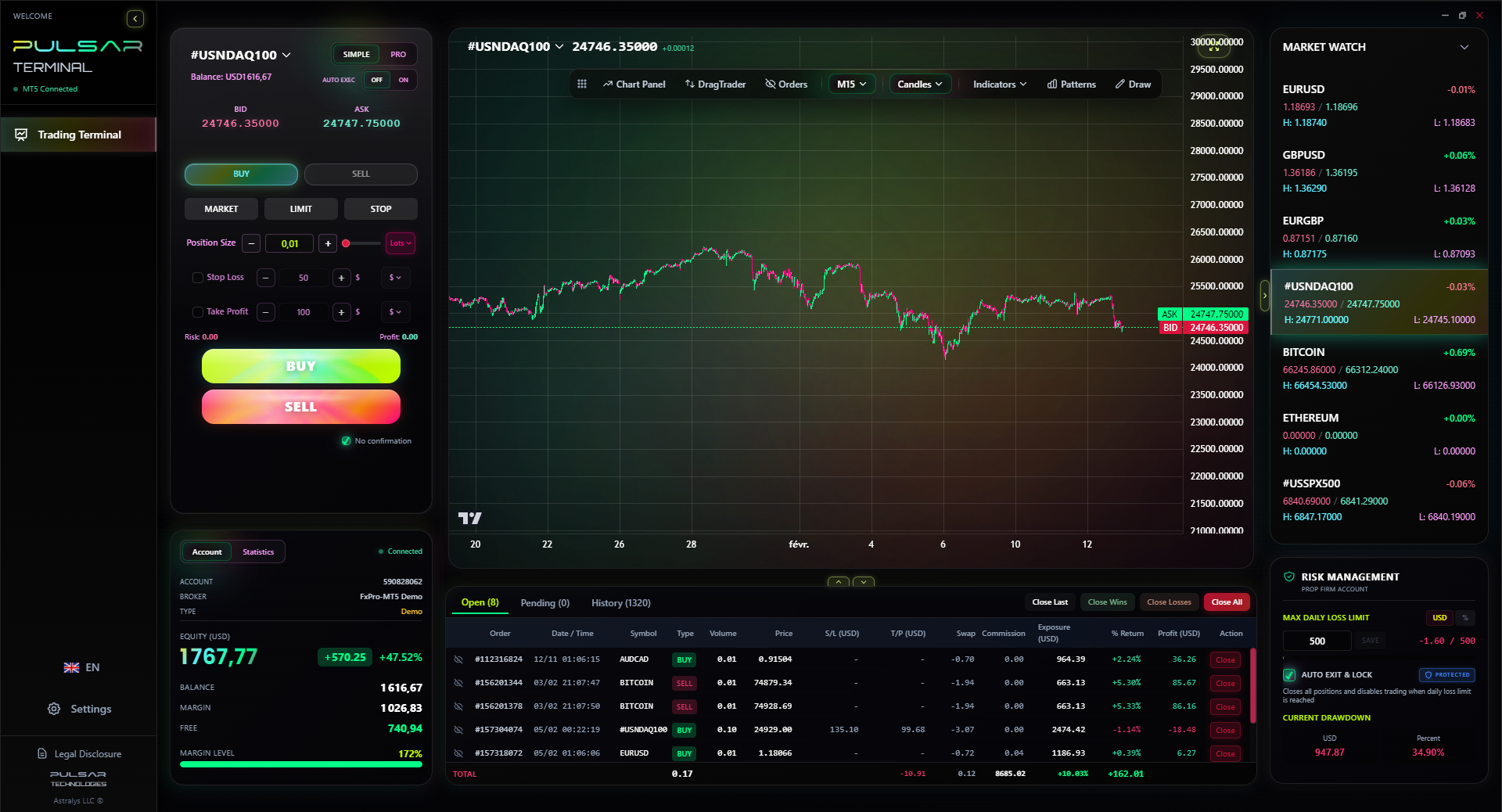
A trailing stop is an SL that moves with the price when you're in profit. It locks in gains. It's fantastic for swing trading trends. But don't start with it. Master a fixed SL first. Tools like Pulsar Terminal can automate trailing stops on MT5, which is a game-saver when you can't watch the screen.
1. Placing It Too Close: This is the fear-based SL. You set it 5 pips away because you're scared to lose money. The market's normal volatility will slap you out of good trades constantly, leaving you with a string of small losses. It's death by a thousand cuts.
2. Placing It Too Wide (or Not at All): The ego-based approach. "My analysis is so good, I don't need one." Or you set it so far away that a 2% risk rule would mean trading a tiny, pointless position. You're either taking a massive risk or not making any money when you're right.
3. Moving It Away From Price: Price hits your SL level, you panic, and you drag the SL order further away, giving the trade "more room." You've just violated your plan and guaranteed a larger loss. The only time you should move an SL is to lock in profit (breakeven or trailing).
4. Ignoring Broker Specifics: Not all orders are equal. A Stop-Loss Market Order is the standard. But know the difference between that and a Guaranteed Stop Loss (GSL). A GSL costs extra but protects you from gaps. Most FSCA-regulated brokers like IG or AvaTrade offer them. Check your broker's policy on slippage, especially on exotic ZAR pairs.
5. Forgetting About Spreads: Your SL is triggered when the bid (for sells) or ask (for buys) price hits your level. If the spread on EUR/ZAR is 14 pips wide, you're already 14 pips "in the hole" when you enter. Factor that into your risk calculation.
💡 Mẹo của Winston
If you feel the urge to remove or widen your SL, close the trade immediately. Your emotion has already overruled your strategy, and you've lost.
“The only time you should move an SL is to lock in profit. Moving it away from price is just delaying a funeral.”
Trading with an FSCA-licensed broker is your first line of defence. It means they have to play by rules designed to protect you, at least a bit.
use & Margin Calls: SA regulators allow use up to 1:500. That's a double-edged sword. High use amplifies gains AND losses. Your SL is critical here. If your losses eat into your required margin, you'll get a margin call and your positions could be liquidated. Your SL should be set to prevent this from happening.
Broker Execution: How your SL is executed matters. With a reputable broker like IC Markets or Pepperstone, an SL usually executes near your specified price. With a shady bucket shop, they might manipulate prices to "stop hunt" and trigger your SL before the market reverses. This is why regulation matters. The FSCA's 2025 crackdown, fining unauthorised schemes R2.1 million, shows they're trying to clean up the space.
Prop Firm Challenges: Many local traders are trying prop firm challenges. These have strict daily loss limits. Your SL isn't just about protecting capital; it's about staying in the game. A tool that can automatically enforce a max daily loss is worth its weight in gold for this.

Pro Tip: Always test your broker's execution on a demo account. Place trades and set SL/TP orders to see how smoothly they're filled, especially during volatile news events. Don't risk your ZAR until you're confident in their systems.
Once you're consistent with a fixed SL, you can explore more sophisticated tactics.
Breakeven Stop: When a trade moves in your favour by a certain amount (e.g., 1.5x your initial risk), move your SL to your entry price. This eliminates the risk on the trade. You're now playing with the market's money.
Partial Closure & Multi-TP/SL: This is a power move. Instead of one SL and one TP for your entire position, you split it. Close part of the position at TP1 (banking some profit) and move the SL for the remainder to breakeven. Let the rest run with a trailing stop. This balances profit-taking with letting winners run. Manually managing this is a headache; software that can do it with a few clicks is a massive advantage.
Volatility-Based Stops: Use the Average True Range (ATR) indicator. Set your SL distance as a multiple of the ATR (e.g., 1.5 x ATR). This automatically adjusts your stop width to current market volatility. On a calm EUR/USD day, your stop is tighter. On a wild USD/ZAR day, it's wider, giving the trade the space it needs.
The Bottom Line: Your SL is the most important order you'll ever place. It's not about being right on every trade; it's about being wrong and still being here tomorrow. I'd rather take ten small, planned losses following my rules than one massive, emotional loss that wrecks my account. That's the difference between a punter and a trader.
💡 Mẹo của Winston
Test your SL level before entering. Ask: 'If price hits this level, will I still believe in my trade idea?' If the answer is yes, your SL is in the wrong place.
Managing advanced techniques like breakeven stops and partial closures manually is chaotic, but Pulsar Terminal automates it all directly on your MT5 platform.
Pulsar Terminal
Công cụ MT5 tất-cả-trong-một: đặt lệnh kéo-thả, multi-TP/SL, trailing stop, grid trading, Volume Profile và bảo vệ prop firm. Hơn 1.000 trader sử dụng mỗi ngày.
FAQ
Q1What's the difference between a Stop Loss and a Take Profit?
A Stop Loss (SL) closes a trade at a loss to limit downside. A Take Profit (TP) closes a trade at a profit to lock in gains. You should always have both orders set before entering any trade. They are the two sides of your risk management plan.
Q2Where should I place my Stop Loss?
Don't pick a random number. Place it just beyond a key technical level that invalidates your trade idea. If buying at support, put the SL below support. If selling at resistance, put it above resistance. This uses market structure, not guesswork.
Q3Is a 50-pip Stop Loss good?
There's no universal "good" pip amount. It depends on the currency pair (50 pips on EUR/USD is different to 50 pips on USD/ZAR), the time frame, and the market's volatility. A 50-pip SL is only "good" if it aligns with a technical level and, when combined with your position size, risks 1-2% of your account.
Q4Can I trade without a Stop Loss?
You can, but you absolutely shouldn't. Trading without an SL is like driving blindfolded. You're relying on hope instead of a plan. Professional traders use SLs religiously. The ones who don't usually don't stay professionals for long.
Q5What happens if there's a price gap and my Stop Loss is missed?
A Stop Loss becomes a Market Order once triggered. If price gaps past your SL level, your order will be filled at the next available price, which could be significantly worse than your SL. This is called slippage. A Guaranteed Stop Loss (offered by some brokers for a fee) protects against this but is more expensive.
Q6How does use in South Africa affect my Stop Loss?
High use (like 1:500 allowed in SA) magnifies everything. A small move against you can cause a large loss in Rand terms. Your SL distance must be tighter, or your position size must be much smaller, to maintain the same percentage account risk. use makes precise SL placement critical.
Q7Should I move my Stop Loss if the trade is going against me?
No. Never move your SL further away to avoid a loss. This destroys your risk plan. The only time you should move an SL is to lock in profit (e.g., to breakeven or to trail it higher in a winning trade).
Bài học của Prof. Winston
Điểm chính:
- ✓Never enter a trade without a pre-set Stop Loss and Take Profit.
- ✓Risk a maximum of 1-2% of your account per trade.
- ✓Base your SL on technical levels, not random pip amounts.
- ✓Use a position size calculator for every single trade.
- ✓FSCA regulation is your baseline protection - use licensed brokers.
Bài viết này hữu ích thế nào?
Nhấp vào ngôi sao để đánh giá
Nhận định giao dịch hàng tuần
Phân tích & chiến lược miễn phí hàng tuần. Không spam.
Về tác giả
David van der Merwe
Nhà giao dịch Thị trường Mới nổi
Trader tại Johannesburg với 11 năm kinh nghiệm về tiền tệ thị trường mới nổi. Chuyên về cặp ZAR, giao dịch theo quy định FSCA và phân tích thị trường Nam Phi.
Bình luận
Cảnh báo rủi ro
Giao dịch các công cụ tài chính tiềm ẩn rủi ro đáng kể và có thể không phù hợp với tất cả nhà đầu tư. Hiệu suất trong quá khứ không đảm bảo kết quả trong tương lai. Nội dung này chỉ mang tính chất giáo dục và không nên được coi là lời khuyên đầu tư. Hãy luôn tự nghiên cứu trước khi giao dịch.
Bạn cũng có thể thích

Cara Trading Forex Sukses: 7 Prinsip dari Trader Profesional
Cara trading forex sukses dengan 7 prinsip trader pro: manajemen modal, disiplin, journal trading, backtest. Data nyata, bukan janji profit palsu.
Jam Trading Forex Terbaik untuk Trader Indonesia: Panduan Lengkap dengan Tabel Waktu
Panduan jam trading forex untuk trader Indonesia. Tabel 4 sesi dunia, jam emas 20:00-00:00, sesi mana yang harus dihindari. Data akurat + tips dari trader berpengalaman.
Top 5 Sàn Forex Uy Tín Nhất 2026: Review Jujur dari Trader Indonesia
Top 5 sàn forex uy tín 2026 untuk trader Indonesia. Review jujur: spread, deposit, withdraw, dukungan lokal. Exness, XM, IC Markets & lebih.
Tải Pulsar Terminal
Tất cả các công cụ tính này được tích hợp trong Pulsar Terminal với dữ liệu thời gian thực từ tài khoản MT5 của bạn.
Tải Pulsar Terminal