


You're sitting there, charts open, wondering why the market feels dead or why you just got stopped out in a random spike.

Olumide Adeyemi
Nhà tiên phong Giao dịch Tây Phi ·  Nigeria
☕ 12 phút đọc
Bạn sẽ học được:
- 1Why Timing Isn't Just About Convenience
- 2The Nigerian (WAT) Trading Schedule Decoded
- 3Matching Your Strategy to the Clock
- 4Local Costs, Brokers, and Naira Considerations
- 5My Biggest Timing Mistakes (And What I Learned)
- 6Putting It All Together: A Nigerian Trader's Daily Routine
- 7Final Thoughts: Trading is a Marathon
You're sitting there, charts open, wondering why the market feels dead or why you just got stopped out in a random spike. Sound familiar? The single biggest mistake I made for years was trading at the wrong time. I'd try to force moves during the Asian session, get chopped up, and miss the real action when London and New York overlapped. Your location in Nigeria, on West Africa Time (WAT), is a massive advantage if you know how to use it. Let's break down exactly when is the best time to trade forex from Lagos, Abuja, or Port Harcourt, and I'll share the hard lessons I learned the expensive way.
When I started, I thought the 24-hour market meant I could trade whenever I fancied. That belief cost me real money. Timing dictates three things that directly hit your P&L: liquidity, volatility, and spread costs.
Liquidity is the market's depth. High liquidity means your orders get filled at the price you want, not some slippage-filled nightmare. Volatility is the size of the price swings. You need movement to make money, but chaotic, news-driven volatility can wipe you out. The spread is the broker's cut, the difference between the buy and sell price. It's your first hurdle to profitability.
Here's the kicker: these three factors change dramatically throughout the day. Trading during the thin, sleepy Asian session (1:00 AM - 10:00 AM WAT) often means wider spreads and erratic, news-driven spikes. I remember placing a seemingly safe EUR/USD trade at 4:00 AM WAT, only for a random Japanese data release to trigger a 15-pip spike against me in seconds. The spread had ballooned to 3 pips on a normally 0.6-pip pair. Lesson learned the hard way.

Warning: Trading during low-liquidity periods (like late New York session or Asian session) exposes you to 'slippage' where your order fills at a worse price than expected, and wider spreads that eat into profits.
The real opportunity for us in Nigeria lies in the sessions where the big players - banks, funds, institutions - are most active. That's where the clean, high-volume moves happen. Your job isn't to trade all day. It's to identify the 3-4 hour window where the odds are most in your favor and be laser-focused then. For a deeper look at managing risk during these volatile windows, a solid position size calculator is non-negotiable.

💡 Mẹo của Winston
The market pays you for patience, not effort. Three high-quality trades in the Power Hour are worth thirty forced trades in the dead of night.
“Your location in Nigeria, on West Africa Time (WAT), is a massive advantage if you know how to use it.”
Forget GMT. We live on West Africa Time (GMT+1). This is your primary lens. Daylight Saving Time (DST) in Europe and the US will shift these by an hour, usually from late March to late October. Always double-check your economic calendar for DST notes.
The Asian Session (Tokyo): 1:00 AM – 10:00 AM WAT
This is the quiet shift. Volatility is generally low, spreads can be wider. Pairs like AUD/USD or NZD/USD might see some action, but the majors often drift. I used to try scalping strategy here, hunting for 5-10 pip moves. It was exhausting and largely unprofitable. The only exception is if you're trading JPY crosses (like GBP/JPY), which can be active. For most Nigerian traders, this is analysis time, not trading time.
The European/London Session: 9:00 AM – 6:00 PM WAT
This is where our day truly begins. Liquidity pours in as London, the world's largest forex hub, opens. Expect increased volatility, especially on Euro and Pound pairs. Major European economic data drops between 8:00 AM and 1:00 PM WAT. I've found the sweet spot often starts around 10:15 AM WAT, after the initial opening volatility settles.
The New York Session: 1:00 PM – 9:00 PM WAT
This is our golden overlap. The most important hours of the trading day for a Nigerian.
The Power Hour: London-New York Overlap
This is it. The main event. Between 1:00 PM and 5:00 PM WAT (2:00 PM to 5:00 PM during European DST), both London and New York are open. Over 70% of all daily forex transactions happen in this window. Liquidity is at its peak, spreads are at their tightest, and trends often accelerate. This is not the time for hesitation.

Example: On a typical day, the EUR/USD spread might be 0.6 pips. During the Power Hour overlap, on a good ECN broker like IC Markets, I've regularly seen it drop to 0.1-0.3 pips. That's direct savings on every trade.
US economic data (like Non-Farm Payrolls, CPI) usually hits at 1:30 PM or 2:00 PM WAT, right in the heart of this overlap. This creates explosive volatility. You can make a month's profit in minutes, or blow up your account. I learned to either trade the setup before the news (anticipating the move) or wait 15-20 minutes after for the dust to settle and a new direction to emerge. Trying to trade the initial spike is like catching a falling knife. For a pair that's especially reactive to US data, check out our XAU/USD guide.
After 5:00 PM WAT, New York carries on but liquidity starts to drain as Europe logs off. The market can become trendier but also more susceptible to sharp, low-volume reversals. I rarely initiate new trades after 7:00 PM WAT.
“The single biggest mistake I made for years was trading at the wrong time.”
Your trading style should dictate your watch.
For the Scalper (Holding minutes to hours): You live and die by the overlap. Your prime time is 10:15 AM to 5:00 PM WAT. This is where you get the tight spreads and consistent pip movements to make your 5-10 pip targets viable. Outside of this, the noise-to-signal ratio is terrible. I scalped for two years and finally admitted I was only profitable between 1:00 PM and 4:00 PM WAT. The rest was break-even at best.
For the Day Trader (Holding hours, closing same day): You have a wider window. You can look for setups from the London open (9:00 AM WAT) and ride them through the New York session. Your analysis in the Asian session can pay off here. The key is to manage positions actively during news events at 1:30 PM WAT.
For the Swing Trader (Holding days to weeks): Time of day matters less for entry, but execution matters more. Always place your entry orders during the high-liquidity overlap (1:00 PM - 5:00 PM WAT) to ensure the best fill. A bad fill on a swing trade can ruin your risk-reward from the start. I once entered a GBP/USD swing trading position at 11:00 PM WAT with a 4-pip spread instead of the usual 1.2. It immediately went 3 pips against me. The psychology of being in the red from the get-go is tough.
The News Trader: Your clock is the economic calendar. Be logged in, focused, and ready 10 minutes before major releases (especially at 1:30 PM WAT). Have a predefined plan for bullish, bearish, and neutral outcomes. No winging it.
“The single biggest mistake I made for years was trading at the wrong time.”
Let's talk brass tacks. Your profitability is eroded by costs before you even start.
Spreads & Commissions: This is your biggest ongoing cost. For major pairs during active hours:
- EUR/USD: Expect 0.6 - 1.2 pips on a standard account. Raw/ECN accounts (like Exness's Zero account) offer from 0.0 pips + a commission (e.g., $3.5 per lot).
- GBP/USD: Slightly wider, 0.9 - 1.5 pips average.

Pro Tip: If you're trading during the high-liquidity overlaps, switch to a Raw/ECN account model. The commission is worth it for the drastically tighter spreads. That 0.1 pip spread vs. a 1.0 pip spread saves you $9 per standard lot traded. It adds up fast.
Overnight Financing (Swap Fees): If you hold a position past 10:00 PM WAT (broker's rollover time), you pay or receive swap interest. It can be a small cost or a tiny income. For swing traders, check the swap rates on your broker's platform. Holding a GBP/JPY buy position overnight can have a significant negative swap that eats profits.
Minimum Deposits & Naira Accounts:
| Broker | Min. Deposit (Approx.) | Key Feature for Nigerians |
|---|---|---|
| Exness | $10 (some payment methods) | Very popular here, offers unlimited use. |
| HFM | ₦0 (but processor may require ~₦4,000) | Offers actual Naira-denominated accounts. |
| FBS | $1 | Very low barrier to entry. |
| IC Markets | $200 | Excellent raw spreads, trusted execution. |
Payment Methods: Funding is easier than ever. Use local bank transfers, Naira cards, or e-wallets like Skrill. Crypto deposits (USDT) are instant on many brokers like Exness or Pepperstone. Withdrawal fees vary, so check your broker's policy.
use: Nigerian residents often have access to very high use (1:1000, even 1:2000). This is a double-edged sword. It lets you control large positions with little capital, but it also makes a margin call happen much faster. I never use more than 1:50, even if 1:500 is offered. Surviving is more important than a moonshot.
💡 Mẹo của Winston
Your broker's time zone is your trading bible. All rollovers, news timestamps, and daily candles close based on their server time, not your phone's time. Know the difference.
“Your job isn't to trade all day. It's to identify the 3-4 hour window where the odds are most in your favor.”
I have to be honest about my losses. They taught me more than the wins.
Mistake 1: Chasing the Asian Session Ghost. In 2019, I was determined to be a 'full-time' trader. I'd wake up at 5:00 AM WAT to trade the Asian-London overlap. The moves were slow, the spreads wide. I'd get bored and overtrade, forcing setups that weren't there. Over three months, I bled about $800 from my account doing this. The lesson? Don't trade just because you're awake. Trade when the market is awake.
Mistake 2: Ignoring the News Calendar. On a Tuesday at 1:30 PM WAT, I was in a nice EUR/USD long trade, up 25 pips. US Retail Sales data was due. I thought, 'I'll just ride it out.' The number missed badly. EUR/USD dropped 40 pips in 90 seconds, hitting my stop loss and then reversing to go up 60 pips. I lost $250 on what should have been a $125 win. The lesson? Always know what's on the calendar. Close, hedge, or widen stops before major news. Now, I use the MACD indicator and RSI indicator to gauge momentum before such events, but I still manage risk first.
Mistake 3: Holding Through the New York Close. I had a profitable USD/JPY trade. New York was winding down (past 8:00 PM WAT). I got greedy, left it open overnight. A speech by a Japanese official after the close moved the market at 11:00 PM WAT. It gapped down against me at the Asian open, wiping out my profit and putting me in a loss. The lesson? If you're a day trader, close your positions before the New York session dies. The overnight risk isn't worth the extra few pips.
These mistakes refined my personal rule: I am an active trader from 10:00 AM to 5:00 PM WAT only. I analyze outside those hours, but I only execute within them. My consistency improved dramatically.
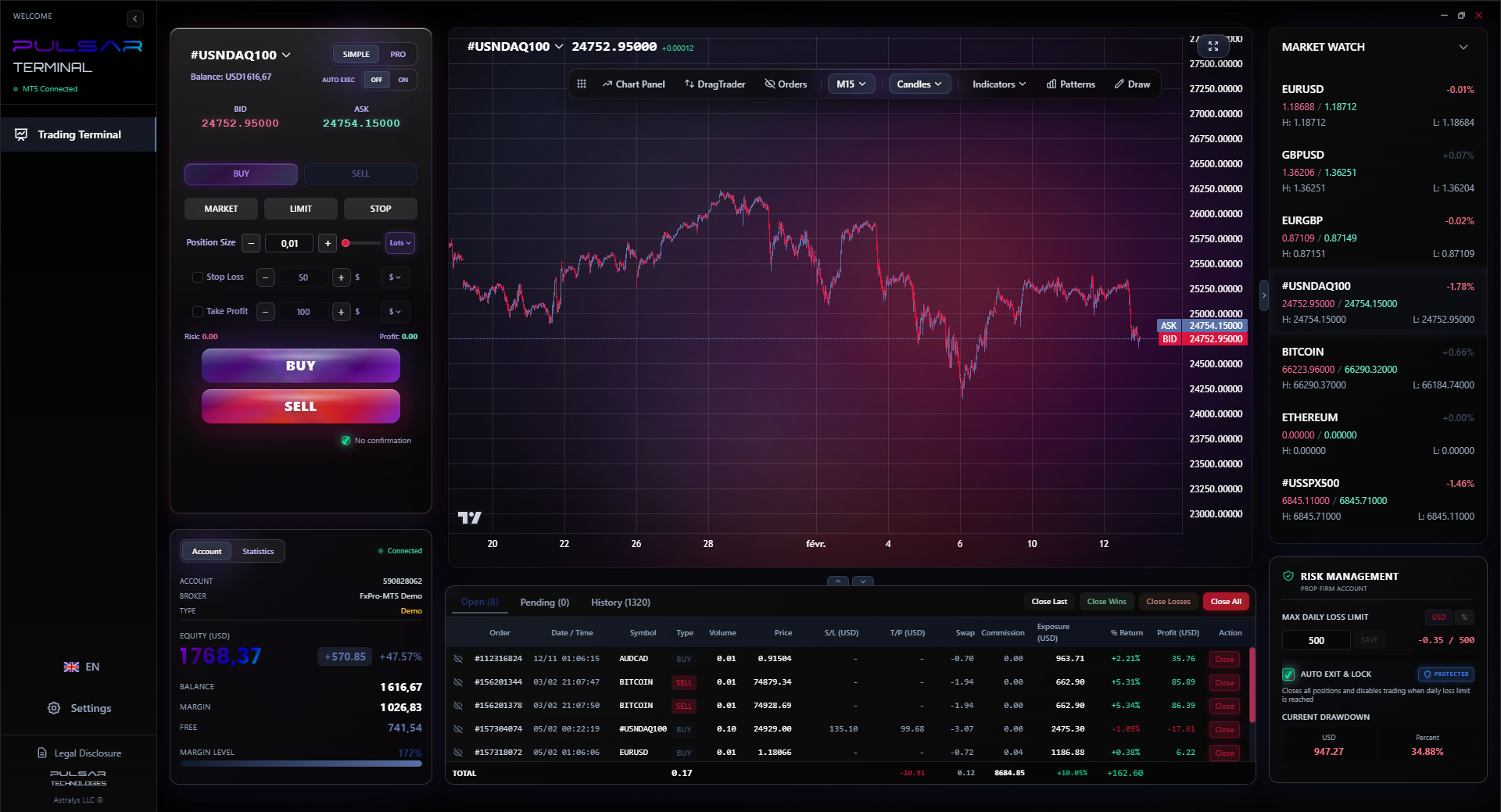
Sticking to a disciplined trading window is one thing, but managing multiple trades and risk within that window is another. Pulsar Terminal automates complex order management like trailing stops and partial closures directly on your MT5, so you can focus on execution during those critical overlap hours.
Pulsar Terminal
Công cụ MT5 tất-cả-trong-một: đặt lệnh kéo-thả, multi-TP/SL, trailing stop, grid trading, Volume Profile và bảo vệ prop firm. Hơn 1.000 trader sử dụng mỗi ngày.
“Your job isn't to trade all day. It's to identify the 3-4 hour window where the odds are most in your favor.”
Here's a sample structure that works, whether you have a 9-5 or trade full-time.
Before 9:00 AM WAT (Preparation):
- Review the economic calendar. Flag high-impact news (red events).
- Do your technical analysis on the higher timeframes (4H, Daily). Identify key support/resistance levels.
- Plan your trades: What pairs? What direction? What are your entry, stop loss, and take profit levels?
9:00 AM – 1:00 PM WAT (London Session - Execution Window 1):
- Markets are active. Look for entries based on your pre-market analysis.
- Be cautious around European news (8:00 AM - 1:00 PM WAT).
- This is a good time to enter swing trading positions you plan to hold for days.
1:00 PM – 5:00 PM WAT (Power Overlap - Execution Window 2):
- Maximum focus required. This is prime time for all strategies.
- 1:30 PM WAT: Be hyper-aware. Manage existing positions before major US news.
- Look for the strongest, highest-volume trends. This is when breakouts are most likely to follow through.
- If you're only going to trade one block of time all day, make it this one.
5:00 PM – 9:00 PM WAT (New York Wind-Down):
- Manage existing trades. Consider taking profits or moving stops to breakeven.
- Avoid entering new trades unless you have a very clear, high-probability setup.
- Use this time to review your day's trades in a journal. What worked? What didn't?
The Weekend: The market is closed. This is for education, strategy review, and rest. Do not spend Saturday stressed over a trade. The mental break is crucial.
💡 Mẹo của Winston
If you find yourself constantly checking charts outside your trading window, you're not trading. You're gambling. Set hours. Stick to them.
“I never use more than 1:50 use, even if 1:500 is offered. Surviving is more important than a moonshot.”
Finding the best time to trade forex isn't about finding a secret hour where you always win. It's about stacking probabilities in your favor. For us in Nigeria, we're uniquely positioned to trade the most powerful session overlaps during reasonable afternoon hours.
The market's $8.6 billion daily turnover in Nigeria (as of 2025) shows we're a growing force. But growth needs discipline. Use your time zone as a framework, not a cage. Let the market's rhythm guide your activity, not your boredom or FOMO.
Start by simply observing for a week. Watch the EUR/USD from 1:00 PM to 5:00 PM WAT. See how it moves compared to 3:00 AM WAT. The difference will be obvious. Then, paper trade during those hours. Then, go live with small size. Respect the clock, manage your risks with a good position size calculator, and you'll have solved one of the biggest puzzles in a retail trader's journey. Now you know when to fight. The rest is about picking the right battles.
FAQ
Q1What is the single best hour to trade forex from Nigeria?
While it varies, the most consistently active and liquid hour is often between 2:00 PM and 3:00 PM WAT (during European DST) or 1:00 PM to 2:00 PM WAT (outside DST). This is deep within the London-New York overlap and often after the initial US news volatility has settled, allowing clear trends to emerge.
Q2Is forex trading legal in Nigeria?
Yes, forex trading is legal. The Central Bank of Nigeria (CBN) oversees foreign exchange activities. While the CBN issues regulations for the institutional market, individual Nigerian traders are permitted to use international brokers regulated abroad (like the FCA, CySEC, or ASIC). It's wise to use reputable, well-regulated brokers.
Q3Do I need to pay tax on my forex trading profits in Nigeria?
Technically, yes. Trading profits could be considered capital gains or personal income. However, enforcement on individual retail trading profits has historically been limited. The prudent approach is to keep detailed records of all your deposits, withdrawals, and trading statements for tax purposes. Consult a local accountant for the latest guidance.
Q4Can I trade with Naira in my forex account?
Some brokers, like HFM, offer Naira-denominated trading accounts. This can simplify things as your profit/loss is calculated in Naira. Most international brokers, however, use USD, EUR, or GBP as the account currency. You can fund these with Naira, but the conversion is done by your payment provider or the broker.
Q5Why are spreads so important for a Nigerian trader?
Spreads are a direct cost. A wider spread means the market has to move further in your direction just for you to break even. During low-liquidity times (like the Asian session), spreads on major pairs can double or triple. Trading during the high-liquidity overlaps ensures you get the tightest possible spreads, preserving your capital.
Q6I work a 9-5 in Lagos. Can I still trade forex?
Absolutely. Your lunch break and late afternoon (1:00 PM - 5:00 PM WAT) align almost perfectly with the most powerful trading overlap. You can focus on swing trades (entering positions to hold for days) or be a very focused day trader in that 4-hour window. It's actually an ideal schedule for quality over quantity.
Q7What is a 'pip' and how much is it worth in Naira?
A pip is the smallest price move a currency pair can make, typically 0.0001 for pairs like EUR/USD. Its value in Naira depends on your trade size and the current USD/NGN rate. For a standard lot (100,000 units), one pip in EUR/USD is usually worth about $10. At an exchange rate of ₦1,500/$, that's roughly ₦15,000. Learn more about pip definition and how to calculate it for your trades.
Bài học của Prof. Winston
Điểm chính:
- ✓Trade the London-New York overlap (1-5 PM WAT) for best liquidity.
- ✓Avoid new trades in the thin Asian session (1-10 AM WAT).
- ✓Always check the economic calendar for 1:30 PM WAT news.
- ✓Use a Raw/ECN account to cut spread costs by over 50%.
- ✓High use (1:1000) is a trap, not a tool.
Bài viết này hữu ích thế nào?
Nhấp vào ngôi sao để đánh giá
Nhận định giao dịch hàng tuần
Phân tích & chiến lược miễn phí hàng tuần. Không spam.
Về tác giả
Olumide Adeyemi
Nhà tiên phong Giao dịch Tây Phi
Một trong những nhà đào tạo forex tích cực nhất tại Nigeria. 8 năm kinh nghiệm giao dịch từ Lagos. Chuyên về chiến lược vốn thấp và thử thách prop firm dành cho trader châu Phi.
Bình luận
Cảnh báo rủi ro
Giao dịch các công cụ tài chính tiềm ẩn rủi ro đáng kể và có thể không phù hợp với tất cả nhà đầu tư. Hiệu suất trong quá khứ không đảm bảo kết quả trong tương lai. Nội dung này chỉ mang tính chất giáo dục và không nên được coi là lời khuyên đầu tư. Hãy luôn tự nghiên cứu trước khi giao dịch.
Bạn cũng có thể thích

Cara Trading Forex Sukses: 7 Prinsip dari Trader Profesional
Cara trading forex sukses dengan 7 prinsip trader pro: manajemen modal, disiplin, journal trading, backtest. Data nyata, bukan janji profit palsu.
Jam Trading Forex Terbaik untuk Trader Indonesia: Panduan Lengkap dengan Tabel Waktu
Panduan jam trading forex untuk trader Indonesia. Tabel 4 sesi dunia, jam emas 20:00-00:00, sesi mana yang harus dihindari. Data akurat + tips dari trader berpengalaman.
Top 5 Sàn Forex Uy Tín Nhất 2026: Review Jujur dari Trader Indonesia
Top 5 sàn forex uy tín 2026 untuk trader Indonesia. Review jujur: spread, deposit, withdraw, dukungan lokal. Exness, XM, IC Markets & lebih.
Tải Pulsar Terminal
Tất cả các công cụ tính này được tích hợp trong Pulsar Terminal với dữ liệu thời gian thực từ tài khoản MT5 của bạn.
Tải Pulsar Terminal