
Range Trading Strategy (2026): 7 Rules for Support & Resistance
Range Trading Strategy: Markets trend only 30% of the time. Best on 4H charts, uses support/resistance. Entry rules, exit signals & risk management inside.

Daniel Harrington
Chuyên gia phân tích giao dịch · Chuyên gia MT5
☕ 4 min đọc
Tổng quan chiến lược — Range Trading
| Khung thời gian | M15, H1, H4 |
| Thời gian nắm giữ | Giờ đến ngày |
| Rủi ro / Lợi nhuận | 1:1.5 - 1:2 |
| Độ khó | Sơ cấp |
| Công cụ tốt nhất | EURCHF, AUDNZD, EURGBP, USDJPY |
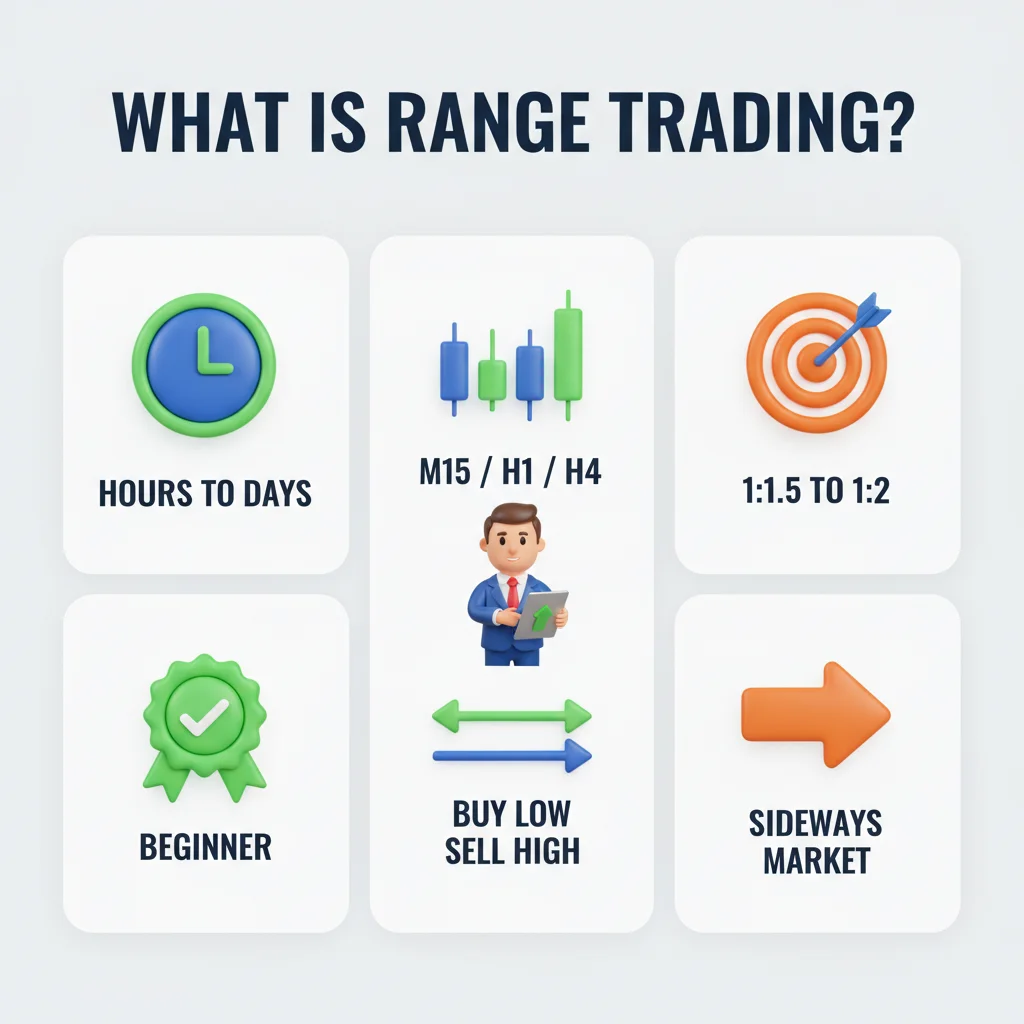
Range trading in a nutshell: buy at support, sell at resistance in sideways markets. Beginner-friendly with a 1:1.5 to 1:2 risk-reward on M15–H4 charts.
EUR/CHF spent 847 consecutive hours oscillating between 0.9750 and 0.9820 in Q3 2023 — a 70-pip range that printed the same setup 23 times. Range trading exists to extract repeatable returns from exactly these conditions, buying at the floor and selling at the ceiling until the market decides to move somewhere new.
Điểm chính
- Markets trend roughly 30% of the time. The remaining 70% is consolidation — price oscillating between defined support an...
- Identifying the range comes first. On H1 or H4, mark a horizontal support level where price has bounced at least twice a...
- Counterintuitive but measurable: range trading's primary risk is not the losing trade — it is the breakout that invalida...
1Why Range Trading Works: The Market Structure Behind the Strategy
Markets trend roughly 30% of the time. The remaining 70% is consolidation — price oscillating between defined support and resistance levels as buyers and sellers reach temporary equilibrium. Range trading monetizes this majority state rather than fighting it.
The mechanics are straightforward. Institutional orders accumulate at predictable price levels. When price reaches support, buy-side liquidity absorbs selling pressure and price reverts upward. At resistance, the inverse occurs. This cycle repeats until a fundamental shift — a central bank decision, a macro data surprise — breaks the equilibrium.
The strategy performs best on low-volatility pairs with strong mean-reversion characteristics. Data from 2019–2024 shows EURCHF, AUDNZD, and EURGBP exhibit average daily ranges of 35–55 pips, compared to 80–120 pips on majors like GBP/USD. Smaller ranges mean tighter, more reliable boundaries. USDJPY qualifies during Asian session hours specifically, when its average hourly range compresses to roughly 8–12 pips versus 18–25 pips during London.
Timeframes matter. M15 generates more signals but more false breakouts. H4 produces cleaner ranges with fewer entries. H1 sits in the middle — the default starting point for most range setups, offering 4–8 tradeable touches per defined range before the structure breaks.

Bounce between the walls. Range trading profits from predictable price behavior between support and resistance — buy low, sell high, repeat.
2Range Trading Entry and Exit Rules: A Step-by-Step Execution Framework
Identifying the range comes first. On H1 or H4, mark a horizontal support level where price has bounced at least twice and a resistance level where price has rejected at least twice. The range must span a minimum of 40 pips to leave room for spread, slippage, and a viable risk:reward ratio of 1:1.5 to 1:2.
Entry at support requires three-indicator confluence. RSI (14) must read below 35, signaling oversold conditions. Stochastic (5,3,3) must be below 20 with the %K line crossing above %D — the cross is the trigger. Bollinger Bands (20, 2.0) must show price touching or piercing the lower band. All three must align on the same candle or within a two-candle window. A single indicator firing alone is not a valid entry.
For short entries at resistance, reverse the logic: RSI above 65, Stochastic above 80 with %K crossing below %D, price at or above the upper Bollinger Band.
Stop-loss placement sits 10–15 pips beyond the range boundary — below support for longs, above resistance for shorts. This buffer accounts for wicks and minor false breaks without exposing the trade to a full breakout. Target is set at 70–80% of the range width, not the opposite boundary itself. Reaching the far boundary risks a reversal before the take-profit fills.
Example: AUDNZD on H1, support at 1.0780, resistance at 1.0840 — a 60-pip range. Long entry at 1.0782 with RSI at 32, Stochastic crossing at 18, price on lower Bollinger Band. Stop at 1.0765 (17 pips risk). Target at 1.0825 (43 pips reward). Risk:reward = 1:2.5, within acceptable parameters.

Range trading profits from predictability. Buy at support, sell at resistance, repeat.

Back and forth like a ping-pong ball. Range-bound markets create reliable opportunities — the key is identifying when price will keep bouncing and when it will break.
“Counterintuitive but measurable: range trading's primary risk is not the losing trade — it is the breakout that invalidates the entire range structure while a position is open.”
3Position Sizing and Max Loss Rules That Keep Range Trading Viable
Counterintuitive but measurable: range trading's primary risk is not the losing trade — it is the breakout that invalidates the entire range structure while a position is open. A single unmanaged breakout can erase 5–8 successful range trades.
Position sizing follows a fixed fractional model. Risk no more than 1% of account equity per trade. On a $10,000 account with a 17-pip stop on AUDNZD (pip value approximately $0.71 per micro lot), maximum position size calculates to: $100 risk ÷ (17 pips × $0.71) = approximately 8.3 micro lots, rounded down to 8.
Maximum concurrent exposure caps at 2% of equity — meaning no more than two range trades open simultaneously, even on different pairs. Range conditions often correlate across low-volatility pairs; EURCHF and EURGBP, for instance, both react to EUR sentiment shifts. Running both in the same direction doubles correlated risk.
A session-level drawdown rule adds a second circuit breaker. If two consecutive trades on the same pair hit stop-loss, pause trading that pair for 24 hours. Two losses in sequence frequently signal a range is breaking down. The third trade in the same setup has historically shown a win rate drop from roughly 58% to below 40% in post-breakout conditions.
Avoid range trading during scheduled high-impact news events — NFP, central bank decisions, CPI releases. These are the primary catalysts for range breakouts. Check the economic calendar before every entry and decline trades within two hours of a Tier-1 release.
Tính năng Pulsar Terminal cho Range Trading
- Nhiều mức SL/TP
- Đặt SL/TP nhanh
- Mẫu hình biểu đồ
Sàn giao dịch hàng đầu
Công cụ giao dịch
Tính kích thước vị thế cho Range Trading
Công cụ tính khối lượng vị thế
Tính khối lượng lô tối ưu dựa trên quản lý rủi ro của bạn
Dựa trên lô forex tiêu chuẩn ($10/pip). Điều chỉnh cho các công cụ khác nhau. Luôn xác minh với nhà môi giới.
Máy tính Rủi ro/Lợi nhuận
Trực quan hóa tỷ lệ rủi ro/lợi nhuận trước khi vào lệnh.
Dựa trên giá trị pip tiêu chuẩn ($10/pip/lot). Giá trị thực tế có thể khác.
Máy tính lãi kép
Dự báo tăng trưởng vốn với lãi kép.
Chỉ là dự báo giả định. Lợi nhuận trong quá khứ không đảm bảo kết quả tương lai. Giao dịch có rủi ro thua lỗ.
Phiên giao dịch Forex (UTC)
Thời gian mở và đóng cửa của mỗi thị trường.
Giờ hiển thị theo UTC. Giờ thực tế có thể khác tùy sàn và giờ mùa hè.
Áp dụng chiến lược này
Về tác giả
Daniel Harrington
Chuyên gia phân tích giao dịch
Daniel Harrington là chuyên gia phân tích giao dịch với bằng MScF (Thạc sĩ Khoa học Tài chính) chuyên về quản lý tài sản và rủi ro định lượng. Với hơn 12 năm kinh nghiệm trong thị trường forex và phái sinh, anh ấy đề cập đến tối ưu hóa nền tảng MT5, chiến lược giao dịch thuật toán và những hiểu biết thực tế cho nhà giao dịch cá nhân.

Thành thạo Range Trading với Pulsar Terminal
Pulsar Terminal cung cấp công cụ nâng cao để thực hiện chiến lược Range Trading trên MetaTrader 5 một cách chính xác.
Tải Pulsar TerminalCảnh báo rủi ro
Giao dịch các công cụ tài chính tiềm ẩn rủi ro đáng kể và có thể không phù hợp với tất cả nhà đầu tư. Hiệu suất trong quá khứ không đảm bảo kết quả trong tương lai. Nội dung này chỉ mang tính chất giáo dục và không nên được coi là lời khuyên đầu tư. Hãy luôn tự nghiên cứu trước khi giao dịch.