


I remember staring at my screen in 2018, watching USD/ZAR climb from 13.85 to 14.20 in a single afternoon.

David van der Merwe
新兴市场交易员 ·  South Africa
☕ 9 分钟阅读
您将学到:
- 1Regulation Is Your First Line of Defense
- 2Understand the Real Costs (Not Just the Spread)
- 3Risk Management Isn't a Suggestion, It's the Law
- 4Choose Your Battles: Currency Pairs Matter
- 5Develop a Mindset, Not Just a Method
- 6Master One or Two Tools Deeply
- 7Taxes and the SARB Are Part of the Game
- 8Continuous Education Is the Only Edge
I remember staring at my screen in 2018, watching USD/ZAR climb from 13.85 to 14.20 in a single afternoon. My short position was bleeding, and I was calculating the loss in rands, not pips. That’s when it hit me: trading here isn't theoretical. It's about your money, in your currency, under your country's rules. After 12 years and more mistakes than I care to admit, here are the 10 essentials of forex trading you need to know, specifically for South Africa.
Forget fancy strategies for a second. Your first and most important check is the broker's license. In South Africa, the Financial Sector Conduct Authority (FSCA) is the sheriff. Trading with an FSCA-licensed broker isn't just a suggestion, it's your primary protection against scams and insolvency.
I learned this the hard way early on. Chasing higher use, I signed up with an 'international' broker that promised 1:500. The platform was slick, withdrawals were smooth... until they weren't. When I tried to pull out a R25,000 profit, the excuses started. 'Processing delays.' 'Bank issues.' It took three months of stressful emails to get my money. An FSCA-regulated broker is legally required to segregate client funds. That means your money is held separately from the company's operating capital. If the broker goes under, your capital isn't part of their bankruptcy estate.
Always verify the FSP number on the FSCA's public register. Don't just trust the badge on their website. A real license is non-negotiable. While some international brokers like IC Markets or XM are reputable globally, starting with an FSCA-regulated entity simplifies everything from deposits in ZAR to local dispute resolution.

Warning: The FSCA's use cap for retail traders is 30:1. Any broker offering you significantly more (like 1:500) to South African residents is likely doing so through an offshore entity, bypassing local consumer protections. You're trading in a regulatory grey area.

💡 Winston 小贴士
The FSCA's 30:1 use cap isn't a restriction, it's a guardrail. The real pros I know rarely use more than 10:1. Discipline with capital is the hallmark of a survivor.
When I started, I only looked at the EUR/USD spread. Big mistake. The true cost of trading in South Africa has layers, and they all eat into your bottom line.
Let's break down a real trade from last month. I went long on GBP/ZAR at 23.1500 with a standard lot (100,000 units).
- The Spread: My broker's spread was 14 pips. At a pip value of roughly R100 for this pair at that level, that's R1,400 gone before the trade even moved. That's a weekend away, vanished.
- The Overnight Financing (Swap): I held the trade for three days. The daily swap rate was -R185. That's another R555.
- The Currency Conversion: My account is in USD, but the profit is in ZAR. The broker's conversion fee added a hidden 1.2% haircut.
Suddenly, the trade needed to move 20 pips just for me to break even. I used to think a 2-pip spread on EUR/USD was cheap. For a local trading USD/ZAR or EUR/ZAR, the game is different. Exotic pairs have wider spreads. You must factor in swap rates, especially if you're swing trading over several days. Some brokers also charge inactivity fees. I got stung with a $10 fee once after taking a month off during the holidays.

Example: Trading USD/ZAR with a 5-pip spread. Pip value ~R70. Cost to open a standard lot: R350. Your trade is R350 in the red from the start. Can your strategy overcome that consistently?
“Suddenly, the trade needed to move 20 pips just for me to break even.”
This is the one essential that will determine if you're still trading in a year. The FSCA's 30:1 use limit is actually a gift. It forces discipline. But you need to be even stricter with yourself.
My worst loss came from ignoring my own rules. It was on EUR/USD, and I was convinced it was bouncing off support. I risked 5% of my account on one trade. A 5% stop-loss sounds conservative, right? The market spiked on unexpected ECB news, blew through my stop, and I lost 8% before I could manually close. I felt sick. That single trade set me back two months of careful profits.
The 1% Rule
Now, I never, ever risk more than 1% of my account equity on a single trade. For a R20,000 account, that's R200. I use a position size calculator for every entry. It tells me exactly how many lots or units I can trade based on my stop-loss distance. This isn't about getting rich quick. It's about surviving long enough to let your edge play out.
Stop-Losses Are Sacred
Place your stop-loss the moment you enter the trade. Not later, not 'when it gets closer.' Do it. A mental stop is no stop at all. Emotion will override it every time. A margin call is a professional failure, and it's entirely preventable.
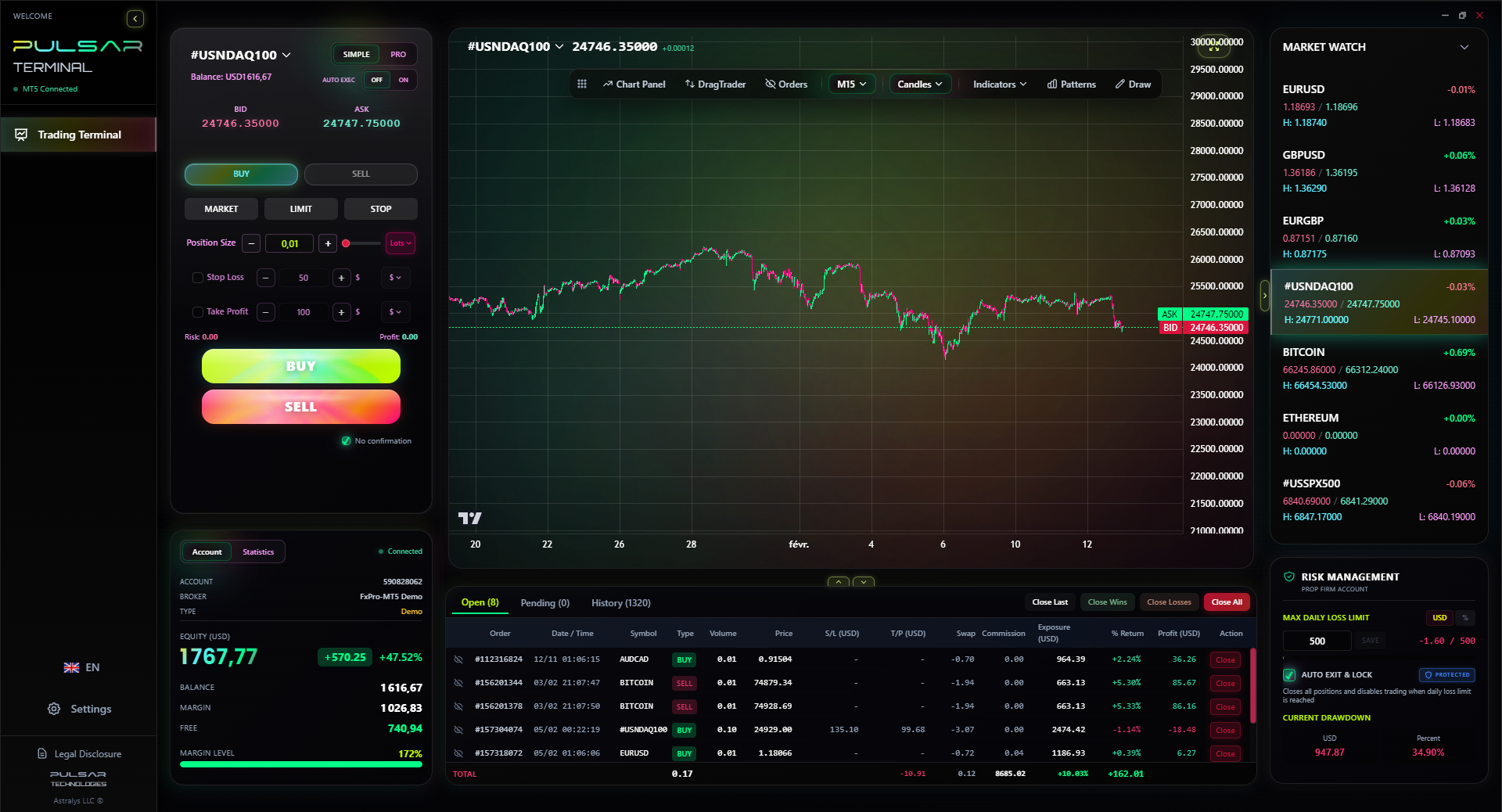
This discipline is what separates the hopeful from the consistent. A tool like Pulsar Terminal can automate this, setting your stop and take-profit levels directly on your MT5 chart the second your order fills, removing any temptation to hesitate.
Sticking to a 1% risk rule requires precise order sizing, which Pulsar Terminal's drag-and-drop order tools on MT5 make fast and error-free.
Pulsar Terminal
MT5一站式工具:拖拽下单、多重止盈/止损、追踪止损、网格交易、成交量分布图和自营交易保护。每日1000+交易者使用。
You wouldn't use a spoon to cut a steak. Don't use the wrong currency pair for your strategy. In South Africa, we have a natural affinity for USD/ZAR and EUR/ZAR. They're volatile, news-driven, and can be incredibly rewarding. They can also destroy an account in hours.
I used to scalp USD/ZAR. The spreads were wide, but the moves were big. Or so I thought. I'd win three small trades, then one news-driven spike would wipe out all my profits and more. The spread made scalping a constant uphill battle.
Majors for Technique, ZAR Pairs for Opportunity
Now, I use majors like EUR/USD or GBP/USD to practice and refine my technical analysis. The liquidity is massive, spreads are tight (often under 1 pip with brokers like Pepperstone), and the charts are clean. It's like training on a smooth track.
I then apply those skills to ZAR pairs, but with a different mindset. I trade them less frequently, with wider stops, aiming for larger swing trading moves driven by local politics, commodity prices (like platinum or gold), or SARB decisions. I treat them with more respect. A tool that offers advanced order types can be a lifesaver here, letting you set a grid of orders to capture a move in a volatile pair without having to watch it every second.
💡 Winston 小贴士
When analyzing USD/ZAR, don't just look at the chart. Have the SARB interest rate decision calendar and the price of platinum (a key SA export) open on another screen. Context is everything.
“A margin call is a professional failure, and it's entirely preventable.”
You can have the best strategy in the world and still fail. I've seen it. The market is a psychological mirror. It shows you your impatience, your greed, your fear.
My biggest psychological leak was revenge trading. After that 8% loss I mentioned, I was furious - at the market, at myself. I jumped back in within minutes, trying to 'make it back.' I ignored my setup, doubled my usual size, and lost another 3%. In one afternoon, I gave up 11% because I couldn't control my emotion.
The Trading Journal Fix
The single best thing I did was start a brutally honest trading journal. Not just 'bought EUR/USD, made 20 pips.' I wrote down my emotional state: 'Felt anxious before Non-Farm Payroll, entered early because I was scared of missing out.' I recorded the outcome. Over time, patterns emerged. I saw that my losing trades often came when I was tired, or after I'd already had a loss.
Now, I have rules for myself beyond the charts. No trading after 10 PM. No trading for 24 hours after a 2% daily loss. Mandatory break after two consecutive losses. This mental framework is more valuable than any indicator. It's what allows you to execute your plan when everything in your gut is screaming to do the opposite.
The internet is flooded with indicators: moving averages, Bollinger Bands, Ichimoku Clouds, the RSI, the MACD. Early on, I had a chart so cluttered with lines and colors it looked like a toddler's drawing. I was paralyzed by conflicting signals.
I blew up a R5,000 demo account trying to use a 'perfect' combination of seven indicators. The reality? Simple is strong.
I now use two things, and I know them inside out.
- Price Action & Support/Resistance: I learn to read the raw price chart. Where did it bounce before? Where did it stall? These are the levels that matter to the big players.
- One Momentum Confirmation Tool: For me, it's the RSI. Not for overbought/oversold signals (a classic mistake), but for spotting divergences. When price makes a new high but the RSI makes a lower high, it shows weakening momentum. That's a powerful warning sign.
Pick one charting platform - MetaTrader 4, MetaTrader 5, TradingView - and learn it completely. Know how to draw trendlines, set Fibonacci retracements, and use the tools at your disposal. Depth beats breadth every time.
💡 Winston 小贴士
Your trading journal should have a 'Mood' column. If you see a string of losses next to 'Frustrated' or 'Tired,' you've found a leak more valuable than any technical pattern.
“The market is a psychological mirror. It shows you your impatience, your greed, your fear.”
This is the boring, essential part nobody wants to talk about. But getting it wrong can ruin everything. In South Africa, profits from forex trading are generally considered revenue (if you trade frequently) or capital gains. You need to declare them to SARS.
I learned this the expensive way. After a good year, I didn't set aside anything for tax. Come filing season, I had a nasty surprise. Now, I put aside 25% of every single withdrawal into a separate savings account. It's not my money until SARS has its share.
The SARB and Your Bank
Also, be aware of your bank's reporting. The South African Reserve Bank (SARB) requires banks to report foreign exchange transactions. If you're constantly depositing and withdrawing large sums in USD to an international broker, your bank might ask questions. It's not illegal, but it can trigger compliance checks. Using a local, FSCA-regulated broker where you can deposit in ZAR often streamlines this process significantly. Keep clear records of all your trades, deposits, and withdrawals. Your future self, dealing with an accountant, will thank you.
The market from 2015 is not the market of 2026. Algorithms, global events, and regulations change. If you stop learning, you become obsolete.
My education isn't about finding a 'secret system.' It's about understanding context. Why did the Rand weaken when the Fed hiked rates? How do load-shedding expectations impact local investor sentiment? I read SARB statements, not just forex blogs.
Learn from the Right Sources
Be wary of 'gurus' selling dreams. Real education is often dull. It's about monetary policy, economic calendars, and risk management psychology. Use broker education (many FSCA brokers like Exness have decent materials), but go beyond it. Read books on trader psychology. Backtest your ideas relentlessly on historical data before risking a cent.
This job is a marathon of constant, incremental improvement. The day you think you know it all is the day you should close your account.
FAQ
Q1Is forex trading legal in South Africa?
Yes, it's completely legal and regulated by the Financial Sector Conduct Authority (FSCA). The key is to use an FSCA-licensed broker to ensure your funds are protected under South African law.
Q2What is the maximum use I can use?
For retail traders, the FSCA limits use to 30:1. This is a protective measure. Some offshore brokers may offer higher ratios, but you then forfeit local regulatory protection, which is a significant risk.
Q3How much money do I need to start forex trading in South Africa?
You can start with very little. Some brokers allow deposits as low as $1 or R100. However, to trade properly with sensible risk management (e.g., not over-leveraging a tiny account), a starting capital of at least R5,000 to R10,000 is more realistic to withstand normal market fluctuations.
Q4Which currency pairs should a beginner start with?
Start with major pairs like EUR/USD or GBP/USD. They have the tightest spreads and highest liquidity, making them more forgiving for learning. Avoid exotic pairs like USD/ZAR initially, as their wider spreads and volatility can quickly amplify beginner mistakes.
Q5How are my forex trading profits taxed?
Profits are typically taxable. If you trade frequently, SARS may view it as income and tax it as revenue. If you hold positions longer-term, it may be considered a capital gain. You must declare this income. It's crucial to keep detailed records and consult with a tax professional familiar with trading.
Q6Can I use international brokers like IC Markets or XM?
Yes, South Africans can legally use international brokers. However, you must understand that you are then under that broker's home jurisdiction (e.g., ASIC in Australia, CySEC in Cyprus). For simplicity and direct protection, starting with an FSCA-regulated broker is strongly advised.
Q7What's the biggest mistake new South African traders make?
Two stand out: 1) Over-leveraging, especially on volatile ZAR pairs, which leads to quick account blow-ups. 2) Ignoring the total cost of trading - the spread, swap fees, and conversion costs on exotic pairs can be a massive hidden drag on profits.
Winston 教授的课程
要点总结:
- ✓Verify your broker's FSCA FSP number. Every time.
- ✓Never risk more than 1% of your account on a single trade.
- ✓Factor in all costs: spread, swap, conversion.
- ✓Master price action before adding complex indicators.
- ✓Set aside 25% of profits for tax from day one.
这篇文章对您有用吗?
点击星星评分
每周交易洞察
免费每周分析与策略。无垃圾邮件。
关于作者
David van der Merwe
新兴市场交易员
约翰内斯堡交易者,11年新兴市场货币经验。专注于ZAR货币对、FSCA监管交易和南非市场分析。
评论
风险提示
金融工具交易存在重大风险,可能不适合所有投资者。过往业绩不代表未来表现。本内容仅供教育目的,不构成投资建议。在交易前请务必自行研究。
您可能还喜欢

Cara Trading Forex Sukses: 7 Prinsip dari Trader Profesional
Cara trading forex sukses dengan 7 prinsip trader pro: manajemen modal, disiplin, journal trading, backtest. Data nyata, bukan janji profit palsu.
Jam Trading Forex Terbaik untuk Trader Indonesia: Panduan Lengkap dengan Tabel Waktu
Panduan jam trading forex untuk trader Indonesia. Tabel 4 sesi dunia, jam emas 20:00-00:00, sesi mana yang harus dihindari. Data akurat + tips dari trader berpengalaman.
Top 5 Sàn Forex Uy Tín Nhất 2026: Review Jujur dari Trader Indonesia
Top 5 sàn forex uy tín 2026 untuk trader Indonesia. Review jujur: spread, deposit, withdraw, dukungan lokal. Exness, XM, IC Markets & lebih.
