


I remember the first time I blew up a demo account.

David van der Merwe
新兴市场交易员 ·  South Africa
☕ 10 分钟阅读
您将学到:
I remember the first time I blew up a demo account. I was 19, not 15, but the arrogance was the same. I'd turned R5,000 into R45,000 in a month on a simulator, trading like a maniac on EUR/USD. I thought I'd cracked the code. Then I deposited real money - my entire student loan disbursement. I lost R8,000 in three days. The spreads were wider, my hands shook clicking the mouse, and the fear of real loss made every decision wrong. That's the gap no 15 year old forex trader can understand until they're legally in the arena. And in South Africa, you can't even step into that arena until you're 18. Let's talk about why that's a good thing, and what you should actually be doing.
Let's get this out of the way first, because I see too many YouTube gurus peddling dreams without mentioning the law. In South Africa, you cannot legally open a live forex trading account if you are under 18. Full stop. This isn't a broker preference; it's black-letter law enforced by the Financial Sector Conduct Authority (FSCA).
The reason is simple: a contract. When you open an account, you enter a legally binding agreement with a broker. In the eyes of South African law, a 15-year-old lacks the legal capacity to do that. It's the same reason you can't take out a car loan or sign a lease. Brokers regulated by the FSCA, like those we review such as Exness or IC Markets, have strict Know Your Customer (KYC) rules. They will ask for your ID number. The system flags you immediately.

Warning: I've heard the "workaround" whispers: "Use your parent's ID." Don't. This is fraud. If you generate profits, you create a tax nightmare for your parents. If you generate losses (which is more likely), you've committed fraud and could get your parents' banking profile flagged. It's a spectacularly bad idea that can have real legal consequences.
The FSCA is there to protect consumers, and yes, that includes protecting minors from themselves. The market is brutal enough for adults with fully developed prefrontal cortexes (the part of the brain for risk assessment that isn't fully formed until your mid-20s, by the way).
You're probably reading this frustrated. I get it. You're hungry, you're smart, and you see an opportunity. But hear me out: this forced waiting period is the greatest gift you could get. Most 18-year-olds jump in live with zero preparation and get eviscerated. You have a 2-3 year head start to build knowledge without losing a single cent.
Think of it like this: would you rather practice flying in a multi-million Rand flight simulator for years, or be thrown into a real cockpit during a storm on your first day? The forex market is that storm every single day. Your demo account is that simulator.
The Psychology Gap
This is the big one. On a demo, a R50,000 loss is a number on a screen. On a live account, it's your future laptop, your car savings, your dignity. That psychological pressure changes everything. It causes overtrading, revenge trading, and abandoning your plan. You can't simulate the gut-churn of a real margin call. But you can use this time to drill discipline into your bones so that when real money is on the line, muscle memory takes over.
Building a Real Foundation
Instead of scheming to get around the rules, use this time to become a true student of the market. Learn what a pip really means in ZAR terms. Understand how the spread eats into your profits on different pairs. Most kids your age are watching TikTok. You could be learning macroeconomics, how interest rates move the Rand, or how to properly backtest a strategy. That knowledge compound interest will make you dangerous by the time you're legally able to trade.

💡 Winston 小贴士
The market doesn't care how smart you are. It only cares how disciplined you are. A monkey with a strict 1% risk rule will outlast a genius who's over-leveraged.
“Your forced waiting period is the greatest gift you could get.”
Okay, so what should you actually do from 15 to 18? Here's a structured plan. Treat it like a professional apprenticeship.
Year 1: The Basics & Demo Immersion
- Open a Demo Account: Do it today. Use MetaTrader 5 (MT5). Don't start with R1 million virtual cash. Start with R20,000. Make it realistic.
- Learn the Jargon: Know the difference between a limit and a stop order. Understand use (and why high use is a trap). Get comfortable with the position size calculator.
- Paper Trade One Strategy: Pick one simple method. Maybe it's a moving average crossover on USD/ZAR. Trade it on demo for 6 months. Keep a detailed journal. Note your emotions, even though it's fake money.
Year 2: Strategy & Market Analysis
- Deep Dive into Analysis: Start studying price action. Learn to read candlestick patterns. Introduce one indicator at a time - really understand what the RSI indicator or MACD indicator is telling you, don't just follow its signals blindly.
- Explore Styles: Try a scalping strategy for a month on the demo. Then try swing trading for a month. See which fits your personality.
- Follow Real Markets: Watch how the Rand reacts to SARB announcements or political news. Build a narrative.
Year 3: Simulation & Refinement
- The "Live" Demo: Set strict rules for your demo as if it were real. A 2% maximum risk per trade. A daily loss limit. No over-leveraging. Use a position size calculator for every single entry.
- Backtest: Learn how to use MT5's strategy tester. Take your chosen strategy and see how it would have performed over the last 5 years of data on EUR/USD.
- Broker Research: Start seriously comparing FSCA-regulated brokers. Look at their spreads on the pairs you want to trade, their deposit methods for South Africans, and their platform tools.

Pro Tip: Your trading journal is your most important tool. For every demo trade, write down: 1) The reason for the trade (e.g., "4H chart support bounce"), 2) Your entry, stop loss, and take profit, 3) The outcome, and 4) What you felt. This builds self-awareness, which is 80% of trading.
Your demo account is your playground. Master these tools so they're second nature by 18.
MetaTrader 5 (MT5): This is the industry standard. Learn everything about it:
- How to set multiple take-profit and stop-loss levels on a single order.
- How to use the market depth (though it's limited in forex).
- How to set price alerts.
TradingView: Use it for superior charting and social ideas (but be skeptical of everyone). Their paper trading feature is also excellent.
Economic Calendars: Get used to checking Forex Factory or Investing.com's calendar. See how volatility spikes around events.
The Math: This is critical. Open a spreadsheet. Calculate everything.
| Scenario | Account Size | Risk per Trade (2%) | Stop Loss (pips) | Pip Value (ZAR) | Position Size (Lots) |
|---|---|---|---|---|---|
| Demo Practice | R20,000 | R400 | 20 pips | ~R10 per pip (USD/ZAR) | 0.20 micro lots |
| Future Live Start | R5,000 | R100 | 30 pips | ~R7.5 per pip (EUR/USD) | 0.04 micro lots |
See how small you start? That's reality. Most 15 year old forex trader dreams involve Lamborghinis, but the pros focus on protecting their R100.
When you're ready for more advanced trade management, you'll appreciate tools that automate the tedious parts. Setting a trailing stop or moving your stop to breakeven at the right moment is a mental game. Having a tool that can execute those rules for you, like a proper MT5 companion app, removes emotion. It lets you focus on the analysis, not the anxiety of manually moving a line as price ticks against you.
💡 Winston 小贴士
Your demo account is a laboratory, not a casino. If you're not treating it with the same seriousness as real money, you're just playing a video game and learning nothing.
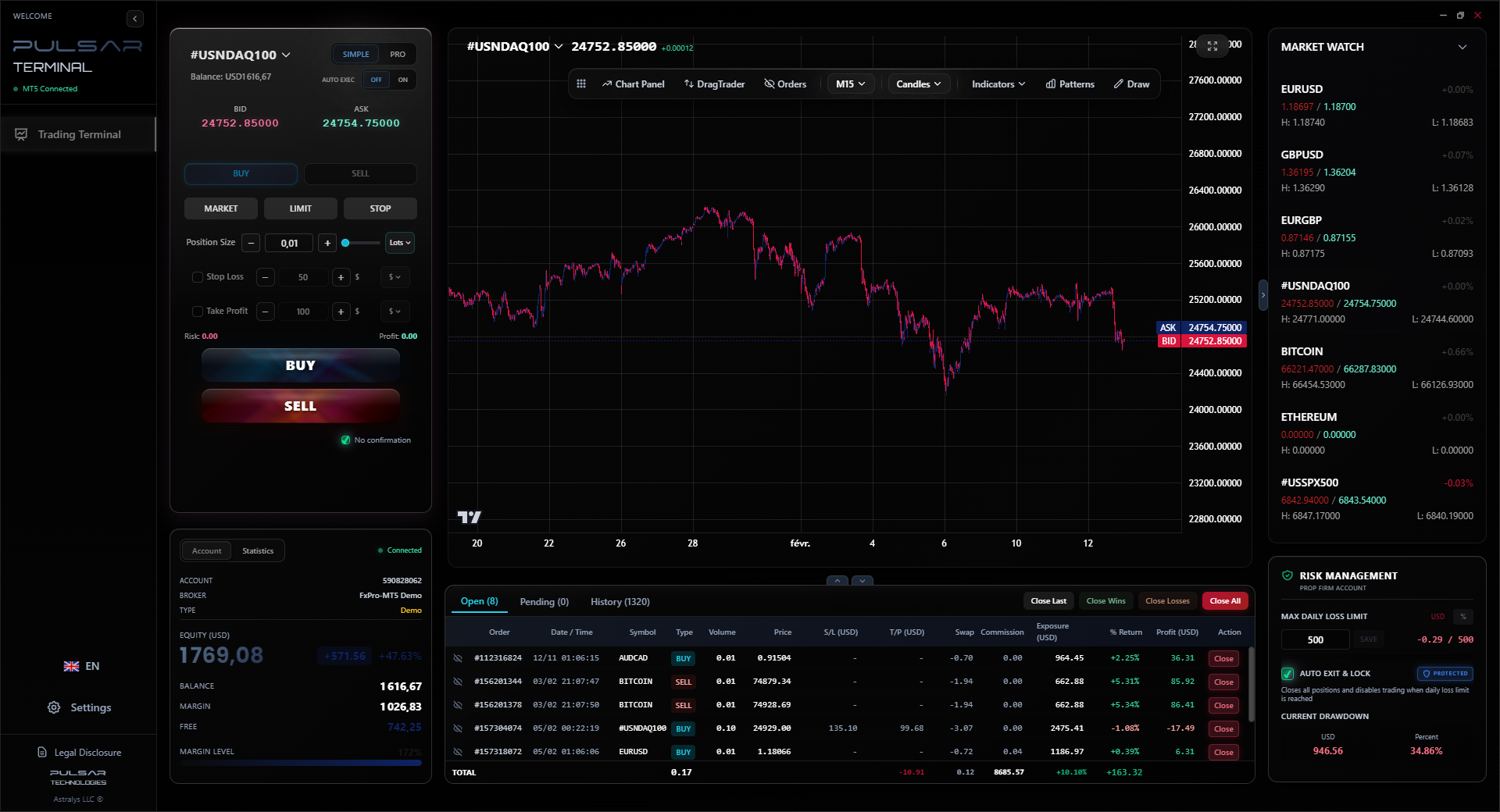
Mastering precise trade management on demo is key, and tools like Pulsar Terminal automate advanced orders like trailing stops and breakeven directly on your MT5 charts, letting you practice like a pro.
Pulsar Terminal
MT5一站式工具:拖拽下单、多重止盈/止损、追踪止损、网格交易、成交量分布图和自营交易保护。每日1000+交易者使用。
“The goal for the first six months of live trading is not to make money. It's to not blow up your account.”
Let's kill the fantasy with some real South African numbers. The global stat is that roughly 80% of retail traders lose money. In SA, it's probably similar, if not worse, given the volatility of the Rand.
What does winning look like? It's boring.
- A consistently profitable professional might aim for a 40-60% win rate.
- Their average winner is bigger than their average loser (a positive risk-to-reward ratio, like 1:1.5 or better).
- They might target 10-20% return on their account per year. Not per month. Per year.
Let me give you a real, humble example from my early days after I'd learned my lesson. I traded GBP/JPY, a volatile pair. I risked 1% (R500 on a R50k account). My stop loss was 50 pips away, so my position size was small. I caught a swing move for 85 pips. My profit was R850. It took 4 days. I made 1.7% on my account. That's a great trade. It wasn't exciting. It was planned, executed, and managed.
Contrast that with the dream of turning R1,000 into R10,000 in a week. That requires insane, unsustainable risk. You might get lucky once. You will lose it all the next time. The market's job is to find those people and take their money. Don't be that person. Use your demo years to internalize that a 2% gain is a victory.
Your birthday arrives. You're legally an adult. Here's your step-by-step, emotion-free checklist.
- Choose Your Broker: Go with an FSCA-regulated broker you've already researched. I've had good experiences with the execution at Pepperstone and XM for South African clients. Compare their final spreads and deposit fees.
- Open Your Account: Use your own details. Your own ID. Be truthful. This builds your financial profile.
- Start Absurdly Small: Your first live deposit should be money you can afford to lose 100% of without changing your life. R2,000? R5,000? That's it. This is a tuition fee, not an investment.
- Trade Micro Lots: Your position size should be 1/10th of what you used on demo. The psychological weight is different. If you were trading 0.1 lots on demo, start with 0.01 lots live.
- Stick to Your Demo Rules: This is the final exam. The strategy is the same. The risk management (1-2% max) is the same. The only thing new is the tremor in your hand. Breathe through it.
Your goal for the first six months of live trading is not to make money. Your goal is to not blow up your account. If you finish month six with roughly the same amount you started with, you're in the top 30% of beginners. Seriously. That's a win. Then you can slowly, carefully, begin to scale.
💡 Winston 小贴士
The goal of your first R5,000 live account is to lose it slowly. If you can make it last 6 months, you've passed the first real test.
“Fall in love with the process. The money, if it ever comes, will be a byproduct.”
I lost more money in my first two years than I care to admit. The irony? I knew the technicals. I could draw Fibonacci levels and spot divergences. What I didn't know was myself. I didn't know how I'd react when a trade went R3,000 against me. I didn't have the discipline drilled in.
You, as a 15 year old forex trader aspirant, have a chance I never had: enforced time to build that discipline without the catastrophic price tag. Use it.
Forget the get-rich-quick nonsense. Fall in love with the process. The analysis. The puzzle. The self-mastery. The money, if it ever comes, will be a byproduct of that obsession. Start your demo today. Journal every trade. Embrace the boring. In three years, you won't be a clueless 18-year-old with a login and a dream. You'll be a seasoned operator with thousands of simulated trades under your belt, ready to play the long game. And in this business, the long game is the only one worth playing.
FAQ
Q1Can I really not trade forex at all if I'm 15 in South Africa?
You cannot trade with real money on a live account. It is illegal for an FSCA-regulated broker to open an account for you. Anyone telling you otherwise is leading you into fraudulent activity. Your entire focus should be on education and demo trading.
Q2Can my parents open an account and let me trade on it?
Technically, they can open an account in their name. However, letting you trade on it likely violates the broker's terms of service. More importantly, it's a terrible idea. All profits become taxable income for your parents, and all losses are legally theirs. It blurs legal and financial lines and teaches you to circumvent rules - a disastrous habit for a trader.
Q3What's the best demo account for a beginner?
Start with a MetaTrader 5 (MT5) demo account from a major broker like IC Markets or Pepperstone. MT5 is the most common professional platform. Set your virtual balance to a realistic amount (R10,000-R50,000) and trade micro lots (0.01) to simulate real conditions.
Q4How much money do I need to start trading when I'm 18?
As little as R2,000-R5,000. The amount is less important than the risk management. With R5,000, you should only be risking R50-R100 per trade, which means trading very small micro-lot positions. The goal of your first deposit is to learn live trading psychology, not to get rich.
Q5What should I learn first about forex trading?
Learn risk management first, last, and always. Before any fancy indicator, understand how to calculate your position size, where to place your stop loss, and how much of your account you're willing to lose on a single trade (never more than 1-2%). Use a position size calculator for every single demo trade to build the habit.
Q6Is forex trading a good way to make money as a student?
It's a terrible way to make money as a student, but it can be an excellent way to learn about money, global economics, and psychology. The vast majority lose. Approach it as a demanding skill to be acquired over years, not a side hustle. Your student income is better spent on, well, being a student.
Q7What are the most important habits to build now?
- Journaling: Record every demo trade with your reasoning and emotion. 2. Pre-trade Calculations: Always calculate your risk and position size before entering. 3. Review: At the end of each week, review your trades without ego. Find your repetitive mistakes. These habits will save you thousands later.
Winston 教授的课程
要点总结:
- ✓Trading live under 18 is illegal in South Africa (FSCA rule).
- ✓Use 2-3 demo years to learn risk management and psychology.
- ✓Never risk more than 1-2% of your account on a trade.
- ✓Your first live goal is survival, not profits.
- ✓A 2% gain is a professional victory.
这篇文章对您有用吗?
点击星星评分
每周交易洞察
免费每周分析与策略。无垃圾邮件。
关于作者
David van der Merwe
新兴市场交易员
约翰内斯堡交易者,11年新兴市场货币经验。专注于ZAR货币对、FSCA监管交易和南非市场分析。
评论
风险提示
金融工具交易存在重大风险,可能不适合所有投资者。过往业绩不代表未来表现。本内容仅供教育目的,不构成投资建议。在交易前请务必自行研究。
您可能还喜欢

Cara Trading Forex Sukses: 7 Prinsip dari Trader Profesional
Cara trading forex sukses dengan 7 prinsip trader pro: manajemen modal, disiplin, journal trading, backtest. Data nyata, bukan janji profit palsu.
Jam Trading Forex Terbaik untuk Trader Indonesia: Panduan Lengkap dengan Tabel Waktu
Panduan jam trading forex untuk trader Indonesia. Tabel 4 sesi dunia, jam emas 20:00-00:00, sesi mana yang harus dihindari. Data akurat + tips dari trader berpengalaman.
Top 5 Sàn Forex Uy Tín Nhất 2026: Review Jujur dari Trader Indonesia
Top 5 sàn forex uy tín 2026 untuk trader Indonesia. Review jujur: spread, deposit, withdraw, dukungan lokal. Exness, XM, IC Markets & lebih.
