


It was October 2023, and the E-mini S&P 500 futures were chopping around the 4320 level like a drunk sailor.

James Mitchell
高级交易分析师
☕ 11 分钟阅读
您将学到:
- 1What Exactly Is Apex Trader Funding?
- 2The Rules: Evaluation vs. Funded Account
- 3The Real Cost: Fees and Profit Split Analysis
- 4Straight Talk: Pros, Cons, and My Experience
- 5How Apex Stacks Up Against Other Prop Firms
- 6Who Is Apex Trader Funding Actually For?
- 7Getting Started: A Veteran's Practical Advice

It was October 2023, and the E-mini S&P 500 futures were chopping around the 4320 level like a drunk sailor. I was in an Apex Trader Funding evaluation account, up about $1,200 for the day, and the temptation to lock it in was screaming at me. But their trailing drawdown rule meant my profit target was a moving finish line. That's the Apex experience in a nutshell: straightforward access, but with quirks that'll test your discipline. I've traded with a few prop firms, and Apex has carved out a specific niche in the futures game. Let's break down if it's the right fit for you.
Apex Trader Funding is a proprietary trading firm, or 'prop firm,' that focuses exclusively on futures. They don't mess with forex or stocks. Their model is simple: you pay a one-time fee for an evaluation account (they call it a 'PA' or Performance Account). Pass their profit target and risk rules, and they'll give you a funded account where you keep a large chunk of the profits.
They've gotten popular for a few reasons. First, the buy-in is relatively cheap. You can get started for under $100 during one of their near-constant sales. Second, their rules are some of the most trader-friendly in the industry, especially regarding daily loss limits. Unlike some firms that hit you with a hard daily stop, Apex uses an end-of-day trailing drawdown. This means you can have a wild intraday swing as long you close above their calculated threshold. It's a big deal for swing trading futures positions.

Warning: Don't let the low entry fee fool you. The real cost is in the profit split. Apex keeps a flat 10% of your gross profits each month, not net. This is a critical difference we'll unpack later.
They offer accounts from $25,000 up to $300,000 in simulated capital. The key thing to remember: you're never trading real money in the markets during the eval or funded stage. You're trading on a simulator, and Apex is taking the opposite side of your trade. Your performance dictates how much they pay you.
This is where you need to put your reading glasses on. Messing up the rules is the fastest way to blow an account.
The Evaluation Challenge
To get funded, you need to hit a profit target without violating the drawdown rules. For a standard $50,000 account, the profit target is $3,000. The drawdown is $2,500, but it's trailing.
Here's the kicker: the trailing drawdown only updates at the end of each trading day (5 PM EST). It starts at $50,000 - $2,500 = $47,500. If you make $1,000 on Monday, your new trailing equity level becomes $48,500. Your drawdown is always $2,500 below that. So on Tuesday, you can theoretically go $2,499 below your starting balance for the day, as long as you recover and finish above $48,500. This gives you breathing room for scalping strategy moves that temporarily go against you.
There's no minimum trading days. If you can nail the target in one session, more power to you.
The Funded Account Rules
Once you're funded, the profit target is gone. You just have to avoid blowing the trailing drawdown. The payout structure changes, though. This is the big one.
You request a payout of your net profits (total gains minus total losses). However, Apex takes a 10% performance fee off your gross profits for the month before paying you. Let's say you make ten trades:
- 9 winners: $4,000 gross profit
- 1 loser: $1,000 loss Your net profit is $3,000. But Apex calculates their fee on the gross profits: 10% of $4,000 = $400. So your payout is $3,000 (net) - $400 (fee) = $2,600.

Example: In a month where I had a lot of small, scratchy trades on the Micro E-mini, my gross profits were $2,800 with net profits of $1,900. Apex's cut was $280 (10% of $2,800). My actual payout was $1,620. That fee on gross profits eats into your win rate more than you think.
The first payout has a 7-calendar-day holding period. After that, you can request payouts anytime, and they pay quickly, usually within 24-48 hours. That's a major plus.

“Apex's model is built on volume and trader retention.”
Everyone looks at the evaluation fee. I look at the lifetime cost of being with a prop firm. Apex's model is built on volume and trader retention.
| Item | Cost | Note |
|---|---|---|
| Evaluation Fee | $85 - $185 (on sale) | One-time, non-refundable. Frequent 80-90% off sales. |
| Monthly Fee (Funded) | $0 | No desk or platform fees. |
| Profit Split | 90/10 (You/Apex) | But calculated on GROSS profits, not net. |
| Payout Fee | $0 | No fee for withdrawals. |
That gross-profit fee is the elephant in the room. Compare it to a firm like FTMO, which takes 30% but on your net profits. Which is better? It depends entirely on your trading style.
If you're a high-frequency trader with a high win rate and small profits relative to gross, Apex's model can be more expensive. Your gross profits balloon from all the small wins, and 10% of that is a big chunk. If you're a lower-frequency, higher-risk-reward trader, where your net profit is closer to your gross profit (fewer, bigger wins), then Apex's 10% is a steal.
I learned this the hard way. My first funded month with Apex, I was trading the EUR/USD guide futures (6E) with a scalping mindset. My gross profits were almost 3x my net. That fee hurt. I had to adjust my strategy to hold winners longer and reduce chop trades.
There's also the 'reset' fee. Blow your evaluation account? You can reset it for a fee (cheaper than a new eval). It's a lifeline, but don't make a habit of it.

💡 Winston 小贴士
The 'gross profit fee' is a tax on activity. To minimize it, focus on quality of trades, not quantity. One good swing can pay for ten scalps.

After trading with them for over a year, here's my unfiltered take.
The Good Stuff:
- Daily Freedom: The end-of-day trailing drawdown is their best feature. It removes the psychological terror of a hard intraday margin call. I've had days in the NQ futures where I was down $1,800 at lunch but finished up $500. With other firms, I'd have been dead at 11 AM.
- Cheap Entry: The sales make it accessible. It's a low-risk way to test your discipline.
- No Time Limit: Once funded, there's no pressure to hit a monthly target. You can wait for your A+ setup.
- Fast Payouts: They're reliable. Money hits your account fast.
- TradingView Integration: You can trade directly from TradingView charts. This is a huge workflow win.
The Not-So-Good Stuff:
- The Gross Profit Fee: I keep hammering it because it matters. It punishes certain styles.
- Simulated Trading: Some traders hate the idea of not impacting the real market. Slippage and fills can feel too perfect sometimes, which might build bad habits.
- Scaling Plan is Meh: Their scaling plan (growing your account size) is slower and more conservative than some competitors.
- Customer Support: It's email-based and can be slow. Don't expect instant chat help during a market crisis.

Pro Tip: Use their rules to your advantage. The end-of-day drawdown means you can use wider stops and go for bigger swings. It actually encourages better position size calculator use because you're not fearing a single bad tick. I shifted from scalping ES to swinging the XAU/USD guide (GC) futures, and my profitability improved precisely because of this rule.
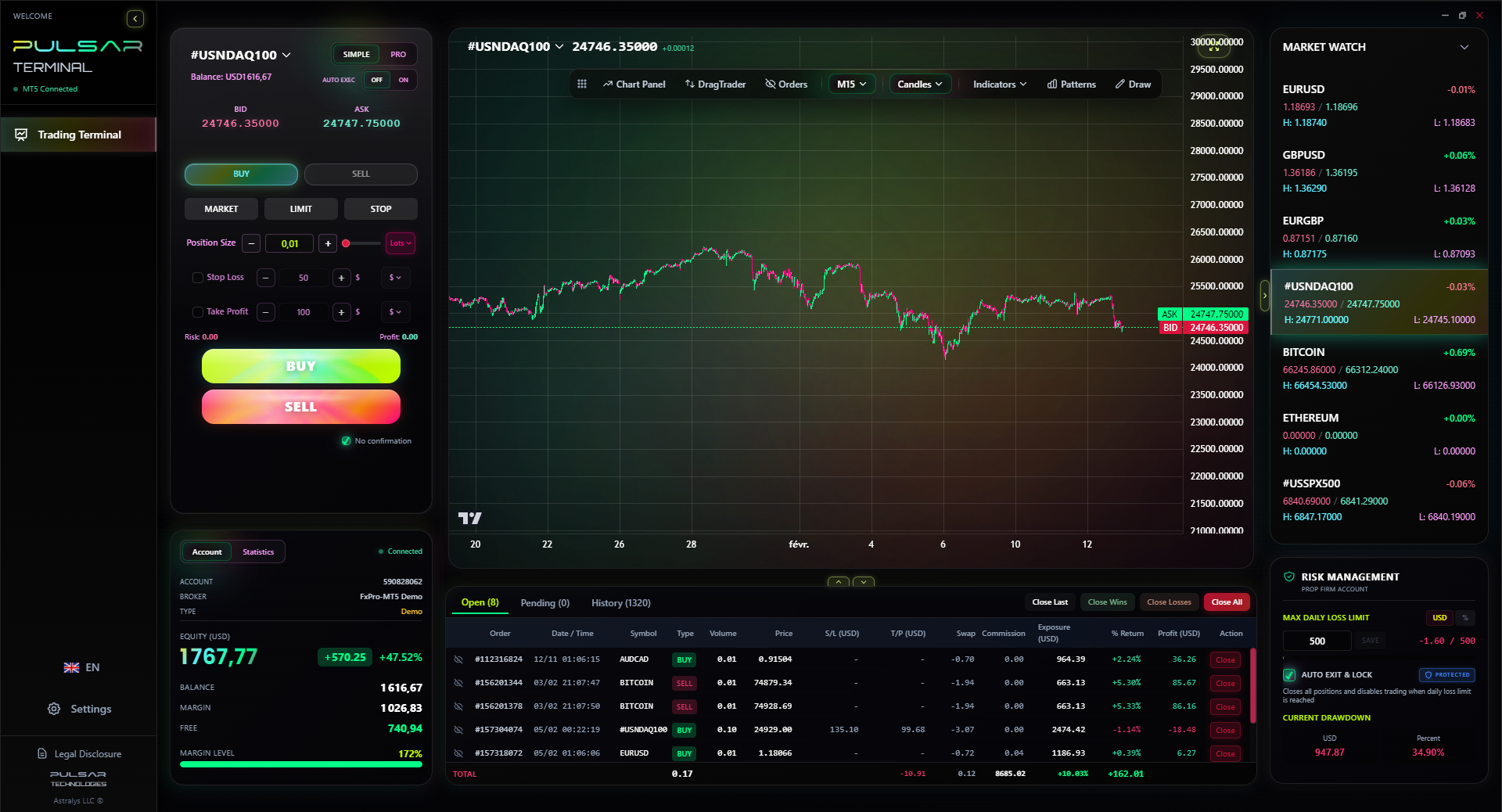
Managing the end-of-day drawdown rule requires precise tracking of your daily P&L, a task made effortless with Pulsar Terminal's real-time equity curve and trade journal built right into MT5.
Pulsar Terminal
MT5一站式工具:拖拽下单、多重止盈/止损、追踪止损、网格交易、成交量分布图和自营交易保护。每日1000+交易者使用。
“The gross-profit fee is the elephant in the room.”
Apex isn't the only game in town. Here’s how it compares in the futures prop firm arena.
Apex vs. Topstep: Topstep is the old-school giant. They have a harder daily loss limit (the 'Max Trailing Drawdown' updates intraday). Their profit split starts at 80/20 but can go to 90/10. Their rules are stricter, but they offer real trading in larger funded accounts. Topstep is for the more disciplined, traditional trader. Apex is for the trader who wants daily flexibility.
Apex vs. Leeloo Trading: Leeloo has a similar eval model but often uses a balance-based drawdown (not trailing equity). This is less forgiving. Their profit split is a straight 80/20 on net profits. For a high-net-profit trader, Leeloo's split might be worse than Apex's gross-profit fee. It requires math.
Apex vs. FTMO/Blue Guardian (Forex Focused): These firms are forex-centric. Their challenge structures are different (two-step phases, strict daily losses). Their profit splits (70/30 or 80/20 on net) are often worse on paper than Apex's 90/10, but again, the net vs. gross calculation flips the script. If you want to trade futures, stick with a futures firm. The contracts and margins are different worlds.
The bottom line? Apex is the king of trader-friendly daily risk rules. If you need room to breathe during the day, they're the best. If you want the highest possible profit split on a net basis and have a clean, low-frequency strategy, another firm might edge them out. For reviews on forex-focused brokers that also offer prop challenges, you can look at Exness review or IC Markets review, but remember, their instruments and rules are different.
💡 Winston 小贴士
Use the end-of-day drawdown as strategic armor. It allows you to set stops based on market structure, not an arbitrary daily loss number. Trade the chart, not the prop firm rule.

Based on what I've seen and my own P&L, Apex is a perfect fit for a specific type of trader.
You'll probably do well with Apex if:
- You're a swing trader or a day trader who holds positions for hours. You need that end-of-day drawdown buffer.
- You have a strategy with a lower trade frequency but a higher risk-reward ratio (think 1:2 or better). This minimizes the impact of the gross-profit fee.
- You're new to prop firms and want a low-cost, low-pressure way to practice trading with 'funded' psychology.
- You love TradingView and want a seamless chart-to-trade workflow.
- You value payout speed and simplicity over complex scaling schemes.
Look elsewhere if:
- You're a hyper-scalper making 50+ trades a day. The gross profit fee will eat you alive.
- You want the prestige of trading real firm capital in the live markets (Apex is sim-to-payout).
- You need hand-holding or immediate customer support.
- You're obsessed with getting the absolute highest possible profit split percentage and are willing to accept stricter daily rules to get it.
My personal journey: I started as a scalp-heavy trader and struggled with the fee structure. I adapted. I began using the MACD indicator on higher timeframes to filter for higher-probability swing setups in the 10-Year Note futures (ZN). Fewer trades, bigger wins. My last payout cycle: Gross Profits $5,200, Net Profits $4,100. Apex fee: $520. My take: $3,580. That's a fee rate of about 12.7% of my net. That's a deal I can live with.
“Apex is the king of trader-friendly daily risk rules.”
If you're going to try Apex Trader Funding, do it right. Don't just buy an eval and wing it.
- Wait for a Sale. They have them almost every month. Never pay full price. A $50,000 eval should cost you $85 or less.
- Choose Your Contract Wisely. Start with the Micros (MES, MNQ, MYM). The pip definition (or tick, in futures) risk is smaller, letting you focus on the process, not the P&L noise. You can hit the target trading just one micro contract if you're consistent.
- Build a Buffer First. When you start the eval, don't go for the target immediately. Aim to build a $500-$1,000 buffer above your starting balance. This pushes your trailing drawdown up, giving you immense psychological safety.
- Track Gross vs. Net Religiously. From day one, use a journal that tracks both. Know what your 10% gross fee would be. It will change how you view taking that extra scratch trade.
- Ignore the 'No Time Limit' at First. Pretend there is a 30-day limit. This forces discipline and prevents you from becoming a passive, scared trader.
- Have a Reset Budget. Mentally allocate funds for 1-2 resets. It takes the pressure off the first try. Consider it tuition.
Finally, remember this is a business arrangement. Apex Trader Funding futures prop firm provides a service (capital, platform, payout system) for a fee. Your job is to determine if your trading style makes that fee worthwhile. For many futures traders, especially those who've been strangled by harsh daily limits, it absolutely is. Just go in with your eyes wide open to the 10% gross profit carve-out. It's the defining feature of their entire model.

FAQ
Q1Does Apex Trader Funding give you real money to trade?
No. You trade simulated capital on their platform. Your performance in the simulation determines the real money they pay you from their own funds. It's a sim-to-payout model.
Q2What is the Apex Trader Funding trailing drawdown?
It's a loss limit that only updates at the end of the trading day (5 PM EST). It trails your account's highest closing equity. This means you can have large intraday losses as long as you recover by the daily close, offering significant flexibility compared to intraday drawdown rules.
Q3Is the Apex profit split really 90/10?
Yes, but with a critical detail. You get 90% of your net profits after they take a 10% fee of your gross profits for the month. This fee on gross profits, not net, makes their model unique and can be more expensive for high-frequency traders.
Q4How long does it take to get a payout from Apex?
Very fast. After your first payout (which has a 7-calendar-day hold), you can request payouts at any time. They typically process and send funds within 24-48 hours, which is one of their strongest features.
Q5Can I trade during news events with Apex?
Yes, there are no specific rules against trading news. However, their data feed can experience lag or widened spreads during high-volatility events, just like any simulated environment. Always manage your risk, especially around news.
Q6What happens if I hit the profit target in one day?
You pass the evaluation immediately. Apex has no minimum trading day rule. If you can hit the target in one session without violating the drawdown, you'll be approved for a funded account.
Q7Is Apex Trader Funding good for beginners?
It can be, due to its low-cost entry during sales and its forgiving daily drawdown rule. However, beginners must understand futures trading is complex and risky. The prop firm challenge adds another layer of psychological pressure. It's better to have a proven, disciplined strategy first.
Winston 教授的课程
要点总结:
- ✓The 10% fee is on GROSS profits, not net.
- ✓End-of-day drawdown allows for intraday recovery.
- ✓Micro futures are best for evaluation phase.
- ✓Payouts are reliably fast (24-48 hours).
这篇文章对您有用吗?
点击星星评分
每周交易洞察
免费每周分析与策略。无垃圾邮件。
关于作者
James Mitchell
高级交易分析师
常驻纽约,拥有超过9年的交易经验。专注于主要美元货币对、自营交易公司挑战和美国监管环境。
评论
风险提示
金融工具交易存在重大风险,可能不适合所有投资者。过往业绩不代表未来表现。本内容仅供教育目的,不构成投资建议。在交易前请务必自行研究。
您可能还喜欢

Cara Trading Forex Sukses: 7 Prinsip dari Trader Profesional
Cara trading forex sukses dengan 7 prinsip trader pro: manajemen modal, disiplin, journal trading, backtest. Data nyata, bukan janji profit palsu.
Jam Trading Forex Terbaik untuk Trader Indonesia: Panduan Lengkap dengan Tabel Waktu
Panduan jam trading forex untuk trader Indonesia. Tabel 4 sesi dunia, jam emas 20:00-00:00, sesi mana yang harus dihindari. Data akurat + tips dari trader berpengalaman.
Top 5 Sàn Forex Uy Tín Nhất 2026: Review Jujur dari Trader Indonesia
Top 5 sàn forex uy tín 2026 untuk trader Indonesia. Review jujur: spread, deposit, withdraw, dukungan lokal. Exness, XM, IC Markets & lebih.
