


Ever feel like the market is just sleeping on you? You're glued to your screen, but nothing's moving.

Olumide Adeyemi
西非交易先驱 ·  Nigeria
☕ 10 分钟阅读
您将学到:
- 1Why the Day of the Week Isn't Just Superstition
- 2The Rhythm of the Forex Week (A Trader's Diary)
- 3The Golden Hours: Session Overlaps for Nigerian Traders
- 4When to Put the Phone Down (Seriously)
- 5Making This Work for a Nigerian Lifestyle
- 6How to See the Volatility, Not Just Guess
- 7Your Simple Weekly Action Plan
Ever feel like the market is just sleeping on you? You're glued to your screen, but nothing's moving. Or worse, you log in and get slapped by a wild swing you never saw coming. A lot of that comes down to timing. You can have the best strategy in the world, but if you're trading when the market is dead, you're just wasting your time and data. Let's break down the real best days to trade forex, specifically for our Nigerian schedule, and I'll share the exact times I've made - and lost - the most money.
It's not about lucky charms or avoiding black cats. The day matters because of liquidity and who's at their desk. Big banks, hedge funds, and corporations move the real money. When London and New York traders are sipping their morning coffee, the market wakes up. When they log off for the weekend, it goes quiet. Trading during low liquidity is like playing football on a muddy, empty pitch. The spreads widen (costing you more), the price can be jerked around by a single large order, and your stop-loss becomes a suggestion rather than a guarantee. I learned this the hard way early on. I tried to scalping strategy on a Saturday morning once, thinking I was clever. The spread on EUR/USD was over 5 pips at my broker instead of the usual 0.8. I got filled on a bad price and was immediately in the red before the market even moved. That's a tax on impatience.

Warning: Low liquidity doesn't just mean slow moves. It can also lead to 'flash spikes' where price jumps 10-20 pips on a tiny volume order, just to trigger a cluster of stop-losses before snapping back. Your broker's spread definition page will tell you they widen during these times for a reason - their own risk goes up.
“Tuesday and Wednesday are the workhorses of the forex week, where clean trends and reliable breaks happen.”
Think of the week like a story, with a clear beginning, middle, and end. Here’s how it typically plays out.
Monday: The Cautious Opening
Monday is often a continuation or adjustment from Friday's close. Asian and European sessions are active, but New York hasn't fully engaged. It can be range-bound or see a slow drift. I don't expect massive trends on Monday mornings. It's a day for analysis, setting up watchlists, and maybe taking smaller, tactical trades. The volatility usually picks up in the London afternoon.
Tuesday & Wednesday: The Sweet Spot
These are, hands down, my favourite days. The market is fully awake. All major sessions (Asia, Europe, North America) are in play during overlaps. Economic data starts flowing. This is when you get clean trends and reliable technical breaks. Most of my profitable swing trading positions are entered on a Tuesday or Wednesday. The liquidity is deep, so you get fair fills.
Thursday: The Prelude to Chaos
Thursday is like Wednesday's slightly more volatile sibling. It's still excellent for trading, but you start to see positioning for the week's end. If there's big data due on Friday (like US Non-Farm Payrolls), the nervousness begins here. I've caught some of my biggest moves on Thursdays, but you need to be mindful of the calendar.
Friday: The Rollercoaster
Friday can be two-faced. The London and New York overlaps are still highly active. But after about 4 PM London time (which is 4 PM Nigerian time), things change. Traders start closing positions to avoid weekend risk. This can cause sudden, sharp moves that have nothing to do with the chart. I never, ever hold a risky position over the weekend unless it's a long-term investment with a huge buffer. I got caught in a 'Friday Squeeze' once on GBP/JPY. Price reversed 80 pips in 15 minutes against me just before the close, turning a winning trade into a loser. I broke my own rule and paid for it.

Example: Let's quantify it. On a typical Wednesday during the London-New York overlap (1 PM - 4 PM WAT), the average true range (ATR) for EUR/USD might be 60-80 pips. On a Monday morning Asian session, that can drop to 20-30 pips. You're trading two completely different instruments.

💡 Winston 小贴士
The market pays you for patience, not for screen time. Waiting for the London-New York overlap is like waiting for the fish to bite at dawn. Everything else is just dangling your hook in an empty pond.
“If you're trading when the market is dead, you're just wasting your time and data.”
This is the secret sauce. The absolute best times to trade are when two major financial centers are open at the same time. For us in Nigeria (West Africa Time, WAT, which is GMT+1), here's the schedule you should live by.
| Overlap Session | Nigerian Time (WAT) | Key Currencies | What Happens |
|---|---|---|---|
| London & Europe | 8:00 AM - 4:00 PM | EUR, GBP, CHF | The core European session. Gets busy from 9 AM. |
| London & New York | 1:00 PM - 4:00 PM | EUR/USD, GBP/USD, USD/CHF | THE MOST VOLATILE PERIOD. Highest volume, best trends. |
| Sydney & Tokyo | 12:00 AM - 6:00 AM | AUD, JPY, NZD | Good for Asian pairs, but generally lower volatility. |
My most consistent profits come between 1 PM and 4 PM WAT. That's when I'm at my desk, no distractions. The EUR/USD guide shows how this pair specifically comes alive during this window. If you have a day job, try to be active during your lunch break (1-2 PM) or right after work. Even 30 minutes in this window is better than 3 hours in the dead of night.

Pro Tip: Set price alerts for your key levels before the London-New York overlap. When 1 PM hits, you'll get a notification if price is approaching, so you don't have to stare at the chart. Use that time to manage your open trades from the morning.
“If you're trading when the market is dead, you're just wasting your time and data.”
Discipline isn't just about taking trades. It's about knowing when not to trade. Here are the times I've learned to avoid, often through losses.
Sunday Evening / Monday Pre-London: The market is just reopening. Gaps are common, liquidity is thin. It's messy. I don't place new orders until the London banks are properly online after 8 AM WAT.
Friday After 4 PM WAT: As mentioned, the weekend close-out. Unpredictable, news-driven spikes. Protect your capital. Close speculative positions.
Major Holiday Periods: Christmas to New Year, Easter week. The entire Western world is on holiday. Volume dries up massively. I remember trading on December 28th a few years back. The chart looked like a flatline. I forced two trades out of boredom and lost on both from whipsaws. The market was closed, even though the platform was open.
During Major News Events (If You're Not a News Trader): If you don't have a specific strategy for trading the NFP or a central bank announcement, just wait. The spread will balloon, orders may be delayed, and the volatility is chaotic. Watch from the sidelines. The 5 minutes after the news is often clearer than the 5 seconds after.
This is where a good broker's execution matters. During volatile times, some brokers struggle. I've had better stability during news with brokers like IC Markets review and Pepperstone review due to their raw spread accounts and deep liquidity pools.
💡 Winston 小贴士
Your first loss is often your smallest. The urge to 'get it back' on a quiet Monday or a sleepy Friday afternoon is where small losses become account-ending ones. When the market sleeps, you should too.
“The absolute best times to trade are when two major financial centers are open at the same time.”
We have unique challenges: power, data costs, and often, a 9-5 job. Here’s a realistic weekly trading plan for a Nigerian retail trader.
The Early Riser (Before Work): 6:30 AM - 7:30 AM WAT. The Asian session (Tokyo) is still open. Check your XAU/USD guide if you trade gold, as it often moves with Asia. Look for any carry-over from the US afternoon. It's a good time for analysis and planning trades for the London open.
The Lunch Break Trader: 1:00 PM - 1:45 PM WAT. You hit the very start of the London-New York overlap. This is prime time. Have your trades planned from the morning. Execute, set your stop-loss and take-profit, then go back to work. Don't micromanage it.
The Evening Trader: 8:00 PM - 10:00 PM WAT. The New York afternoon. Volatility has dropped from its peak, but there can be good, smooth trends as the US session winds down. It's a calmer environment for analysis and setting up for the next day.
The Weekend: No trading. Use Saturday morning to review your week. What worked? What didn't? Check the economic calendar for the week ahead. This is your study and planning time. Sunday evening, maybe set some alerts, but don't trade.
Your most powerful tool is the pending order. You don't need to be at the screen 24/7. Do your analysis, place your buy-stop or sell-limit orders at key levels with attached stop-loss and take-profit, and walk away. Let the market come to you. This is how you use a tool like a position size calculator before you're in the heat of the moment.
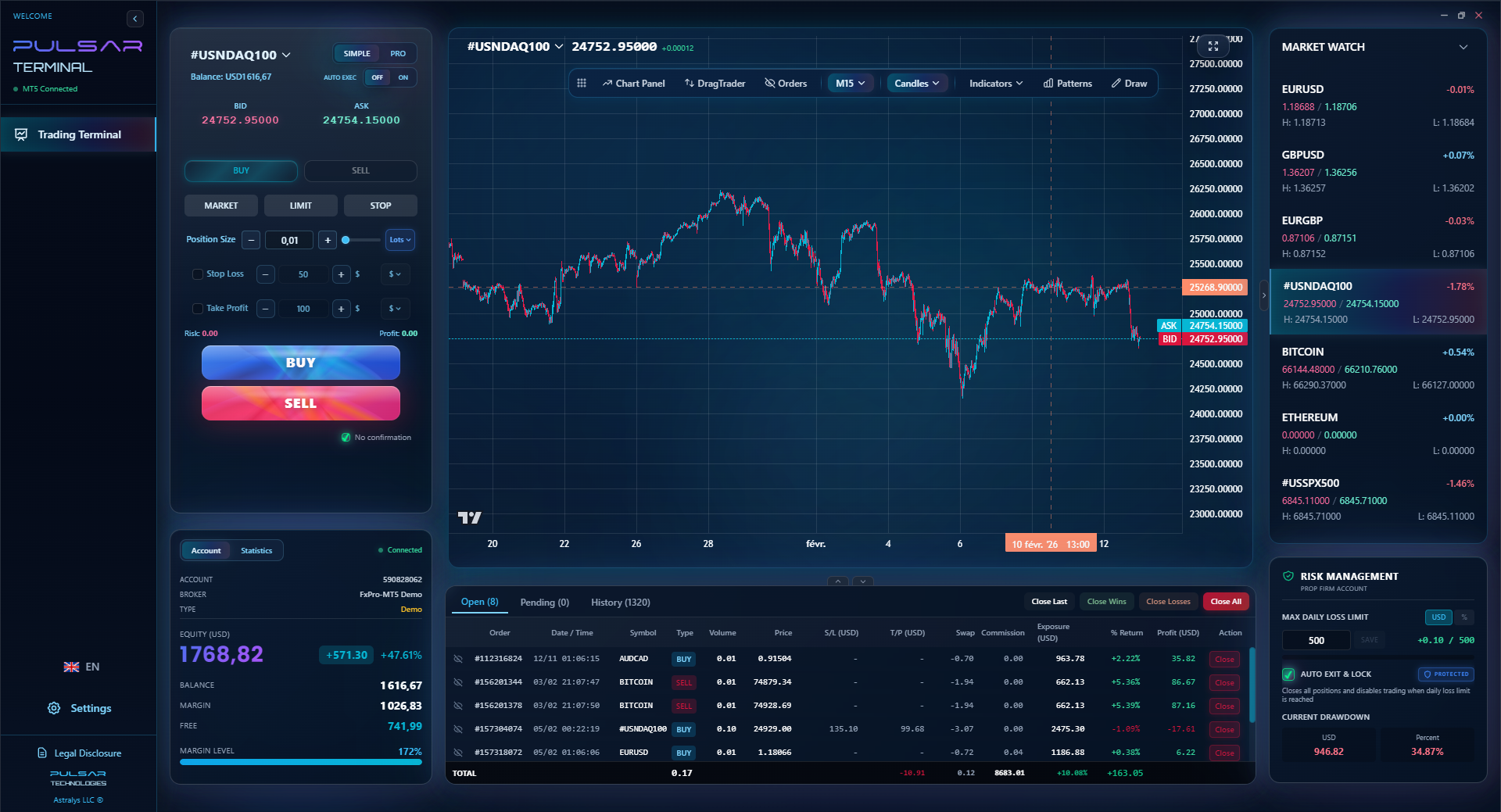
Sticking to a precise trading schedule is easier when your orders, stops, and take-profits are managed automatically, letting you focus on analysis during your key windows.
Pulsar Terminal
MT5一站式工具:拖拽下单、多重止盈/止损、追踪止损、网格交易、成交量分布图和自营交易保护。每日1000+交易者使用。
“The absolute best times to trade are when two major financial centers are open at the same time.”
You don't have to memorize schedules. Your charts can show you when the market is alive.
The ATR Indicator: The Average True Range is your best friend. Add it to your chart (14 period). Watch the line rise during overlap sessions and fall on Mondays or Fridays late. A rising ATR confirms you're in a good trading window. I pair this with the MACD indicator for trend confirmation during these volatile periods.
Economic Calendar: This is non-negotiable. You must know when high-impact news (red events) are scheduled. A quiet Tuesday can turn wild at 2 PM WAT if there's a US CPI print. Mark these times in your diary. I use the calendar to avoid trading 5 minutes before and 5 minutes after a major release, unless that's my specific strategy.
Volume Indicators: While forex has no central exchange volume, tools like the Volume Profile can show you where price was traded most. Platforms with good volume data (often derived from tick volume) can help you see activity spikes. High volume during a breakout at 2 PM WAT is a much stronger signal than the same breakout at 4 AM.
Warning: Don't confuse volatility with opportunity. High volatility means bigger potential profits and bigger potential losses. Always adjust your position size. A 50-pip stop-loss might be fine at 10 AM, but at 2 PM, the market could blow through it in a news spike. Use wider stops or smaller lots during peak volatile windows.
💡 Winston 小贴士
A plan for the week is worthless without a plan for the hour. Know not just which day, but which 90-minute window you are trading in. Be a sniper, not a soldier spraying bullets.
“Discipline isn't just about taking trades. It's about knowing when not to trade.”
Let's make this concrete. Here's what a successful week looks like for me now, after years of trial and error.
Sunday Night: Check calendar. Note major events. No trading. Monday 7 AM: Review weekend gaps. Analyse charts. Set potential orders for Tuesday/Wednesday. Trade lightly, if at all. Tuesday 1 PM: Be at my desk. Manage any open orders. Look for new entries during the London-New York overlap. This is my primary trading day. Wednesday 1 PM: Repeat. The market is in full flow. Most trends are established. Thursday: Stay alert. Continue trading overlaps, but start tightening stops on existing profitable trades ahead of any Friday news. Friday 1 PM: Final trading window. By 3:30 PM, I'm closing any short-term speculative positions. I never hold a swing trade over the weekend unless it's miles in profit with a trailing stop. Friday 4 PM: Log off. The week is done.
The core of this isn't complicated. It's about concentration. Focus your effort, your capital, and your mental energy on the 10-15 hours per week that matter most. The rest of the time, you're either planning, managing, or resting. Trying to trade every session is a fast track to burnout and a blown account. I promise you, waiting for the right day and the right hour makes all the difference between feeling like the market is against you and feeling like you're finally in sync with it.
FAQ
Q1Is Friday a good day to trade forex?
It can be, but with major caveats. The early part of Friday, especially during the London-New York overlap (1-4 PM WAT), is active. However, you must close all speculative positions well before the weekly close (after 4 PM WAT) to avoid the unpredictable 'weekend squeeze' where traders exit positions. I treat Friday as a day to take profits, not to enter new, risky trades.
Q2What is the best time to trade forex in Nigeria?
The absolute best time is 1:00 PM to 4:00 PM West Africa Time (WAT). This is when the London and New York trading sessions overlap, creating the highest liquidity and volatility. This is when major currency pairs like EUR/USD see their biggest and most reliable moves.
Q3Can I trade forex successfully only on weekends?
No. The forex market is closed to institutional players over the weekend. While some brokers offer weekend trading on cryptocurrencies or limited FX pairs, liquidity is extremely thin, spreads are massively widened, and price action is unreliable. It's not real forex trading. Use weekends for analysis and rest.
Q4Which day has the lowest volatility?
Monday during the Asian/early European session (before 8 AM WAT) and Friday after the New York close (after 4 PM WAT) typically have the lowest volatility. Major holiday periods like Christmas week also see dramatically reduced activity.
Q5How do economic calendars affect the best days to trade?
They can completely override the typical weekly rhythm. A high-impact news event (like US Non-Farm Payrolls on a Friday) turns that day into the most volatile of the month. A quiet Tuesday can become chaotic if a surprise central bank announcement happens. Always check the calendar. The best days are high-volatility days without unpredictable news spikes, which is why Tuesday and Wednesday are often ideal.
Q6I work a 9-5 in Lagos. Can I still trade?
Absolutely. Your key window is your lunch break (1-2 PM WAT). That's prime time. Use the morning to plan your trades via price alerts. Execute at lunch, set your stop-loss and take-profit, then go back to work. Evening (8-10 PM WAT) is also viable for analysis and managing longer-term trades. You don't need to be screen-bound all day.
Winston 教授的课程
要点总结:
- ✓Focus 80% of your effort on Tuesday-Thursday, 1-4 PM WAT.
- ✓Never hold a risky trade over the weekend. Close by Friday 4 PM.
- ✓Use the ATR indicator to see volatility, don't guess.
- ✓Wider spreads on quiet days eat your profits before the trade starts.
- ✓Your lunch break (1 PM WAT) is more valuable than 4 hours on a Monday morning.
这篇文章对您有用吗?
点击星星评分
每周交易洞察
免费每周分析与策略。无垃圾邮件。
关于作者
Olumide Adeyemi
西非交易先驱
尼日利亚最活跃的外汇交易教育者之一。从拉各斯出发有8年交易经验。专注于低资金策略和面向非洲交易者的自营公司挑战。
评论
风险提示
金融工具交易存在重大风险,可能不适合所有投资者。过往业绩不代表未来表现。本内容仅供教育目的,不构成投资建议。在交易前请务必自行研究。
您可能还喜欢

Cara Trading Forex Sukses: 7 Prinsip dari Trader Profesional
Cara trading forex sukses dengan 7 prinsip trader pro: manajemen modal, disiplin, journal trading, backtest. Data nyata, bukan janji profit palsu.
Jam Trading Forex Terbaik untuk Trader Indonesia: Panduan Lengkap dengan Tabel Waktu
Panduan jam trading forex untuk trader Indonesia. Tabel 4 sesi dunia, jam emas 20:00-00:00, sesi mana yang harus dihindari. Data akurat + tips dari trader berpengalaman.
Top 5 Sàn Forex Uy Tín Nhất 2026: Review Jujur dari Trader Indonesia
Top 5 sàn forex uy tín 2026 untuk trader Indonesia. Review jujur: spread, deposit, withdraw, dukungan lokal. Exness, XM, IC Markets & lebih.
