


You're probably staring at your chart right now, wondering which magic line will finally unlock consistent profits in Nifty or Bank Nifty options.

Rajesh Sharma
高级外汇分析师 ·  India
India
☕ 12 分钟阅读
您将学到:
- 1Why Getting Your Indicators Right Matters More Than Ever
- 2The Non-Negotiable Trio: Volatility First, Price Second
- 3Momentum & Trend: Your Directional Compass
- 4The Options-Specific Secret Weapon (It's Not on Your Chart)
- 5Building Your Personal Indicator Dashboard: A Practical Setup
- 6Costs: The Silent Indicator Killer You Can't Ignore
- 7My Personal "Indicator Fusion" Framework for 2026
- 8Common Pitfalls to Avoid Like the Plague
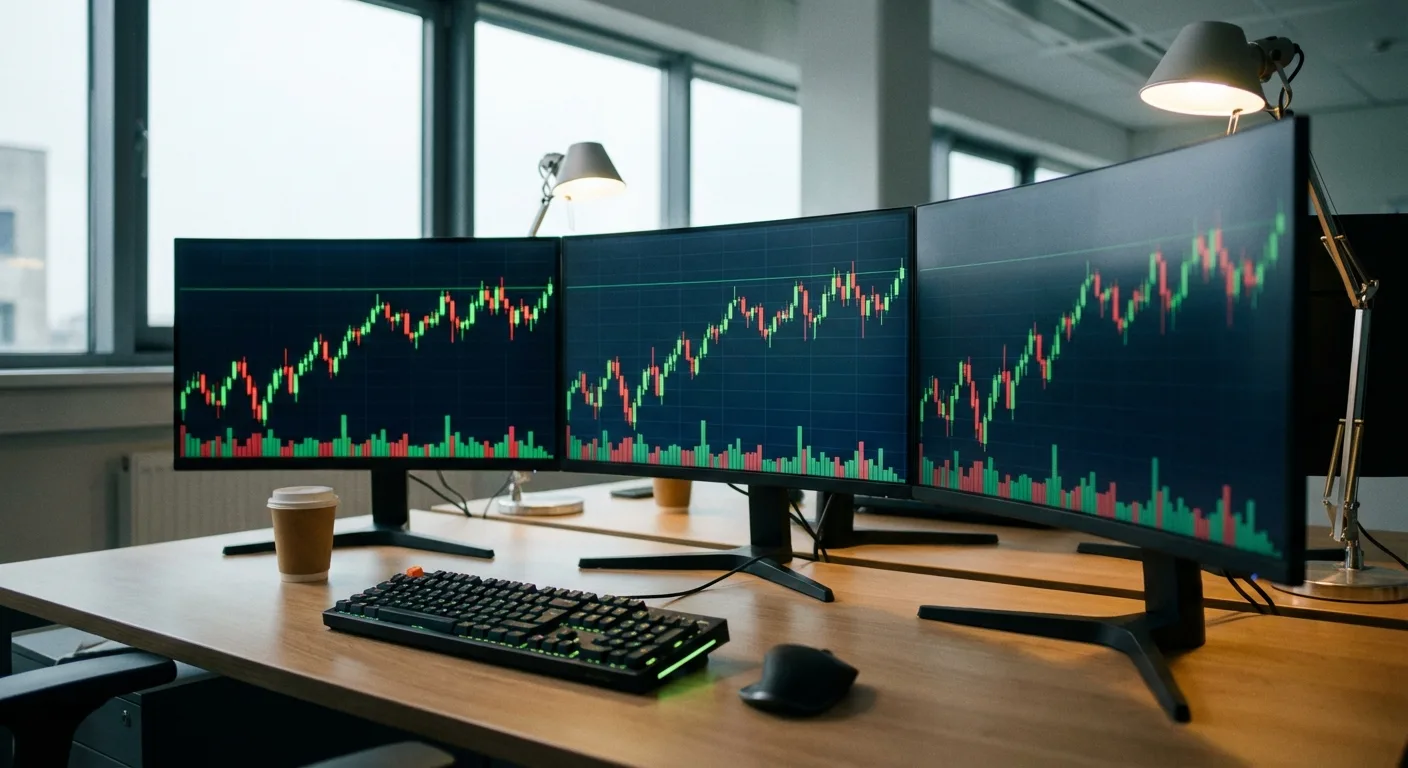
You're probably staring at your chart right now, wondering which magic line will finally unlock consistent profits in Nifty or Bank Nifty options. I've been there. After 12 years of trading in Mumbai, from the old BOLT terminals to today's slick apps, I can tell you there's no single holy grail. But there is a clear winner for the most effective approach in our unique market. The real answer isn't about picking one indicator; it's about understanding how the new SEBI rules have changed the game and which combinations give you an edge when 89% of traders are losing money. Let's cut through the noise.
The game changed in late 2024. SEBI, spooked by those loss statistics, decided to make it harder for the casual punter. The minimum contract size for index options jumped to ₹15-20 lakhs. You now pay 100% premium upfront. An extra 2% margin hits you on expiry day for short positions. This isn't just paperwork; it fundamentally changes how you trade.
Before, you could get away with sloppy entries. A bad Nifty call option might cost you ₹5,000. Now, with the bigger contract sizes and full premium paid immediately, the same mistake can lock up ₹25,000 of your capital instantly. Your margin is tied up, and your risk is real from minute one. This is where indicators stop being pretty lines and become your capital's bodyguard. They're your filter to avoid the noise trades that will now bankrupt you faster.
I learned this the hard way in November '24. I was short a Bank Nifty 48000 put, using my old 'gut feel' for support. The contract size had just increased, but I didn't adjust my mental stop-loss. A sudden 300-point drop against me triggered not just a loss, but that new 2% Extreme Loss Margin. My broker's system auto-squared off other positions to cover it. I lost ₹42,000 on one trade because I wasn't using a volatility indicator to warn me. That was the last time I traded without a structured, indicator-based plan.

Warning: The 100% upfront premium rule means you can't just 'try' a trade anymore. Every entry must be justified by clear signals, or you're donating money to the market.
Forget what you learned about stocks. In options, volatility isn't just a metric; it's the price tag. The premium you pay or receive is directly tied to expected volatility. If you're not measuring it, you're trading blind.
India VIX: The Market's Fear Gauge
This is your starting point every single morning. The India VIX, calculated by the NSE, tells you the market's expectation of volatility over the next 30 days. A VIX above 20? The market is nervous, premiums are expensive. A VIX below 15? It's complacent, premiums are cheaper.
Here's my rule: I never sell options (go short volatility) when the VIX is below 14. The premium is too low for the risk. I never buy options (go long volatility) when the VIX is above 22 unless I have a very strong directional view, because I'm paying for fear that might not materialize. Most of my profitable trades happen in the VIX 16-20 range.
Average True Range (ATR)
While VIX gives you the broad expectation, the ATR on your Nifty chart tells you what's actually happening. It measures the average trading range over a period (I use 14 days). If the ATR is expanding, current volatility is rising, confirming the VIX's fear. If the VIX is high but the ATR is low and falling, it suggests fear is fading, and option premiums might be set to collapse - a great setup for selling strategies.
Bollinger Bands
This is where volatility meets price action. Bollinger Bands consist of a middle SMA (usually 20-period) with two bands plotted two standard deviations away. When the bands squeeze tight, it's a period of low volatility, often preceding a big move (a breakout). When they expand, volatility is high.
For options, a Bollinger Band squeeze can signal a great time to buy a straddle (buying both a call and a put), anticipating a big move in either direction. A wide expansion after a big trend often signals a good time to sell options, expecting a reversion to the mean. I pair this with the RSI indicator to avoid selling at the very peak of a trend.

Example: On March 15, 2026, Nifty was in a tight range, VIX was at 17 (moderate), but the daily chart showed a severe Bollinger Band squeeze. The 20-day ATR was at a 1-month low. This was a classic volatility compression setup. I bought an ATM weekly straddle for ₹8,500 total premium. Two days later, a sharp 180-point breakout happened. The straddle's value jumped to ₹14,200 - a 67% gain in two days. The squeeze gave the signal.

💡 Winston 小贴士
The market spends most of its time in a range, not a trend. Your default assumption should be range-bound action. Use Bollinger Band edges and RSI extremes for mean reversion plays until a clear trend is confirmed by price holding beyond the 21 EMA.

“The best indicator for option trading isn't a line on your chart; it's the Put-Call Ratio, the crowd's fear and greed made into a number.”
Volatility tells you the 'how much,' but momentum and trend indicators tell you the 'which way.' You need both to place a smart bet.
The Exponential Moving Average (EMA) Stack
For Indian indices, which trend remarkably well, EMAs are king. I keep it simple on my main chart: 9 EMA (short-term sentiment), 21 EMA (the institutional benchmark), and 50 EMA (major trend). The rules are straightforward:
- Price > all three EMAs = Strong uptrend. Look for call buying or put selling opportunities on dips.
- Price < all three EMAs = Strong downtrend. Look for put buying or call selling opportunities on rallies.
- Price tangled in the EMAs = Range-bound, choppy market. Avoid directional bets; maybe look at credit spreads.
The 'Golden Cross' (21 EMA crossing above 50 EMA) and 'Death Cross' (21 EMA crossing below) still work on weekly charts for major trend shifts. Don't ignore them.
Relative Strength Index (RSI) – The Indian Adjustment
The textbook says overbought is 70, oversold is 30. In India's often momentum-driven markets, that's too generous. We get sustained trends. My adjusted levels:
- RSI above 60 on the daily chart: Potentially overbought. Be cautious buying calls, consider selling calls or buying puts if other signals align.
- RSI below 40 on the daily chart: Potentially oversold. Be cautious buying puts, consider selling puts or buying calls. I only consider extremes above 75 or below 25 as strong reversal signals. This adjustment alone saved me from getting steamrolled in the Nifty rally of early 2025.
MACD for Conviction
The MACD indicator is my final gatekeeper. It's slow, but it catches the big moves. I won't enter a long-dated option buy (like a monthly expiry) unless the MACD histogram is in my favor and the signal line crossover agrees. For swing trading options strategies, it's useful. It's terrible for scalping though - just too laggy.

Here's the insider edge: the best indicator for option trading isn't a technical chart tool at all. It's the Put-Call Ratio (PCR).
The PCR is the total volume of put options traded divided by the total volume of call options traded, usually for a specific index like Nifty. You find it on your broker's options chain or on sites like NSE.
- PCR > 1.2: More puts are being bought than calls. This indicates bearish sentiment, often seen as a contrarian bullish signal. When everyone is buying puts for protection, smart money might be accumulating.
- PCR < 0.8: More calls are being bought. Indicates bullish sentiment, often a contrarian bearish signal.
- PCR around 1.0: Neutral sentiment.
The magic happens at extremes. In January 2026, after a nasty correction, the Nifty PCR hit 1.45. Extreme fear. I combined that with an RSI of 38 on the daily chart and price bouncing off the 50 EMA. It was a triple confirmation. I bought near-month 21500 calls. The market rallied 4% over the next week, and those calls tripled in value. The PCR gave me the courage to act when others were panicking.

Pro Tip: Don't just look at the total PCR. Look at the PCR for specific strike prices around the spot price. A high PCR at lower strikes shows where traders are buying protection, revealing their perceived support levels.
“In India's new high-margin world, a bad trade doesn't just lose money; it locks up your capital and can trigger a cascade of auto-square-offs.”
You can't have 20 indicators flashing. You'll be paralyzed. Here’s the exact setup I use on my trading screen for Nifty options. I call it the "Tri-Frame Dashboard."
Chart 1: The Big Picture (30-minute timeframe)
- Primary Tool: 9, 21, 50 EMA stack.
- Job: Identify the intraday trend. Is price above or below the 21 EMA? That's my bias for the session.
Chart 2: The Timing Chart (5-minute timeframe)
- Indicators: Bollinger Bands (20,2), RSI (14-period).
- Job: Find entries. I look for price to touch the outer Bollinger Band and for RSI to be >60 or <40 for a potential reversal entry. Or, I look for a squeeze near the middle band for a breakout entry.
Separate Monitor/Window:
- India VIX Chart: Is it rising or falling?
- Live Options Chain with PCR: What's the sentiment at different strikes?
- My position size calculator open: To ensure every trade respects the new, higher margin requirements.
This setup keeps me from overtrading. If the Big Picture chart is bearish (price < 21 EMA), I only look for put buys or call sells on the Timing chart. I ignore bullish signals. Discipline is everything, especially now.
Remember, with the new algo trading rules and OTR limits, placing tons of tiny orders to 'test' the market is a bad idea. Your dashboard should give you high-conviction signals, not encourage button-mashing.
💡 Winston 小贴士
Volatility is mean-reverting. A sky-high VIX will fall. A crushed VIX will rise. Your edge lies in positioning for this reversion, not extrapolating the current state.
You can have the world's best signal, but if you don't account for costs, you'll lose. Let's break down what a winning trade actually needs to overcome in India.
Say you make a profitable options trade with a ₹10,000 premium. Here's where the money goes (using a typical discount broker):
| Charge | Calculation | Amount |
|---|---|---|
| Brokerage | Flat ₹20 per executed order | ₹20 |
| Exchange Charge | ~₹0.01 per crore on premium | ~₹0.10 |
| SEBI Turnover Fee | 0.0001% of premium | ₹0.10 |
| GST | 18% on (Brokerage + Ex. Charge) | ₹3.62 |
| STT (NEW Rate) | 0.15% of Premium (on sell side) | ₹15.00 |
| Stamp Duty | Varies by state, approx. 0.003% | ₹0.30 |
| Total Cost | ~₹39.12 |
That's nearly ₹40 per trade, just to enter and exit. If your net profit on that ₹10,000 trade is ₹300, costs ate over 13% of your gains. The new, higher STT from April 2026 makes this even more critical.
What this means for your indicators: Your system's win rate and profit factor must be high enough to absorb this friction. A strategy that generates lots of small wins might get completely wiped out by costs. This is why combining indicators to filter for only high-probability, higher-reward setups is crucial. Don't trade for a 5-point target. Aim for moves where the profit potential is 3-5 times your total cost. My rule: I don't enter a trade unless my indicator-based target offers at least ₹150 in potential profit per lot, after all costs are considered.

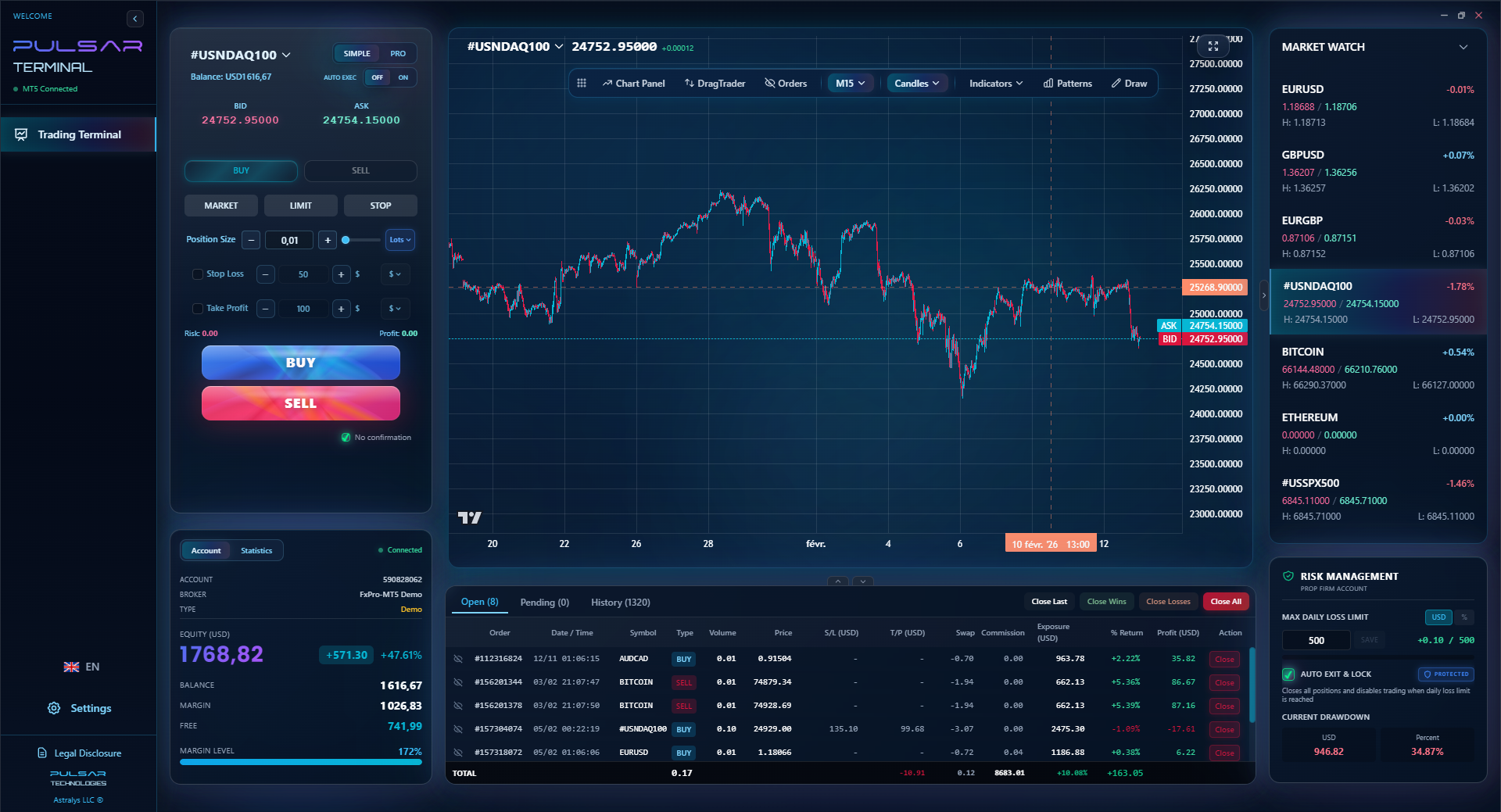
Managing multiple option legs and their precise exits is complex, but tools like Pulsar Terminal let you set multi-level take-profits and stop-losses for your entire strategy directly on your MT5 chart, automating the risk management your indicators demand.
Pulsar Terminal
MT5一站式工具:拖拽下单、多重止盈/止损、追踪止损、网格交易、成交量分布图和自营交易保护。每日1000+交易者使用。
“Your indicator's main job isn't to find winners; it's to identify losers quickly so you can exit before a small loss becomes a margin call.”
So, what's the best indicator for option trading? It's a system. Here's my step-by-step checklist for every trade in this new regulatory environment.
- Volatility Check: Is India VIX between 16-20? If yes, proceed. If <14, I'm cautious about selling. If >22, I'm cautious about buying.
- Trend Filter: On the 30-min chart, is price consistently above or below the 21 EMA? This sets my directional bias. No bias = no trade.
- Sentiment Gauge: What's the PCR? Is it at an extreme (>1.3 or <0.7) offering a contrarian signal, or neutral confirming my bias?
- Entry Signal: On the 5-min chart, do I have a Bollinger Band touch/squeeze AND an RSI reading confirming (e.g., band touch + RSI >60 for a potential short)?
- Risk & Cost Finale: I plug the trade into my position size calculator. Given the new margin rules, does the position size keep my risk below 1% of my capital? Is my target profit at least 3x the total estimated cost (brokerage, STT, etc.)?
If all five boxes are checked, I pull the trigger. If not, I wait. This framework forces patience and quality over quantity. In 2025, using this, I took only 37 Nifty options trades for the entire year. 24 were winners, with a net profit of ₹2.87 lakhs after all costs. It's boring. It's disciplined. It works.
The brokers that support this kind of analysis best are those with strong charting and options analytics. I've found Zerodha Kite/Sensibull combo excellent for this, and Upstox has also upped its game. The key is a platform that lets you see charts, the options chain, and the VIX without constantly switching tabs.
Let me save you some expensive lessons.
Pitfall 1: Chasing Lagging Indicators. Don't buy a call just because the 50 EMA just turned up. By the time a slow EMA confirms a trend, a big chunk of the move is over, and option premiums are expensive. Use EMAs for context, not entry.
Pitfall 2: Ignoring Time Decay (Theta). This is the biggest one. You can be right on direction but still lose money if the market doesn't move fast enough. Indicators don't show theta. Always be aware of how many days to expiry. I rarely buy options with less than 7 days left unless it's a very high-volatility, event-driven play.
Pitfall 3: Overcomplicating. More indicators ≠ more wisdom. I see traders with 10 oscillators that all say the same thing. Pick one from each category (Trend, Momentum, Volatility), learn them inside out, and stick with them. My core three are EMAs, RSI, and Bollinger Bands. That's it.
Pitfall 4: Forgetting the Human Element. The PCR is a sentiment indicator. So is watching how the market reacts to news. If Nifty gaps up on great earnings but can't hold the high and sells off, that's a stronger bearish indicator than any RSI reading. Use the charts, but don't turn off your brain.
Finally, remember the ultimate goal isn't to be right about the market. It's to manage risk. A good indicator setup's primary job is to tell you when you're wrong, quickly. Always know your exit point before you enter. A margin call in this new high-margin world is a disaster you might not recover from quickly.

FAQ
Q1Is there really one best indicator for trading Bank Nifty options?
No. For Bank Nifty, which is more volatile than Nifty, I prioritize volatility indicators even more. I start with the India VIX (though it's for Nifty, it correlates), then look at Bollinger Band width on the Bank Nifty chart itself. ATR is also crucial. I then use the 9 and 21 EMA on a 15-minute chart for intraday direction. No single tool does it.
Q2How much capital do I need to start options trading with indicators in 2026?
Realistically, more than before. Due to SEBI's increased contract sizes and 100% upfront premium rule, a single index option trade can easily require ₹50,000-₹2,00,000 in margin/capital blocked. To trade safely and withstand a couple of losses, I wouldn't start with less than ₹3-5 lakhs in your trading account. Starting small with just ₹50,000 is extremely risky now and limits you to very few, high-risk strategies.
Q3Can I use these indicators for weekly expiry options?
Yes, but you must be faster. For weekly expiries, I use shorter timeframes. My setup becomes: 5-minute chart for trend (21 EMA), 2-minute or tick chart for entry (RSI and Bollinger Bands). The PCR is even more important for weeklies, as sentiment shifts quickly. Remember, time decay accelerates in the last week, so be precise and don't hold losers hoping for a reversal.
Q4What's the most common mistake with the RSI in options?
Trading the standard 70/30 overbought/oversold levels blindly. In strong Indian trends, the RSI can stay above 60 or below 40 for weeks. Use it as a gauge of momentum strength, not a reversal signal by itself. Wait for RSI to diverge from price (e.g., price makes a new high but RSI makes a lower high) for a stronger reversal signal, especially for option buying.
Q5Do I need paid software for these indicators?
Absolutely not. Every decent broker platform in India (Zerodha Kite, Upstox, Angel One) offers EMA, RSI, Bollinger Bands, and MACD for free. The India VIX is publicly available on the NSE website. Sensibull (free tier) offers fantastic PCR and options chain analysis. The tools are free; the skill is in knowing how to combine them.
Q6How do the new SEBI rules affect my indicator strategy?
They force you to be more selective. With higher margins and costs, you can't afford to take 10 low-quality trades a day based on weak signals. Your indicator system must filter for only the highest-probability setups with a clear risk/reward. The rules have effectively killed high-frequency, low-capital options scalping for most retail traders. Focus on quality, not quantity.
Winston 教授的课程
要点总结:
- ✓Combine Volatility (VIX/BB), Trend (EMA), and Sentiment (PCR) for a complete picture.
- ✓Adjust RSI levels to 60/40 for Indian market trends.
- ✓Account for all costs: STT at 0.15% can kill small wins.
- ✓New SEBI rules demand higher capital and higher conviction per trade.
这篇文章对您有用吗?
点击星星评分
每周交易洞察
免费每周分析与策略。无垃圾邮件。
关于作者
Rajesh Sharma
高级外汇分析师
在印度和南亚市场拥有超过10年的交易经验。从NSE货币衍生品起步,后转入国际外汇市场。专注于USD/INR和新兴市场货币对。
评论
风险提示
金融工具交易存在重大风险,可能不适合所有投资者。过往业绩不代表未来表现。本内容仅供教育目的,不构成投资建议。在交易前请务必自行研究。
您可能还喜欢

Cara Trading Forex Sukses: 7 Prinsip dari Trader Profesional
Cara trading forex sukses dengan 7 prinsip trader pro: manajemen modal, disiplin, journal trading, backtest. Data nyata, bukan janji profit palsu.
Jam Trading Forex Terbaik untuk Trader Indonesia: Panduan Lengkap dengan Tabel Waktu
Panduan jam trading forex untuk trader Indonesia. Tabel 4 sesi dunia, jam emas 20:00-00:00, sesi mana yang harus dihindari. Data akurat + tips dari trader berpengalaman.
Top 5 Sàn Forex Uy Tín Nhất 2026: Review Jujur dari Trader Indonesia
Top 5 sàn forex uy tín 2026 untuk trader Indonesia. Review jujur: spread, deposit, withdraw, dukungan lokal. Exness, XM, IC Markets & lebih.
