


You're looking for the best prop trading firms in India because you're tired of trading with your own small account.
Rajesh Sharma
高级外汇分析师 ·  India
India
☕ 13 分钟阅读
您将学到:
- 1The Legal Grey Area: Can You Even Do This?
- 2How the Game is Rigged (And How to Win Anyway)
- 3What Actually Matters When Choosing a Firm
- 4Top Prop Firms for Indian Traders (2026 Reality Check)
- 5The Real Cost: It's More Than Just the Fee
- 6How Indian Traders Blow Up: The Classic Mistakes
- 7The Final Verdict: Is It Worth It For You?
You're looking for the best prop trading firms in India because you're tired of trading with your own small account. You want access to real capital. But here's the brutal truth most articles won't tell you: 90% of traders who sign up for these challenges fail, and a good chunk of the rest get their first payout and then blow the account within months. I've been there. I've passed challenges, I've failed them, and I've watched friends lose lakhs in fees chasing the dream. This isn't a fluffy listicle. This is a risk manager's breakdown of what actually works in the Indian context, what's legal, and how to not become another statistic.
Let's cut through the marketing. The number one question Indian traders have is: "Is this legal?" The answer is complicated, and anyone who tells you it's simple is lying.
Proprietary trading itself - where a firm trades its own capital - is perfectly legal in India. Big banks and brokerages do it. The murky part is the modern "funded challenge" model offered by international firms like FTMO or FundedNext. SEBI doesn't issue licenses for this specific activity. They've basically said, "Use these platforms at your own risk."
Here’s the practical reality for you, the trader:
- You can participate. Indian residents can legally pay evaluation fees to foreign firms under the RBI's Liberalized Remittance Scheme (LRS). You're buying a service (an evaluation), not making an investment. The annual limit is $250,000, which is more than enough for any challenge fee.
- The big restriction is on YOU trading forex directly. The RBI frowns upon individuals speculating on international forex pairs. But here's the loophole prop firms use: they are the entity with the capital and broker relationship. You are just operating their capital. This is the key distinction that makes it accessible.
- Taxes are your responsibility. Any profit share you receive is income. You must declare it and pay tax on it. The firm won't deduct TDS for you. Keep immaculate records of every payout.

Warning: The regulatory winds are shifting. SEBI's new 2025 broker regulations bring algo and prop trading into clearer focus. The RBI is also tightening norms for bank lending to prop firms, requiring 100% collateral from April 2026. This doesn't directly stop you from trading with a foreign firm, but it signals increased scrutiny. Don't assume the landscape will look the same in two years.
The safest legal route is to trade INR pairs (USD/INR, EUR/INR) with a SEBI-registered domestic broker. But let's be honest, you're looking at prop firms for the use and access to global markets like NASDAQ or Gold. That means dealing with the international model.
My advice? Treat it as a professional service. You're paying for a test to access a performance-based job. Don't mortgage your house for the fee. And for god's sake, talk to a CA about the tax implications before you get your first payout.
“Prop firms aren't testing if you can make money. They're testing if you can avoid losing it in very specific, controlled ways.”
Prop firms are not charities. Their business model is built on evaluation fees. They only make real money from traders who are consistently profitable and can manage the firm's capital without hitting their strict rules. Most traders fail this test.
The Two-Phase Gauntlet
Almost all firms use a two-step process:
- Evaluation/Challenge Phase: You trade a demo account with specific profit targets and, more importantly, strict loss limits. A typical rule set: Make 10% profit, but never exceed a 5% total drawdown or a 3% daily loss limit. This is where 80% are eliminated.
- Verification/Funded Phase: If you pass, you often do a shorter, similar second phase to "verify" your consistency. Then you get a live account with the firm's capital.
The traps aren't hidden, but traders ignore them. The daily loss limit is the silent killer. You're up 2% for the day, get greedy, one trade reverses, and now you're down 3.1%. Account blown. No warning, no margin call, just instant failure.
The Psychology of the Drawdown
Here’s a personal story. I passed a $50,000 challenge with a firm. The total drawdown was 8%. I thought, "Easy. I'll never lose 4k on a 50k account." I got funded. My first month, I made a 6% profit. I was flying. The second month, I had a string of three losing trades. My equity dropped 4.5%. I was still in profit overall, but I was now only 3.5% away from blowing the entire account. That pressure changes everything. You stop trading your strategy and start trading to not lose. I scrambled, took a terrible trade out of fear, and hit the 8% max drawdown. Game over.
The firms aren't cheating. The rules are clear. But they are designed to filter for a very specific, disciplined, and risk-averse trader. It's not about being a superstar. It's about being a survivor. You need a position size calculator and the discipline to use it for every single trade, especially when you're winning.

💡 Winston 小贴士
The evaluation fee is the cheapest market tuition you'll ever pay. It teaches you more about your own discipline than a year of demo trading.
“The daily loss limit doesn't exist to protect the firm's capital. It exists to protect you from yourself.”
Forget the shiny marketing about "instant funding" or "highest capital." Here are the real levers that affect your survival and profitability.
| Criteria | Why It Matters | What to Look For |
|---|---|---|
| Profit Split | This is your actual pay. | 80% or higher is standard now. Some offer 90% or even 100% on specific plans. |
| Drawdown Rules | This is your lifeline. | Is it based on balance or equity? Equity-based is stricter. Is it trailing? Static is better for beginners. |
| Daily Loss Limit | Your circuit breaker. | A clear, separate daily limit (e.g., 3%) is non-negotiable. It saves you from yourself. |
| Payout Frequency & Fee | Getting your money. | Bi-weekly or monthly. Check if the firm charges a withdrawal fee - it eats profits. |
| Trading Platforms | Your tools. | MT4/MT5 are universal. cTrader is great for ECN. Direct TradingView integration is a bonus. |
| Instrument Spreads | Your trading cost. | Raw spreads from 0.0 pips on majors like EUR/USD are ideal. |
The Withdrawal Trap: I once chose a firm because they offered 90% profit splits. What they didn't highlight was a $50 withdrawal fee per transaction. My first profit was $1,200. My payout was $1,030 (90% of $1,200 = $1,080, minus $50). That $50 fee is a 4.2% tax on my profit. Always read the fine print on payouts.
Platform is Key: You will be spending hours on this platform. If you love TradingView for analysis, a firm like ThinkCapital that lets you execute directly on it is a huge workflow advantage. If you're a dedicated MT5 user for scalping, make sure the firm's version supports one-click trading and has reliable fills.

Pro Tip: The "best" firm is the one whose rules best match your natural trading style. A aggressive swing trading strategy needs a firm with no daily loss limit and a large total drawdown. A cautious scalper needs a firm with tight spreads and a clear daily limit to prevent a bad run from becoming a catastrophe.
“The daily loss limit doesn't exist to protect the firm's capital. It exists to protect you from yourself.”
Based on the current landscape, fee structures, and accessibility for Indian traders, here are the firms that are consistently in the conversation. Remember, "top" doesn't mean easiest. It means they have a credible model, clear rules, and a track record of paying.
1. FundedNext: They've made a huge push into the Indian market. They offer a unique "Balance Drawdown" model on some challenges (drawdown is based on your starting balance, not your highest equity), which is significantly more forgiving for new funded traders. Profit splits go up to 90%, and they have a 15% profit target for challenges. They also allow scalping and news trading.
2. FTMO: The original giant. They are the most established and have the strictest reputation. Their rules are tough (trailing drawdown during the challenge), but that's why their funded trader success rate is likely higher. If you can pass an FTMO challenge, you've genuinely proven something. They set the standard others follow.
3. FundingPips: Gained popularity for straightforward rules and high profit splits (up to 100% on their Monthly plan). Their evaluation fees start low ($29), making them a lower-risk entry point for testing your mettle. They're known for good customer support and relatively fast payouts, often in crypto which can be efficient for India.
4. FXIFY: Stands out for flexible trading styles. They have multiple account models, including ones with no daily drawdown limit, which is rare and valuable for certain strategies. They offer raw spreads and commission-free options via their partner broker, which is crucial for high-frequency strategies.
5. OneFunded: A newer firm (launched 2024) that's grown fast by catering to global traders, including India. They offer a variety of account sizes and a profit split up to 95%. They also have a "Free Retry" option on some plans if you fail near the target, which is a nice psychological cushion.
A Note on "Instant Funding" Firms: Some firms skip the evaluation for a higher fee. I'm skeptical. The evaluation, for all its pain, is a necessary filter. If you can't pass a simulated challenge, you have no business trading real firm capital. The evaluation fee is the cheapest lesson you'll ever get.
💡 Winston 小贴士
If you can't explain your edge in one sentence and how you'll protect against a 5% drawdown, you're not ready for a prop firm. Go back to the simulator.
“View the challenge fee as a licensing exam cost, not an investment. Most people fail their driving test the first time, too.”
Let's do the math that most traders avoid. You see a $50,000 account challenge for a $299 fee. You think, "If I pass, I'm trading 50k!" But what's the real journey?
Scenario: You're a decent trader with a 60% pass rate on challenges (which is very high).
- Attempt 1: Fee $299. Fail.
- Attempt 2: Fee $299. Pass.
- Total Cost Before Trading Live: $598
Now you're funded. You must make back that $598 in profits for the firm before you see a single rupee of personal profit. On an 80% split, the firm keeps 20%. So, you need to generate $598 / 0.20 = $2,990 in gross profit just to break even on your fees.
On a $50,000 account, that's a 5.98% return. You have to make almost 6% on the firm's capital just to get back to zero on your personal investment. This is why blowing a funded account is so devastating - you're not just losing future profits, you're confirming a total loss on your initial investment.

Example:
- Challenge Fee: ₹25,000 (approx $299)
- Expected Pass Attempts: 2
- Total Fee Cost: ₹50,000
- Gross Profit Needed to Recover Fees (80/20 split): ₹50,000 / 0.20 = ₹250,000
- Required Return on $50k Account: 5%
This math is why I tell traders to view the fee as an educational and licensing cost. It's the price of admission to a very tough game. Don't start with your dream $200k account. Start with the smallest, cheapest challenge the firm offers. Prove you can navigate the rules and the psychology first. Both Exness and IC Markets offer demo accounts that mimic prop firm conditions - use them for practice first.
“View the challenge fee as a licensing exam cost, not an investment. Most people fail their driving test the first time, too.”
After coaching traders for years, I see the same mistakes on repeat. Here’s how to sidestep them.
1. Overleveraging on "Sure Things." You get a hot tip on XAU/USD or Nvidia earnings. You size up to 5% of your account on one trade, thinking it's a slam dunk. A spike in volatility hits your stop, and you've just taken a 5% loss. If your daily limit is 3%, you're already over it. Account terminated. The fix: Never risk more than 1% of your account's total capital on a single trade. Use a calculator.
2. Chasing Losses After a Bad Day. You hit your 3% daily loss limit at 11 AM. Frustrated, you jump on another trade in a different market to "make it back." This is how a 3% bad day becomes a 10% disaster and a blown account. The daily limit is a gift. It forces you to walk away. Use it.
3. Ignoring the Instrument-Specific Rules. Some firms don't allow holding trades over major news events or have restrictions on exotic pairs. You get a great MACD indicator signal on a minor forex pair, take the trade, and then find out it violated the rules. They can and will void the trade or close your account.
4. Withdrawal Anxiety. You finally make a 10% profit. You're eligible for a payout. But you think, "If I just make it 15%, my payout will be so much bigger." So you keep trading, often with less discipline because you're "playing with the firm's money." This is when drawdowns happen. Withdraw profits regularly. It psychologically reinforces success and resets your risk.
The core of all these pitfalls is a lack of a mechanical, unemotional plan. Your trading plan must include not just entries and exits, but daily stop-loss rules. This is where technology can help. A tool that can automatically enforce a daily stop-loss for you removes emotion from the most critical decision.
💡 Winston 小贴士
Your first funded account goal isn't to buy a car. It's to earn enough for three more challenge fees. That's your runway.
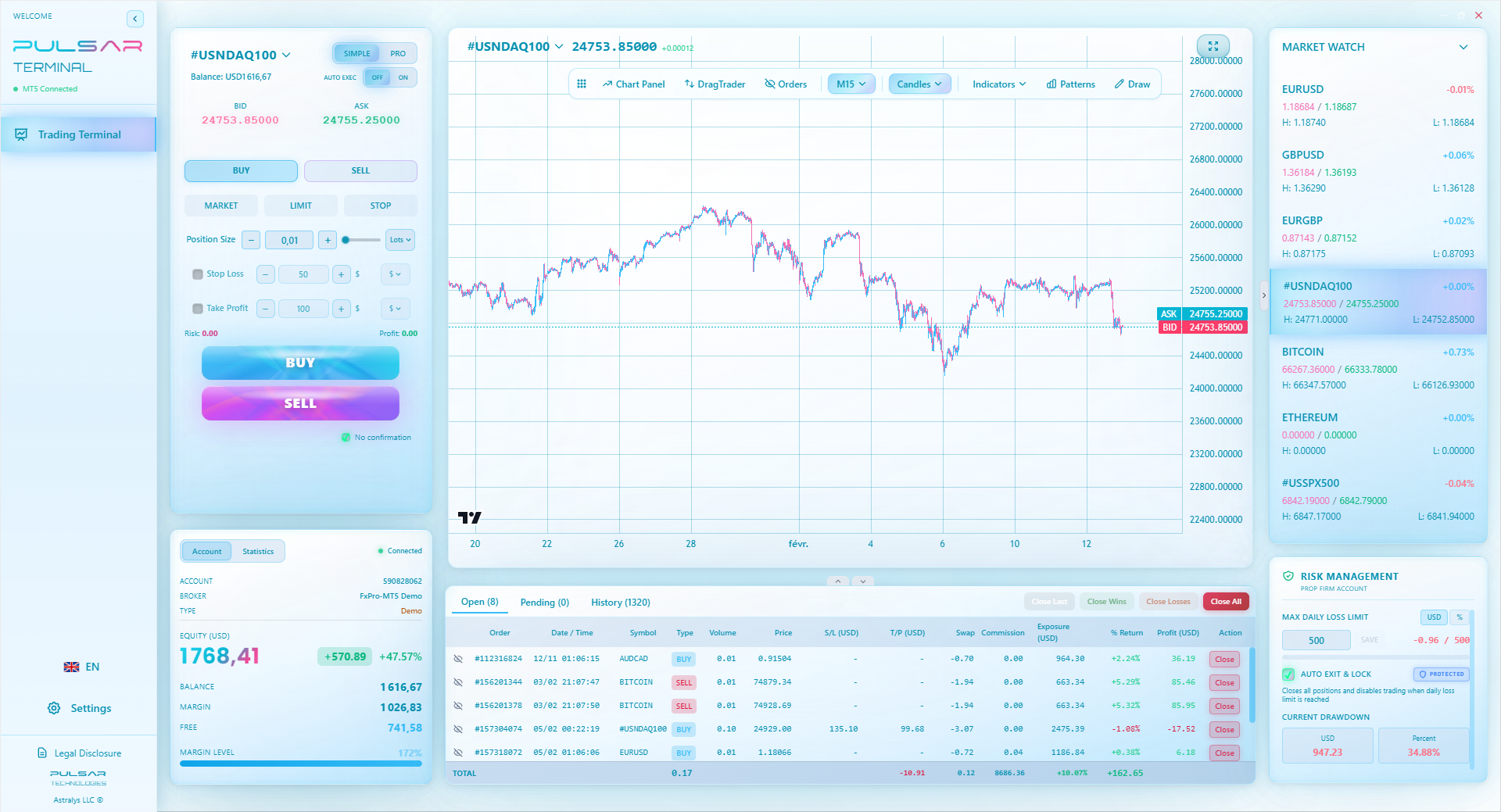
Manually enforcing a strict daily loss limit is emotionally brutal; Pulsar Terminal automates this as a hard stop directly on your MT5 platform, removing the temptation to cheat.
Pulsar Terminal
MT5一站式工具:拖拽下单、多重止盈/止损、追踪止损、网格交易、成交量分布图和自营交易保护。每日1000+交易者使用。
“A 90% profit split on a blown account is worth exactly zero. A 70% split on a consistently profitable one is a career.”
Prop trading firms are a legitimate path for skilled, disciplined traders to access capital. For the right person, they are a game-changer. But they are a magnifying glass: they amplify both skill and flaws.
You might be a good candidate if:
- You have a proven, written trading strategy with a positive expectancy over at least 6 months on a demo or small live account.
- You have the emotional discipline to follow rules even when they stop you from making money (like hitting a daily profit target and stopping).
- You treat trading as a business, with clear risk management above all else.
You should avoid this entirely if:
- You're looking for a "get rich quick" scheme.
- You're still experimenting with different indicators like the RSI indicator or strategies.
- The evaluation fee would cause you financial stress.
Your Action Plan:
- Paper Trade the Rules: Pick a firm's rule set (e.g., 10% target, 5% max drawdown, 3% daily loss). Trade on a demo account for one month strictly under those rules. Can you do it?
- Start Small: If you pass step one, buy the smallest, cheapest challenge a reputable firm offers. Consider it tuition.
- Prioritize Survival: Your only goal in the challenge is to not break the rules. The profit target will come if your strategy works.
- Plan for Payouts: Before you get funded, know exactly how you'll withdraw profits and how you'll declare them for taxes.
The best prop trading firms in India aren't the ones with the flashiest ads. They're the ones that provide a fair, transparent framework for talented traders to be rewarded. Your job is to prove you're one of them. Don't focus on being the best trader in the world. Focus on being the most disciplined one in the challenge. That's how you get funded, and more importantly, how you stay funded.
FAQ
Q1Is prop trading legal for individuals in India?
Participating in evaluation challenges with international prop firms operates in a legal grey area. It's not explicitly illegal, but it's not regulated by SEBI. You are using the RBI's LRS scheme to pay for a service. The legal risk is low for the trader, but the regulatory environment is evolving, so stay informed.
Q2How do I receive payouts from international prop firms in India?
Cryptocurrency (USDT, Bitcoin) is the most common and efficient method, as it bypasses traditional banking hurdles. Some firms also offer international bank wire transfers to your INR account, but this can involve higher fees and longer processing times. A few are starting to integrate local payment methods for smaller payouts.
Q3What is the biggest mistake traders make in prop firm challenges?
Ignoring the daily loss limit. Traders focus on the profit target and the total drawdown, but a single bad trading session where you breach the daily limit (often 3-5%) will terminate your account instantly, even if you're far from the total drawdown. It's the number one account killer.
Q4Can I trade Indian stocks (Nifty, Bank Nifty) with these firms?
Most international prop firms focus on global markets (Forex, US stocks, indices, crypto). A few specialized firms or domestic Indian prop setups may offer Indian markets. If trading NSE/BSE is your goal, you'll need to specifically seek out a firm that provides that access, which is less common.
Q5Are prop firm evaluation fees refundable?
Sometimes, but don't count on it. Some firms offer to refund your challenge fee after you achieve a certain number of payouts (e.g., FTMO). Most firms do not refund fees if you fail. Always check the specific terms before you pay.
Q6What's better for a beginner: a high profit split or easier rules?
Easier rules, 100%. A 70% profit split on an account you can actually keep is infinitely better than a 90% split on an account you'll blow in a week. Look for firms with static (non-trailing) drawdowns during the challenge and clear, reasonable daily limits.
Q7Do prop firms provide training or support?
Generally, no. You are expected to be a fully-formed trader. Some firms have community forums or basic educational content, but they are not teaching you how to trade. Their service is providing capital to those who already have a strategy and discipline.
Winston 教授的课程
要点总结:
- ✓Success is 90% rule adherence, 10% strategy.
- ✓Always calculate the gross profit needed to recover your fees first.
- ✓The daily loss limit is your most important tool.
- ✓Start with the smallest challenge account you can find.
这篇文章对您有用吗?
点击星星评分
每周交易洞察
免费每周分析与策略。无垃圾邮件。
关于作者
Rajesh Sharma
高级外汇分析师
在印度和南亚市场拥有超过10年的交易经验。从NSE货币衍生品起步,后转入国际外汇市场。专注于USD/INR和新兴市场货币对。
评论
风险提示
金融工具交易存在重大风险,可能不适合所有投资者。过往业绩不代表未来表现。本内容仅供教育目的,不构成投资建议。在交易前请务必自行研究。
您可能还喜欢

Cara Trading Forex Sukses: 7 Prinsip dari Trader Profesional
Cara trading forex sukses dengan 7 prinsip trader pro: manajemen modal, disiplin, journal trading, backtest. Data nyata, bukan janji profit palsu.
Jam Trading Forex Terbaik untuk Trader Indonesia: Panduan Lengkap dengan Tabel Waktu
Panduan jam trading forex untuk trader Indonesia. Tabel 4 sesi dunia, jam emas 20:00-00:00, sesi mana yang harus dihindari. Data akurat + tips dari trader berpengalaman.
Top 5 Sàn Forex Uy Tín Nhất 2026: Review Jujur dari Trader Indonesia
Top 5 sàn forex uy tín 2026 untuk trader Indonesia. Review jujur: spread, deposit, withdraw, dukungan lokal. Exness, XM, IC Markets & lebih.
