


Can you trade forex on weekends in South Africa? You're probably asking because you saw a price move on a Saturday and felt that FOMO.

David van der Merwe
新兴市场交易员 ·  South Africa
☕ 9 分钟阅读
您将学到:
Can you trade forex on weekends in South Africa? You're probably asking because you saw a price move on a Saturday and felt that FOMO. I get it. The short answer is a qualified 'yes,' but the real answer is more of a 'you can, but you probably shouldn't.' The weekend market is a different beast entirely - thin, expensive, and full of traps. Let's cut through the broker marketing and look at what weekend trading actually means for a ZAR-based trader in 2026.
First, let's kill a myth. The real interbank forex market - where the big banks trade trillions - is closed from Friday evening (around 10 PM SAST) until Sunday evening. The liquidity dries up. The real players go home. What's left is a shadow market run by a handful of brokers offering Contracts for Difference (CFDs) on currency pairs. You're not trading the actual spot market; you're trading a broker's synthetic price quote.
Why does this matter? Because everything changes. The spreads (the cost to enter a trade) widen, sometimes dramatically. I've seen EUR/USD spreads blow out to 5 or 6 pips on a quiet Sunday afternoon, compared to 0.8 pips during the London session. That's like starting every race five meters behind. Execution can be slow and slippage (getting a different price than you clicked) is more common. The FSCA allows this, but it's a derivative product based on 'market conditions,' not live interbank data.

Warning: Weekend prices are often indicative. Your broker is making a market for you. This creates a massive conflict of interest, as they may be on the other side of your trade. It's not a level playing field.
So, can you trade forex on weekends? Technically, yes. Practically, you're entering a casino where the house controls the dice. For most strategies, especially scalping which relies on tight spreads, it's a non-starter.
“The weekend market is a different beast entirely - thin, expensive, and full of traps.”
Not many FSCA-regulated brokers bother with this. The ones that do typically limit it to a few major pairs and, more commonly, push you toward crypto CFDs. Here's the real breakdown for 2026.
The Limited Forex Crew:
- IG South Africa: Probably the most prominent. They offer weekend quotes on majors like EUR/USD, GBP/USD, and USD/JPY. Remember, these are their own prices.
- AvaTrade (FSCA No. 45984): Offers weekend trading on a select list. They've been around forever and are solidly regulated.
The Crypto-First Brokers: This is where the '24/7' action really is. These brokers offer CFDs on Bitcoin, Ethereum, etc., all weekend.
- ThinkMarkets (FSP 49835): 24/7 crypto CFD access on their ThinkTrader platform.
- Plus500: Regulated by the FSCA, their whole model is based on CFDs, including crypto.
The Local Favorite (Strictly 24/5):
- Khwezi Trade: A proper South African broker, regulated as an OTC Derivatives Provider. They offer ZAR-based accounts on MT5, but trading is 24/5. They represent the mainstream, professional approach.
Don't just pick a broker for weekend access. Test their weekday execution with a demo account first. I've had better fills with IC Markets during the week than with some 'weekend' brokers at any time. Your priority should be a good broker, not a gimmick.

💡 Winston 小贴士
If your broker offers weekend trading, check their 'Product Details' for the specific pairs. The spreads listed there for weekends are often 3-5x wider than weekday spreads. Do the math before you click.
“You're not trading the actual spot market; you're trading a broker's synthetic price quote.”
This is where they get you. The costs aren't in some hidden fee; they're baked into the terrible trading conditions.
Wider Spreads = Immediate Loss
Your trade is in the red the moment you open it. A 5-pip spread on EUR/USD means you need the market to move 5 pips in your favor just to break even. During the week, that hurdle is often below 1 pip. It cripples short-term strategies and eats into any potential profit. Use a position size calculator and plug in a 5-pip spread instead of a 1-pip spread. The difference in required movement to be profitable is shocking.
Gaps & Sunday Night Volatility
The most dangerous period isn't Saturday afternoon; it's Sunday night when the real market reopens at 10 PM SAST. If news broke over the weekend, the market gaps. Your weekend broker's synthetic price might not reflect the true opening price at all. I learned this the hard way in 2020. I was long USD/JPY over a weekend with a broker offering weekend prices. The real market opened 40 pips lower on Sunday night. My broker's 'weekend' price smoothed it out, but my stop-loss was based on their fake price. When their system aligned with the real market on Monday, my position was closed at a much worse loss than my stop dictated. A brutal lesson in synthetic vs. real liquidity.
No Meaningful Analysis
Your charts are meaningless. The volume is fake. Technical indicators like RSI or MACD are calculating based on 0.001% of normal market activity. It's like trying to predict the weather by looking at a puddle.

Pro Tip: If you must hold over the weekend, place your orders with a proper 24/5 broker before the Friday close. Your order will execute at the first available price Sunday night, accepting the gap risk. It's cleaner than messing with synthetic weekend prices.
“You're not trading the actual spot market; you're trading a broker's synthetic price quote.”
You want to work on your trading over the weekend? Good. That's the right attitude. But place trades? No. Here's what you should actually be doing.
1. Analyze & Plan: The weekend is golden for analysis. The markets are closed, so price isn't moving. You can calmly review the weekly charts, identify key support and resistance levels on majors like EUR/USD or XAU/USD, and plan your trades for the week ahead. Mark up your charts with entry zones, stop-loss, and take-profit levels.
2. Backtest Strategies: Fire up your trading platform on demo mode and test your strategy against historical data. Did that pin bar setup work last month? Now's the time to find out, without real money on the line.
3. Manage Your Portfolio: Review your open positions. Do your stop-losses need adjusting based on the weekly close? Calculate your exposure. Are you over-leveraged? This is risk management time, not trade initiation time.
4. Study the Fundamentals: The economic calendar for the coming week is released. Which central bank speeches, inflation data (like SA CPI), or Fed announcements could move the market? Plan around them.
I made more money by using Sundays to prepare for Monday's London open than I ever did trying to scalp a dead market on Saturday. One focused Sunday planning session saved me from a terrible margin call the following Wednesday. Preparation beats desperation every time.
💡 Winston 小贴士
The best Sunday night trade is often no trade at all. Watch the first 30-60 minutes after the 10 PM open to see where real liquidity establishes, rather than guessing in the dark.
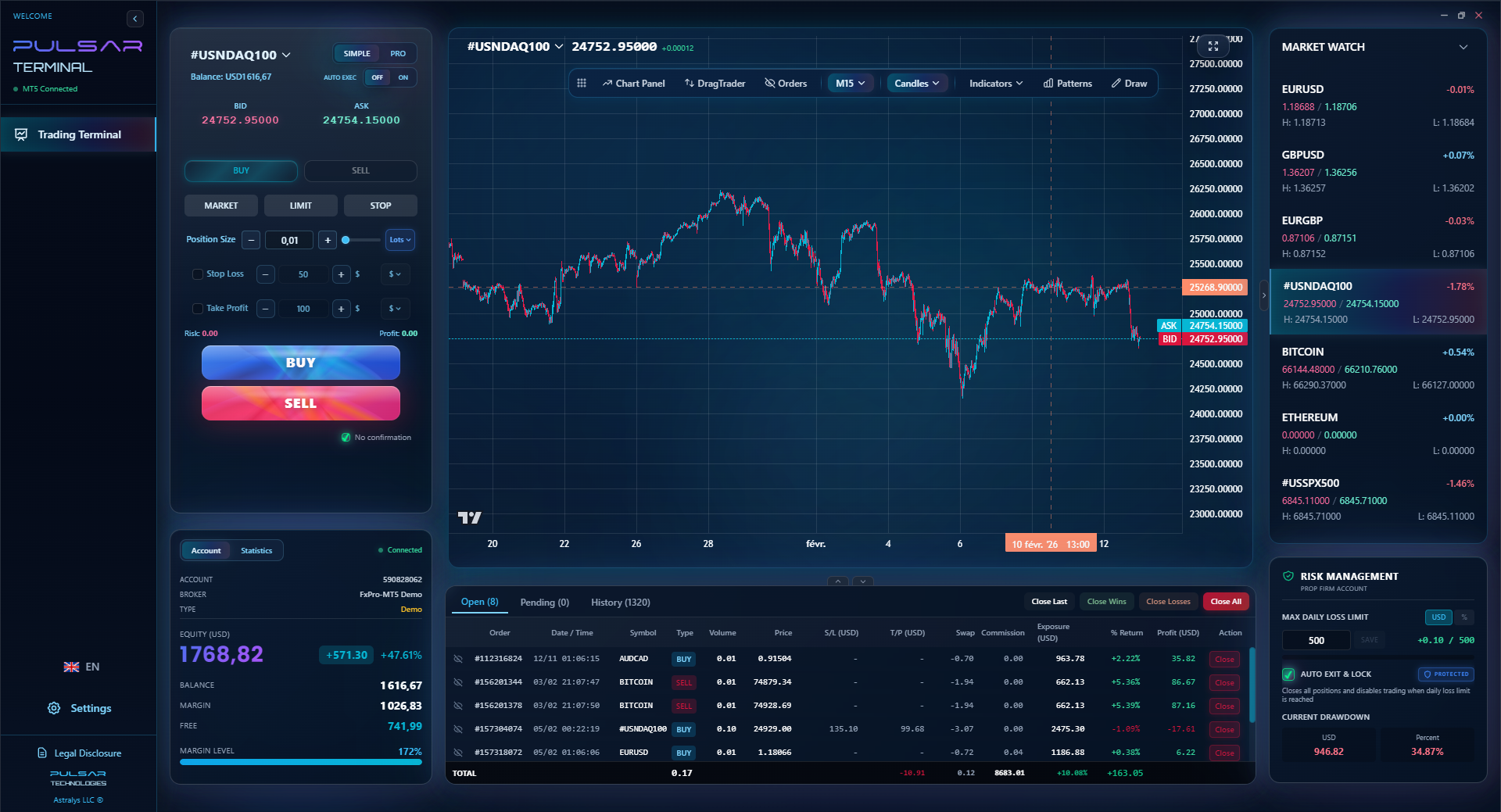
Using your weekend to plan precise trade entries and complex order structures is smart, and Pulsar Terminal lets you set them up with drag-and-drop ease for Monday's open.
Pulsar Terminal
MT5一站式工具:拖拽下单、多重止盈/止损、追踪止损、网格交易、成交量分布图和自营交易保护。每日1000+交易者使用。
“I made more money by using Sundays to prepare for Monday's London open than I ever did trying to scalp a dead market on Saturday.”
Brokers love to say 'trade crypto 24/7!' It's their main weekend selling point. And yes, crypto markets never sleep. But trading a Bitcoin CFD with a broker on the weekend is often worse than trading forex.
The spreads on crypto CFDs can be astronomical - $50, $100, even more on Bitcoin. The volatility is extreme, and with the wider spreads, your break-even point is a mile away. Also,, you're not buying Bitcoin; you're buying a CFD. You don't own the asset. You're exposed to the broker's solvency and their pricing model.
If you're desperate to trade on a weekend, crypto is the only game with real global volume. But for a retail trader using a South African broker? The costs are prohibitive. It's designed to suck in impatient traders. The real crypto traders are on proper exchanges, not CFD platforms. This is a classic case of accessibility not equating to profitability.

Example: Bitcoin is trading at $65,000. Your CFD broker shows a Buy price of $65,100 and a Sell price of $64,900. That's a $200 spread. You need Bitcoin to move $200 in your favor just to reach breakeven. On a quiet weekend, that could take hours, all while paying overnight financing fees.
“I made more money by using Sundays to prepare for Monday's London open than I ever did trying to scalp a dead market on Saturday.”
Let's talk specifics for the Mzansi trader. You're dealing in Rands, paying with local banks, and navigating a unique market.
Minimum Deposits: You'll see ads for accounts starting at R70. Forget it. That's a toy. To trade seriously and survive the inevitable losses, you need a real buffer. A realistic minimum is R5,000. I advise my students to start with at least R10,000. This lets you trade sensible position sizes without blowing up your account on three bad trades. Brokers like XM or Pepperstone offer ZAR accounts, which helps avoid currency conversion fees.
Payment Methods: Use Instant EFT or a local bank transfer. It's usually free and fast. Avoid credit card deposits if you can; some banks treat them as cash advances.
The ZAR Pairs: USD/ZAR is our home game. It's volatile, liquid during SA hours, and can be traded 24/5. It often moves on local political news. This is a far better focus for a South African trader than trying to trade a sleepy EUR/USD on a Sunday. Understand the local drivers: SARB interest rate decisions, Eskom news, political stability. This is your edge.
The South African forex market is growing (projected to hit over $6.8 billion by 2033), but that growth is in proper, liquid weekday trading. Don't get sidetracked by the weekend sideshow.
“Weekend trading is a distraction you can't afford.”
No.
Not as a strategy. Not as a way to build consistent wealth. The cons - wild spreads, synthetic prices, execution risk, and Sunday night gaps - overwhelm the single pro of 'having access.'
Think of it like this: professional traders, the guys with the Bloomberg terminals and direct market access, they're not trading weekends. Why would you, with a retail account and a 100:1 use, think you can outsmart a market that doesn't even exist?
Your job as a trader is to find edges. The weekend retail CFD market is an edge for the broker, not for you. Your edge comes from preparation, discipline, and trading during high-liquidity sessions like the London/SA overlap or the US open.
Use the weekend to become a better trader. Not a more active one. The market will be there on Monday morning, full of real opportunity. Be patient, be prepared, and keep your money safe from the weekend ghosts.
I've traded for over a decade. My most profitable years began when I stopped trying to trade every possible hour and started focusing on the right hours. Weekend trading is a distraction you can't afford.
FAQ
Q1Can I trade USD/ZAR on the weekend in South Africa?
Extremely unlikely. Most brokers offering weekend trading limit it to major pairs like EUR/USD or GBP/USD. USD/ZAR, being an emerging market currency pair, requires real liquidity from local banks, which are closed. You'll almost certainly find it unavailable from Friday evening to Sunday evening.
Q2What time does the forex market open on Sunday in South Africa?
The real interbank market reopens at 10:00 PM South African Standard Time (SAST) on Sunday. This is when liquidity returns and proper trading begins. Brokers offering 'weekend' prices will typically switch from their synthetic quotes to live prices around this time.
Q3Are weekend trading profits legitimate?
Profits are paid out if that's what your broker's terms state. However, 'legitimate' is a tricky word. The prices aren't from the real market, so you're profiting from the broker's pricing model, not necessarily beating the global forex market. It's a different game with different rules.
Q4Is weekend trading good for news-based strategies?
It's terrible. Major economic news (like US NFP, Fed decisions) is released during weekday business hours. Weekend news is sporadic and often causes massive gaps when the market reopens. You can't smoothly trade a news release in a market with no depth; you'll just get horrible slippage or be unable to close your position.
Q5What is the minimum deposit to start trading forex in SA?
While some brokers allow deposits as low as R70, that's a gimmick. To trade seriously and implement proper risk management, a minimum of R5,000 is a realistic starting point. For a swing trading approach with less stress, R10,000-R20,000 is a more sensible base.
Q6Do I pay swap/rollover fees on weekend trades?
Yes, absolutely. Swap fees (the cost of holding a position overnight) are typically applied once a day. You will be charged for Friday night's rollover, and then again for Saturday night, even though the market is technically closed. These fees are tripled on Wednesdays to account for the weekend. Always check your broker's swap schedule.
Winston 教授的课程
要点总结:
- ✓Real interbank forex is closed weekends; you trade synthetic CFDs.
- ✓Weekend spreads can be 5x wider, killing short-term profits.
- ✓Sunday 10 PM SAST market open carries high gap risk.
- ✓Use weekends for analysis & planning, not live trading.
- ✓A R5,000 minimum is realistic; R70 accounts are toys.
这篇文章对您有用吗?
点击星星评分
每周交易洞察
免费每周分析与策略。无垃圾邮件。
关于作者
David van der Merwe
新兴市场交易员
约翰内斯堡交易者,11年新兴市场货币经验。专注于ZAR货币对、FSCA监管交易和南非市场分析。
评论
风险提示
金融工具交易存在重大风险,可能不适合所有投资者。过往业绩不代表未来表现。本内容仅供教育目的,不构成投资建议。在交易前请务必自行研究。
您可能还喜欢

Cara Trading Forex Sukses: 7 Prinsip dari Trader Profesional
Cara trading forex sukses dengan 7 prinsip trader pro: manajemen modal, disiplin, journal trading, backtest. Data nyata, bukan janji profit palsu.
Jam Trading Forex Terbaik untuk Trader Indonesia: Panduan Lengkap dengan Tabel Waktu
Panduan jam trading forex untuk trader Indonesia. Tabel 4 sesi dunia, jam emas 20:00-00:00, sesi mana yang harus dihindari. Data akurat + tips dari trader berpengalaman.
Top 5 Sàn Forex Uy Tín Nhất 2026: Review Jujur dari Trader Indonesia
Top 5 sàn forex uy tín 2026 untuk trader Indonesia. Review jujur: spread, deposit, withdraw, dukungan lokal. Exness, XM, IC Markets & lebih.
