


I was staring at a $23 challenge fee for a $5,000 account.

James Mitchell
高级交易分析师
☕ 10 分钟阅读
您将学到:

I was staring at a $23 challenge fee for a $5,000 account. It felt like a steal. Three days later, a single news spike on the EUR/USD wiped out my 5% daily loss limit. Poof. Gone. That's the real cost of chasing the cheapest prop firm. It's not just the entry fee, it's the rules, the platform, and the regulatory hurricane about to hit this entire industry. Let's cut through the marketing and find what 'cheap' actually means for your wallet and your sanity.
When you're hunting for the cheapest prop firm, you're probably looking at the challenge price. That's your first mistake. I made it too. I've paid fees from $10 to $500. The real cost is hidden in the rules that determine if you keep your funded account.
Let me give you a real example. In 2023, I passed a challenge with a firm that had a $49 fee. Cheap, right? Their profit split was 80/20, which is standard. But their trailing drawdown was brutal. On a $100k account, the max drawdown was $6,000. It trailed from the highest equity point, not the starting balance. A few winning trades pushed my high watermark up, which then dragged the stop-loss level up with it. A period of consolidation ate away at that buffer, and I hit the drawdown without the account balance ever going negative. I lost the account without technically having a losing day. That $49 fee cost me a potential $100k account.

Warning: A low challenge fee is often a marketing tool to get volume. The firm's business model may rely on a high failure rate, so they design rules to make passing sustainably very difficult.
The cheapest prop firm for you is the one whose rules align with your trading style. A scalper needs different rules than a swing trader. If you're a scalper, a firm with a high commission structure on a RAW spread account might make your strategy unprofitable, even if the challenge was only $25.
Here’s what to price-check beyond the entry fee:
- Profit Split: 80% is baseline. 90% is good. Some, like FundedNext Futures, offer 100% after certain milestones. Don't get dazzled by a high split if the challenge rules are impossible.
- Drawdown Type: Is it trailing? Static? From starting balance or from peak equity? This is the biggest account killer.
- Commission & Spreads: If they offer a 'RAW' account, you'll pay a commission per lot. If it's 'All-In', the spread is wider. You need to know which suits your scalping strategy or swing trading approach.
- Payout Threshold & Frequency: Can you get paid when you have $101 in profit, or do you need $1,000? Is it monthly, bi-weekly, or on-demand?

💡 Winston 小贴士
A low fee is a seductive trap. The firm's goal is to collect it, not to fund you. Your goal is the opposite. Never let their goal win.
Based on recent data, here are some firms with low entry points. I'm listing them, but I'm not endorsing them. You need to do your own deep dive on their rulebooks.
| Firm | Example Challenge Cost | Account Size | Key Consideration |
|---|---|---|---|
| OFP Funding | ~$23 | Varies | Very low entry, but scrutinize their consistency rules. |
| Goat Funded Trader | $17 - $22 | $5,000 | Nano accounts are cheap, but scaling takes time and more fees. |
| Atlas Funded | $1 - $5 upfront* | Varies | 'Access' model. You pay the rest after passing. High pressure to then fund the full fee. |
| Blue Guardian | $10 (Instant Starter) | $5,000 | One-step evaluation, but check their trading days requirement. |
| Phidias | $55 (one-time) | $25,000 | Static drawdown model. No profit target for phase 2, which is unusual. |
*Note: The 'Access' model is clever. It gets you in the door for peanuts, but the remaining fee (say, $200) is due once you pass. It feels like a sunk cost, so you pay it. The firm wins either way.

Pro Tip: The absolute cheapest prop firm might be one having a sale on a larger account. A 50% off sale on a $200, 100k challenge ($100) can be better value than a full-price $50, 10k challenge. Wait for holidays like Black Friday.
I tried the Goat Funded Trader $22 challenge. Passed it in a week. The real test came during the funded period. The platform was stable (they use Match-Trader), but the psychological pressure of trading a 'real' $5k account that was actually simulated was weird. My first payout was $152 after their split. It worked, but it took a month to get that $22 back. Was it worth it? Barely. It was a learning experience, not a revenue stream.
Remember, these firms aren't brokers like Exness or IC Markets. You're not getting a live account. You're getting a simulated account where they promise to pay you your share of the simulated profits. This distinction is about to become the most important thing in the industry.
“The real cost is hidden in the rules that determine if you keep your funded account.”
If you think you're just comparing fees and rules, you're missing the tidal wave. The prop firm industry in the US has been a regulatory ghost, but that's over. The SEC and CFTC are closing in, and it's going to burn down some of these 'cheap' shops.
Here’s what’s happening and why you should care:
The End of the Gray Area
For years, firms called themselves 'educational' or traded their own capital to avoid SEC/CFTC oversight. That loophole is slamming shut. New rules are reclassifying many prop firms as 'dealers' or Commodity Trading Advisors (CTAs). That means registration, net capital requirements, and audits. By 2026, mandatory licensing in the US is expected.
What does this mean for you? Firms that can't afford the compliance costs will vanish. Your challenge fee and any unrealized profits will vanish with them. The cheapest prop firm today might be a bankrupt one tomorrow.
Your Money Isn't Safe (Yet)
Unlike with a regulated broker where client funds are segregated, most prop firms hold your challenge fee and payout reserves in their own operating accounts. If they go under, you're an unsecured creditor. Good luck.
The push for stricter KYC/AML checks is a direct result of payment processors and banks getting nervous. They don't want to handle money for unregulated financial entities.
The Hybrid Model is the Future
Some smarter firms are pivoting to a 'hybrid model.' They partner with an actual regulated broker (think Pepperstone or similar) to execute trades. The prop firm handles the evaluation and funding, but the trade goes through a real, licensed entity. This offers a layer of protection. When you're comparing costs, check if the firm uses a regulated broker partner. It's a sign of longevity.
Warning: If a firm's terms don't clearly state what happens to your funds if they cease operations, run. Do not pass Go. Do not collect $200. This regulatory shift is the single biggest risk to your capital in the prop space.
💡 Winston 小贴士
If you can't articulate the firm's drawdown rule in one simple sentence, you don't understand it well enough to risk your money. Walk away.
Let's talk about the real math. The industry pass rate is abysmal - around 5-10% pass evaluations, and only about 7% ever see a payout. The business model for many cheap firms is built on you failing and re-taking challenges.
Let's say you pick a firm with a $30 challenge. You're a decent trader, but you blow the daily loss limit twice. That's $60. You take a break, come back, and fail again on the trailing drawdown. That's $90 total. You finally pass on the fourth try ($120 total spent). You're now in a funded account, but the psychological scars and the pressure to 'make back' that $120 lead to overtrading. You hit the max drawdown in the funded account.
You've spent $120 and have nothing to show for it but frustration. That $30 challenge just cost you four times its price. I've been in this cycle. It feels like digging a hole with a teaspoon.
Contrast that with saving for a $200, one-step evaluation at a more established firm with sensible rules. You wait, you practice more in a demo, you get your position size calculator dialed in. You pass on the first or second try. Your total cost is $200-$400, but you have a much higher chance of staying funded.
Which path is truly cheaper? The one with a lower sticker price, or the one with a higher chance of a return? This is where you need to be brutally honest with your own skill level. If you're not consistently profitable in a demo over 3-6 months, you are just donating challenge fees. The cheapest prop firm for an unprofitable trader is none of them.

“The hunt for the cheapest prop firm is often a distraction. It's a search for a shortcut. There isn't one.”
You find a cheap firm. The rules look okay. You sign up. Then you get access and find they use a clunky, proprietary web platform with 200ms of latency and spreads that widen to 5 pips on the EUR/USD during the London open. Your scalping strategy is dead on arrival.
This is a critical cost. The trading platform is your workspace. If it's junk, you will make mistakes. Most firms offer MT4, MT5, cTrader, or DXtrade. Some use Tradovate or NinjaTrader for futures. Know what you're getting.
Execution is everything. In a simulated environment, some firms might be tempted to manipulate slippage or requotes to protect their capital. You won't find this in their marketing. You only find it when your stop-loss gets filled 3 pips past your level on a calm Tuesday.
I once traded with a firm that used a white-label MT5 server. My entries on XAU/USD (gold) were consistently a dollar worse than the price on my independent charting software. Was it manipulation or just terrible server location? I couldn't prove it, but it killed my edge. That 'cheap' account was worthless.
Pro Tip: Before buying a challenge, see if the firm offers a free demo or a trial period on their actual platform. Check the spreads during volatile periods (market open, news events). Compare them to a major broker like XM. If they're significantly worse, that's an ongoing tax on every trade you make.
💡 Winston 小贴士
Regulation isn't boring paperwork. It's the fence that keeps the wolves out. In 2026, trading with an unregulated prop firm is like storing your gold in a cardboard box.

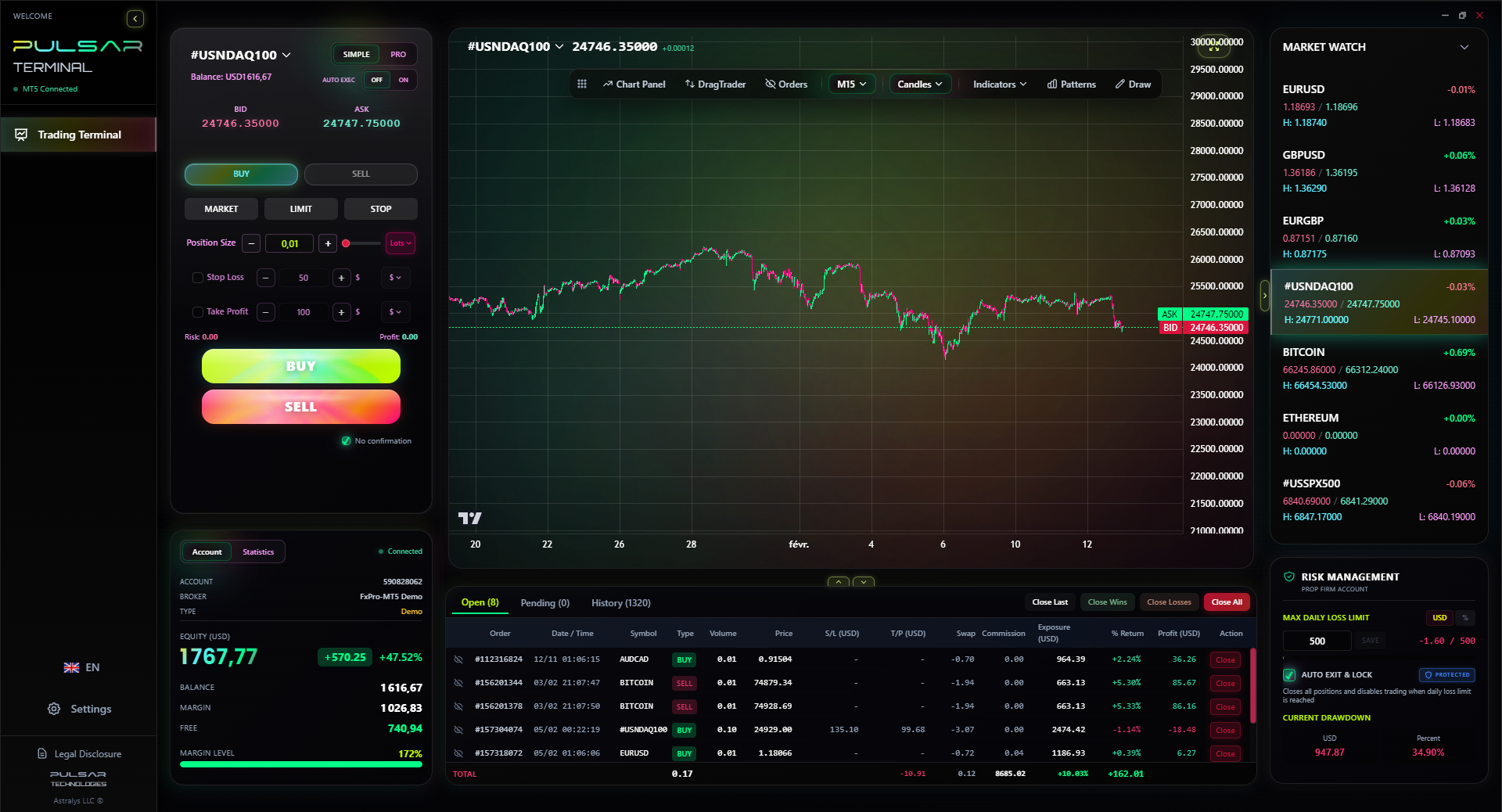
Managing complex prop firm rules like trailing drawdown and daily loss limits is exhausting; Pulsar Terminal automates these protections directly on your MT5 chart so you can focus on trading.
Pulsar Terminal
MT5一站式工具:拖拽下单、多重止盈/止损、追踪止损、网格交易、成交量分布图和自营交易保护。每日1000+交易者使用。
Forget the headline price. Use this checklist. If you can't answer these questions from the firm's website or support, move on.
- Regulatory Posture: Do they mention regulatory compliance? Are they partnered with a regulated broker? (This is becoming the most important question).
- Rule Clarity: Are the drawdown rules crystal clear? Static or trailing? From balance or equity? Is the profit target realistic?
- Total Cost of Passing: Challenge fee + likely retake fees based on your historical performance. Be pessimistic.
- Platform & Tools: Is it a platform you know? Does it have the tools you need? Can you use EAs or custom indicators? If you rely on advanced tools, a platform that doesn't support them is a non-starter.
- Payout Proof: Can you find recent, verifiable payout proofs from other traders? Not just testimonials on their site, but on independent forums or social media.
- Scalability: If you pass the $5k account for $20, what does it cost to scale to $50k or $100k? Is it another huge challenge fee, or a reasonable scaling plan based on performance?
- Support: When you have a question about a margin call or a trade dispute, can you get a human on chat within minutes?
My final piece of advice: The hunt for the cheapest prop firm is often a distraction. It's a search for a shortcut. There isn't one. The goal isn't to pass a cheap challenge. The goal is to get and stay funded, and get paid. Sometimes, paying a moderate premium for a firm with a solid reputation, clear rules, and a path to longevity is the most economical decision you can make. Don't let a low number blind you to the high risk of failure and loss. Your capital and your time are worth more than that.
FAQ
Q1What is the absolute cheapest prop firm challenge I can buy?
As of now, you can find challenges for as low as $1-$5 upfront with models like Atlas Funded's 'Access,' or flat fees around $17-$23 from firms like Goat Funded Trader or OFP Funding. But remember, the cheapest entry fee often comes with the highest risk of losing due to tricky rules or poor platform execution.
Q2Are these cheap prop firms legitimate? Will they actually pay out?
Some are legitimate and do pay, while others are unsustainable operations. The key is evidence. Look for a long track record of verified payouts (not just screenshots they provide). The coming 2026 US regulations will force many illegitimate or poorly capitalized firms to shut down, which is a major payout risk.
Q3What's more important: a low challenge fee or a high profit split?
A high profit split is meaningless if you can't get or stay funded. Focus on the rules (drawdown, consistency) first, then the platform and execution quality. A 70% split on an account you keep for years is better than a 90% split on an account you lose in a week. Only after those factors are acceptable should you compare fees and splits.
Q4How do US regulations affect my choice of a prop firm?
Massively. You should now prioritize firms that are preparing for SEC/CFTC regulation, perhaps by partnering with regulated brokers (hybrid model). Choosing a firm that ignores the regulatory shift is a huge risk - they could be forced to close, taking your challenge fee and any earned profits with them.
Q5Is it worth starting with a very small, cheap funded account?
It can be a useful, low-stakes learning environment to understand the prop firm psychological pressure. However, the profit potential is tiny. A 10% gain on a $5k account is only $500, and your share might be $400. After the challenge fee, that's not much for a month's work. View nano accounts as paid practice, not a real income source.
Q6What's the biggest mistake traders make when choosing a cheap prop firm?
They only look at the price tag and ignore the rulebook. The #1 account killer is the drawdown rule, especially trailing drawdown from peak equity. A firm with a low fee but a brutal trailing drawdown is designed for you to fail. Always, always read the full rules of engagement first.
Winston 教授的课程
要点总结:
- ✓Price is the entry fee; rules are the real cost.
- ✓US regulatory changes in 2026 make firm stability critical.
- ✓A 5% pass rate means cheap fees are often failure taxes.
- ✓Always test the trading platform's execution before buying.
这篇文章对您有用吗?
点击星星评分
每周交易洞察
免费每周分析与策略。无垃圾邮件。
关于作者
James Mitchell
高级交易分析师
常驻纽约,拥有超过9年的交易经验。专注于主要美元货币对、自营交易公司挑战和美国监管环境。
评论
风险提示
金融工具交易存在重大风险,可能不适合所有投资者。过往业绩不代表未来表现。本内容仅供教育目的,不构成投资建议。在交易前请务必自行研究。
您可能还喜欢

Cara Trading Forex Sukses: 7 Prinsip dari Trader Profesional
Cara trading forex sukses dengan 7 prinsip trader pro: manajemen modal, disiplin, journal trading, backtest. Data nyata, bukan janji profit palsu.
Jam Trading Forex Terbaik untuk Trader Indonesia: Panduan Lengkap dengan Tabel Waktu
Panduan jam trading forex untuk trader Indonesia. Tabel 4 sesi dunia, jam emas 20:00-00:00, sesi mana yang harus dihindari. Data akurat + tips dari trader berpengalaman.
Top 5 Sàn Forex Uy Tín Nhất 2026: Review Jujur dari Trader Indonesia
Top 5 sàn forex uy tín 2026 untuk trader Indonesia. Review jujur: spread, deposit, withdraw, dukungan lokal. Exness, XM, IC Markets & lebih.
