


Another 'platinum' trading course promising the keys to the kingdom? If you're a South African trader, you've probably seen the ads for Colin Davids Platinum Forex.

David van der Merwe
新兴市场交易员 ·  South Africa
☕ 9 分钟阅读
您将学到:
Another 'platinum' trading course promising the keys to the kingdom? If you're a South African trader, you've probably seen the ads for Colin Davids Platinum Forex. The question isn't whether it exists, but whether it's another expensive distraction or something that can actually help you keep more money in your pocket than you give to the broker. Having traded through the 2018 ZAR volatility and the 2020 madness, I've seen these systems come and go. Let's strip away the marketing and see what's really on offer.
From what's publicly available, Colin Davids Platinum Forex is presented as a complete trading education package. It's not a signal service where you get told what to buy and sell. Instead, it's marketed as teaching you a complete methodology - a supposed 'A to Z' of trading the forex markets, likely with a focus on concepts applicable to a South African trading a global market.
This typically means they'll cover the basics (what's a pip, what's a spread), move into some form of technical analysis, and then present their proprietary 'system'. This system is almost always a combination of common indicators set up in a specific way, paired with a set of rules for entry, exit, and money management. The 'Platinum' label is the hook, suggesting it's the top-tier, elite version of his teachings.
My first rule with any paid system: if they spend more time showing you testimonials with luxury cars than showing you a raw, unedited trade log from the last six months, be skeptical. The real value is in the discipline and risk management taught, not in a magic indicator setup.
This is where the rubber meets the road for us. These courses are almost always priced in US Dollars. A 'platinum' package could easily run you $1,000 to $3,000 or more. At an exchange rate of around R18.50 to the dollar, you're immediately looking at a cost of R18,500 to R55,500+ before you've even placed a single trade.
The Real Cost of Education
You need to view this as a capital investment. Is this the best use of R30,000 for your trading? Could that money be better used as actual trading capital to learn by doing? I made this mistake early on. I spent about R25,000 on a fancy course in 2015, only to realize the core strategy was just a dressed-up version of basic support and resistance that I could have learned from a library book. That R25k would have been a far better teacher in a live account, even if I lost it, because the lessons would have been real.
Regulatory Grey Area
Be aware of the regulatory stance. The Financial Sector Conduct Authority (FSCA) regulates brokers and financial service providers. An individual selling educational content operates in a murkier space. They are not managing your money, so they don't need the same license. This means you have very limited recourse if you feel the product wasn't as advertised. It's buyer beware, pure and simple.

Warning: Any educator who guarantees profits or suggests you can quit your job immediately is violating financial advertising principles and is a major red flag. Sustainable trading is a grind, not a lottery ticket.

💡 Winston 小贴士
A system is only as good as the person following it. The most expensive course can't install discipline in you. That comes from practice, journaling, and a deep respect for risk.
“The entry signals are the flashy car; the risk management is the insurance and brakes. You don't drive without them.”
Without access to the specific manual, I can tell you what these systems almost always contain based on two decades of tearing them apart. They usually revolve around a few common elements.
The Indicator Stack
Expect to see a combination of moving averages (like a 20-period and 50-period EMA), an oscillator like the RSI indicator or Stochastic, and maybe a volatility indicator like Bollinger Bands. The 'secret sauce' is the specific settings and the rules for when they align. For instance, 'only take a buy when the price is above the 20 EMA, the 20 EMA is above the 50 EMA, and the RSI has crossed above 30 from below.' It's not revolutionary; it's about creating a structured filter to avoid emotional trades.
The Rules of Engagement
This is the most critical part. A good system will hammer home position sizing and risk management. It should force you to calculate your stop-loss distance in pips for every single trade and use a position size calculator to determine your lot size so you never risk more than 1-2% of your capital. If the Platinum Forex course doesn't make this its central pillar, it's worthless. I once followed a system that was great at entries but vague on exits. I turned a 40-pip profit on EUR/USD into a 15-pip loss because I had no trailing stop rule. The entry means nothing without an exit plan.

Pro Tip: Before buying any course, ask for a sample of the risk management section. If they won't provide it, walk away. The entry signals are the flashy car; the risk management is the insurance and brakes. You don't drive without them.
A system like this needs to work with the brokers we can actually use in South Africa. The good news is, if it's based on standard MT4 or MT5 indicators, it will work with most major international brokers popular here.
You'll likely be setting this up on MetaTrader. You'll apply the indicators to your charts, maybe save a template, and that's it. The complexity isn't in the setup; it's in the consistent execution of the rules. I've tested similar strategies on platforms from Exness (good for low spreads on majors) and IC Markets (excellent execution speed for scalping). Both handled the basic technical analysis without a hiccup.
The real practical test is during load-shedding. Does your strategy require you to stare at the charts all day, or does it use end-of-day signals? A system that needs constant screen attention is a liability when Eskom has other plans. A more strong system for our environment might lean towards 4-hour or daily charts, where a few hours offline won't wreck your trade. This is a crucial, often overlooked, local consideration.
💡 Winston 小贴士
Before spending a Rand on education, paper trade a simple strategy for three months. If you can't be profitable on demo with perfect conditions, a new system won't help.
“You're not paying for a secret. You're paying for clarity, discipline, and a shortened learning curve.”
So, is Colin Davids Platinum Forex worth it? It's impossible to give a definitive yes or no without seeing the exact content. But I can give you a framework to decide.
Consider it ONLY if:
- You are a complete beginner who needs structure and are willing to pay a premium for it being packaged as a 'course'.
- You have thoroughly vetted the provider. Can you find independent reviews from past users (not testimonials on his site)?
- The cost is a trivial amount of money to you, and you view it as one of many educational resources.
For most people, I believe there are better paths:
- The Free Route: Babypips.com's 'School of Pipsology' is utterly free and will teach you 90% of what any basic course will. Combine that with practicing risk management on a demo account for 6 months.
- The Cheap & Targeted Route: Instead of one mega-course, buy 3-4 highly rated books on specific topics. Get one on market psychology (e.g., Trading in the Zone), one on technical analysis (e.g., Technical Analysis of the Financial Markets), and one on a specific strategy like swing trading. Total cost: under R2,000.
- Invest in Tools, Not Just Teachings: If you have R30,000 to spend, consider allocating most of it to your trading capital and a portion to a superior trading terminal. The discipline from a tool that enforces rules can be more valuable than another ebook.
My own journey was littered with course purchases. The one that finally made a difference wasn't the most expensive; it was the one that focused relentlessly on my journaling process and psychological mistakes. The strategy itself was simple. Remember, you're not paying for a secret. You're paying (hopefully) for clarity, discipline, and a shortened learning curve. Make sure that's what you're actually getting.
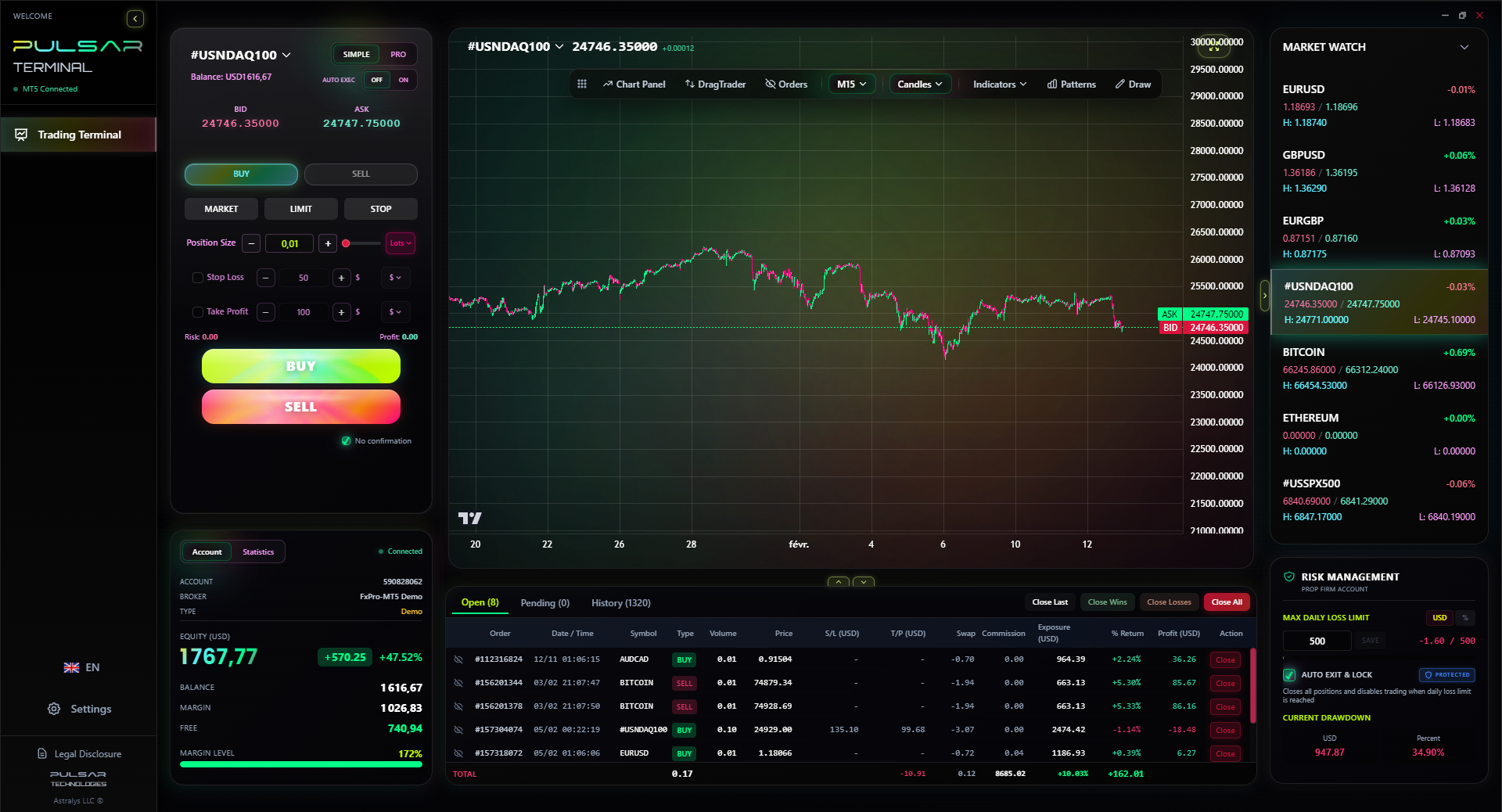
Manually moving stops to breakeven and managing multiple trades is where discipline fails; a tool like Pulsar Terminal automates these rules directly on your MT5, enforcing the very risk management a course can only preach.
Pulsar Terminal
MT5一站式工具:拖拽下单、多重止盈/止损、追踪止损、网格交易、成交量分布图和自营交易保护。每日1000+交易者使用。
Let's be blunt. The trading education space is full of charlatans. Here's how to spot them and what good looks like.
Red Flags (Run the other way):
- Guaranteed Returns: This is illegal for regulated entities and a sure sign of a scam.
- Live Account 'Proof' on a Demo: I've seen this. Always ask for the account number. A demo account starts with '1' or '2'. A live account number is longer and different.
- Pressure to Sign Up Today: 'The price doubles tomorrow!' This is a classic marketing tactic for a product that doesn't sell on its own merits.
- Vague on Risk Management: If they can't explain their max risk per trade and drawdown controls in simple terms, they're not traders; they're marketers.
Green Lights (Potentially Legitimate):
- They Discuss Losses Openly: A real trader has losing trades. If their presentation shows a realistic win rate (50-60%) and emphasizes risk/reward, that's honest.
- They Focus on Psychology: Talking about fear, greed, and discipline is a sign they've been in the trenches.
- They Provide a Clear, No-BS Refund Policy: A 30-day money-back guarantee with clear terms shows confidence in the product's value.
- They Recommend Specific, Reputable Brokers: Like XM or Pepperstone, which are known entities, rather than obscure, white-label platforms.
💡 Winston 小贴士
The market doesn't care what you paid for your knowledge. A R500,000 course and a free YouTube video both result in the same P&L. Focus on the execution, not the pedigree of the teacher.
“The real 'platinum' knowledge is found in your trade journal, not in a course.”
Forget about finding a magic system. Your goal is to build a strong trading business that can survive our unique challenges: currency volatility, load-shedding, and the emotional toll of trading with Rand-denominated savings.
Start with a foundation of rock-solid risk management. Decide your maximum risk per trade (I never go above 1.5%) and use a calculator for every single trade. This one habit will do more for your survival than any indicator setup.
Choose a style that fits your life. Can't watch screens all day? Don't try to be a scalper. Look at higher timeframes. A swing trading approach based on daily charts might be perfect.
Finally, track everything. Your trade journal is your real teacher. Note your entry, exit, why you took the trade, and most importantly, your emotional state. You'll start to see your own patterns - that's where the real 'platinum' knowledge is found. It's not in a course; it's in you, revealed through consistent, recorded action. All a good course can do is give you the structure to discover it for yourself.
FAQ
Q1Is Colin Davids Platinum Forex a scam?
Not necessarily a 'scam' in the classic sense of stealing your money and disappearing, but it could be a severe case of overpromising and underdelivering for the price. The term 'scam' depends on whether the product delivers value commensurate with its cost. Without seeing the materials, the high USD price tag for South Africans is a major concern, as similar education is often available for far less or even free.
Q2Can I make money using this system?
Any system, no matter how good, is just a tool. Your profitability depends 95% on your discipline, risk management, and psychology. A trader with mediocre strategy and excellent discipline will outperform a genius with no self-control every time. The system might provide a framework, but it won't make you money. You make money by executing it flawlessly, which is the hard part.
Q3What is a realistic amount to start trading forex in South Africa?
Realistically, you need enough to survive inevitable losses while practicing proper position sizing. With many brokers like Exness offering micro lots, you can technically start with R1,500. But to properly trade and not get wiped out by a few bad trades, I'd suggest a minimum of R10,000. This allows you to risk R100-R150 per trade (1-1.5%) and have enough capital to learn without a margin call coming after you in a week.
Q4Are there free alternatives to paid courses like this?
Absolutely. Babypips.com is the gold standard for free, structured forex education. YouTube has countless reputable traders sharing quality content (focus on the ones teaching concepts, not just showing off profits). Your local library has books on technical analysis and trading psychology. Paid courses offer curation and structure, but the raw information is widely available for free.
Q5How do I know if a trading educator is legitimate?
Look for transparency. Do they show real, recent trade histories with live account statements? Do they talk openly about losses and risk? Are they regulated by a body like the FSCA for any aspect of their work? Do they have a long-term, consistent online presence? Avoid anyone who only shows luxury lifestyle shots, uses high-pressure sales tactics, or guarantees specific returns.
Q6What timeframes are best for South African traders dealing with load-shedding?
Higher timeframes are your friend. Focusing on the 4-hour (H4) or daily (D1) charts means you only need to check your trades a few times a day. This makes you resilient to power outages. Avoid strategies that require constant monitoring of 1-minute or 5-minute charts, as you'll be setting yourself up for stress and potential losses when the power cuts.
Winston 教授的课程
要点总结:
- ✓Risk management is 90% of the game; a system is just the vehicle.
- ✓Never risk more than 1.5% of your capital on a single trade.
- ✓Test any strategy on demo for 100 trades minimum.
- ✓Higher timeframes (H4/D1) are more resilient to SA's infrastructure issues.
这篇文章对您有用吗?
点击星星评分
每周交易洞察
免费每周分析与策略。无垃圾邮件。
关于作者
David van der Merwe
新兴市场交易员
约翰内斯堡交易者,11年新兴市场货币经验。专注于ZAR货币对、FSCA监管交易和南非市场分析。
评论
风险提示
金融工具交易存在重大风险,可能不适合所有投资者。过往业绩不代表未来表现。本内容仅供教育目的,不构成投资建议。在交易前请务必自行研究。
您可能还喜欢

Cara Trading Forex Sukses: 7 Prinsip dari Trader Profesional
Cara trading forex sukses dengan 7 prinsip trader pro: manajemen modal, disiplin, journal trading, backtest. Data nyata, bukan janji profit palsu.
Jam Trading Forex Terbaik untuk Trader Indonesia: Panduan Lengkap dengan Tabel Waktu
Panduan jam trading forex untuk trader Indonesia. Tabel 4 sesi dunia, jam emas 20:00-00:00, sesi mana yang harus dihindari. Data akurat + tips dari trader berpengalaman.
Top 5 Sàn Forex Uy Tín Nhất 2026: Review Jujur dari Trader Indonesia
Top 5 sàn forex uy tín 2026 untuk trader Indonesia. Review jujur: spread, deposit, withdraw, dukungan lokal. Exness, XM, IC Markets & lebih.
