


You've seen the Instagram posts.

David van der Merwe
新兴市场交易员 ·  South Africa
☕ 11 分钟阅读
您将学到:
- 1What 'Dream Chasers Forex' Really Means (And Why It's Dangerous)
- 2The South African Forex Market: The Real Numbers
- 3The 4 Reasons Most SA Traders Blow Up (I Failed on #3)
- 4Building a Process, Not Chasing a Dream
- 5Practical Tools & Tech for the SA Trader
- 6Trading the ZAR: Local Knowledge is a Double-Edged Sword
- 7Your Real First Steps (If You're Starting Today)
You've seen the Instagram posts. The rented Lamborghinis, the stacks of cash, the 'forex lifestyle' gurus promising you can quit your job in 90 days. That's the dream chasers forex world. But here's the question you need to ask yourself: why do 89% of retail traders in South Africa lose money? I've been trading for 12 years, mentored hundreds of traders, and watched more accounts blow up than I can count. This isn't about crushing your dreams. It's about replacing fantasy with a real, executable plan that doesn't end with you wiring your last R5,000 to some 'coach' in Sandton.
Let's cut through the marketing. 'Dream Chasers Forex' isn't a regulated school or a single entity. It's a vibe. A marketing angle used by dozens of individuals, Telegram groups, and 'academies' selling the idea of overnight wealth through trading. I've reviewed their content. It's heavy on motivation, light on risk management, and almost completely silent on the statistical reality.
In South Africa, this is particularly toxic because it preys on economic anxiety. When you're facing load-shedding, a weak Rand, and job uncertainty, a promise of financial freedom through a laptop is incredibly seductive. The problem? These dream chaser programs often cost R15,000 to R50,000 for what is repackaged information you could find for free. They'll teach you a basic scalping strategy or how to draw support and resistance, then send you off with 1:500 use. It's a recipe for disaster.

Warning: If a 'forex coach' shows more pictures of their car than their verified MyFSCA registration number, run. The Financial Sector Conduct Authority (FSCA) is our regulator. Anyone providing financial advice for a fee needs to be licensed. Check them on the FSCA website. Every single time.
My own painful lesson? Early in my career, I bought into a similar 'mastermind' for $2,000. The guru talked a big game about 'institutional order flow.' I used his method, loaded up on EUR/USD, and watched a single Non-Farm Payroll report wipe out 60% of my account. The method had no stop-loss rules. The guru's response? 'You didn't believe hard enough.' That's when I realized I was chasing a dream, not a profession.

💡 Winston 小贴士
The market doesn't care about your dreams, your rent, or your ego. It only responds to price. Trade the price, not your fantasy.
Forget the hype. Let's talk about the actual market you're stepping into. South Africa is the biggest forex hub on the continent, with over 200,000 active traders and a daily volume nudging $21 billion. The ZAR is involved in about 1% of all global forex transactions. That's the opportunity.
The Cost of Doing Business
You don't trade for free. Your broker makes money, and you need to understand exactly how, or you'll be bankrupt before you even start.
| Fee Type | What It Is | Typical Cost in SA |
|---|---|---|
| Spread | Difference between buy & sell price | 0.9 - 1.5 pips on EUR/USD for major brokers |
| Commission | Fee per lot traded | $3 - $7 per round turn (in/out) |
| Overnight Swap | Interest for holding a position past 5pm NY time | Varies by pair; can be positive or negative |
| Currency Conversion | Cost to fund your ZAR account in USD/EUR | 0.5% - 2% from your bank or broker |
A pip on EUR/USD with a standard lot is worth about $10. If your spread is 1.5 pips, you're down R280 (at ZAR 18.50/$) the moment you click 'buy'. You have to make that back just to break even. This is why scalping with a high-spread broker is a near-impossible task for most.
The Broker Landscape
You have good options here. Brokers like FP Markets and AvaTrade are directly regulated by the FSCA (check license #45984). Others, like Pepperstone and IC Markets, operate under strong international regulation but accept South African clients. Minimum deposits can be as low as $0 (Fusion Markets) or R4,000 (IG). My advice? Start with the absolute minimum. Prove you can trade on a demo, then a tiny live account, before you even think about larger sums.

Pro Tip: Always calculate your total cost per trade: Spread (in ZAR) + Commission (in ZAR) + Potential Swap. Use a position size calculator that lets you input your broker's specific fees. If the cost to enter and exit a trade is more than 30% of your target profit, your strategy is probably not viable.
“Trading is a skill like surgery or engineering. It takes years of deliberate practice.”
The FSCA warns that between 51% and 89% of retail accounts lose money. It's not bad luck. It's predictable, repeated behavior. Here’s the autopsy of a blown account.
1. use Suicide. South African brokers often offer use up to 1:500 for professional clients. That's insanity for a beginner. At 1:500, a 0.2% move against you wipes out your entire margin. I've seen guys take R2,000, get 1:500 use, and control a R1,000,000 position. One bad trade on USD/ZAR and it's all gone. It's not trading. It's gambling with a fancy interface.
2. Chasing the 'Forex Lifestyle' Instead of Building a Skill. Trading is a skill like surgery or engineering. It takes years of deliberate practice. The dream chasers sell the destination (the car, the watch) and skip the 10,000 hours of boring, painful work required to get there. You wouldn't let someone who watched a few YouTube videos perform brain surgery on you. Why let that version of yourself manage your money?
3. No Risk Management Plan (My Big Mistake). This is where I personally failed hardest. In 2017, I had a great run. Turned $5,000 into $22,000 in three months trading gold (XAU/USD). Got cocky. I entered a huge long position at $1280, convinced the Fed would be dovish. I didn't place a stop-loss. 'I'll watch it,' I thought. I went to sleep. The Fed was hawkish. I woke up to a margin call. Price had gapped down to $1260. I lost $18,000 in 8 hours. One trade. All because I abandoned my own rule: never risk more than 1% of your account on a single idea.
4. Trading Based on Emotion, Not Edge. You buy USD/ZAR because the Rand 'feels' weak. You sell because a buddy at work said there's going to be riots. This is noise. A trading edge is a statistically verifiable advantage. Maybe you've backtested a specific MACD and RSI divergence setup on the 4-hour chart and it wins 55% of the time with a solid risk/reward. That's an edge. 'Feeling' is not an edge.
The antidote to the dream chaser fantasy is a boring, written, repeatable process. This is what professional traders do. Amateurs focus on profits. Pros focus on process.
Your Non-Negiable Trading Plan:
- Market Condition: Are you trading a trending market or a ranging market? Your strategy must match. Don't use a swing trading breakout strategy in a choppy range.
- Entry Trigger: What is the EXACT candle close, indicator cross, or price action pattern that triggers your entry? 'It looks good' is not a trigger.
- Stop-Loss Placement: Where is your invalidation point? Place it there BEFORE you enter the trade. Use ATR (Average True Range) or support/resistance, not an arbitrary number.
- Take-Profit Placement: Where do you take profits? Use a risk-reward ratio of at least 1:1.5. Better to have two partial take-profits (e.g., close half at 1:1 R:R, let the rest run).
- Position Size: This is the most important step. Use a calculator. If your stop-loss is 50 pips away on EUR/USD, and you're only willing to risk R150 (1% of a R15,000 account), your position size is tiny. That's okay. Survival is the goal.

Example: Let's say you have a R20,000 account. Your 1% risk per trade is R200. You see a setup on EUR/USD where your stop-loss is 25 pips away. Each pip on a micro lot (0.01) is worth about R1.85. Maximum position size = R200 / (25 pips * R1.85) = 4.32 micro lots. So, you'd enter with 0.04 lots. Not exciting, but it's sustainable.
This process removes emotion. You're not a hero or a failure. You're a mechanic following a checklist. The profits come as a byproduct of executing this checklist hundreds of times without deviation.
💡 Winston 小贴士
Your first R10,000 profit will teach you less than your first R2,000 loss. Study your losses like a forensic scientist. They hold the real lessons.
“Amateurs focus on profits. Pros focus on process.”
You don't need a R50,000 course. You need the right tools and the discipline to use them.
Platforms: MT4 and MT5 are the standards here for a reason. They're strong, support automated trading (Expert Advisors), and are offered by almost every broker, from Exness to XM. Don't get distracted by flashy new platforms until you've mastered one.
Charting & Analysis: TradingView is excellent for analysis and idea generation. But for execution, stick to your broker's platform to avoid latency issues.
The Game-Changer: Trade Management Tools This is where modern software saves you from yourself. Manually moving stop-losses to breakeven or trailing a stop is stressful and error-prone. A tool that automates this based on your rules is useful, especially when dealing with the volatile ZAR pairs.
Imagine you get a good entry on USD/ZAR. Your rule is to move stop to breakeven when price moves 1.5x your risk in your favor, then trail it. Doing this manually at 3am when price spikes is how mistakes happen. Automation locks in your profit and lets you sleep. This kind of disciplined exit management is what separates the 10% from the 90%.
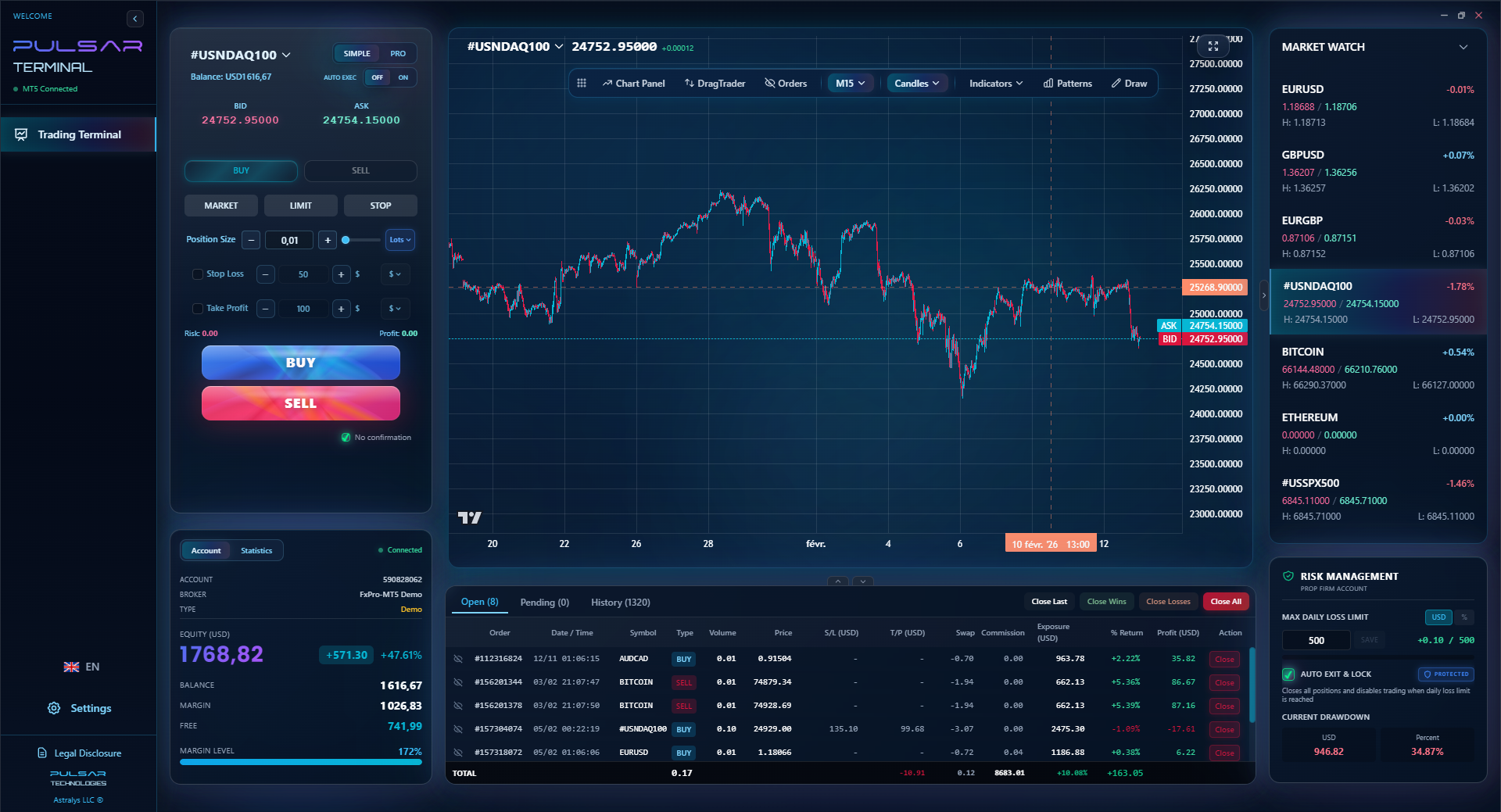
Automating your trade management rules, like moving stops to breakeven or trailing profits, is critical for removing emotion, and tools like Pulsar Terminal handle this directly on your MT5 platform.
Pulsar Terminal
MT5一站式工具:拖拽下单、多重止盈/止损、追踪止损、网格交易、成交量分布图和自营交易保护。每日1000+交易者使用。
Trading USD/ZAR, EUR/ZAR, or GBP/ZAR feels familiar. You hear the news, you feel the inflation. This local knowledge can be helpful, but it's also a massive psychological trap.
The Trap: You 'know' the Rand is weak because of Eskom, so you only want to buy USD/ZAR. This is a bias. The market has already priced in the Eskom news. Sometimes, the ZAR rallies on unexpected political developments or a sudden surge in commodity prices (we're a major exporter). I got caught shorting USD/ZAR in late 2025, convinced the Rand couldn't strengthen further. The All Share Index boom and credit rating upgrades proved me wrong. I lost 2% of my account being a 'local expert.'
How to Use Local Insight Wisely:
- Trade the Reaction, Not the News. Don't trade before the SARB announcement. Wait for the price to absorb the news and show you its direction. The initial spike is often a false move.
- Mind the Liquidity. ZAR pairs are less liquid than EUR/USD. This means wider spreads, especially during off-hours (Asian session) and around news events. Your stop-loss can get slipped.
- Correlation Check. The ZAR is a commodity currency. Watch gold and platinum prices. A strong rally in gold often supports the ZAR. Don't trade USD/ZAR in a vacuum.
The safest path for a beginner is often to master one major pair like EUR/USD first. The liquidity is immense, spreads are tight, and you're less likely to be swayed by emotional local headlines. Once you're profitable there, you can apply your process to the more volatile ZAR markets.
“You're not chasing a dream. You're building a skill. One boring, disciplined trade at a time.”
If you take nothing else from this guide, follow this sequence. It's the opposite of the dream chaser's 'deposit and get rich' pitch.
Phase 1: Education (Months 1-3)
- DO NOT DEPOSIT REAL MONEY.
- Read the FSCA's warnings about forex trading. Understand the risks legally.
- Open a demo account with a reputable FSCA-regulated broker like AvaTrade or an international one like Pepperstone.
- Learn what a pip is, what use does, what a spread is. Paper trade every day. Lose fake money. A lot of it.
Phase 2: Strategy Development & Backtesting (Months 4-6)
- Choose ONE pair. EUR/USD is best.
- Learn one simple strategy. Price action support/resistance, or a single indicator setup.
- Write down the exact rules. Then, use your demo account's 'history backtest' feature or manually go back through 100+ past trades. Record the wins and losses. Does it have a statistical edge? If not, scrap it and try another. This is the real work.
Phase 3: Micro-Live Trading (Month 7+)
- Open a live account with the absolute minimum deposit. For many brokers, that's $100 or less.
- Trade the smallest possible size (0.01 lots, micro lots).
- Your goal for the next 6 months is NOT to make money. Your goal is to execute your plan perfectly for 100 trades in a row. To follow your risk management rules even when you're emotional. If you can do that, and your strategy has an edge, the money will come. Slowly.
This path isn't sexy. There's no Lamborghini after 90 days. But it's the only path that doesn't end with you as another statistic, wondering where your savings went. You're not chasing a dream. You're building a skill. One boring, disciplined trade at a time.
FAQ
Q1Is 'Dream Chasers Forex' a legitimate school or regulated by the FSCA?
No. 'Dream Chasers Forex' is a marketing term used by various unaffiliated individuals and groups. It is not a single, registered financial services provider with the FSCA. Always verify any educator or signal provider's FSP number directly on the FSCA website (https://www.fsca.co.za/). If they can't provide one, they are operating illegally in South Africa.
Q2What is a realistic monthly return for a skilled forex trader in South Africa?
A consistently profitable, skilled retail trader might target 5-10% per month on their trading capital. Anyone promising you 20%, 50%, or 100% monthly returns is either lying or taking insane, unsustainable risks. Remember, Warren Buffett's average annual return is about 20%. If it sounds too good to be true, it is. Focus on risk-adjusted returns, not hype.
Q3What's the best broker for a beginner in South Africa?
The 'best' broker is one that is properly regulated (FSCA is ideal), has low and transparent costs, and offers a reliable platform like MT4/MT5. For a beginner, brokers like AvaTrade (FSCA regulated) or Pepperstone (top-tier international regulation) are good starting points because of their educational resources and user-friendly platforms. Start with their demo accounts.
Q4How much money do I really need to start trading forex?
Technically, you can start with as little as $10 or $50 at some brokers. But realistically, you need enough capital so that your position sizes are meaningful and trading costs (spreads) don't consume your potential profits. A more practical minimum for applying proper risk management is R10,000 - R20,000. This allows you to risk R100-R200 per trade (1-2%) while still trading sensible lot sizes.
Q5Why is use so dangerous for new traders?
use amplifies both gains and losses. At 1:100 use, a 1% market move against you results in a 100% loss of your margin. New traders misuse use to over-trade, putting on positions far too large for their account size. This turns normal market volatility into account-ending events. Treat high use like fire: a useful tool for experts, a disaster for the untrained.
Q6Can I make a living from forex trading in South Africa?
A very small percentage of traders do, but it's an extremely difficult path that requires years of dedication, significant starting capital (R500,000+ to generate a livable income at conservative returns), and immense psychological discipline. For 99% of people, it should be approached as a supplemental income activity or a serious hobby, not a primary career plan, especially in the first 3-5 years.
Winston 教授的课程
要点总结:
- ✓Verify FSCA registration for any paid service.
- ✓89% of retail accounts lose money. Be the 11%.
- ✓Never risk more than 1% of capital per trade.
- ✓Master EUR/USD before volatile ZAR pairs.
这篇文章对您有用吗?
点击星星评分
每周交易洞察
免费每周分析与策略。无垃圾邮件。
关于作者
David van der Merwe
新兴市场交易员
约翰内斯堡交易者,11年新兴市场货币经验。专注于ZAR货币对、FSCA监管交易和南非市场分析。
评论
风险提示
金融工具交易存在重大风险,可能不适合所有投资者。过往业绩不代表未来表现。本内容仅供教育目的,不构成投资建议。在交易前请务必自行研究。
您可能还喜欢

Cara Trading Forex Sukses: 7 Prinsip dari Trader Profesional
Cara trading forex sukses dengan 7 prinsip trader pro: manajemen modal, disiplin, journal trading, backtest. Data nyata, bukan janji profit palsu.
Jam Trading Forex Terbaik untuk Trader Indonesia: Panduan Lengkap dengan Tabel Waktu
Panduan jam trading forex untuk trader Indonesia. Tabel 4 sesi dunia, jam emas 20:00-00:00, sesi mana yang harus dihindari. Data akurat + tips dari trader berpengalaman.
Top 5 Sàn Forex Uy Tín Nhất 2026: Review Jujur dari Trader Indonesia
Top 5 sàn forex uy tín 2026 untuk trader Indonesia. Review jujur: spread, deposit, withdraw, dukungan lokal. Exness, XM, IC Markets & lebih.
