


Let's cut through the noise.

Olumide Adeyemi
西非交易先驱 ·  Nigeria
☕ 11 分钟阅读
您将学到:
- 1What Exactly Is an EA in Forex? (It's Not What You Think)
- 2The Legal & Regulatory Landscape for EA Trading in Nigeria
- 3Choosing a Broker for EA Trading: The Non-Negotiables
- 4Finding & Testing a 'Profitable' EA: The Due Diligence Process
- 5Managing Risks with the Naira's Wild Ride
- 6Common Pitfalls & Scams to Avoid at All Costs
- 7The Ultimate Edge: Building or Commissioning Your Own EA
Let's cut through the noise. The biggest myth about EA forex in Nigeria is that it's a 'set-and-forget' money printer. I bought into that fantasy years ago, and it cost me over ₦500,000 in blown accounts before I learned the hard truth. An EA is just a tool, and in a market as volatile as ours, a blunt tool will destroy your capital. This guide isn't about selling you a magic robot. It's about showing you how to use automation intelligently, legally, and profitably, with the Naira's wild swings as your backdrop, not your downfall.
An Expert Advisor (EA) is simply a piece of software that runs on the MetaTrader platform (MT4 or MT5). It's a set of coded instructions that can open, manage, and close trades automatically based on whatever rules its programmer wrote. Think of it as a very obedient, very emotionless assistant that never sleeps.
Here's the critical part most sellers don't tell you: an EA is only as smart as its logic and as strong as its testing. The fancy names - 'Gold Miner Pro,' 'Naira Profit Cannon' - are just marketing. Under the hood, it's just code executing a scalping strategy or a trend-following system, often using common indicators like the RSI indicator or MACD indicator.

Warning: The most dangerous EAs are the ones sold as '100% win rate' systems. I fell for one early on. It worked beautifully in a trending market for two weeks, netting me about $800. Then market conditions shifted to a tight range, and it proceeded to place 12 losing trades in a row, wiping out my gains and my initial deposit. The EA didn't fail; it was just designed for one specific market phase and I was too naive to understand that.
“An EA is just a tool, and in a market as volatile as ours, a blunt tool will destroy your capital.”
This is where many Nigerian traders get confused. Let's be clear: using an EA for personal trading is perfectly legal. You're not breaking any laws by automating your own strategy. The regulations focus on the entities providing the services.
The Key Players:
- Central Bank of Nigeria (CBN): They regulate the official foreign exchange market. Their recent reforms (2024-2026), like unifying exchange rates and launching the Electronic Foreign Exchange Matching System (EFEMS), are about stabilizing the wholesale market. As a retail trader using an EA on an international platform, you're operating outside this official system.
- Securities and Exchange Commission (SEC): They oversee capital markets. While they're becoming more involved, direct, hands-on regulation of every international broker serving Nigerians is still developing.
What This Means For You: You will almost certainly be using an international broker that accepts Nigerian clients. Your protection comes from that broker's regulatory body (like ASIC in Australia or CySEC in Europe), not directly from the CBN. This makes choosing a reputable, well-regulated broker your first and most important line of defense. I personally verify a broker's license before even downloading their MT5 platform. Trust me, it saves future headaches.
Taxes: Yes, you have to pay. Profits from forex trading are subject to Capital Gains Tax, which is currently 10% on your gross profits. You report this to the Federal Inland Revenue Service (FIRS). Keep a detailed trade journal; it makes tax season much easier.

💡 Winston 小贴士
Never let an EA trade without a hard stop-loss. Code it in. A runaway loss from a software glitch or extreme volatility is a preventable disaster.
“You don't 'find' a profitable EA; you prove it through relentless testing.”
Not all brokers are created equal for EA forex. Your fancy EA is useless if your broker's servers are laggy, spreads widen to insane levels during news events, or they don't allow algorithmic trading. Here’s what to look for, backed by real data from brokers popular here.
Platform & Execution
You need a broker that offers MetaTrader 4 or, preferably, MetaTrader 5. MT5 is better for EAs as it handles more data and has a more advanced strategy tester. Ensure they allow ‘Expert Advisors’ and ‘Algorithmic Trading’ in their terms. Look for low-latency servers, especially if you're scalping.
Spreads, Commissions, and the Naira Factor
With the Naira's volatility, every pip counts. You need tight, consistent spreads. Many brokers offer ‘raw spread’ accounts with a commission per trade, which is often cheaper for active EA trading. Check the typical spreads on major pairs like EUR/USD.
| Broker | Typical EUR/USD Spread (Raw/ECN) | Commission (per lot, round turn) | Key Point for EA Traders |
|---|---|---|---|
| IC Markets | 0.0 - 0.1 pips | $7.00 | Excellent for high-frequency EAs, great execution speed. My go-to for testing. |
| Pepperstone | 0.0 - 0.2 pips | $7.00 | Reliable with strong regulation, good for strong EAs. |
| Exness | 0.0 - 0.3 pips | $0* | *On some accounts. Good for beginners due to low minimum deposit, but watch for spread widening. |
| XM | 0.6 - 1.0 pips | $0 | Wider spreads but no commission. Simpler for slower, swing-style EAs. |

Pro Tip: Always test your EA on a demo account with your chosen broker for at least two weeks. I once moved an EA from a demo on IC Markets to a live account on a different broker. The slight difference in execution speed turned a profitable strategy into a loser because my entries were consistently a few pips worse.
Deposits and Withdrawals
This is the Nigerian reality check. Funding your account can be a hurdle. Most international brokers don't accept direct Naira deposits. You'll likely need to use:
- Cryptocurrency (USDT is most common)
- Bank wire in USD (through your domiciliary account)
- Some payment gateways that convert Naira
Factor in the fees and conversion rates. A ‘free deposit’ might hide a poor exchange rate that costs you 2-3% right off the bat. I always calculate the final amount that lands in my trading account to compare true costs.
“You don't 'find' a profitable EA; you prove it through relentless testing.”
This is where you separate the pros from the victims. You don't 'find' a profitable EA; you prove it through relentless testing.
Step 1: Ignore the Marketing. If the sales page has more testimonials than performance reports, run. You want to see a verified Myfxbook or FxBlue statement. This shows real, audited trading history. Look for:
- At least 12-18 months of live results (not just demo).
- A consistent strategy, not a few lucky trades.
- How it handles drawdowns (losing periods). A 40% drawdown might be normal for that system, but can you stomach it?
Step 2: Backtest, But Don't Trust It Blindly. Use MT5's Strategy Tester. Backtesting shows how the EA would have performed on past data. It's useful, but it has a fatal flaw: curve-fitting. An EA can be perfectly optimized to past data and fail miserably in the future. I learned this after buying an EA that had a 99% modeling quality backtest. It failed in live markets because it was over-optimized for specific volatility conditions that changed.
Step 3: Forward Test on DEMO. This is non-negotiable. Run the EA on a demo account for a minimum of one month, but ideally through different market conditions (high volatility, low volatility). Compare its demo performance to its claimed live performance. Are the results in the same ballpark?
Step 4: Understand the Strategy. Before you risk a kobo, you must know what the EA is trying to do. Is it a grid trader? A martingale? A trend follower? Each carries specific risks. A grid EA, for example, can perform well in a range but can cause a catastrophic margin call if a strong trend develops against it.
💡 Winston 小贴士
Test your EA through the Naira's volatile periods in your backtest. If it can't handle the market noise from our local economic news, it's not strong enough.
“The Naira's volatility isn't just a trade; it's a macro-economic force that affects your entire trading reality.”
The Naira isn't just a currency pair you might trade (like USD/NGN, which isn't commonly available); its volatility is a macro-economic force that affects your entire trading reality.
1. Account Denomination: Should you trade a USD account or a Naira account if offered? Almost always, choose USD. Your EA's logic, your risk parameters, and global market prices are all based on major currencies. Trading a Naira-denominated account adds an uncontrollable variable: the USD/NGN exchange rate on your profit/loss conversion. Your EA could be right on the EUR/USD trade, but you could lose money if the Naira strengthens unexpectedly when you withdraw.
2. Position Sizing is Everything: This is the most important tool in your risk management kit. You must use a position size calculator. Never let an EA control position size with a fixed lot size. It should calculate position size based on a percentage of your account balance (e.g., 1-2% risk per trade).
Real Example: In early 2024, when the Naira was in freefall, I had an EA running on a $5,000 account risking 2% per trade ($100). The EA went through a 7-trade losing streak - it happens. My total loss was $700, or 14% of my account. Painful, but survivable. If I'd been risking 5% per trade, that streak would have wiped out 35% of my capital. I'd have likely shut it down in panic. Proper position sizing let me stick to the plan.
3. Monitor Correlation: If your EA trades USD pairs (like EUR/USD or XAU/USD), be aware that major USD news can move all your trades in the same direction. Your EA might open multiple positions that are all effectively betting on the same dollar move, amplifying your risk. You need to monitor overall exposure.
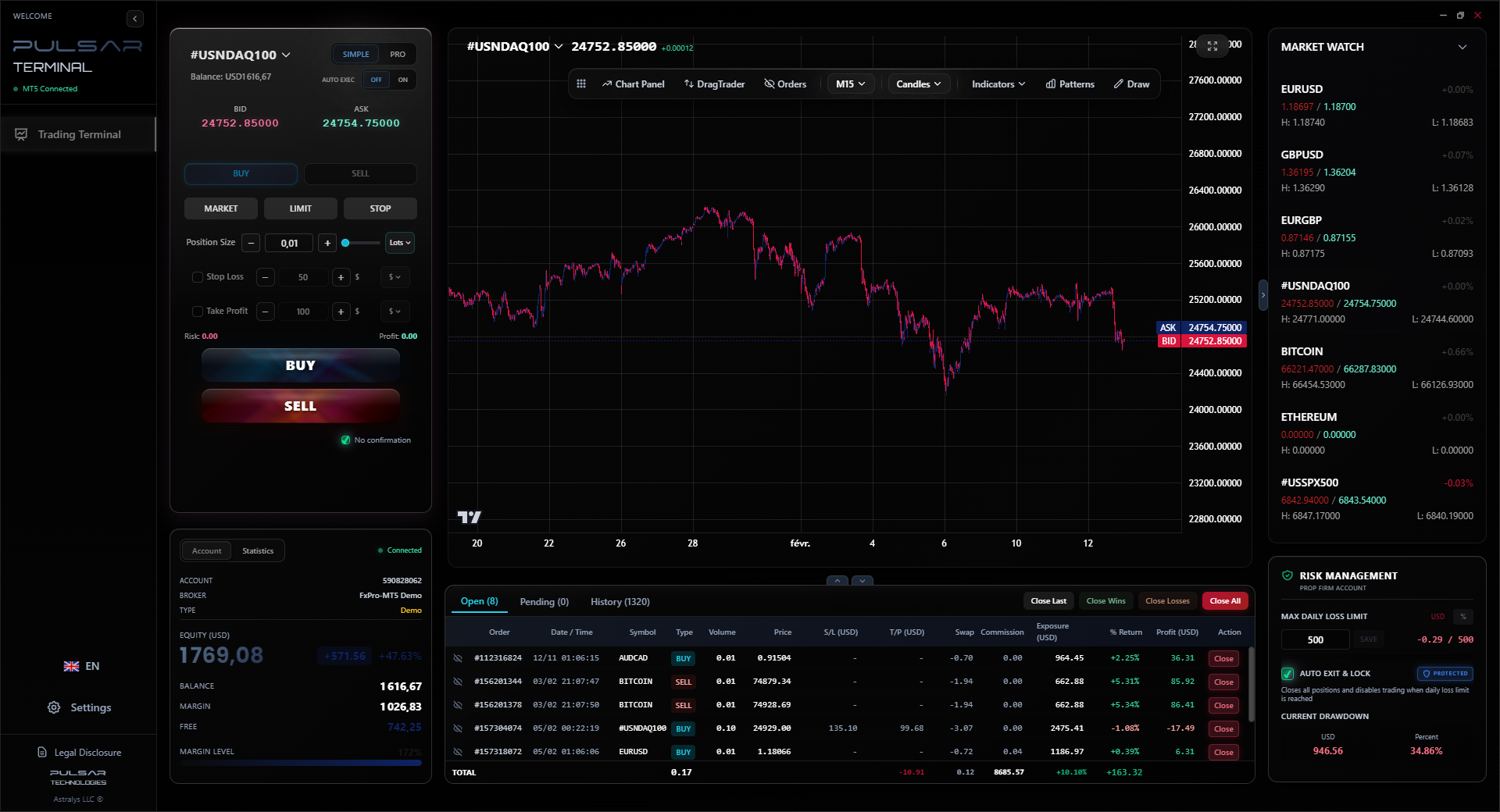
Managing multiple EA trades and complex risk rules is exhausting to monitor manually, which is where a tool like Pulsar Terminal for MT5 automates your entire trade management plan directly on the chart.
Pulsar Terminal
MT5一站式工具:拖拽下单、多重止盈/止损、追踪止损、网格交易、成交量分布图和自营交易保护。每日1000+交易者使用。
“The Naira's volatility isn't just a trade; it's a macro-economic force that affects your entire trading reality.”
I've seen it all, and I've fallen for some of it. Here's your cheat sheet to avoid losing your money.
The 'Signal Service' Disguised as an EA: You pay a monthly fee for an EA that doesn't trade. It just pops up buy/sell alerts on your chart. You have to execute the trades manually. This is just a glorified, overpriced signal service. You're paying for automation but not getting it.
The Over-Optimized 'Holy Grail': The seller shows incredible backtest results from 2020-2022. What they don't show is that the EA has 50 different parameters tweaked to fit that exact historical period. It will fail in the present. Ask for out-of-sample testing (performance on data it wasn't optimized for).
The Martingale/Grid Death Trap: These EAs increase lot sizes after a loss to try and recover. They work until they don't, and when they fail, they can wipe out your entire account. I lost $2,000 in one night to a 'safe' grid EA when the Swiss Franc unpegged from the Euro in 2015. The market gap meant my losses were double what the EA's logic could handle.
The 'Copy My Account' Scam: Someone offers to let you copy their trades via a platform like MQL5 Signals for a fee. Their track record looks amazing. Often, they are running multiple accounts, showing the one lucky account that performed well. The rest are blown. Or worse, they use a tiny account with huge risk to generate a great percentage gain, which is impossible to sustain with real money.
Warning: If someone contacts you on WhatsApp or Telegram unsolicited, promising guaranteed EA profits, block them immediately. No legitimate vendor operates that way.
💡 Winston 小贴士
The best EA you'll ever own is the one that automates *your own* proven manual strategy. It turns your discipline into a 24-hour asset.
“The only way to get an EA that truly fits your risk tolerance is to build it yourself.”
After years of buying disappointing EAs, I realized the only way to get something that truly fits my risk tolerance and market view was to build it. You don't need to be a coder.
Option 1: Learn MQL5. It's based on C++, and there are tons of free tutorials. Start by automating your manual strategy. Even a simple EA that just places your specific trade setups and manages your stop-loss and take-profit rules is a massive upgrade. It removes emotion and lets you test your idea objectively.
Option 2: Hire a Freelance Programmer. Platforms like MQL5.com and Upwork have many competent programmers. This is what I did for my primary swing trading system.
Here was my process:
- I had a clear, written-down manual strategy with defined entry, exit, and risk rules.
- I hired a programmer on MQL5.com for about $500.
- I provided the exact logic. ("Buy when the daily RSI crosses above 30 and the price is above the 200 EMA, with a stop loss at the previous swing low.")
- We went back and forth on testing for a month.
The result? An EA that executes my strategy perfectly, 24/7. I know every line of its logic because I wrote the rules. That confidence is worth more than any purchased EA. It's not infallible, but its losses are my strategy's losses, which I understand and accept. That's the real power of EA forex: turning your disciplined edge into an automated machine.
FAQ
Q1Is forex trading with EAs legal for individuals in Nigeria?
Yes, it is completely legal for individuals to trade forex using their own capital and automated tools like Expert Advisors. The Central Bank of Nigeria (CBN) regulates the official foreign exchange market, but retail trading on international platforms falls under the purview of the brokers' own international regulators. You are responsible for declaring your trading profits and paying the 10% Capital Gains Tax to FIRS.
Q2What is the minimum amount I need to start EA trading in Nigeria?
Technically, you can start with as little as $10 with some brokers like Exness. However, for serious EA trading that can withstand drawdowns and cover costs, I strongly recommend a minimum of $1,000. This allows for proper position sizing (risking 1-2% per trade) and gives the EA enough room to operate without being immediately crippled by a few losses or the broker's minimum trade size. Always use a position size calculator.
Q3Which is better for EAs, MetaTrader 4 (MT4) or MetaTrader 5 (MT5)?
MetaTrader 5 (MT5) is objectively better for EA development and testing. It has a more powerful strategy tester, handles more data points (bar history), supports more timeframes, and allows for more sophisticated hedging strategies. While many EAs are still built for MT4, the industry is shifting to MT5. For any new EA project, I now use MT5 exclusively.
Q4How do I fund my forex trading account for EA use from Nigeria?
The most common and efficient methods are: 1) Cryptocurrency deposits (especially USDT), which are fast and have relatively low fees. 2) Bank wire transfer from your domiciliary account (in USD). Direct funding with Naira cards is very difficult due to CBN restrictions. Always check your broker's specific deposit options and be aware of any conversion fees that might eat into your starting capital.
Q5Can I run an EA on my phone?
You can, but you absolutely should not. For an EA to run, the MetaTrader platform must be open and connected to the broker's server. If you close the app on your phone or lose connection, the EA stops. You need to run EAs on a dedicated VPS (Virtual Private Server), which is a remote computer that runs 24/7. This ensures your EA is never offline and executes trades with minimal latency. Most serious brokers offer or recommend affordable VPS services.
Q6Are there any profitable free EAs?
There are free EAs available in code repositories like MQL5.com, but 'profitable' is the key word. A free EA is usually a basic strategy shared by a developer. It might be profitable under certain conditions, but it comes with no support, updates, or guarantees. You must backtest and forward test it extensively yourself. Treat any free EA with more skepticism than a paid one - no one gives away their real golden goose for free.
Q7How much profit can I realistically make with an EA?
Anyone promising a specific monthly percentage is lying. Realistic returns for a strong, well-tested EA are between 5% to 20% per year, compounded. This is after accounting for drawdowns, losses, and periods of low activity. An EA that makes 2% per month consistently is exceptional. My goal is always capital preservation first. Aiming for 100% returns annually almost always leads to excessive risk and account blow-ups.
Winston 教授的课程
要点总结:
- ✓EA profitability depends 90% on risk management, 10% on strategy.
- ✓Always forward test on demo for a full market cycle (1-3 months min).
- ✓Use a VPS for 24/7 operation; phone execution will fail.
- ✓Stick to brokers with tight spreads (<1.0 pip on EUR/USD) for EA viability.
- ✓Budget 10% of profits for FIRS Capital Gains Tax from day one.
这篇文章对您有用吗?
点击星星评分
每周交易洞察
免费每周分析与策略。无垃圾邮件。
关于作者
Olumide Adeyemi
西非交易先驱
尼日利亚最活跃的外汇交易教育者之一。从拉各斯出发有8年交易经验。专注于低资金策略和面向非洲交易者的自营公司挑战。
评论
风险提示
金融工具交易存在重大风险,可能不适合所有投资者。过往业绩不代表未来表现。本内容仅供教育目的,不构成投资建议。在交易前请务必自行研究。
您可能还喜欢

Cara Trading Forex Sukses: 7 Prinsip dari Trader Profesional
Cara trading forex sukses dengan 7 prinsip trader pro: manajemen modal, disiplin, journal trading, backtest. Data nyata, bukan janji profit palsu.
Jam Trading Forex Terbaik untuk Trader Indonesia: Panduan Lengkap dengan Tabel Waktu
Panduan jam trading forex untuk trader Indonesia. Tabel 4 sesi dunia, jam emas 20:00-00:00, sesi mana yang harus dihindari. Data akurat + tips dari trader berpengalaman.
Top 5 Sàn Forex Uy Tín Nhất 2026: Review Jujur dari Trader Indonesia
Top 5 sàn forex uy tín 2026 untuk trader Indonesia. Review jujur: spread, deposit, withdraw, dukungan lokal. Exness, XM, IC Markets & lebih.
