


Here's a statistic that should make you pause: FNB's exchange rate margin on a standard international transfer can be up to 4%.

David van der Merwe
新兴市场交易员 ·  South Africa
☕ 11 分钟阅读
您将学到:
- 1FNB Forex Operating Hours: The 9-to-5 Trap
- 2The Real Costs: FNB's Hidden Fees vs. Trading Broker Spreads
- 3The Regulatory Landscape: FSCA, ODP, and Why Your Bank Isn't "Safer"
- 4How to Actually Trade Forex from South Africa: A Practical Guide
- 5The Top Mistakes South African Traders Make (And How to Avoid Them)
- 6When *Should* You Use FNB Forex Services? (The Only Valid Reasons)
- 7Making the Switch: Your Action Plan
Here's a statistic that should make you pause: FNB's exchange rate margin on a standard international transfer can be up to 4%. On a R100,000 transfer, that's R4,000 gone before the money even leaves the country. Most South Africans think using their bank for forex is the safe, official route. I'm here to tell you it's often the most expensive way to lose money, and their limited FNB forex hours are just the start of the problem. Trading or moving currency through a retail bank is like buying a car from a dealership that only opens when the factory is closed.
Let's get the basic facts straight. FNB's dedicated forex services don't run 24/7. The Forex Contact Centre operates 08:00 to 17:00 on weekdays and 08:00 to 12:00 on Saturdays. General branch tellers, where you can do cash forex, typically work 09:00 to 16:00 weekdays and 09:00 to 12:00 Saturdays. They're closed Sundays and public holidays.
Now, why does this matter for a trader? The global forex market runs 24 hours a day, five days a week. Major news like US Non-Farm Payrolls drops at 14:30 SA time on a Friday. A surprise SARB announcement can hit at 15:00. If you're relying on FNB's channels and something happens outside their hours, you're stuck. Your risk is unmanaged. I learned this the hard way years ago, trying to move USD profits from a broker back to my FNB account on a Saturday afternoon after a big win on XAU/USD. The money was in limbo until Monday, and the rand had weakened by the time it cleared, costing me about R1,200 on a R50,000 conversion.

Warning: Using a bank for time-sensitive forex transactions means you're trading in a part-time market with full-time risks. Your ability to react is dictated by their schedule, not the market's.
FNB does have a 24/7 online platform for businesses (FX Online), but that's for hedging and larger commercial transactions, not for the retail trader looking to convert a few thousand rand from a trading account. For the average person, the access is deliberately limited.
This is where the rubber meets the road. Banks make money on forex through opacity. Trading brokers make money on volume and transparency. The difference is staggering.
FNB's Fee Structure: How They Get You
For international transfers, FNB charges two ways: a fixed fee and an exchange rate margin.
- Transfer Fee: R200-R300 for sends under R10k; 0.55% commission (min R550) for over R10k.
- Exchange Rate Margin: This is the killer. They add 1% to 4% onto the interbank rate. Let's do the math. The interbank rate for USD/ZAR is 18.50. With a 3% margin, FNB's rate to you becomes about 19.06. To buy $1,000, you'd pay R19,060 instead of R18,500. That's a R560 hidden cost, on top of the transfer fee.
What a Real Trading Broker Charges
A regulated broker like IC Markets or Pepperstone makes money on the spread - the difference between the buy and sell price. For major pairs like EUR/USD, raw spread accounts can have spreads as low as 0.0 pips plus a small commission. Even a standard account might have a 1-pip spread.
Here’s a direct comparison for converting ZAR to USD, assuming a R100,000 transaction:
| Cost Component | FNB (International Transfer) | Typical Forex Broker (Trading EUR/USD) |
|---|---|---|
| Primary Fee | 3% Exchange Rate Margin | 1 Pip Spread (0.01%) |
| Fixed Fee | R550 (0.55% commission) | $3.50 per lot commission |
| Total Cost on R100k | ~R3,550 | ~R200 (equivalent) |
| Access Hours | Business Hours Only | 24/5 Market Hours |
I'm not saying brokers are charities. But their model aligns with active traders who execute often. The bank's model profits from your one-off, uninformed transaction. They're not built for trading; they're built for occasional currency conversion at a high premium.

Example: In 2023, I tested this. I sent $5,000 via FNB's standard channel and compared the total ZAR cost to buying the same $5,000 spot on a broker platform (by going long USD/ZAR and closing). The broker route was cheaper by over R1,800, even accounting for the broker's spread and a wire fee to fund the account. The bank's 'convenience' is expensive.

💡 Winston 小贴士
A bank's forex desk is a cost centre designed to profit from your ignorance. A broker's trading desk is a utility designed to profit from your volume. Know which one you're using.
“FNB's 3% forex margin is a silent tax on every international transaction you make.”
A common myth: "My money is safer with FNB because they're a big bank." For holding your rands, yes. For forex trading or getting competitive forex rates, not necessarily.
The real regulator for forex trading in South Africa is the Financial Sector Conduct Authority (FSCA). Since the mid-2020s, they've pushed brokers to obtain an Over-the-Counter Derivatives Provider (ODP) licence. This isn't a light-touch regulation. It demands strict capital adequacy, client fund segregation (your money is held in separate trust accounts), regular reporting, and fair conduct rules.
A reputable FSCA-licensed ODP broker like those we review (Exness, XM) is legally required to protect you in ways that are specific to trading. FNB is regulated by the SARB for banking, but their forex trading offering within their app is a different beast. It's often a white-label of a third-party platform with less competitive conditions.
The New Tax Rule You Must Know
In October 2025, SARB tightened exchange controls. Now, if you're a non-resident receiving funds from South Africa, the bank must check your SARS tax compliance before sending the money. You'll need a TCS-AIT PIN. For traders, this matters if you have an offshore trading account and want to withdraw profits back to SA. The flow into SA is less restricted, but getting money out requires more paperwork. This makes choosing an FSCA-regulated broker within South Africa more attractive for many, as profits can be paid to your local bank account without this offshore compliance hurdle.
The point is this: the safety argument for using your bank for forex activities is outdated. The FSCA's ODP regime provides a strong, modern framework specifically for trading. Your protection comes from using a properly regulated entity for the specific service you need, not from defaulting to your familiar bank.
Forget trying to use FNB's app for active trading. Here's the real-world setup for a South African trader in 2026.
Step 1: Choose an FSCA-Regulated Broker
Your first filter should be the regulator. Go to the FSCA's website and verify the broker's ODP license. This is non-negotiable. It ensures your funds are segregated and the broker meets local standards. Global brokers like IC Markets or Pepperstone have FSCA-regulated entities specifically for South African clients.
Step 2: Fund Your Account in ZAR
This is easier than ever. Most brokers accept instant EFTs via PayFast, Ozow, or SiD. You deposit rands from your FNB account (or any other), the broker converts it at a reasonable interbank rate to fund your trading account in USD, EUR, or another base currency. The fee for this is vastly lower than FNB's forex margin. Some also accept cryptocurrency deposits.
Step 3: Use a Professional Platform (MT5)
MetaTrader 5 (MT5) is the industry standard for a reason. It's powerful, supports algorithmic trading, and has better tools for analysis than any bank app. This is where you'll do your real analysis, place trades, and manage risk. Learn to use indicators like the RSI and MACD properly on this platform, not on a simplified bank interface.
Step 4: Execute and Manage Trades 24/5
Now you have access. You can react to news, set stop-loss orders, and use advanced order types. Your trading isn't constrained by FNB forex hours. If you're a scalping trader, you need this. If you're a swing trading investor, you can place your orders anytime it suits you.
Step 5: Withdraw Profits Back to Your FNB Account
Withdraw in ZAR directly to your South African bank account. The broker handles the conversion. Because it's a bulk transaction for them, you get a far better rate than the retail 3% margin. The process takes 1-3 business days. You use FNB for what it's good at: holding your rands securely.
💡 Winston 小贴士
Your most important trading hours are 14:30 to 16:00 SA time when US data drops. If your platform is closed then, you're flying blind.
“Limited hours mean unmanaged risk. You can't stop a bleeding trade if your bank's forex desk is closed.”
I've coached hundreds of local traders. The patterns are painfully consistent.
Mistake 1: Confusing Banking with Trading. Using your bank's platform for trading is like using a spork to build a house. It's the wrong tool. Banks are for custody and payments. Specialized brokers are for execution. Don't blend the two.
Mistake 2: Ignoring the True Cost of a Pip. Traders obsess over entry points but forget that a wide spread destroys their edge from the start. If your strategy needs a 10-pip move to break even, but you're paying a 3-pip spread because you're on a poor platform, you've already lost. Always calculate your break-even including spread and commission. Our position size calculator can help with this.
Mistake 3: Underestimating the Impact of Limited Hours. You go long on USD/ZAR before a US inflation report at 14:30 SA time. The number is catastrophic for your trade. The market gaps down 50 pips against you. But it's Friday, and it's now 16:05. FNB's forex desk is closed. You can't adjust your stop or close the trade. You're forced to hold that loss over the entire weekend, facing potential Sunday night gap risk. I've seen this lead to a margin call. With a 24/5 broker, you'd have been able to manage that risk immediately.
Mistake 4: Chasing "Signal Sellers" on Social Media. The FSCA issued over a hundred warnings against these guys in early 2025 alone. If someone is selling you signals on WhatsApp or Telegram, they're likely not regulated. Your first line of defence is a regulated broker and your own education, not a stranger's hot tip.

Pro Tip: Your biggest edge isn't a secret indicator. It's controlling your costs (spreads, fees) and your access (24/5 platforms). Nail those two things first, before you even think about a trading strategy.
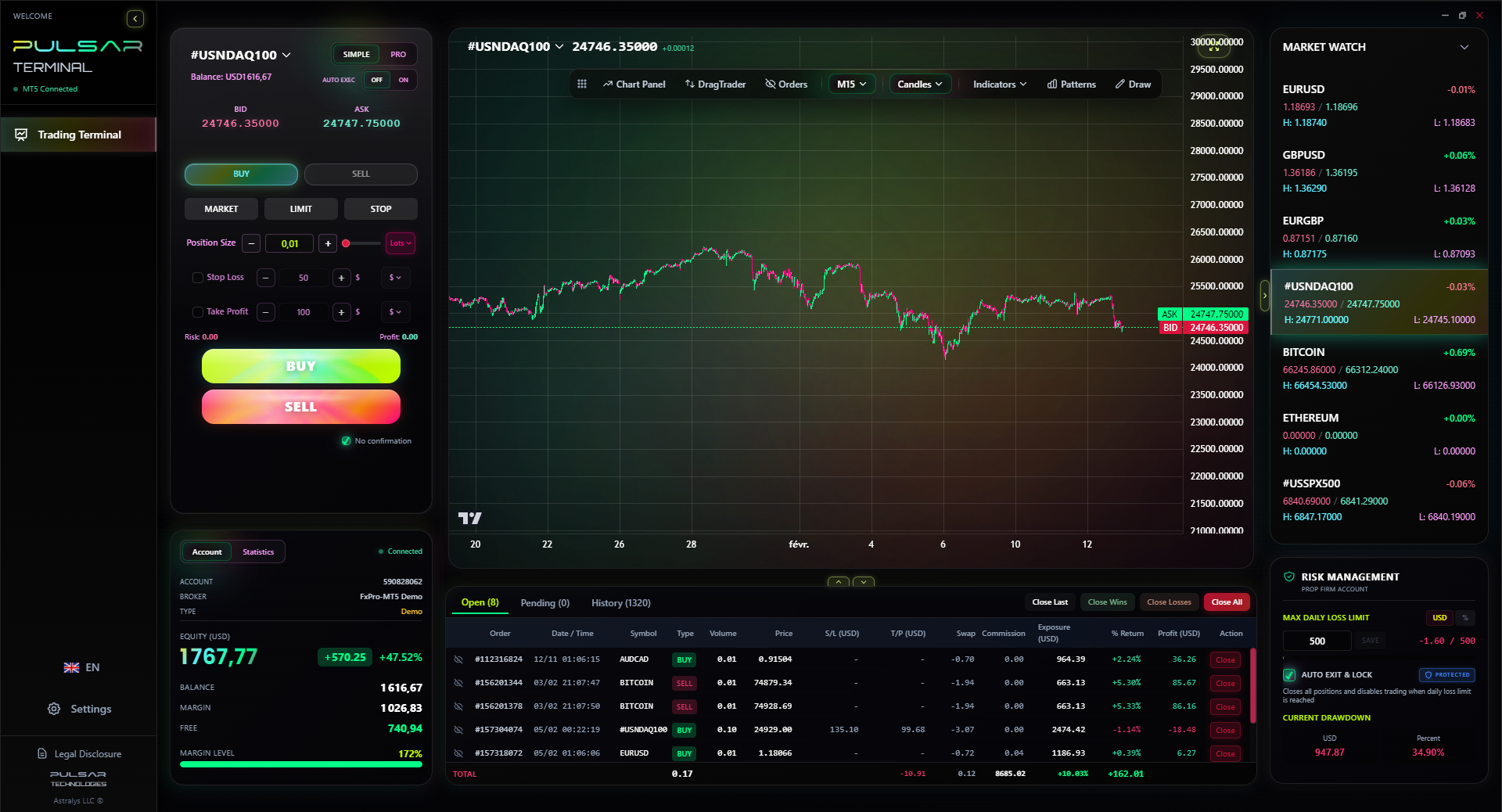
Managing risk outside of bank hours is critical, and Pulsar Terminal's automated trailing stop and breakeven features work directly on MT5 to protect your trades 24/5.
Pulsar Terminal
MT5一站式工具:拖拽下单、多重止盈/止损、追踪止损、网格交易、成交量分布图和自营交易保护。每日1000+交易者使用。
I'm not saying never use FNB for anything forex-related. That's unrealistic. There are specific, limited cases where it makes sense.
- Physical Cash for Travel: Need euros or US dollars in cash for a holiday? Walking into an FNB branch during their teller hours is a legitimate way to get it. You'll pay the high margin, but the convenience of having physical notes may be worth it for a small amount.
- Large, Structured International Payments: If you're buying property abroad or paying for university tuition, and you need a formal SWIFT transfer with documentation, using FNB's channel is appropriate. You're paying for the compliance and paper trail.
- Receiving International Payments in ZAR: If a client overseas is paying you in rands via SWIFT, it will land in your FNB account. That's fine. It's a passive receipt.
The common thread? These are infrequent, non-speculative transactions. They are not trading. The moment your activity involves speculation on price movements, seeking profit from volatility, or requires timely execution, you've left the bank's domain and entered the trading world. Use the right tool for the job.
💡 Winston 小贴士
Test the withdrawal process with a small amount before you commit serious capital. If you can't get your money out easily, nothing else matters.
“The safety argument for using your bank to trade forex is a comforting myth from a bygone era.”
Ready to move beyond FNB forex hours? Here's a simple, low-risk way to start.
- Open a Demo Account: Don't put real money in yet. Go to the website of an FSCA-regulated broker and open a demo account on MT5. Play with it for a month. Get used to the platform, the order types, and seeing real-time spreads.
- Make a Small Live Deposit: Fund an account with an amount you can afford to lose completely - R2,000 or R5,000. Use an instant EFT. The goal here isn't to get rich. It's to test the entire cycle: deposit, execution, withdrawal. Place a few tiny trades to feel the real cost of a pip.
- Execute a Full Withdrawal Test: This is critical. After a few weeks, withdraw your remaining balance back to your FNB account. Note how long it takes, what the final exchange rate was, and any fees. This proves the system works.
- Scale Up Gradually: Only once you're comfortable with the mechanics and the costs should you consider funding with more meaningful capital.
The mental shift is from seeing forex as a 'bank service' to seeing it as a 'global market' you can access directly. Your bank becomes the endpoint for your profits, not the gateway to the market. It's a more powerful, and cheaper, way to operate.
FAQ
Q1Can I trade forex directly on the FNB app?
Yes, FNB offers a forex trading feature within its banking app. However, it typically offers a limited selection of currency pairs, higher spreads than dedicated brokers, and is subject to the bank's own platform limitations. For serious trading, a specialized FSCA-regulated broker using MT5 is a far better option.
Q2What are FNB's exact forex hours for phone calls?
The FNB Forex Contact Centre operates from 08:00 to 17:00 on weekdays and 08:00 to 12:00 on Saturdays. For general forex enquiries via their Payment Solutions line, hours are 07:45 to 16:15 on weekdays.
Q3Is it illegal to use an international forex broker in South Africa?
No, it is not illegal. However, it is highly recommended to use a broker that is regulated by the South African FSCA (with an ODP license). This ensures your funds are protected under local law. Using an unregulated offshore broker is risky and not advised.
Q4How much does FNB charge for a forex transfer?
FNB charges two main fees: 1) A fixed commission (e.g., 0.55% with a minimum of R550 for sends over R10k), and 2) An exchange rate margin, which is a hidden fee of 1% to 4% added to the interbank rate. This margin is often the largest cost.
Q5What is the best way to fund an international trading account from South Africa?
The easiest and most cost-effective method is usually via Instant EFT through local payment processors like PayFast or Ozow. You deposit ZAR from your SA bank account, and the broker converts it. This is cheaper and faster than doing a SWIFT transfer through your bank.
Q6Why are FNB's forex rates worse than the rates I see online?
The rates you see online (like on Google) are interbank mid-rates. FNB (and all retail banks) add a margin (1-4%) to that rate to make their profit. Dedicated forex brokers make money on the spread (the bid/ask difference), which for major pairs can be less than 0.1%, making their effective rate much closer to the interbank rate.
Q7Does the new SARS tax rule affect my forex trading profits?
The October 2025 SARB rule primarily affects non-residents receiving funds from South Africa. If you are a South African resident trading with an FSCA-regulated broker and withdrawing profits to your local bank account, this specific rule is less relevant. You are, of course, still subject to normal South African tax laws on your trading profits.
Winston 教授的课程
要点总结:
- ✓FNB forex margins (1-4%) are 30-120 times higher than broker spreads.
- ✓Market access limited to business hours creates unmanageable weekend risk.
- ✓FSCA ODP regulation, not bank branding, provides real trader protection.
- ✓Always test the full deposit-trade-withdrawal cycle with small money first.
这篇文章对您有用吗?
点击星星评分
每周交易洞察
免费每周分析与策略。无垃圾邮件。
关于作者
David van der Merwe
新兴市场交易员
约翰内斯堡交易者,11年新兴市场货币经验。专注于ZAR货币对、FSCA监管交易和南非市场分析。
评论
风险提示
金融工具交易存在重大风险,可能不适合所有投资者。过往业绩不代表未来表现。本内容仅供教育目的,不构成投资建议。在交易前请务必自行研究。
您可能还喜欢

Cara Trading Forex Sukses: 7 Prinsip dari Trader Profesional
Cara trading forex sukses dengan 7 prinsip trader pro: manajemen modal, disiplin, journal trading, backtest. Data nyata, bukan janji profit palsu.
Jam Trading Forex Terbaik untuk Trader Indonesia: Panduan Lengkap dengan Tabel Waktu
Panduan jam trading forex untuk trader Indonesia. Tabel 4 sesi dunia, jam emas 20:00-00:00, sesi mana yang harus dihindari. Data akurat + tips dari trader berpengalaman.
Top 5 Sàn Forex Uy Tín Nhất 2026: Review Jujur dari Trader Indonesia
Top 5 sàn forex uy tín 2026 untuk trader Indonesia. Review jujur: spread, deposit, withdraw, dukungan lokal. Exness, XM, IC Markets & lebih.
