


I was staring at a 92% win rate on my screen.

David van der Merwe
新兴市场交易员 ·  South Africa
☕ 9 分钟阅读
您将学到:
- 1What Backtesting Actually Is (And Why You Can't Skip It in SA)
- 2What to Actually Look For in a Backtesting App
- 3The Trap of Curve-Fitting and Other Soul-Crushers
- 4Platforms That Work With SA Brokers and ZAR Pairs
- 5From Theory to Practice: Taking Your Test Live in SA
- 6The Final Word: Is It Worth The Effort?
I was staring at a 92% win rate on my screen. My custom RSI divergence strategy, backtested over five years of EUR/ZAR data, looked like a money printer. I funded my account with R20,000, full of confidence. Two weeks later, I was down R4,700. The beautiful equity curve from the backtest had lied. The market had shifted, my logic was flawed, and I’d committed the cardinal sin of over-optimization. That painful lesson in 2021 cost me real money, but it taught me everything about what a forex backtesting app can and cannot do for you here in SA.
Let's cut through the jargon. Backtesting isn't about finding a holy grail. It's about stress-testing your trading idea against history to see if it would have survived. In South Africa, with our unique market pressures, this isn't a luxury, it's a necessity.
Think about it. You're not just trading EUR/USD. You're likely looking at USD/ZAR or EUR/ZAR. The Rand isn't just another currency pair, it's a rollercoaster driven by load-shedding announcements, commodity prices, and political noise. Throwing a strategy designed for calm majors onto the ZAR without testing it is financial suicide.
A proper forex backtesting app lets you simulate your trades on historical data. You define your rules: "Buy when the MACD indicator crosses above the signal line on the 1-hour chart, with a 20-pip stop loss." The software then runs that rule across every 1-hour bar for the last 5 years and shows you the hypothetical result. The key word is hypothetical. My early mistake was believing those results were a promise.

Warning: The FSCA's use cap of 30:1 (and the incoming 1:200 cap) changes your risk profile dramatically. A strategy that backtests well at 1:500 use from an offshore broker will blow up at local use. You must backtest with the correct use and realistic spreads from your broker, like those from Exness review or IC Markets review, which offer low spreads crucial for accurate results.

💡 Winston 小贴士
A profitable backtest is a hypothesis, not a conclusion. The live market is the only exam that counts.
Data Quality is Everything
Garbage in, garbage out. If your app uses poor quality or incomplete tick data, your test is worthless. For ZAR pairs, you need data that includes the wild swings during SA market hours (8am-5pm SAST). Many free apps use smoothed-out hourly data, which misses the intraday volatility that will stop you out. I learned this the hard way testing a scalping strategy on USD/ZAR. The backtest showed a 70% success rate. Live trading? It was barely 45%. The difference was the lack of 1-minute spread data in the test.
Realistic Modelling of Costs
This is where most amateur tests fail. You must account for the spread, commission, and swap fees. That 0.6 pip average spread on EUR/USD? It can widen to 3 pips on USD/ZAR during news. If your backtest assumes a fixed 1-pip spread, you're lying to yourself. A good app lets you input variable spreads and commissions. Always use the worst-case spread your broker quotes, not the best.
Flexibility in Strategy Design
Can you code or use a visual builder? Platforms like MetaTrader's Strategy Tester (built into MT4/MT5) are the standard. They're not perfect, but they're integrated with the platform you'll likely trade on with brokers like XM review or Pepperstone review. You need to test not just entries, but your exit logic - trailing stops, multiple take-profit levels. Does the app let you simulate partial closes? If not, your results are too clean.

Example: Let's say your strategy has a 50 pip take-profit and a 30 pip stop-loss. Without factoring in a 2.5 pip spread on ZAR pairs, your test assumes a 1.67 reward-to-risk ratio. Factor in the spread, and your effective risk is 32.5 pips, dropping your R:R to 1.54. That small change turns a profitable strategy into a breakeven one over hundreds of trades.
“The goal isn't to create the perfect backtest. The goal is to avoid the obviously stupid trades.”
This is the part that breaks most traders. You get a beautiful backtest, you go live, and it fails. Here’s why.
Curve-Fitting (Over-Optimization): This is my original sin. You tweak your strategy parameters until they fit the historical data perfectly. "Oh, a 14-period RSI works, but a 17-period RSI with a 1.2 deviation is amazing!" You’ve just created a strategy that’s tailored to past noise, not future price action. The market has no memory. To avoid this, use a technique called walk-forward analysis. Test your strategy on a chunk of data (e.g., 2018-2020), then validate it on unseen data (2021-2022). If it fails on the unseen data, it’s junk.
Ignoring Slippage and Execution: Your backtest assumes you get filled at the exact price of your signal. In reality, during a SARB interest rate announcement, your market order on USD/ZAR might slip 10 pips. A good backtesting app has a slippage model. Set it to at least 1-2 pips for majors and 3-5+ for ZAR pairs.
Survivorship Bias: This is less common with forex majors but can affect data from some apps. They use data for currency pairs that exist today, ignoring pairs that have ceased trading or were too illiquid. For SA traders, just ensure your ZAR pair data is complete.

Pro Tip: The single best way to fight curve-fitting is to simplify. The more complex your strategy (e.g., "RSI below 30, MACD bullish, on a Tuesday, during a full moon"), the more likely it’s fitted to the past. A simple strategy that survives a strong backtest has a far better chance in the live market. Use a position size calculator with your backtested win rate and average loss to find your realistic risk per trade.
💡 Winston 小贴士
If you can't explain your strategy's edge in one simple sentence, your backtest is probably just fitting noise.
You have options, from free and basic to expensive and professional. Your choice depends on your skill level and budget.
MetaTrader Strategy Tester (Free): Built into MT4 and MT5. It’s where 80% of retail traders start. Pros: It’s free, integrated, and uses your broker’s data. You can code Expert Advisors (EAs) in MQL4/5. Cons: The data quality is only as good as your broker’s historical feed, and modelling can be simplistic. It’s a solid starting point. Most FSCA-regulated brokers like those listed offer MT4/5.
TradingView Premium (Paid): Its backtesting feature, "Strategy Tester," is surprisingly powerful and visual. You can code in Pine Script (easier than MQL for many) and test on TradingView’s decent data. Great for visual learners. The big con for SA traders? Its data on ZAR pairs can be limited in depth compared to dedicated platforms. Cost: From about $15/month.
Professional Standalone Software (Expensive): Think platforms like Soft4FX, Forex Tester, or FX Blue’s trading simulator. These are designed specifically for rigorous backtesting. They often come with high-quality tick data you can purchase for specific pairs. The learning curve is steeper, and costs can run from $500 to over $1000 for a license. I only recommend this if you’re serious about developing automated systems.
The Reality Check: No matter the platform, you must ensure it can handle the specific conditions of trading with an FSCA-regulated broker - the correct use, the ability to model the spread definition on exotic pairs, and the correct trading hours. Don’t backtest a strategy for a broker offering 1:1000 if you’re trading at 1:30 locally.
“A positive expectancy backtest is just a license to start testing in a demo account, not a ticket to wealth.”
Your backtest says you have an edge. Now what? You don’t just dump your life savings in. This is the disciplined, boring part that makes the money.
Start with a Demo: Run the strategy on a demo account for at least a month, through a full market cycle. Track every trade in a journal. Does the live performance match the backtest within a reasonable margin of error? If the backtest had a 55% win rate and demo is at 52%, that’s okay. If it’s at 40%, something’s wrong.
Use a Proper Position Size Calculator: Your backtest should give you key stats: your historical win rate, your average win, and your average loss. From this, you can calculate your expected value. Let’s say your backtest over 500 trades shows a 40% win rate, with average wins of R800 and average losses of R500.
Expected Value = (0.40 * 800) + (0.60 * -500) = 320 - 300 = R20.
A positive R20 expectancy per trade is good. Now, using a 1% risk model on a R10,000 account (R100 risk), you can work backwards to find your position size. This is how you move from vague hope to mathematical expectation.
Manage Your Psychology: Seeing a string of 3-4 losses live is terrifying, even if your backtest had longer losing streaks. You’ll be tempted to abandon the plan. This is where your backtest report is your anchor. You can look at it and say, "The system survived a 7-loss streak in 2019. This is within parameters." Without that proof, you’ll second-guess yourself into failure.
Tax and Admin: Remember, the SARS wants its share. Your backtesting can help with record-keeping. A well-documented strategy makes it easier to justify your trading income and expenses come tax season. Keep those backtest reports and your live trade logs.
💡 Winston 小贴士
The best backtesting feature is the 'walk-forward' analysis. It's the difference between fitting the past and preparing for the future.
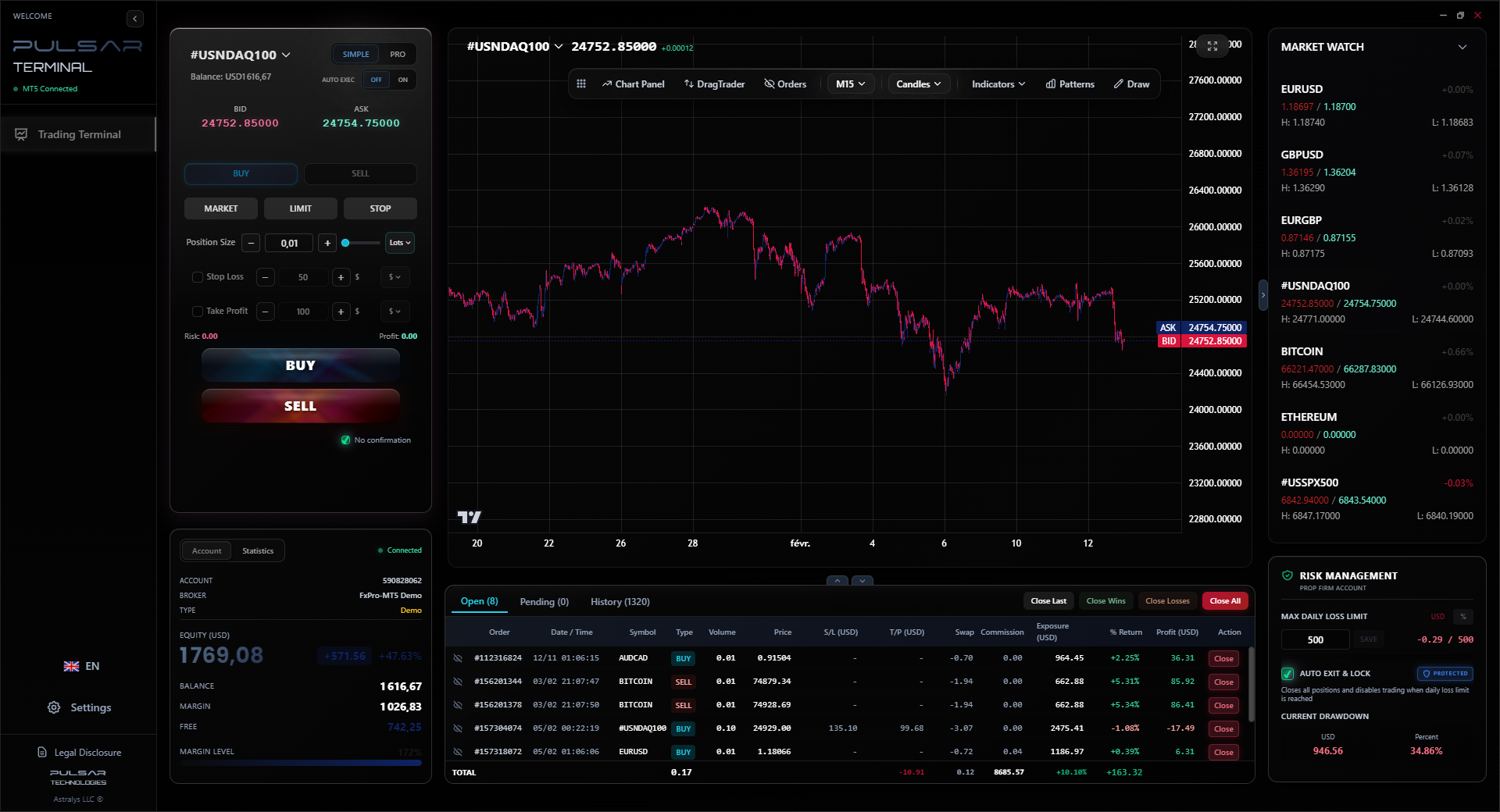
Once your backtest is solid, executing it precisely is key. Pulsar Terminal's drag-and-drop orders and multi-TP/SL management on MT5 let you implement complex strategies exactly as you designed them.
Pulsar Terminal
MT5一站式工具:拖拽下单、多重止盈/止损、追踪止损、网格交易、成交量分布图和自营交易保护。每日1000+交易者使用。
Absolutely, but only if you do it right. A forex backtesting app is not a crystal ball. It's a laboratory. You don't go into a lab, mix random chemicals, and then drink the result expecting superpowers. You run controlled, repeatable experiments to understand probabilities.
For the South African trader, it's even more critical. Our market is smaller, more volatile, and has unique constraints. Testing a strategy on USD/ZAR without accounting for political event volatility is a recipe for a margin call.
Start with the free tools. Master the MetaTrader Strategy Tester. Learn about walk-forward analysis and curve-fitting. Test simple ideas first - maybe a basic moving average crossover on EUR/USD before you try a complex multi-indicator system on EUR/ZAR. The goal isn't to create the perfect backtest. The goal is to avoid the obviously stupid trades before you risk a single cent of your hard-earned Rand.
My journey from that R4,700 loss to consistent profitability started when I stopped looking for a perfect backtest and started using backtesting to eliminate my worst ideas. That shift in perspective is the real value of the tool.
FAQ
Q1Is it legal to use forex backtesting apps in South Africa?
Yes, completely legal. Backtesting uses historical data to simulate trading; you're not executing real market orders or moving money. The legal focus is on your live trading activity, which must be done through an FSCA-regulated broker or within your exchange control allowances if using an international broker.
Q2What's the biggest mistake SA traders make with backtesting?
Using default settings and unrealistic assumptions. They backtest a strategy with 1:500 use, zero spread, and no slippage on EUR/USD, then try to run it live with 1:30 use and a 3-pip spread on USD/ZAR. The results are meaningless. You must model the exact conditions of your live trading environment.
Q3Can I backtest strategies for trading the Rand (ZAR) pairs?
You can, but you need to be extra careful about data quality. Ensure your backtesting app or data feed includes high-quality tick data for USD/ZAR, EUR/ZAR, etc. The volatility and spread widening on these pairs are significant, and low-quality data will give you wildly optimistic results.
Q4How much historical data do I need for a reliable backtest?
Aim for at least 5-10 years of data, covering different market environments (bullish, bearish, sideways, high volatility). For a swing trading strategy, daily data might suffice. For day trading or scalping, you need tick or 1-minute data. Testing on just 6 months of a trending market will almost always give a deceptively good result.
Q5My backtest is profitable, but my demo trading isn't. Why?
This is the classic reveal of a flawed test. The most common reasons are: 1) Curve-fitting/over-optimization, 2) Not accounting for spread/slippage/commission in the test, 3) Poor quality historical data that doesn't match live data feed prices, or 4) Psychological errors in live execution (hesitation, overriding signals). Go back and audit your testing methodology.
Q6Are there any free backtesting apps good enough to start with?
Yes. The MetaTrader 4/5 Strategy Tester is free and is directly linked to the platform you'll likely trade on. TradingView also has a free backtester for its basic data, though you'll need a paid plan for serious use. Start with these before considering expensive professional software.
Q7How does the FSCA's 30:1 use cap affect my backtesting?
It fundamentally changes your risk and position sizing. You must set your backtesting software's use parameter to 30:1 (or lower) to see the true performance of your strategy. A strategy that relies on high use to be profitable will show its true colors as a loser when tested under local regulatory limits.
Winston 教授的课程
要点总结:
- ✓Always backtest with local FSCA use limits (30:1).
- ✓Factor in real ZAR pair spreads (3-5+ pips minimum).
- ✓Use walk-forward analysis on 5+ years of data.
- ✓A strategy must survive demo trading before going live.
- ✓Simplify your rules to avoid curve-fitting noise.
这篇文章对您有用吗?
点击星星评分
每周交易洞察
免费每周分析与策略。无垃圾邮件。
关于作者
David van der Merwe
新兴市场交易员
约翰内斯堡交易者,11年新兴市场货币经验。专注于ZAR货币对、FSCA监管交易和南非市场分析。
评论
风险提示
金融工具交易存在重大风险,可能不适合所有投资者。过往业绩不代表未来表现。本内容仅供教育目的,不构成投资建议。在交易前请务必自行研究。
您可能还喜欢

Cara Trading Forex Sukses: 7 Prinsip dari Trader Profesional
Cara trading forex sukses dengan 7 prinsip trader pro: manajemen modal, disiplin, journal trading, backtest. Data nyata, bukan janji profit palsu.
Jam Trading Forex Terbaik untuk Trader Indonesia: Panduan Lengkap dengan Tabel Waktu
Panduan jam trading forex untuk trader Indonesia. Tabel 4 sesi dunia, jam emas 20:00-00:00, sesi mana yang harus dihindari. Data akurat + tips dari trader berpengalaman.
Top 5 Sàn Forex Uy Tín Nhất 2026: Review Jujur dari Trader Indonesia
Top 5 sàn forex uy tín 2026 untuk trader Indonesia. Review jujur: spread, deposit, withdraw, dukungan lokal. Exness, XM, IC Markets & lebih.
