


You're trying to figure out how to trade forex from Nigeria, and everywhere you look, you see two prices for the Naira: the official CBN rate and the 'black market' rate.

Olumide Adeyemi
西非交易先驱 ·  Nigeria
☕ 11 分钟阅读
您将学到:
- 1What Exactly Is the Forex Black Market? (It's Not What You Think)
- 2Why Does Nigeria Have Such a Huge Parallel Market?
- 3black-market-rate-vs-official
- 4How the Black Market Directly Impacts Your Forex Trading
- 5The Real Risks and Dangers (Beyond Just Losing Money)
- 6Practical Trading Strategies for This Messy Reality
- 7What's Next? The Future of the Naira and Parallel Market
- 8Final Words from a Veteran in the Trenches
You're trying to figure out how to trade forex from Nigeria, and everywhere you look, you see two prices for the Naira: the official CBN rate and the 'black market' rate. Which one is real? More importantly, which one affects your trading account and your life? Forget the textbook definitions. I've traded through multiple currency crises here, and I'll tell you exactly how this parallel market works, why it exists, and the brutal, practical impact it has on every single trade you place.
Let's clear this up first. When Nigerians say 'forex black market' or 'parallel market,' we're not talking about a shadowy alley deal (though it can feel like that). It's an informal, but highly organized, over-the-counter (OTC) market for foreign exchange. It exists because the official channels, primarily through the Central Bank of Nigeria (CBN), can't meet the massive demand for dollars, euros, and pounds.
The key driver? Access. Or rather, the lack of it. Businesses need dollars to import goods. Individuals want forex for travel, school fees, or just to preserve savings. When the banks say 'no,' or impose restrictive limits, people find another way. This market is run by licensed Bureau de Change operators (BDCs) and a vast network of street traders, often called 'abokis.' The rate they quote is the Naira's real-world street price, and it's usually much weaker than the CBN's official rate.
For you, the trader, this is critical. The black market rate determines the real cost of funding your international broker account. If you're depositing $1000, you're not paying the CBN's rate. You're paying the street rate, plus whatever fee your payment processor tacks on. That initial cost directly eats into your potential profits before you've even placed a trade. I learned this the hard way in 2016. I calculated my risk on the official rate, funded my account via a grey-channel transfer, and realized my effective entry cost was 15% higher. My entire risk management plan was blown before I started.
This isn't an accident. It's a direct result of specific economic policies and realities. The core issue is a structural foreign exchange shortage. Nigeria earns most of its forex from oil exports. When oil prices crash, dollar inflows dry up, but the demand for imports (from petrol to wheat to iPhones) doesn't. The CBN then faces a brutal choice: devalue the official Naira or try to defend it with controls.
Historically, the preference has been for controls. This creates a classic economic scenario: artificial scarcity. When the price is held artificially low (the official rate), demand skyrockets and a shortage is guaranteed. The black market emerges to fill that gap, but at a much higher price that reflects true scarcity.
The Domino Effect on Everything
This dual-rate system breaks everything. It creates massive arbitrage opportunities for the connected. It fuels inflation because the cost of anything imported is priced at the parallel market rate. For you, it means the Naira value of your trading profits is volatile. You might make a 10% return in dollars, but if the parallel Naira weakens 20% in that period, you've actually lost purchasing power in local terms. Your broker's USD profits are only half the story; the conversion back to NGN is the other, often more brutal, half. Understanding this disconnect is the first step to being a savvy trader here. You're not just trading EUR/USD; you're also implicitly trading against NGN volatility.

💡 Winston 小贴士
The parallel market premium is a tax on impatience. The more desperate you are for forex, the higher the tax. Plan your funding needs weeks, not hours, in advance.
“Funding your broker is your first trade, and in Nigeria, it often comes with a 10%+ 'surcharge' before you even see a chart.”
This is where the rubber meets the road. You'll see two prices quoted everywhere: NAFEX (or I&E Window) and Parallel. Here’s what they actually mean for you.
| Rate Type | Who Sets It? | Who Can Access It? | Reality for Retail Traders |
|---|---|---|---|
| Official CBN Rate | Central Bank of Nigeria | Government, select large corporations | Largely irrelevant. You won't get this rate. |
| NAFEX (I&E Window) | Market-driven within CBN bands | Banks, institutional investors, some eligible transactions | The closest to 'official' you might see for transfers, but still often with bottlenecks. |
| Parallel Market Rate | Street demand & supply (AbokiFX, street BDCs) | Everyone else (Businesses, individuals, you) | This is your real funding cost. This determines the Naira value of your profits/losses. |
The gap between NAFEX and Parallel is the premium. A wide premium (like ₦150+) signals severe stress, limited official liquidity, and high demand for cash dollars. I watch this gap like a hawk. When it widens sharply, I know funding my trading account is about to get more expensive, and I might delay a large deposit.

Warning: Never, ever use the official CBN rate for your personal trading calculations. If you're planning a trade that requires a $500 deposit, calculate the Naira cost using the current parallel rate from a source like AbokiFX. Basing it on the official rate is a surefire way to underfund your account and blow your position size calculator numbers.
This isn't abstract economics. This hits your P&L in three concrete ways.
1. The Cost of Entry: Funding your broker is your first trade. Let's say the NAFEX rate is ₦1,450/$, but the parallel rate is ₦1,600/$. To deposit $1,000, you're paying ₦1,600,000, not ₦1,450,000. That's an immediate ₦150,000 'surcharge' (over 10%) just to get in the game. This destroys the math of small accounts. A 2% risk on a $500 account is meaningless if you paid a 15% premium to fund it.
2. Profit & Loss in Naira Terms: You close a trade with a $500 profit. Great! But when you withdraw, you convert it back to Naira. Is the parallel rate now ₦1,550 or ₦1,650? That difference changes your Naira profit by ₦50,000. You're effectively running a second, unhedged currency trade (USD/NGN) on every withdrawal. I once made a nice $2,000 profit on a XAU/USD guide swing trade over three weeks. By the time I withdrew, a sudden Naira devaluation in the parallel market had increased my Naira gain by an extra ₦80,000. It was luck, not skill.
3. Broker Choice and Funding Methods: This environment makes your choice of broker critical. You need a broker with reliable, low-cost deposit/withdrawal methods that work within Nigeria's constraints. Some international brokers are a nightmare to fund. This is a major reason why brokers with strong local payment partnerships, like Exness review or XM review, are popular here. Their systems are built for this chaos.

Pro Tip: Think of your trading capital in Dollar Terms Only. Set your risk management (e.g., 1% per trade) based on your USD account balance. Then, mentally write off the Naira premium you paid as a sunk cost. This separates your trading discipline from the currency volatility you can't control.
💡 Winston 小贴士
Your first trade is the currency conversion. Calculate your effective entry price (Naira cost per dollar) and write it down. If your trading can't overcome that hurdle, you're in the wrong business.
“You're not just trading EUR/USD; you're also implicitly trading against NGN volatility every time you deposit or withdraw.”
Trading is risky enough. Dealing with the parallel market adds layers of danger you must understand.
Financial Scams: This is the big one. You're dealing with large sums of cash or informal transfers. 'Wire transfer' scams are rampant. Someone offers you a rate too good to be true (it is), you send Naira, and the dollars never arrive. Or you meet a 'BDC' operator who disappears with your money. I know two traders who lost millions of Naira this way. Never deal with an unverified, unknown entity.
Legal Grey Area: While trading forex with international brokers is legal, sourcing dollars outside official channels operates in a grey zone. The CBN periodically cracks down on forex speculation. Your funds could get stuck in a frozen account.
Volatility and Slippage: The parallel market rate isn't stable. The quote you get at 10 AM can be gone by 10:15, especially during times of news or scarcity. You could agree on a rate, send your money, and then be told the rate has 'moved' and you need to send more. This is slippage on your life savings.
Impact on Trading Psychology: This is subtle but deadly. Knowing you paid a huge premium to fund your account can make you risk-averse (you're scared to lose the expensive capital) or recklessly aggressive (you're trying to 'make back' the premium quickly). Both mindsets will destroy you. You must fund your account with money you can afford to lose, premium included, and then trade your system coldly. Using a tool that enforces discipline, like setting automatic trailing stop orders, can help remove emotion.
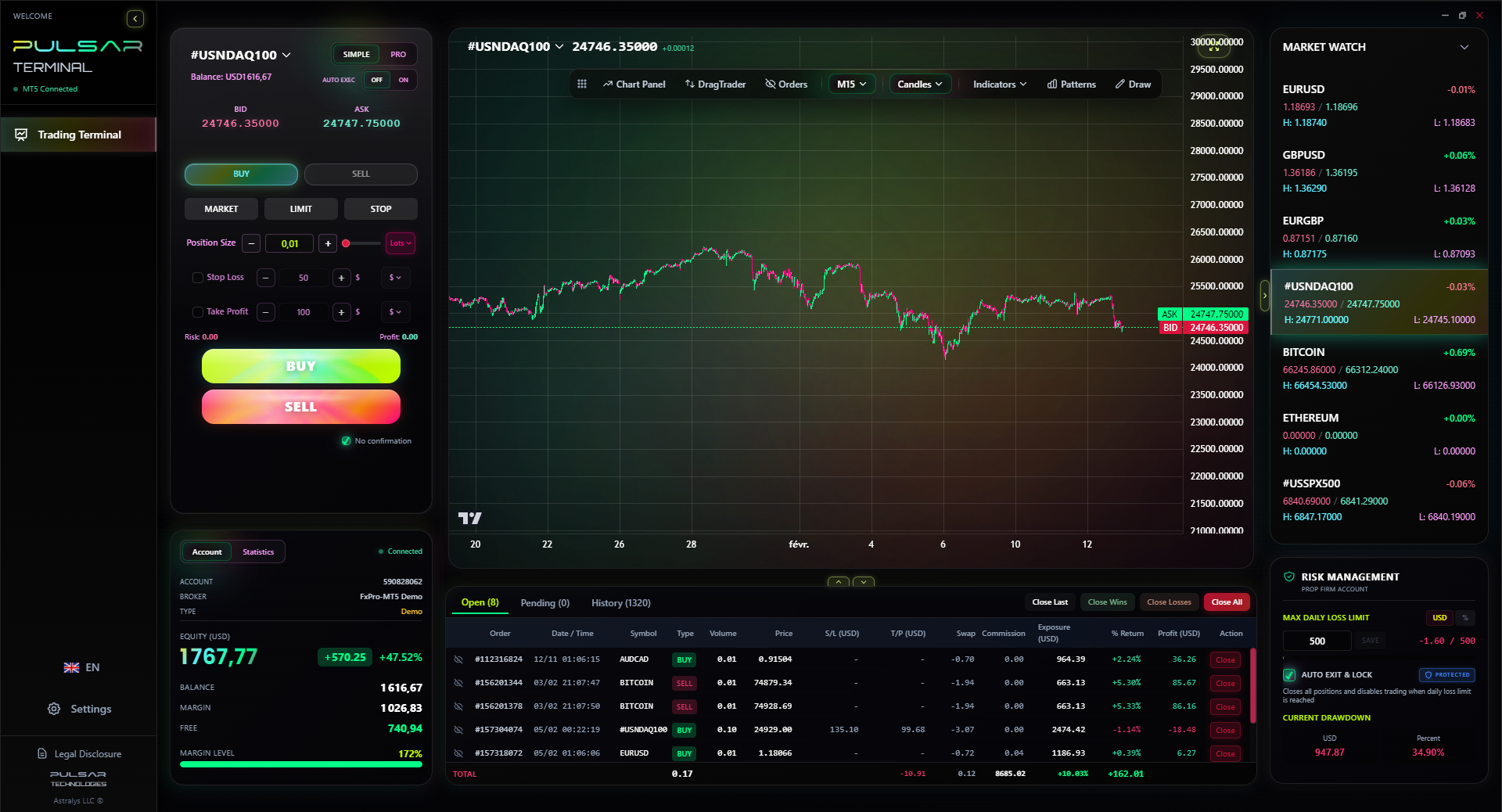
When trading in a high-stress environment like Nigeria's, emotional discipline is key. Pulsar Terminal's automated trade management tools, like setting trailing stops and breakeven points, execute your plan without hesitation, removing the local noise from your trading decisions.
Pulsar Terminal
MT5一站式工具:拖拽下单、多重止盈/止损、追踪止损、网格交易、成交量分布图和自营交易保护。每日1000+交易者使用。
How do you trade successfully in this system? You adapt. You get pragmatic.
1. Go Big or Go Home (With Your First Deposit): The premium you pay is a fixed cost. It hurts a $500 account proportionally way more than a $5,000 account. If possible, save up and make one larger initial deposit to amortize that hit. Scraping together $200 every month is a fast track to having your capital eroded by fees and premiums.
2. Hedge Your Naira Exposure (If You Can): This is for more advanced traders. If you have a large USD profit sitting in your broker, you're short Naira (betting it will weaken). Sometimes, you can hedge this by holding a Naira-denominated asset you believe will appreciate. It's complex and not always feasible, but being aware of the exposure is key.
3. Choose the Right Instruments: Focus on major pairs with tight spreads. Your edge is already slimmed by funding costs. Don't make it worse trading exotic pairs with huge spreads. The EUR/USD guide is your friend. Its liquidity keeps costs low.
4. Master Withdrawal Timing: You can't time the parallel market, but you can be observant. Avoid withdrawing during periods of obvious panic or liquidity crunches (often month-ends when demand for dollars spikes). It's not perfect, but it helps.
5. Embrace a Long-Term Mindset: The pressure to 'make quick returns' to justify the premium is immense. Fight it. The best strategy is often a patient, disciplined swing trading approach where you're not churning your account and paying spreads constantly. Let your edge play out over time.
“Trying to time the parallel market is as futile as trying to catch a falling knife with your eyes closed.”
Will this ever change? In the short to medium term, no. The structural issues (dependence on oil, high import demand) aren't going away. However, the gap between the official and parallel rates can widen or narrow based on policy.
A floatation of the Naira (letting the official rate be truly set by the market) would narrow the gap dramatically. It would cause a one-time, painful devaluation, but then kill the arbitrage incentive for the black market. This is politically tough, so it happens in fits and starts.
As a trader, your job isn't to predict policy. Your job is to build a strong system that can survive any outcome. This means:
- Using a broker that's stable under pressure.
- Having multiple, verified funding channels.
- Keeping some of your capital in hard currency (USD in your broker account is this).
- Never basing your trading survival on a favorable move in the parallel rate.
The black market is a symptom. Your trading is the cure for your own financial health. Focus on what you can control: your education, your risk management (always know your margin call level), and your emotional discipline. The rest is just noise you have to navigate.
💡 Winston 小贴士
When everyone is panicking about the Naira rate, that's often when the calm, disciplined trader finds the best opportunities in the *other* markets. Fear is local, but liquidity is global.
Look, trading from Nigeria is hard mode. The forex black market adds a layer of complexity and cost that a trader in the US or UK simply doesn't face. I've been frustrated by it, lost money to it, and cursed it more times than I can count.
But here's the truth: it also forces a level of financial realism and toughness that is useful. You learn the true value of a dollar, not the paper price. You understand global capital flows in your bones because you live the consequence of them every day.
Don't see the parallel market as just an obstacle. See it as the ultimate teacher of risk. It teaches you that nothing is guaranteed, prices are never truly fixed, and access is everything. Those lessons, painfully learned, will make you a more paranoid, more prepared, and better trader than someone who has it easy.
Start small. Use a reputable broker like IC Markets review or Pepperstone review known for good execution. Fund your account through the most legitimate channel you can find. Then, forget the Naira. Trade your plan in dollars. Manage your risk in dollars. Your goal is to grow the USD number in that account. The rest is a conversion problem for future you to solve, one that will always be easier with more dollars in the bank.
Stay sharp, manage your risk, and keep your head down. The market doesn't care about our local problems. It just is. Our job is to trade it.
FAQ
Q1Is it illegal to use the forex black market in Nigeria?
It's a major grey area. While obtaining forex for personal needs like travel or education through informal channels is common, it often violates CBN's exchange control regulations. The CBN periodically cracks down on what it calls 'illegal forex trading.' The legal risk is higher for those moving large sums speculatively. Using your international broker's official deposit methods is always the safer route.
Q2What's the best way to fund my forex trading account from Nigeria?
The 'best' way balances cost, speed, and safety. First, check which deposit methods your broker supports for Nigerian clients. Bank wire transfers (using the NAFEX rate) are official but can be slow and may be questioned. Using broker-integrated payment processors (like local debit/credit card deposits or specific e-payment platforms) is often faster and more reliable, though they may use a rate closer to the parallel market. Always use the official channels provided by your licensed broker.
Q3How often do black market forex rates change?
Constantly. Rates can change multiple times per day based on dollar liquidity, demand surges (e.g., near month-end or school fee payment periods), and significant economic or political news. Platforms like AbokiFX provide frequent updates, but the rate you get from a specific dealer is only valid at the moment of agreement.
Q4Does the black market rate affect the prices on my trading platform?
No, not directly. Your trading platform (MT4/MT5) shows global market prices for currency pairs like EUR/USD or GBP/USD. These are independent of the USD/NGN parallel rate. The black market rate affects you at the funding and withdrawal stage - converting your Naira to USD to deposit, and USD back to Naira when you withdraw profits.
Q5Should I wait for the Naira to get stronger before funding my account?
Trying to time the parallel market is as difficult as timing any other market. If you wait for a stronger Naira, you might miss trading opportunities. A better approach is to factor the current premium into your start-up capital as a fixed cost. If you have a profitable trading strategy, the gains should outweigh this initial cost over time.
Q6Can I trade the USD/NGN pair directly on a forex broker?
Typically, no. Most major international forex brokers do not offer USD/NGN as a tradable pair due to Nigeria's capital controls and the illiquidity of the official market. The Naira is not freely convertible on the global forex market. Any platform offering it directly is likely a CFD on the unofficial rate and comes with extreme risk and potential illegality.
Q7How do prop firms fit into this with the black market?
Prop firm challenges add another layer. You're trading their capital, but you still need to fund the initial challenge fee, which is in dollars. You'll pay the parallel rate for that. Passing the challenge requires strict discipline to avoid a margin call. The black market premium makes failing that challenge even more costly, so risk management is non-negotiable.
Winston 教授的课程
要点总结:
- ✓The funding premium is a sunk cost. Trade your USD account size, not your Naira investment.
- ✓A wide NAFEX/Parallel gap (>₦150) signals high stress. Delay large deposits if possible.
- ✓Your real profit is in Naira terms. A USD win can be a Naira loss if the rate moves against you.
- ✓Use only verified, broker-provided channels. A 2% better rate isn't worth a 100% scam risk.
这篇文章对您有用吗?
点击星星评分
每周交易洞察
免费每周分析与策略。无垃圾邮件。
关于作者
Olumide Adeyemi
西非交易先驱
尼日利亚最活跃的外汇交易教育者之一。从拉各斯出发有8年交易经验。专注于低资金策略和面向非洲交易者的自营公司挑战。
评论
风险提示
金融工具交易存在重大风险,可能不适合所有投资者。过往业绩不代表未来表现。本内容仅供教育目的,不构成投资建议。在交易前请务必自行研究。
您可能还喜欢

Cara Trading Forex Sukses: 7 Prinsip dari Trader Profesional
Cara trading forex sukses dengan 7 prinsip trader pro: manajemen modal, disiplin, journal trading, backtest. Data nyata, bukan janji profit palsu.
Jam Trading Forex Terbaik untuk Trader Indonesia: Panduan Lengkap dengan Tabel Waktu
Panduan jam trading forex untuk trader Indonesia. Tabel 4 sesi dunia, jam emas 20:00-00:00, sesi mana yang harus dihindari. Data akurat + tips dari trader berpengalaman.
Top 5 Sàn Forex Uy Tín Nhất 2026: Review Jujur dari Trader Indonesia
Top 5 sàn forex uy tín 2026 untuk trader Indonesia. Review jujur: spread, deposit, withdraw, dukungan lokal. Exness, XM, IC Markets & lebih.
