


Chasing a bonus from forex brokers in South Africa is the fastest way I know to lose your discipline and blow up your account.

David van der Merwe
新兴市场交易员 ·  South Africa
☕ 10 分钟阅读
您将学到:
- 1Why Bonuses Are a Psychological Trap (I Fell For It)
- 2FSCA Rules: What's Actually Allowed in South Africa
- 3The Real Costs: Spreads, Commissions & The ZAR Factor
- 4Broker Breakdown: Who Offers What (And The Fine Print)
- 5A Risk Manager's Guide to Using a Bonus Safely
- 6No-Deposit vs. Deposit Bonus: The Strategic Difference
- 7Red Flags & What to Look For Instead
Chasing a bonus from forex brokers in South Africa is the fastest way I know to lose your discipline and blow up your account. I’ve done it. You get that 100% match, feel invincible, and suddenly you’re trading three times your normal size. This guide isn’t about finding the biggest bonus. It’s about understanding the catch, the local rules, and how to use these offers without letting them use you. I’ll show you which brokers play fair, what the FSCA really allows, and how to calculate if a bonus is actually worth your time.
Let's be brutally honest. A bonus isn't free money. It's a liability with your name on it, designed to alter your behavior. Brokers aren't charities. They offer a 50% or 100% deposit bonus because the math works in their favor.
Here’s my own painful lesson. Years ago, I took a $5,000 account and activated a 100% bonus, giving me $10,000 in buying power. My brain immediately saw a $10,000 account. I broke every rule. I entered a GBP/USD trade with a position size meant for a $10k account, not my real $5k. The market moved 50 pips against me - a manageable loss on my real capital - but the psychological pressure of losing 'bonus money' made me freeze. I didn't cut the loss. I watched it run to -150 pips, wiping out a huge chunk of my actual deposit. The bonus didn't protect me. It made me reckless.
The core mechanism is increased use. If you deposit R10,000 and get a 100% bonus, you now have R20,000 to trade with. Your risk per trade, if you're not careful, just doubled. Most traders fail to adjust their position size calculator for their real equity, not their boosted balance.

Warning: The primary condition attached to almost every bonus is the volume requirement. You must trade a certain number of lots (e.g., trade 20 lots for every $100 of bonus) before you can withdraw the bonus or any profits made from it. This forces overtrading, the #1 killer of accounts.

💡 Winston 小贴士
A bonus is a test of your system, not a part of it. If your trading plan requires a broker's promotion to be profitable, the plan is flawed.
You can't talk about forex brokers in South Africa with bonus offers without understanding the referee: the Financial Sector Conduct Authority (FSCA). They're not asleep at the wheel. Their job is to protect you from the worst excesses, and they have specific rules on promotions.
The FSCA prohibits brokers from offering "guaranteed profits" or "excessive incentives" that could be seen as misleading. Every bonus promotion must have clear, upfront terms and conditions. This is good for you. It means the sketchy "500% super bonus!" ads you see from unregulated offshore brokers are a major red flag and likely not from an FSCA-licensed entity.
A key protection is client fund segregation. FSCA-regulated brokers must keep your money in separate accounts from their own operating funds. This matters for bonuses because it means your deposit is (theoretically) safer, even if the broker gets into financial trouble. Always verify a broker's FSCA license number on the regulator's website before depositing a single cent.
The use Cap
This is a big one. The FSCA influences use caps for retail clients. While not a single hard number, you'll typically see FSCA-regulated brokers offering use between 1:30 and 1:100 on major pairs like EUR/USD. This is lower than the 1:500 or 1:1000 you might find offshore. A bonus on top of already-restricted use is less dangerous than the same bonus on ultra-high use. It's a built-in safety net, whether you like it or not.
“A bonus isn't free money. It's a liability with your name on it, designed to alter your behavior.”
A bonus is a shiny distraction from the real engine of broker profitability: your trading costs. Choosing a broker with a great bonus but terrible spreads is like getting a free helmet with a motorcycle that has no brakes.
Let's talk numbers. For a South African trader, costs come in a few layers:
1. The Spread on USD/ZAR: This is your home turf. Don't just look at EUR/USD spreads. Check the USD/ZAR pair. A wide spread here eats directly into your profits on any trade involving the Rand. I've seen spreads vary from 300 to 800 pips on this pair depending on the broker and account type. That's your immediate cost of entry.
2. Commissions: Many "raw spread" or ECN accounts charge a commission per lot. The standard range is $5 to $10 per round turn (open and close) for a standard lot (100,000 units). You need to add this to the spread definition to get your true cost.
3. Swap Rates (Overnight Fees): If you hold a trade past 5 PM New York time, you pay or receive a swap. For ZAR pairs, these can be significant. If you're swing trading, this cost matters.
Here’s a quick comparison of two scenarios:
| Broker Type | Bonus Offer | EUR/USD Spread | Commission per Lot | Real Cost for 1 Lot Trade |
|---|---|---|---|---|
| "Bonus-Focused" Broker | 100% Deposit Bonus | 1.8 pips | $0 | $18 (1.8 pips x $10 per pip) |
| "Low-Cost" ECN Broker | 20% Cashback | 0.2 pips | $7 | $9 (0.2 pips x $10 + $7 commission) |
See the trap? The "high bonus" broker charges you double the transaction cost. You have to make a lot of profit just to cover their wider spreads before the bonus even starts to help. Always run this math.
Based on the current landscape, here’s a look at some FSCA-regulated brokers known for bonuses. Remember, this is a snapshot - offers change monthly. The conditions are what you need to memorize.
XM: They're a major player for South Africans. Offer: A $30 no-deposit bonus (perfect for testing their platform) and a 100% deposit bonus up to $5,000. FSCA-regulated. The catch? For the deposit bonus, you need to trade a lot of volume to unlock it (e.g., 1 lot for every $100 of bonus). This is classic overtrading bait. Read our full XM review for more details.
Exness: Also FSCA-licensed. They lean more into cashback promotions and deposit bonuses rather than huge no-deposit offers. Known for very low minimum deposits ($10). Their conditions are usually clear, but again, volume targets apply. Check their specific terms on their South African site.
FBS: Famous for a generous $140 no-deposit bonus. Sounds amazing, right? The withdrawal conditions are notoriously strict. You'll likely need to hit a high volume target (like 3 standard lots) before you can withdraw any profits generated from that $140. It's a marketing tool to get you in the door.
AvaTrade: FSCA-regulated (License 45984). They offer bonus promotions periodically, but they're more known for fixed spreads and a user-friendly platform. Minimum deposit is around R1,500. Their bonus terms tend to be slightly less aggressive on volume, but you must check each promotion's specifics.

Pro Tip: The "no-deposit bonus" is the ultimate test broker. Use it to check execution speed, platform stability, and customer service response. Never expect to get rich from it. Consider any profit a lucky bonus.
A note on IG: They are top-tier and FSCA-regulated, but they've shifted new South African clients to their international entity. This means you might not get the full FSCA consumer protections. They're not really a "bonus" broker. They compete on trust and platform quality. For similar reputable, low-cost alternatives, see our reviews of IC Markets or Pepperstone.
💡 Winston 小贴士
The most valuable 'bonus' any broker offers is fast, reliable order execution. Everything else is just marketing confetti.
“The moment you start chasing lot volume to unlock the bonus, you're dead.”
If you decide to go for a bonus, here’s how to do it without self-destructing. This is the protocol I wish I’d followed.
Step 1: Treat the Bonus as Non-Existent for Position Sizing. This is the golden rule. If you deposit R5,000 and get a R5,000 bonus, your trading capital is R5,000. Full stop. Use your position size calculator based on R5,000. The bonus is simply a buffer against a margin call, not extra ammunition.
Step 2: Map Out the Volume Requirement Before You Accept. Let’s say the bonus is $1,000, and the condition is to trade 20 lots per $100 bonus. That’s 200 lots total. Ask yourself: "How many lots do I normally trade in a month?" If the answer is 10 lots, this will take you 20 months of forced trading. That’s a terrible deal. Only accept if the volume requirement aligns with your natural, strategy-based trading frequency.
Step 3: Use It as a Drawdown Shield. This is the smartest use. That extra bonus equity lowers your account margin level. If you risk 1% of your real capital (R5,000 = R50 risk per trade), the bonus acts as a cushion. It can prevent a string of losses from triggering a stop-out. It gives your strategy room to breathe.
Step 4: Never Change Your Strategy. The moment you start chasing lot volume to unlock the bonus, you’re dead. You’ll start taking low-probability scalping strategy trades or holding losers longer to avoid realizing a loss. Stick to your plan as if the bonus wasn’t there.
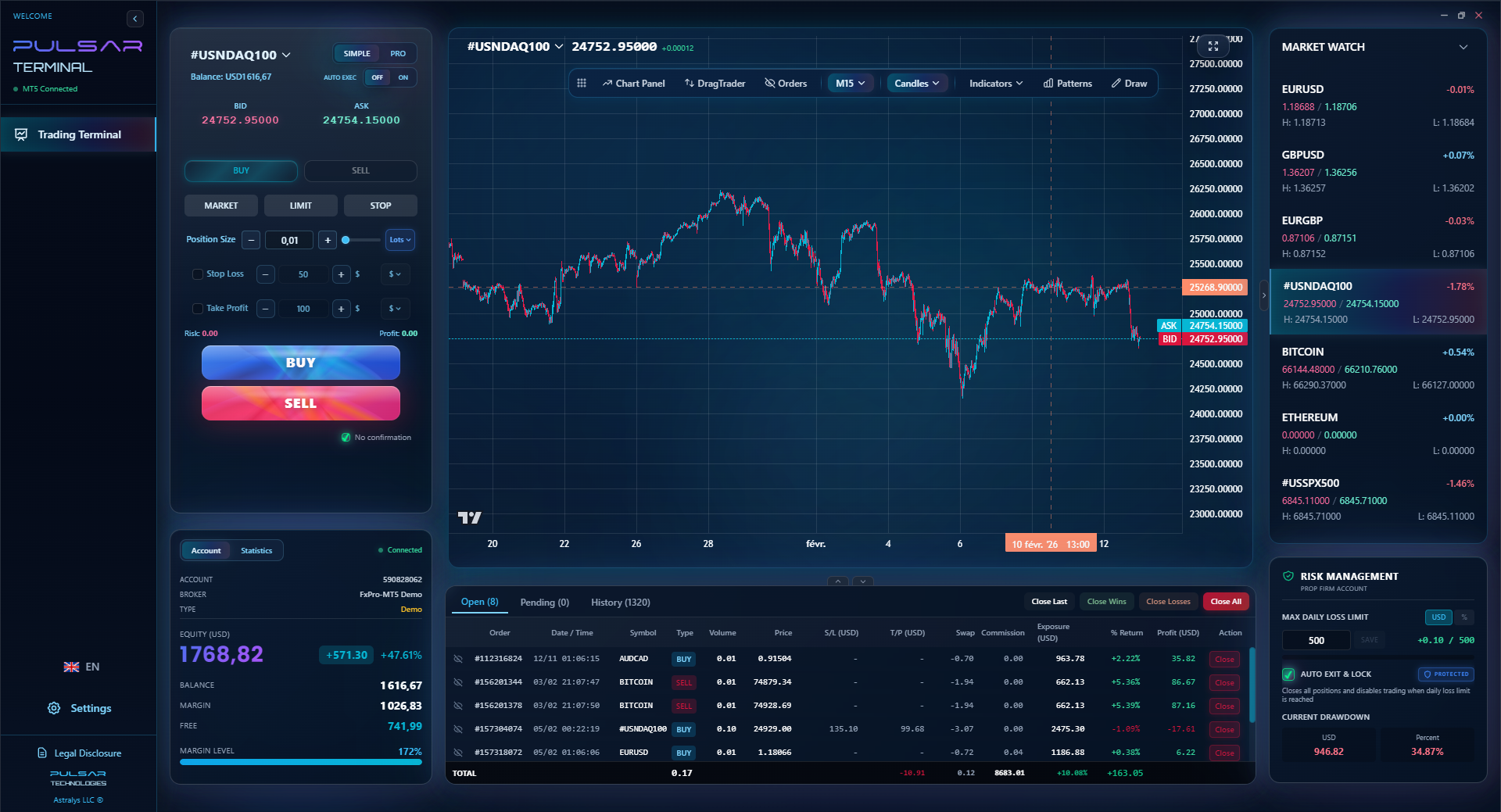
Managing a bonus often means tracking complex volume targets; Pulsar Terminal's trade journal and analytics can automatically track your lot progress against your bonus requirements, so you're never trading blind.
Pulsar Terminal
MT5一站式工具:拖拽下单、多重止盈/止损、追踪止损、网格交易、成交量分布图和自营交易保护。每日1000+交易者使用。
These are two completely different beasts with different purposes.
The No-Deposit Bonus ($30 - $140)
- What it is: Free credit to trade with. You can't withdraw the bonus itself.
- The Real Value: It's a risk-free broker test drive. Use it to:
- Test order execution speed during volatile news events.
- Experience their customer support with a real query.
- Practice a specific strategy on a live, but not-your-money, account.
- The Mindset: Any profit is a lucky bonus. The goal is information gathering, not funding your retirement. If you manage to meet the volume target and withdraw $100, great. But that’s not the primary objective.
The Deposit Bonus (20% - 100% Match)
- What it is: Extra funds added when you deposit your own money.
- The Strategic Use: As outlined above - as a drawdown buffer. It can be genuinely useful for a disciplined trader. For example, a 50% bonus on a R10,000 deposit gives you R15,000 buying power. If you only trade as if you have R10k, that extra R5k is pure psychological and financial padding.
- The Bigger Question: Often, you’ll find that brokers offering huge deposit bonuses have higher overall trading costs. Would you rather have a 100% bonus with a 2-pip spread, or a 20% bonus with a 0.1-pip spread? For active traders, the low-cost option almost always wins in the long run.
“Sometimes, the best bonus is no bonus at all. A clean, low-cost account lets you focus on trading, not fulfilling arbitrary quotas.”
If a bonus offer has these features, run.
- "Guaranteed Profit" or "No Risk": Illegal under FSCA rules. Instant scam marker.
- Unrealistically High Bonus (e.g., 200%+): The volume requirement will be impossible, or the broker is unregulated and plans to disappear with your deposit.
- Vague or Hidden Terms: If you can't find the clear volume target or withdrawal rules in 2 minutes of looking, they're hiding something.
- Pressure to Deposit Quickly: "Offer expires in 2 hours!" This is a sales tactic to bypass your rational judgment.
Instead of obsessing over the bonus percentage, prioritize these factors:
- FSCA Regulation: Non-negotiable. Verify the license.
- Total Trading Cost: Spread + Commission on the pairs you trade.
- Deposit/Withdrawal Methods: Easy, local options like Ozow, SID Instant EFT, and fast ZAR withdrawals.
- Platform & Tools: Do they offer MT4/MT5? Are there good charting tools? For serious analysis, having advanced tools like those in a Pulsar Terminal can be far more valuable than a temporary bonus.
- Real Minimum Deposit: Can you start with a sensible amount like R2,000, or are you forced to deposit R20,000 to get the 'good' conditions?
Sometimes, the best bonus is no bonus at all. A clean, low-cost account from a reputable broker lets you focus on trading, not fulfilling arbitrary quotas.
💡 Winston 小贴士
Always calculate your maximum position size based on your deposited capital, ignoring the bonus entirely. The bonus is for the broker's peace of mind, not yours.
FAQ
Q1Are forex trading bonuses legal in South Africa?
Yes, but they are strictly regulated by the FSCA. Brokers cannot offer "guaranteed profits" or misleading promotions. All terms and conditions, especially trading volume requirements for withdrawal, must be clearly disclosed. An offer that seems too good to be true probably is and may be from an unregulated entity.
Q2Can I actually withdraw money from a no-deposit bonus?
It's very difficult by design. You can usually only withdraw the profits you make from trading the bonus credit, and only after reaching a high trading volume target (e.g., trade 3 lots for a $30 bonus). The bonus credit itself is never withdrawable. View it as a free demo account with a tiny chance of a payout.
Q3What is the typical use for FSCA-regulated brokers?
The FSCA encourages responsible use. Most reputable, locally regulated brokers offer use between 1:30 and 1:100 for major forex pairs for retail clients. This is significantly lower than the 1:500 or 1:1000 offered by some offshore brokers, acting as a built-in risk control.
Q4Which FSCA broker has the best bonus?
"Best" is subjective. XM and FBS are known for large no-deposit offers ($30 and $140 respectively). However, "best" should mean "most usable with the fairest conditions." Often, a smaller bonus or a cashback promotion from a broker with lower spreads (like Exness or IC Markets) provides more real value than a large bonus with high trading costs.
Q5How do I calculate if a bonus is worth it?
- Calculate your normal monthly trading volume in lots. 2. Find the bonus's volume requirement (e.g., 20 lots per $100). 3. See how long it would take you to meet it naturally. If it forces you to 10x your trading, it's a bad deal. Then, compare the broker's spreads/commissions to a low-cost, non-bonus broker. The higher costs might outweigh the bonus value.
Q6What's more important, a bonus or low spreads?
Low spreads (and commissions) are almost always more important for active traders. A bonus is a one-time event. Trading costs are paid on every single trade you make. Over a year, saving 1 pip per trade on 100 trades is a guaranteed saving that likely exceeds the value of a temporary bonus with strings attached.
Winston 教授的课程
要点总结:
- ✓Size positions on your deposit, not your bonus-boosted balance.
- ✓A 100% bonus with a 2-pip spread is worse than a 20% bonus with a 0.2-pip spread.
- ✓Volume requirements force overtrading, the #1 account killer.
- ✓Use no-deposit bonuses to test execution, not to get rich.
这篇文章对您有用吗?
点击星星评分
每周交易洞察
免费每周分析与策略。无垃圾邮件。
关于作者
David van der Merwe
新兴市场交易员
约翰内斯堡交易者,11年新兴市场货币经验。专注于ZAR货币对、FSCA监管交易和南非市场分析。
评论
风险提示
金融工具交易存在重大风险,可能不适合所有投资者。过往业绩不代表未来表现。本内容仅供教育目的,不构成投资建议。在交易前请务必自行研究。
您可能还喜欢

Cara Trading Forex Sukses: 7 Prinsip dari Trader Profesional
Cara trading forex sukses dengan 7 prinsip trader pro: manajemen modal, disiplin, journal trading, backtest. Data nyata, bukan janji profit palsu.
Jam Trading Forex Terbaik untuk Trader Indonesia: Panduan Lengkap dengan Tabel Waktu
Panduan jam trading forex untuk trader Indonesia. Tabel 4 sesi dunia, jam emas 20:00-00:00, sesi mana yang harus dihindari. Data akurat + tips dari trader berpengalaman.
Top 5 Sàn Forex Uy Tín Nhất 2026: Review Jujur dari Trader Indonesia
Top 5 sàn forex uy tín 2026 untuk trader Indonesia. Review jujur: spread, deposit, withdraw, dukungan lokal. Exness, XM, IC Markets & lebih.
