


Here's a statistic that should make you sit up: between 2007 and 2013, a group of traders from the world's biggest banks colluded to fix the WM/Reuters 4pm London Fix, a benchmark that sets the value of trillions in assets, including your ZAR pairs.

David van der Merwe
新兴市场交易员 ·  South Africa
☕ 8 分钟阅读
您将学到:
- 1What Was the 'Forex Cartel'? The Naked Truth
- 2How This Directly Impacts You, The South African Trader
- 3The Market Structure Now: What's Changed (And What Hasn't)
- 4Practical Steps to Protect Your Capital in a Post-Cartel World
- 5Trading Psychology: Trusting the Market Again
- 6The Final Verdict for 2026 and Beyond
Here's a statistic that should make you sit up: between 2007 and 2013, a group of traders from the world's biggest banks colluded to fix the WM/Reuters 4pm London Fix, a benchmark that sets the value of trillions in assets, including your ZAR pairs. They called their chatrooms "The Cartel," "The Bandits' Club," and "The Mafia." This isn't a conspiracy theory. It's a settled fact that resulted in over $10 billion in fines. As a South African trader, you're not just trading charts. You're trading in a market with a proven history of institutional corruption. Understanding this isn't about fear. It's about building a strategy that accounts for the real, sometimes ugly, mechanics of price discovery.
Let's strip away the mystery. The forex cartel wasn't a shadowy cabal in a bunker. It was a bunch of senior FX traders at banks like Barclays, Citi, JPMorgan, and RBS. Their job was to execute massive client orders at the 4pm London Fix, a critical daily snapshot of currency rates.
The scam was simple, and that's what's so galling. In private chatrooms, they'd collude. One would say, "I have a big sell order for EUR/USD at the fix." The others would then adjust their own trading to push the rate down before the fix, making the sell order more profitable. They'd then split the spoils. They bragged about it, calling themselves "The Cartel." This manipulation directly impacted emerging market currencies, which means the USD/ZAR and EUR/ZAR rates you were watching were not always clean.

Warning: Don't think this is ancient history. The incentives that created the cartel still exist. While blatant chatroom collusion is (hopefully) dead, the structural advantage of major banks in the opaque, decentralized FX market is very much alive. When you're up against that, your position size calculator isn't just a tool. It's your first line of defense against volatility you can't see coming.
The fines were historic, but for the banks involved, it was often just a cost of doing business. For the individual trader in Sandton or Cape Town, it was a stark lesson: the playing field is not level. Your first-person experience with sudden, unexplained spikes in the USD/ZAR pair at 4pm? Now you know a potential reason why.
You might think, "That was London, that was majors. I trade USD/ZAR." That's a dangerous assumption. The ZAR is a liquid emerging market currency, but its value is often derived from its relationship to the USD and EUR. When the cartel manipulated the EUR/USD benchmark, it created ripple effects across all correlated pairs.
The ZAR and Benchmark Manipulation
Think about it. A big institutional client, like a South African mining company, needs to convert a billion Rand worth of dollar revenues at the fix. Their bank's trader is in a chatroom. The manipulation of the EUR/USD rate can alter the entire dollar index momentum, which the ZAR often inversely tracks. Your technical analysis on the USD/ZAR chart might have been perfect, but a manipulated benchmark could trigger your stop-loss before the "real" price movement even began.
Liquidity and Your Spreads
Post-scandal, regulations forced more transparency around the fix. But one unintended consequence for retail traders? Sometimes, worse liquidity at the exact fix time. Big banks became more cautious, pulling back from providing quotes. I've personally seen the spread definition on USD/ZAR widen from 5 pips to 25+ pips in the minute before 4pm London. If you had a market order anywhere near that time, you got slaughtered on the spread. I learned this the hard way in 2019, losing nearly 2% of a position not on the trade direction, but purely on execution slippage at the fix.
This environment makes a scalping strategy around these key benchmark times incredibly risky. It's a game you're not equipped to play. Your broker's XM review or Exness review might talk about tight spreads, but they can't control what happens in the interbank market at these critical junctures.

💡 Winston 小贴士
A market that can be rigged for years is a market that doesn't respect your clever analysis. Respect it back by making your stop-losses wider and your position sizes smaller.
“Your edge must come from discipline and risk management, not from trying to out-smart the market at the microsecond level.”
So, is the fix still rigged? The direct, illegal collusion is likely suppressed. But the market structure that allowed it is still flawed. The 4pm fix is now based on a longer, one-minute window of trading (from 3:59:30 to 4:00:30) to prevent last-second "banging the close." This helped, but it didn't create a saintly market.
The power is still concentrated. The top 5 banks still control a huge portion of FX trading volume. Their algorithms see order flow you don't. They have lower latency. This isn't illegal; it's just a massive advantage. For you, this means the ghost of the cartel lives on in the form of normal, legalized asymmetry. Your edge must come from discipline and risk management, not from trying to out-smart the market at the microsecond level.

Pro Tip: Treat major benchmark windows (like the 4pm London Fix, 10am NY Fix) like scheduled news events. If you're not specifically trading the fix, avoid having open market orders or tight stop-losses 5 minutes before and after. Switch to a longer time frame and let the institutional dust settle. This one habit saved my account more times than a perfect MACD indicator crossover ever did.
This isn't about giving up. It's about trading smarter with open eyes. Here’s your action plan.
- Know the Fix Times: Mark your calendar: 4pm London (5pm SAST in summer, 6pm SAST in winter). The 10am NY fix (4pm SAST) is also significant. Don't trade through them blindly.
- Use Limit Orders, Not Market Orders: Especially around key times. You control the price. A market order is a blank cheque to the liquidity providers.
- Widen Your Stops: If you must hold a position through a fix, give it room to breathe. A 20-pip stop on USD/ZAR might be fine most of the day, but it's a sitting duck at 3:55pm London. Consider the increased volatility.
- Focus on the Longer Game: The cartel's influence was on very short-term, pinpoint manipulation. Their actions often got swallowed by the broader trend within hours or days. This is why I shifted my personal focus to swing trading. It gets you away from the noisy, potentially manipulated micro-moves. A 200-pip swing trade doesn't care about a 5-pip fix manipulation.
- Choose Your Broker Wisely: A good broker acts as a buffer. Look for ones with strong liquidity partnerships that offer consistent execution. Check our deep dives on IC Markets review and Pepperstone review to see how they handle order execution during volatile periods. Do they offer slippage protection?
I made the mistake in my early years of trying to "trade the fix," thinking I could ride the wave of big orders. All I did was consistently get stopped out. The lesson? Don't try to play their game. Play your own.
💡 Winston 小贴士
The ghost of the cartel doesn't live in chatrooms anymore. It lives in the 2 seconds of slippage on your market order. Use limit orders.
“Don't try to play their game. Play your own.”
Learning about the cartel can breed cynicism. You start seeing every unexplained move as manipulation. That's a toxic mindset that will paralyze you.
The psychological fix is this: accept the imperfection. The market is not a pure, efficient machine. It's a messy human system with flaws, advantages, and yes, occasional cheating. Your trading plan must be strong enough to withstand that. If your entire strategy fails because of a 10-pip spike at 4pm, your strategy was too fragile to begin with.
Build a plan that assumes you have no edge in information or speed. Your edge comes from your process: your risk-reward ratios, your consistent position size calculator use, and your emotional discipline. When you see a weird spike, your reaction shouldn't be "The cartel is back!" It should be, "My stop-loss was hit. My risk for this trade was 1%. On to the next setup." This is the only way to maintain sanity and longevity in this business.

Example: Let's say you trade gold, which is also heavily traded around the fix. You read our XAU/USD guide and see a setup. Instead of a 5-dollar stop, you place it 8 dollars away to account for fix volatility. You size your position so that 8 dollars still equals your maximum 1% risk. You've just accounted for cartel-era volatility without even thinking about the cartel.
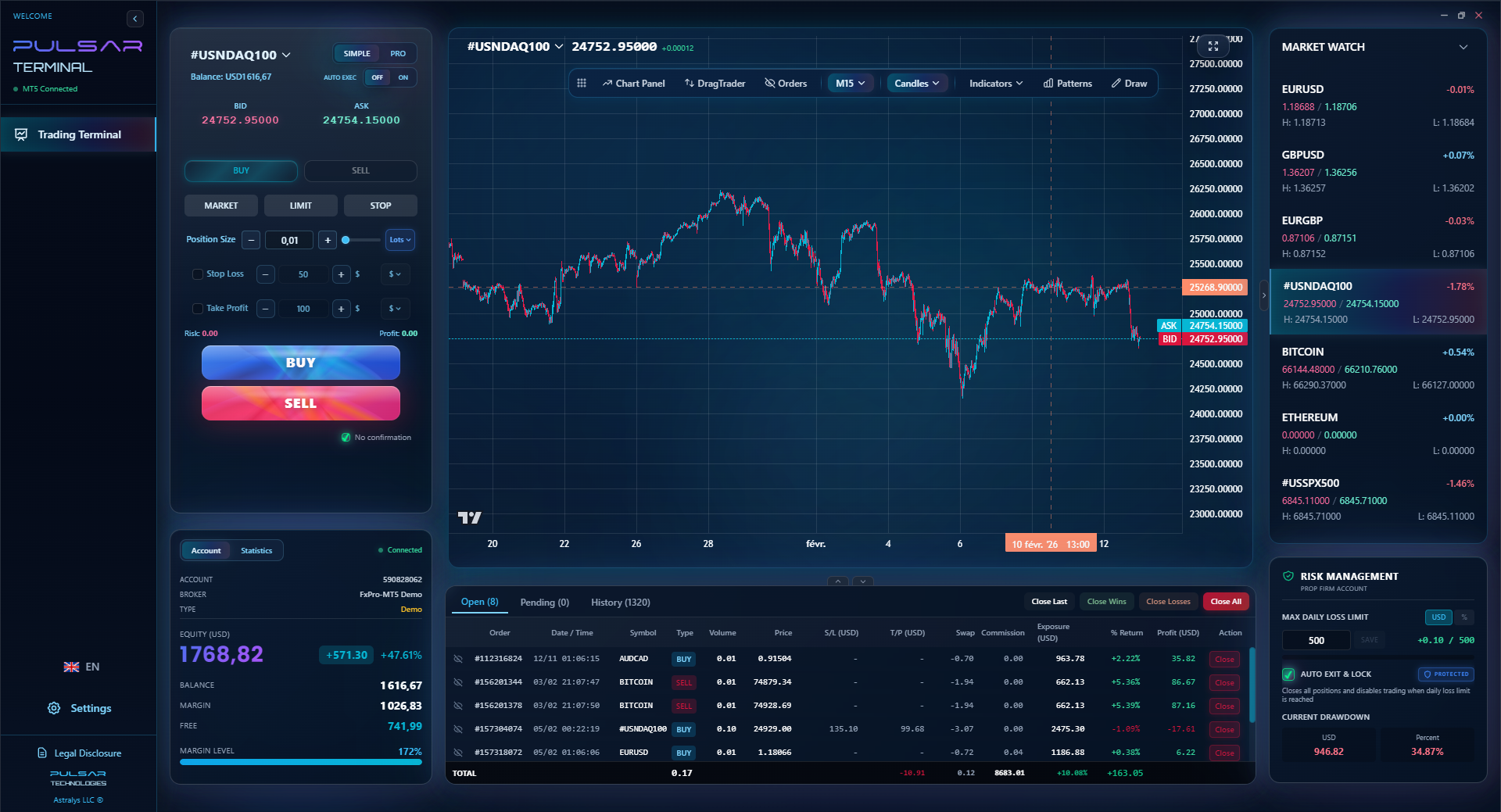
When you're managing trades in a market with a history of sharp spikes, having tools that automate your risk management—like setting multi-level take-profits and trailing stops—isn't a luxury, it's a necessity for survival.
Pulsar Terminal
MT5一站式工具:拖拽下单、多重止盈/止损、追踪止损、网格交易、成交量分布图和自营交易保护。每日1000+交易者使用。
The forex cartel era proved the market could be rigged. The post-cartel era proves it's still a tough, unfair fight. But it's a fight you can win by choosing your battles wisely.
Don't waste energy on anger or conspiracy hunting. Channel it into building an unshakable process. Use the tools available to retail traders today - better charting, transparent brokers, instant news - that the cartel traders of 2010 didn't have to contend with.
Your takeaway should be empowerment, not fear. You now know a dirty secret of the market's past. That knowledge makes you a more informed, and therefore a more dangerous, trader. You won't be caught off guard. You'll plan for the chaos, protect your capital with wider stops, and focus on the time frames where your edge is actually valid. That's how you outlast the ghosts of the cartel.
FAQ
Q1Is the Forex market still manipulated like the cartel did?
The specific, illegal chatroom collusion has been heavily prosecuted and is likely rare now. However, the structural manipulation - where big banks with superior information and speed exploit their advantage - is legal and very much part of the market. The playing field is still uneven, just in a more regulated way.
Q2What time is the London Fix in South African time?
It depends on daylight savings. When the UK is on British Summer Time (BST, roughly late March to late October), 4pm London is 5pm SAST. When the UK is on Greenwich Mean Time (GMT), 4pm London is 6pm SAST. Always double-check the current time difference.
Q3Should I avoid trading USD/ZAR around the fix?
If you're a day trader or scalper, absolutely. The volatility and potential spread widening can ruin your risk management. If you're a swing trader, it matters less, but you should still consider widening your stop-loss orders if your position will be open during that window.
Q4Did the cartel traders go to jail?
Very few faced criminal charges. Most of the consequences were billions in fines paid by the banks. Some traders were fired and banned from the industry. The lack of jail time for a multi-billion dollar, global fraud is a key point of anger about the whole scandal.
Q5As a retail trader, can I see evidence of manipulation?
Not directly. You'll see the symptoms: sudden, high-volume spikes with no clear news catalyst at key benchmark times, or abnormal spread widening. You can't see the chatrooms or order flow collusion, but you can see the price action it creates.
Q6What's the most important lesson from the cartel scandal?
Trust your risk management, not the market's fairness. Assume the worst can happen at any time - a sudden spike, a frozen platform, a widened spread. Your position sizing and stop-loss strategy are what protect you when the market shows its ugly side.
Winston 教授的课程
要点总结:
- ✓The 4pm London Fix is a volatility zone, not a trading signal.
- ✓Widen stops by 40-50% during benchmark windows.
- ✓Limit orders protect you from spread exploitation.
- ✓Swing trading avoids the manipulated micro-noise.
这篇文章对您有用吗?
点击星星评分
每周交易洞察
免费每周分析与策略。无垃圾邮件。
关于作者
David van der Merwe
新兴市场交易员
约翰内斯堡交易者,11年新兴市场货币经验。专注于ZAR货币对、FSCA监管交易和南非市场分析。
评论
风险提示
金融工具交易存在重大风险,可能不适合所有投资者。过往业绩不代表未来表现。本内容仅供教育目的,不构成投资建议。在交易前请务必自行研究。
您可能还喜欢

Cara Trading Forex Sukses: 7 Prinsip dari Trader Profesional
Cara trading forex sukses dengan 7 prinsip trader pro: manajemen modal, disiplin, journal trading, backtest. Data nyata, bukan janji profit palsu.
Jam Trading Forex Terbaik untuk Trader Indonesia: Panduan Lengkap dengan Tabel Waktu
Panduan jam trading forex untuk trader Indonesia. Tabel 4 sesi dunia, jam emas 20:00-00:00, sesi mana yang harus dihindari. Data akurat + tips dari trader berpengalaman.
Top 5 Sàn Forex Uy Tín Nhất 2026: Review Jujur dari Trader Indonesia
Top 5 sàn forex uy tín 2026 untuk trader Indonesia. Review jujur: spread, deposit, withdraw, dukungan lokal. Exness, XM, IC Markets & lebih.
