


I lost $1,200 in two days trading XAU/USD (gold) back in 2015.

Olumide Adeyemi
西非交易先驱 ·  Nigeria
☕ 9 分钟阅读
您将学到:
- 1What You're Actually Trading (It's Not a Barrel of Oil)
- 2Why 90% of Nigerian Traders Lose on Commodities
- 3Your Practical Setup: Broker, Platform, Capital
- 4Trading Gold (XAU/USD): The Safe-Haven Illusion
- 5Trading Crude Oil (XTI/USD): Riding the Volatility Beast
- 6Risk Management: The Only Thing That Keeps You Alive
- 7A Week in the Life of a Forex Commodity Trader
I lost $1,200 in two days trading XAU/USD (gold) back in 2015. I thought I'd cracked it. Oil news was bullish, the charts looked primed, and I went all in. I didn't account for the spread widening to 50 pips during the Asian session, or the fact my broker's 'instant execution' meant my stop-loss got ignored on a spike. Wiped out. That's the reality of forex commodity trading here. It's not just buying 'oil' or 'gold', it's navigating a minefield of spreads, use, and broker nonsense to find real opportunity.
Let's clear this up first. When you trade a 'forex commodity', you're not buying physical gold bars or taking delivery of crude oil in Port Harcourt. You're trading a financial derivative called a Contract for Difference (CFD). Your profit or loss is the difference between the price you open and close the contract at. In Nigeria, the most common ones are XAU/USD (gold vs US dollar) and XTI/USD (West Texas Intermediate crude oil). You might also see XBR/USD (Brent crude).
These instruments are priced in US dollars, so your Naira account gets converted. This adds a hidden layer of currency risk. If the Naira weakens against the dollar, your profit in Naira terms shrinks, even if the trade itself was good. I've seen trades that were marginally positive in USD turn into a loss after conversion on a bad Naira day.

Warning: Many Nigerian 'gurus' sell the dream of trading commodities like it's a simple buy-low-sell-high game. They never mention the contract specs. One standard lot of XAU/USD is 100 ounces of gold. At $2,300 per ounce, that's a notional value of $230,000. Your $500 account with 1:500 use is playing with fire it doesn't understand.
The failure rate is astronomical, and it's not just bad analysis. It's structural.
Broker Shenanigans and Spreads
Local and offshore brokers love offering commodities because the spreads can be massive. A typical EUR/USD spread might be 1 pip. For XAU/USD, a 30-50 pip spread during off-hours is common. For XTI/USD (oil), I've seen it blow out to 100 pips around inventory reports. If you're trying a scalping strategy on oil with a 10-pip target, you're already 100 pips in the hole before the market moves. You need to check reviews for brokers known for decent commodity spreads. Our Exness review and IC Markets review detail their specific commodity conditions.
Liquidity and Gaps
Oil and gold don't trade 24/5 like major forex pairs. There are specific market hours (London and New York sessions are key) where volume is high. Outside those times, liquidity is thin. A piece of news can cause a price gap - your stop-loss gets filled at a much worse price than you set. My $1,200 loss? That was a gap on a Sunday night open.
The News Trap
Nigerians are acutely aware of global oil prices. You think, 'OPEC is meeting, surely oil will go up!' So you buy. The market has already priced in the expected outcome. The actual news is a 'sell the fact' event, and you get crushed. Trading the rumor and selling the news is a cliché because it works, especially in commodities.

💡 Winston 小贴士
The spread isn't a fee, it's the first mile of your marathon. If you can't make it past that, you shouldn't be in the race. Always calculate your target relative to the spread.
“Trading the rumor and selling the news is a cliché because it works, especially in commodities.”
Forget fancy theories. Here's the boring, essential groundwork.
Broker Choice: This is your first make-or-break decision. You need a broker regulated by a top-tier authority (like ASIC or FCA) that offers decent execution on commodities. Many offshore brokers accept Nigerians but have terrible conditions. Look for:
- Fixed or low variable spreads on XAU/USD and XTI/USD.
- No requotes on stop-loss orders.
- A reliable platform like MT4/MT5. I personally use MT5 for commodities as it handles futures expiry rolls better.
Check our deep dives on Pepperstone review and XM review for their commodity offerings.
Starting Capital: With the volatility in commodities, starting with less than $500 is a recipe for a margin call. Here’s a brutal example from last year:
- I took a 0.01 lot position on XTI/USD at $72.50.
- My stop-loss was at $71.50 (a 100 pip/ $10 risk).
- Oil dropped sharply on inventory data to $71.00.
- The spread widened, and my stop was filled at $71.60.
- I lost $9 on the trade, plus the widened spread cost me an extra $4. On a $100 account, that's a 13% loss on one trade. Use a position size calculator religiously.

Pro Tip: Fund your account in USD if you can. It removes the Naira volatility variable from your trade calculations. If you must fund in Naira, mentally mark your account balance in USD and track your performance in dollars, not the ever-fluctuating Naira value.
Gold is not just a shiny metal. It's a sentiment gauge. In Nigeria, we see it as a store of value, but in the markets, it's a chaos indicator.
What Moves It:
- Real US Interest Rates: This is the big one. When US Treasury yields rise faster than inflation, gold (which pays no interest) becomes less attractive. I got caught in 2022 ignoring this.
- USD Strength: XAU/USD is priced in dollars. A strong dollar usually means weaker gold. You're trading a currency pair where one side is a metal.
- Geopolitical Fear: Wars, crises. The price spikes on headlines, but the sell-off can be vicious once the fear subsides. You have to be quick.
My Go-To Setup: I combine a simple trend filter with the RSI indicator. On the 4-hour chart, if price is above the 89-period EMA, I only look for buy setups. I wait for price to pull back to a support level (like a previous swing high) and for the RSI to dip near 40 (not oversold at 30). If it holds and starts curling up, that's my entry. I aim for a 2:1 risk/reward. My last winning trade: Bought at $1984, stop at $1976, took profit at $2000. 16 pip risk, 32 pip gain.
For a deeper breakdown, read our dedicated XAU/USD guide.
💡 Winston 小贴士
Your trading platform's order execution is more important than any indicator. A bad fill on your stop-loss will kill a good strategy. Test it with small trades first.
“Your strategy can be mediocre, but your risk management must be elite. Full stop.”
Trading oil is a part-time job. You must be glued to the calendar.
The Weekly Ritual: The American Petroleum Institute (API) report every Tuesday and the US Energy Information Administration (EIA) inventory report every Wednesday are market-moving events. The market doesn't just react to whether inventories went up or down, but by how much versus expectations. I learned this the hard way. Inventories rose by 1 million barrels, but the expectation was a rise of 3 million. That's technically a build, but the market saw it as bullish (less than expected) and rallied 200 pips. I was short and got destroyed.
A Simpler, Safer Approach: I stopped trying to trade the news directly. Now, I use the 1-hour chart and look for consolidation patterns after the news volatility has settled (usually 2-3 hours post-report). The market often establishes a new range. I'll trade breakouts from that range with a tight stop. It's less glamorous, but it keeps me from getting whipped around.
Correlation Check: Oil has a loose correlation with CAD pairs (like USD/CAD) because Canada is a major exporter. If oil is screaming higher and USD/CAD isn't moving down, something's off. That divergence can be a warning sign. This is where a platform with good multi-chart layout is key.
Your strategy can be mediocre, but your risk management must be elite. Full stop.
The 1% Rule is a Starting Point: Never risk more than 1% of your account per trade. On volatile commodities, I often tighten this to 0.5%. On a $1,000 account, that's a $5 risk per trade. That means your position size on gold or oil will be tiny, maybe 0.01 lots or less. It feels boring. Good. Boring survives.
Stop-Loss Placement: This is an art. Don't just place it arbitrarily. Place it beyond a recent swing high/low where the market structure would invalidate your trade idea. For example, if you're buying oil on a support bounce, put your stop below the most recent significant low. If that stop distance means you're risking 3% of your account, the trade is no good. Walk away.
The Trailing Stop Mindset: Once a trade moves in your favor by 1.5x your initial risk, consider moving your stop to breakeven. Then, you can trail it. Manually trailing a stop on a volatile oil trade is stressful. This is one area where tools can help manage psychology.

Example: You buy XAU/USD at $2,150, stop at $2,140 (risk $100 on a $10k account). Price moves to $2,165. You've made $150. Move your stop to $2,150 (breakeven). Now, the trade is risk-free. You can let it run or trail a stop behind each new swing low. This turns emotional hope into a mechanical process.
💡 Winston 小贴士
If you find yourself constantly moving your stop-loss further away, you've already lost. The market is telling you you're wrong. Listen.
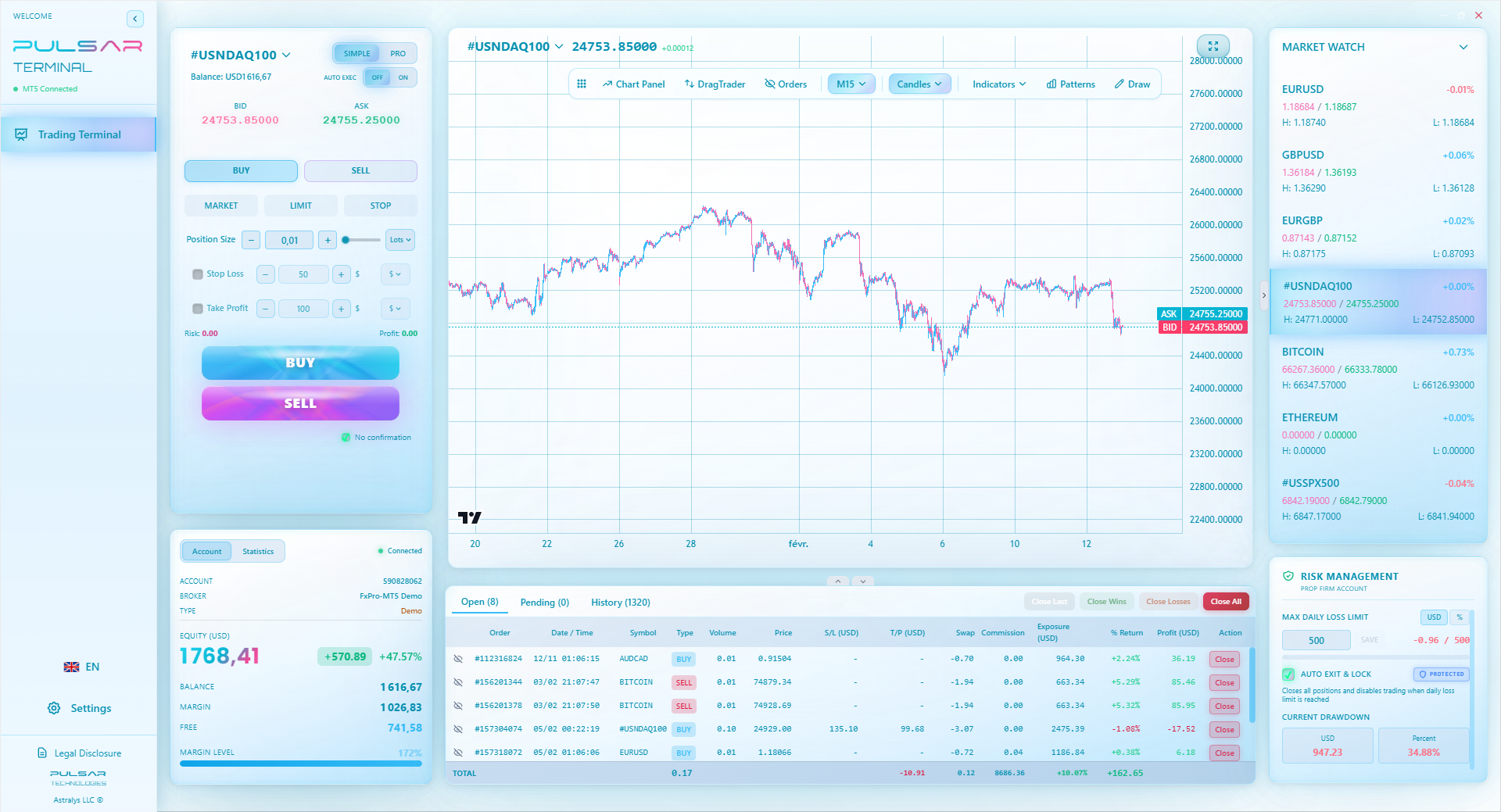
Managing multiple take-profit levels and trailing stops manually on volatile oil trades is nearly impossible, which is where automation tools like Pulsar Terminal for MT5 become essential for executing a disciplined plan.
Pulsar Terminal
MT5一站式工具:拖拽下单、多重止盈/止损、追踪止损、网格交易、成交量分布图和自营交易保护。每日1000+交易者使用。
“The real win is consistent, small gains that compound and protect your capital from Naira devaluation.”
Let's stitch this into a realistic routine for a Nigerian trader.
Sunday Evening: Check charts. Look for any gaps from the Friday close. No trading. Just assessment.
Monday-Wednesday (Active Days): Focus on gold during London/NY overlap. Be alert for oil on Tuesday/Wednesday around 3:30-4:30 PM Nigerian time for the EIA report. I don't trade the release. I watch. I might place a trade 90 minutes later if a clear pattern forms.
Thursday-Friday: More focus on gold and any end-of-week positioning. Fridays can be tricky as traders close positions before the weekend, causing unpredictable moves.
Your Journal is Key: Every trade gets logged. Entry, exit, spread cost, reason for entry, emotional state. I review mine every Sunday. My biggest lesson came from seeing that 70% of my losing commodity trades were taken outside London/NY hours. I just stopped trading then. My profitability jumped.
Final Reality Check: Forex commodity trading isn't a side hustle. It's a skilled profession that requires capital, education, and immense discipline. The YouTube ads showing Lamborghinis are lying. The real win is consistent, small gains that compound and protect your capital from Naira devaluation. That's the honest goal. For a longer-term approach, understand the principles of swing trading which often suits commodity volatility better than frantic day-trading.
FAQ
Q1What is the minimum amount I need to start forex commodity trading in Nigeria?
Technically, some brokers let you start with $10. Practically, you need at least $500 to have any chance of surviving volatility and managing proper position sizing. With less, a single spread widening or small adverse move will blow your account.
Q2Which is easier to trade for beginners, gold or oil?
Gold (XAU/USD) is generally 'easier' as it's slightly less chaotic than oil and has more predictable drivers (USD, yields). Oil (XTI/USD) is news-driven and prone to extreme spikes. Start by paper trading gold to understand the pace.
Q3How do I avoid scams from forex commodity 'gurus' in Nigeria?
If they promise guaranteed returns, show off luxury cars constantly, or ask for money for a 'special signal group', it's a scam. Real education focuses on risk management and psychology, not hot picks. Verify any broker they recommend through independent reviews like ours.
Q4Can I trade commodities with my local Nigerian bank?
No. Nigerian banks do not offer retail CFD trading on international commodities. You must use an international online broker. Be sure they accept Nigerian clients and offer reliable deposit/withdrawal methods like bank transfer or local payment processors.
Q5What's the biggest mistake Nigerian traders make with commodities?
Using excessive use. A broker offers 1:500, so they use it all on a gold trade. A 0.5% move against them wipes out their account. They confuse high use with high opportunity, when it's actually high risk.
Q6Do I need to follow global news to trade commodities?
Absolutely. For oil, you must watch OPEC meetings, US inventory data, and geopolitical events in producing regions. For gold, watch US Federal Reserve announcements, inflation data, and major geopolitical tensions. An economic calendar is your most important tool.
Q7Is forex commodity trading taxable in Nigeria?
The tax situation for individual retail forex traders in Nigeria is currently unclear and not consistently enforced. However, you should keep detailed records of all your trades and profits. Consult a Nigerian tax professional for the most current advice pertaining to your specific situation.
Winston 教授的课程
要点总结:
- ✓Commodity spreads can be 50-100 pips. Factor them in.
- ✓Trade gold & oil only during high-liquidity sessions.
- ✓Risk 0.5-1% max per trade on volatile commodities.
- ✓Fund in USD to remove Naira volatility from your P&L.
这篇文章对您有用吗?
点击星星评分
每周交易洞察
免费每周分析与策略。无垃圾邮件。
关于作者
Olumide Adeyemi
西非交易先驱
尼日利亚最活跃的外汇交易教育者之一。从拉各斯出发有8年交易经验。专注于低资金策略和面向非洲交易者的自营公司挑战。
评论
风险提示
金融工具交易存在重大风险,可能不适合所有投资者。过往业绩不代表未来表现。本内容仅供教育目的,不构成投资建议。在交易前请务必自行研究。
您可能还喜欢

Cara Trading Forex Sukses: 7 Prinsip dari Trader Profesional
Cara trading forex sukses dengan 7 prinsip trader pro: manajemen modal, disiplin, journal trading, backtest. Data nyata, bukan janji profit palsu.
Jam Trading Forex Terbaik untuk Trader Indonesia: Panduan Lengkap dengan Tabel Waktu
Panduan jam trading forex untuk trader Indonesia. Tabel 4 sesi dunia, jam emas 20:00-00:00, sesi mana yang harus dihindari. Data akurat + tips dari trader berpengalaman.
Top 5 Sàn Forex Uy Tín Nhất 2026: Review Jujur dari Trader Indonesia
Top 5 sàn forex uy tín 2026 untuk trader Indonesia. Review jujur: spread, deposit, withdraw, dukungan lokal. Exness, XM, IC Markets & lebih.
