


I lost NGN 450,000 in a single afternoon.

Olumide Adeyemi
西非交易先驱 ·  Nigeria
☕ 9 分钟阅读
您将学到:
- 1The Myth of the Holy Grail (And Why You're Chasing It)
- 2The Only Concept That Matters: Asymmetric Risk
- 3How Nigerian Traders Get This Wrong (The Naira Trap)
- 4Building Your Risk Framework: The 2% Rule is Just the Start
- 5The Psychology of Execution: Your Mind is Your Worst Enemy
- 6Applying the Concept: Gold and EUR/USD Are Not the Same
- 7Your Action Plan: What to Do in the Next 24 Hours
- 8Final Word: Survival Isn't Sexy, But It's Everything
I lost NGN 450,000 in a single afternoon. It was 2015, and I was convinced I'd cracked the code. EUR/USD was trending up, I had a 'perfect' entry, and I loaded up. I didn't have a stop loss. Why would I? The market was going my way. Then a news headline hit, and the chart reversed so fast my head spun. My account went from green to a margin call in minutes. That's the moment I learned the only forex concept that truly matters isn't about finding entries. It's about surviving them.
Let's be brutally honest. You're probably here looking for the secret. The one indicator, the magic pattern, the guru's strategy that prints money. I get it. I spent years and a small fortune searching for it myself. The Nigerian forex scene is flooded with this promise: buy my signals, follow my method, and you'll quit your 9-to-5. It's a powerful fantasy.
The painful truth? The 'holy grail' doesn't exist. Not in Lagos, not in London, not anywhere. The market is a chaotic, probabilistic environment. No strategy wins 100% of the time. The real forex concept you need to internalize is that trading is a game of managing probabilities and losses, not predicting the future with certainty.
I once backtested a complex strategy involving three moving averages and the RSI indicator. On historical data, it showed an 80% win rate. I was ecstatic. I funded a live account with NGN 200,000. In the first two weeks, I had 8 losing trades in a row. The strategy failed because it couldn't adapt to a simple shift in market volatility. I was looking for a crystal ball when I should have been building a shock absorber for my account.
Forget everything else for a moment. If you only learn one forex concept, make it this: Asymmetric Risk. This is the core of professional trading. It means your potential reward on any trade should be significantly larger than your potential risk.
Most new traders do the exact opposite. They see a trade moving in their favor by 50 pips and get scared, taking a quick profit. Then they see a trade moving against them by 50 pips and get hopeful, letting it run into a -200 pip disaster. This destroys accounts.
The Math of Ruin
Let's use real numbers. Say you start with NGN 500,000. If you lose 50% (NGN 250,000), you now need to make a 100% return just to get back to break-even. That's an uphill battle you'll likely lose. Your job is to avoid those large, asymmetric losses while seeking asymmetric gains.

Example:
- Bad Risk/Reward: You risk NGN 10,000 to make NGN 5,000 (1:0.5). You need to be right 67% of the time just to break even.
- Good Risk/Reward: You risk NGN 5,000 to make NGN 15,000 (1:3). You can be wrong 70% of the time and still be profitable.
This is why your position size calculator is more important than your entry signal. A great entry with terrible position sizing will still blow up your account. A mediocre entry with strict 1:3 risk/reward and proper position sizing can be part of a winning long-term plan.

💡 Winston 小贴士
If you can't state your exact Naira risk and reward before clicking 'buy,' you're not trading. You're gambling. Close the platform.
“The market's job is to trigger every emotional flaw you have: greed, fear, hope, and ego.”
We face unique psychological traps here. The volatility of the Naira against majors like the USD creates a sense of urgency and FOMO (Fear Of Missing Out). You see USD/NGN spiking and you jump in, afraid the train is leaving the station. This leads to emotional trading with no plan.
Another common mistake is converting potential profits back to Naira in your head. 'If this trade hits target, that's 3 months' salary!' This thinking corrupts your process. You're no longer trading the chart; you're trading your bills. You'll hold losers too long hoping they turn around to pay the rent, and cut winners too short to 'secure' that tangible Naira amount.
Local broker promotions can exacerbate this. They might offer crazy use like 1:1000. On a NGN 100,000 account, that feels like you're trading with NGN 100,000,000! It's an illusion. That use is a double-edged sword that will cut you far faster than it cuts the market. A 0.1% move against you with that use wipes out your entire deposit. I learned this the hard way with an Exness review cent account, thinking the small units protected me. The psychology of trading 'thousands' of units made me reckless.
You've heard 'never risk more than 2% per trade.' It's a good starting point, but it's incomplete. A real framework is more dynamic.
- Maximum Daily Loss: This is your circuit breaker. Mine is 5% of my account. If I hit that, I shut down the platform for the day. No excuses, no 'one more trade to recover.' This single rule saved me from turning a bad morning into a catastrophic week more times than I can count.
- Maximum Weekly Loss: Set at 10-15%. It forces you to stop, review, and reset after a string of losses.
- Position Sizing Based on Stop Loss: Your position size shouldn't be a fixed lot size. It should be calculated based on the distance to your stop loss. A tight stop on a scalping strategy might allow for a slightly larger size. A wide stop on a swing trading setup demands a much smaller size. This keeps your Naira risk constant.

Warning: Don't just set a stop loss and forget it. A common trick is to move your stop loss further away when the trade goes against you, 'giving it more room to breathe.' You're not giving it room, you're doubling down on a bad decision. This is how a 2% risk trade morphs into a 20% account killer.
“You're not giving a trade 'room to breathe,' you're doubling down on a bad decision.”
You can have the best framework on paper. But if you can't execute it, it's worthless. The market's job is to trigger every emotional flaw you have: greed, fear, hope, and ego.
Here's a personal confession. I had a rule: never trade during the London open news spike. One day in 2020, I saw GBP/USD screaming upwards. My rule said wait. My greed said 'get in now!' I entered without a stop, rationalizing I'd place it once the spike settled. A minute later, the spike reversed. I froze. Instead of taking the small, immediate loss, I watched it go -10 pips, -20 pips, -50 pips. I finally exited with a loss of NGN 75,000. I broke every rule in my framework because of a 60-second emotional hijacking.
Automation is your friend here. Use pending orders with attached stop loss and take profit. Set them and walk away. The less you have to click 'buy' or 'sell' in the heat of the moment, the better. This is where tools that enforce discipline become useful, turning your plan into action without requiring emotional fortitude in the moment.
💡 Winston 小贴士
Your best trade of the year will be the one you didn't take because the risk was unclear. Patience is a position.
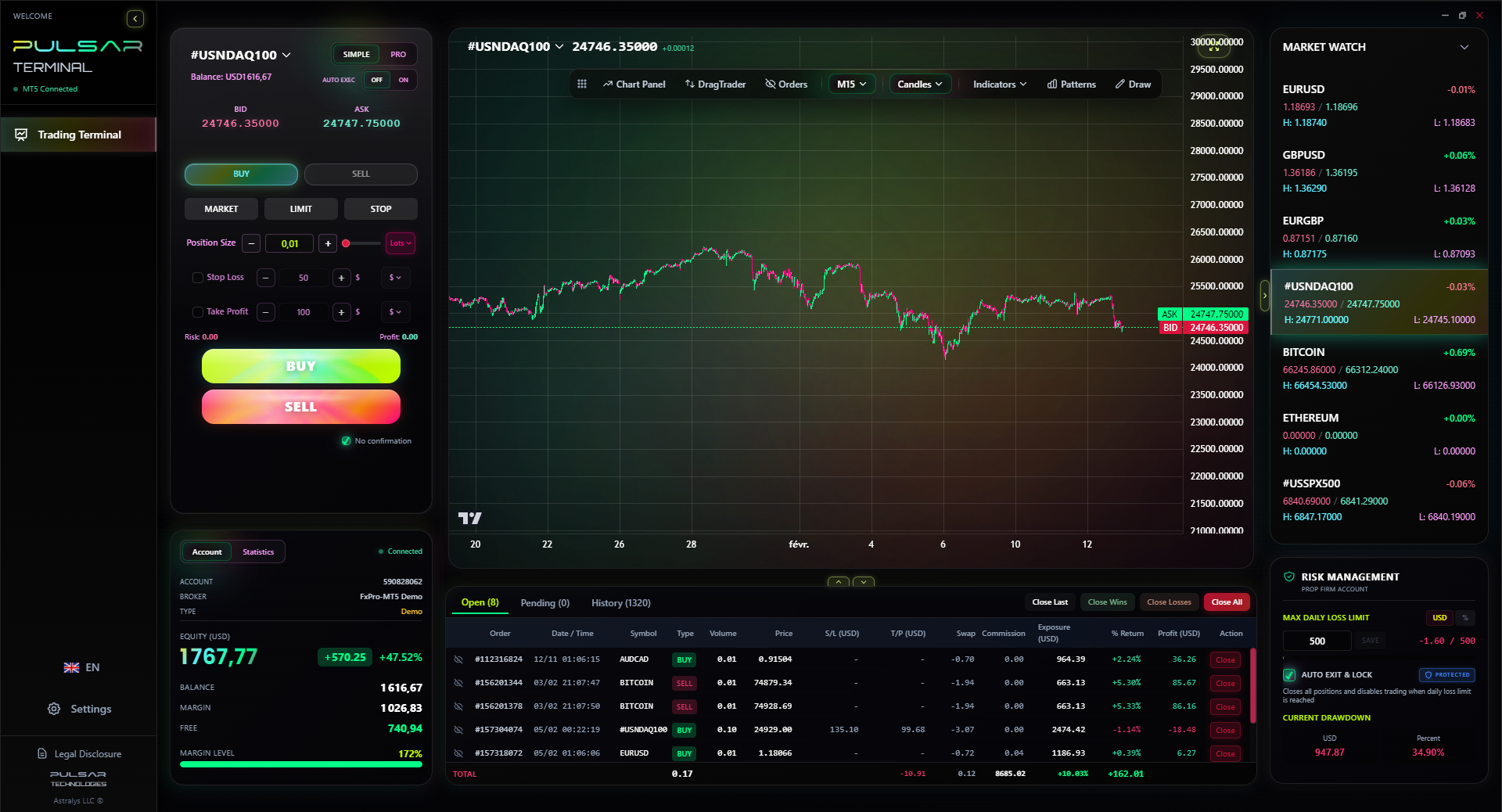
Maintaining discipline during volatile sessions is nearly impossible manually, which is why automating your risk rules with a tool like Pulsar Terminal is non-negotiable for serious traders.
Pulsar Terminal
MT5一站式工具:拖拽下单、多重止盈/止损、追踪止损、网格交易、成交量分布图和自营交易保护。每日1000+交易者使用。
A critical mistake is treating all instruments the same. Your risk parameters must adjust to the instrument's personality.
Take Gold (XAU/USD). It's volatile. A typical daily range can be $50. A 1% move is common. If you place a tight 5-pip stop loss on gold, you'll get stopped out by noise 99 times out of 100. Trading gold requires wider stops, which means smaller position sizes to keep your risk constant. Check our specific guide on managing this in our XAU/USD guide.
Now, EUR/USD. It's generally less volatile, more liquid, and often range-bound. A 50-pip day is significant. You can use tighter stops relative to gold. But you must understand its session behavior (quiet Asia, active London/NY overlap).
| Instrument | Personality | Risk Implication |
|---|---|---|
| XAU/USD (Gold) | High Volatility, News Sensitive | Requires wider stops, smaller position size. |
| EUR/USD | High Liquidity, Lower Volatility | Tighter stops possible, mind the spread during news. |
| USD/NGN | Extreme Local Volatility, Illiquid | Very wide spreads, high risk of slippage. Avoid unless deeply experienced. |
The forex concept of asymmetric risk applies to all, but the tactical application changes. Don't use your gold lot size on the Euro.
“Survival isn't sexy, but it's everything. Your goal is to still be in the game next year.”
Theory is useless without action. Here's your homework.
- Audit Your Last 20 Trades. Use your broker's statement. Calculate your average winner and average loser in pips. Then calculate the Naira amount. I bet your average loser is bigger than your average winner. This is the proof you need to change.
- Write Your Rules. Get a notebook. Write down your MAXIMUM risk per trade (e.g., 1.5% of equity). Write your MAXIMUM daily loss (e.g., 5%). Write that you will ALWAYS use a stop loss. Sign it.
- Practice with a Tool. Before your next live trade, use a demo account or a position size calculator to plan it. Decide your entry, stop loss, and take profit before you click. Calculate the exact lot size that keeps your risk at 1.5%. This is the boring work that makes money.
- Choose Your Broker Wisely. You need a broker with reliable execution so your stops are honored. You don't need the highest use. Look for one with a strong track record in our IC Markets review or Pepperstone review. Slippage on your stop loss can turn a 2% risk into a 10% loss instantly.

Pro Tip: For one week, do not allow yourself to take any profit until your take profit target is hit. Your only job is to manage the stop loss. This trains you to let winners run. You'll be shocked at how many trades would have hit your original target if you'd just left them alone.
Talking about stop losses and risk percentages isn't as exciting as showing off a 500-pip winner screenshot on WhatsApp. But the traders posting those are usually the ones who blow up next quarter. The quiet traders who grind out consistent 2-5% monthly returns by rigidly managing risk are the ones still here a decade later.
The forex concept of capital preservation is the foundation. Everything else - your MACD indicator cross, your support and resistance levels, your fundamental analysis - is just decoration on that foundation. A beautiful house on a cracked foundation will collapse.
Start treating your trading capital like a finite resource. Because it is. Every Naira you lose is a soldier that can't fight another day. Your primary goal is not to be a hero on any single trade. Your goal is to still be in the game next year, and the year after that. That's the only concept that, once mastered, makes all the others worth learning.
FAQ
Q1Is 1:1 risk-to-reward ratio okay if my strategy has a high win rate?
It's mathematically dangerous. Even with a 60% win rate, a 1:1 ratio gives you a small edge that can be wiped out by trading costs (spreads, commissions). You're working incredibly hard for minimal gain. A single string of losses can devastate your account. Always aim for at least 1:1.5, with 1:3 being a much more strong target for long-term survival.
Q2I use a prop firm challenge account. Does this risk concept still apply?
It applies even MORE critically. Prop firms have strict daily and overall loss limits. A single oversized trade can blow your challenge instantly. You must be even more disciplined with your position sizing. The pressure to 'pass' often leads traders to break their rules, which is exactly why most fail. Tools that automate your margin call protection are essential in this high-pressure environment.
Q3How do I calculate my position size if my broker uses lots?
You don't think in lots. You think in risk (e.g., NGN 5,000). You determine your stop loss distance in pips (e.g., 30 pips). You then use a position size calculator (many free ones online) to tell you how many micro, mini, or standard lots equal NGN 5,000 risk for that specific instrument and stop distance. The lot size is the RESULT of your calculation, not the starting point.
Q4What if my stop loss gets hit too often by market noise?
This means your stop loss is placed in a poor location, likely too close to your entry in a volatile market. Your stop should be placed at a logical level where your trade idea is proven wrong (e.g., beyond a key swing high/low). If that logical level is far away, you must reduce your position size accordingly to keep your Naira risk constant. Don't move the stop closer to fit a desired lot size.
Q5Can I ever average down on a losing trade?
Almost never. 'Averaging down' is just a fancy term for throwing good money after bad. It increases your risk exposure on a trade that is already moving against you. The only time professionals might add to a position is when it's moving in their favor (pyramiding), and even that is an advanced technique. For 99% of traders, one entry, one stop loss, one take profit is the model to follow.
Q6How long does it take for this mindset to become automatic?
It's a constant battle. You'll have periods of discipline followed by lapses. Keeping a detailed trade journal where you note not just your P&L, but your emotional state and rule adherence, is key. After 100 trades executed with strict pre-defined risk, it starts to feel unnatural to trade any other way. The first 30 are the hardest.
Winston 教授的课程
要点总结:
- ✓Risk 1-2% max per trade, no exceptions.
- ✓Aim for minimum 1:3 risk-to-reward ratio.
- ✓Set a 5% daily loss limit and STOP.
- ✓Position size is determined by stop distance.
- ✓The instrument's volatility dictates your stop width.
这篇文章对您有用吗?
点击星星评分
每周交易洞察
免费每周分析与策略。无垃圾邮件。
关于作者
Olumide Adeyemi
西非交易先驱
尼日利亚最活跃的外汇交易教育者之一。从拉各斯出发有8年交易经验。专注于低资金策略和面向非洲交易者的自营公司挑战。
评论
风险提示
金融工具交易存在重大风险,可能不适合所有投资者。过往业绩不代表未来表现。本内容仅供教育目的,不构成投资建议。在交易前请务必自行研究。
您可能还喜欢

Cara Trading Forex Sukses: 7 Prinsip dari Trader Profesional
Cara trading forex sukses dengan 7 prinsip trader pro: manajemen modal, disiplin, journal trading, backtest. Data nyata, bukan janji profit palsu.
Jam Trading Forex Terbaik untuk Trader Indonesia: Panduan Lengkap dengan Tabel Waktu
Panduan jam trading forex untuk trader Indonesia. Tabel 4 sesi dunia, jam emas 20:00-00:00, sesi mana yang harus dihindari. Data akurat + tips dari trader berpengalaman.
Top 5 Sàn Forex Uy Tín Nhất 2026: Review Jujur dari Trader Indonesia
Top 5 sàn forex uy tín 2026 untuk trader Indonesia. Review jujur: spread, deposit, withdraw, dukungan lokal. Exness, XM, IC Markets & lebih.
