


Let's be honest.

Olumide Adeyemi
西非交易先驱 ·  Nigeria
☕ 9 分钟阅读
您将学到:
- 1Why Most Course Outlines Fail You
- 2The 5 Essential Modules: A Non-Negotiable Framework
- 3What to Ruthlessly Cut From Your Study Plan
- 4Your 90-Day Practical Exercise Roadmap
- 5Choosing a Broker & Supplementing Your Course
- 6My Biggest Mistake & The Lesson That Stuck
- 7How to Build Your Personal Trading Plan Document
Let's be honest. Most forex course outlines are a waste of your time and money. They're packed with fluff, outdated theory, and zero practical application. I've seen traders spend over ₦500,000 on courses that left them more confused. The truth is, a proper forex course outline isn't about memorizing a hundred indicators. It's a structured path from zero knowledge to consistent execution. Here's the blueprint I wish I had when I started.
When I first started, I bought a popular online course. The outline looked impressive: 12 modules, 100+ videos. It promised the world. Two months and ₦150,000 later, I couldn't place a single confident trade. The problem? The outline was designed to look complete, not to build a trader.
It was theory-heavy, filled with complex economic models that have little bearing on your 4-hour chart. It spent weeks on history and broker structures but only a day on actual trade management. The biggest sin? It never mentioned psychology or risk management until the very end, as an afterthought.
A good forex course outline is a practical training manual. It should be sequential, where each module builds a skill you use in the next. If the outline spends more time on 'The History of Bretton Woods' than on 'How to Set a Stop-Loss,' run. Your goal isn't to pass a university exam. It's to protect your capital and make decisions under pressure.

Warning: Be extremely wary of courses where the outline is secret until you pay. A legitimate educator is proud of their structure and will show it to you upfront. If they're hiding it, they're probably selling hype, not education.

💡 Winston 小贴士
Print out your trading plan and tape it to your monitor. If you can't see a rule, you won't remember it when fear or greed takes over.
“A good forex course outline is a practical training manual, not a theoretical textbook.”
After blowing up my first account and reviewing a dozen failed courses, I distilled everything down to five core modules. This is the skeleton of any worthwhile forex course outline.
Module 1: The Absolute Foundations (No Jargon Allowed)
This isn't about impressing you with terms. It's about survival. You must understand: what a currency pair actually is (you're buying one economy, selling another), how to read a basic candlestick, what a bid/ask price means, and the brutal reality of spreads and commissions. Most importantly, you need to know what a pip definition is and how to calculate its value in Naira. If you don't get this, you can't calculate your risk. Full stop.
Module 2: The Engine Room – Your Trading Platform
You can know all the theory in the world, but if you can't use MetaTrader 4 or 5, you're stuck. This module is 100% practical. How to place a market order, a pending order, set a stop-loss and take-profit. How to modify and close trades. This is where you learn the mechanics. I practiced on a demo account for two weeks just doing this, making every mistake possible with virtual money.
Module 3: Risk Management – Your Only Job
This is the most important module, and it should be revisited constantly. We're not talking vague ideas. We're talking hard rules. The 1% risk rule (never risk more than 1% of your account on a single trade). How to use a position size calculator religiously. Understanding use as a double-edged sword and how it can lead to a margin call. This module saved my career after I lost 30% of my account in one week being 'clever.'
Module 4: Market Analysis – Putting the Pieces Together
This is where most courses go off the rails, teaching 50 indicators. You need three types of analysis. First, price action: support/resistance, basic candlestick patterns. Second, one or two key indicators for confirmation - like the RSI indicator for overbought/oversold conditions or the MACD indicator for momentum. Third, a basic understanding of how major news (like US Non-Farm Payrolls) causes volatility. Pick one style, like swing trading, and go deep on it.
Module 5: Trading Psychology & Building a Plan
This is where a trader is made. You'll learn about the emotional cycle of a trade (euphoria, anxiety, hope, despair). You'll build a written trading plan that dictates every action: your daily routine, your trade checklist, your rules for when to stop trading. This module forces you to be honest with yourself. My plan has a rule: after two consecutive losses, I walk away for the day. It's simple, but it's saved me from revenge trading.
“Your first 6 months should be about consistency, not profits.”
Time is your most valuable asset. Don't waste it. Here's what a lean, effective forex course outline avoids.
- Over-Complicated Indicators: You don't need the 'Super Trend Fibonacci Harmonic Wave Indicator.' If it has more than three words in its name, ignore it. Master a simple tool like the RSI first.
- Predictive 'Sure-Fire' Systems: Any course that sells a '100% win rate' system is a scam. Period. Trading is about probability and risk management, not certainty.
- Excessive Focus on Exotic Pairs: Start with the majors. The EUR/USD guide and XAU/USD guide (Gold) are perfect. Their liquidity means tighter spread definition costs, which is crucial when you're trading with smaller capital in Naira.
- Day Trading as a Starting Point: Scalping strategy requires immense skill, speed, and low-latency connections. For most Nigerians starting out, the costs (spreads) and stress will eat you alive. Swing trading is a more forgiving school.

Pro Tip: Your first 6 months should be about consistency, not profits. Your goal is to execute your plan flawlessly on a demo account, then a small live account. If you can't be consistent while losing virtual money, you'll panic with real cash.
“Your first 6 months should be about consistency, not profits.”
Theory without practice is useless. Here’s a timeline to attach to your forex course outline.
Weeks 1-2: Platform Familiarity Open a demo account with a broker like Exness review or IC Markets review (they have good demo systems). Don't even think about analysis. Just place 50 buy and sell orders. Set and move stops and limits. Get comfortable with the clicks.
Weeks 3-8: The 'Journaling' Phase Pick one pair, like EUR/USD. Your job is not to make money. Your job is to find 3 potential trades per week using your chosen method (e.g., support/resistance + RSI). Write down in a journal:
- The setup (e.g., 'Price bounced off weekly support, RSI was at 30').
- Your planned entry, stop-loss, take-profit.
- The risk in % and Naira.
- Then, watch what happens. Did it work? Why or why not? This builds pattern recognition without financial risk.
Weeks 9-12: Live Simulation Fund a live micro account with an amount you can afford to lose - maybe ₦20,000. Your only goal is to place 10 trades following your complete plan, using proper position size calculator for each. The profit/loss is irrelevant. The pass/fail is whether you followed every step of your plan. This bridges the psychological gap between demo and real trading.
💡 Winston 小贴士
Spend your first ₦50,000 on education and a demo account, not live trading. It's the highest-return investment you'll make in this business.
“Risk management isn't a module in a course; it's the entire foundation of your career.”
Your education doesn't happen in a vacuum. The broker you choose and the resources you use daily are part of your learning environment.
Broker Selection is Critical: For Nigerian traders, you need a broker that accepts local deposits (like bank transfers or debit cards), has a solid reputation, and offers tight spreads. I've used several over the years. Brokers like XM review and Pepperstone review have been reliable for many. Always start with a demo account to test their platform execution and spreads during your local trading hours.
Your Course is the Foundation, Not the Ceiling: No single course has it all. Use your core forex course outline as a base, then supplement with focused resources. Watch real trading sessions on YouTube (look for live analysis, not just winners). Read market recaps from financial sites. Join a serious trading community where traders discuss setups and mistakes, not just their profits.
The market changes. Your education should never stop. The course gets you to the starting line. The daily work of analysis and review keeps you in the race.
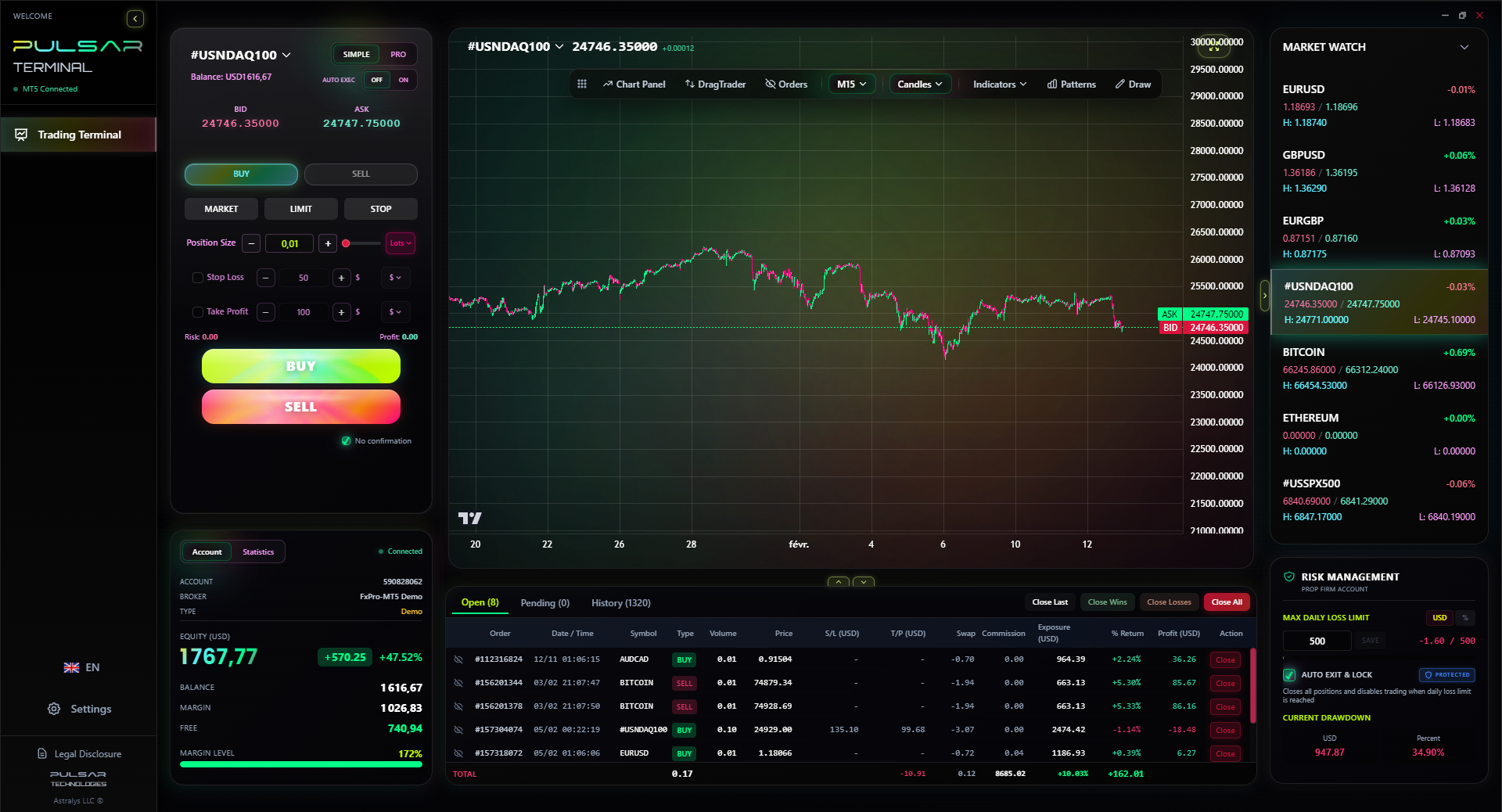
Sticking to your trading plan's rules, like precise stop-loss management, is easier when you have tools that automate execution directly on your MT5 charts.
Pulsar Terminal
MT5一站式工具:拖拽下单、多重止盈/止损、追踪止损、网格交易、成交量分布图和自营交易保护。每日1000+交易者使用。
“Risk management isn't a module in a course; it's the entire foundation of your career.”
I want to share a specific, painful loss because it taught me more than any course module. Early on, I had a 'perfect' setup on GBP/USD. I risked 3% of my account (triple my rule), convinced it was a sure thing. The trade went my way initially, up 1.5%. Greed kicked in. I moved my stop-loss to breakeven too early, then cancelled it entirely to 'let the trade run.'
A surprise news headline hit. The pair reversed violently. I froze, watching the loss grow from a small negative to -2%, -4%, -7%. I finally panicked and closed at a 9% account loss. One trade. Nearly a tenth of my capital gone.
That experience is now baked into my personal forex course outline for psychology. It violated every rule: over-leveraged, no disciplined stop-loss, emotional attachment. The lesson wasn't about analysis; it was about self-discipline. Now, I never move a stop-loss to breakeven unless I have a clear technical reason (like a new support level forming), and I use tools to help automate this discipline where possible.
“One trade nearly wiped out a tenth of my capital. That pain taught me more than any winning streak.”
This is your final exam. Your trading plan is the tangible output of your education. It's a living document. Here's what to include:
1. The Daily Routine:
- What time do you analyze the markets? (I do it after London open, 8 AM WAT).
- What charts (timeframes) do you review?
- What news sources do you check?
2. The Trade Checklist (Pre-Entry): A simple yes/no list. For me:
- Is this a tested setup from my strategy? (Y/N)
- Is key news due in the next 24 hours? (If Y, avoid or use tiny size)
- Have I calculated the position size using my calculator? (Y/N)
- Is the risk 1% or less of my account? (Y/N)
- Am I emotionally calm? (Y/N) If all are 'Yes,' I can place the trade.
3. The Money Management Rules:
- Maximum risk per trade: ___% (e.g., 1%).
- Maximum risk per day: ___% (e.g., 3%).
- Maximum risk per week: ___% (e.g., 6%).
- Profit goal per month: ___% (Realistic! 5-10% is excellent).
4. The Post-Trade Review: Every Friday, review all trades. Not just P&L. Ask: Did I follow my plan? Where did my edge work? Where did it fail? This review is how you refine your personal 'course outline' forever.
Sticking to this written plan is the hardest part of trading. It's also the only part that leads to long-term survival.
💡 Winston 小贴士
Your trading journal is your best teacher. A trade you don't review is a mistake you're guaranteed to repeat.
FAQ
Q1How long does it take to complete a good forex trading course?
A solid foundational course should take 4-8 weeks of part-time study. But remember, the course is just the start. Plan for at least 6 months of dedicated demo and small-live practice before you have the muscle memory and emotional control to trade seriously. This is a skill, not information download.
Q2Can I learn forex trading for free in Nigeria?
Yes, to a point. There's a wealth of free information online - broker education centers, YouTube, blogs. The challenge is curation and structure. A free path lacks a coherent forex course outline, so you can end up with knowledge gaps and conflicting advice. Using a free broker demo and building your own structured study plan from quality free resources is possible but requires more discipline.
Q3What is the single most important topic in a forex course?
Risk and money management. It's not even close. You can have a mediocre trading strategy with impeccable risk management and survive. The best strategy in the world with poor risk management will blow up your account. Any course that treats this as a minor topic is dangerously flawed.
Q4How much should I pay for a forex course in Nigeria?
Prices range from ₦20,000 to over ₦500,000. A high price doesn't guarantee quality. A reasonable range for a complete, well-structured video course from a reputable educator is between ₦50,000 and ₦150,000. Never take a loan or use money you need for living expenses to pay for a course.
Q5Should the course teach about Nigerian regulations?
It should at least mention the landscape. The SEC Nigeria does not currently license forex brokers for retail trading. This means you'll be using international brokers. A good course should explain this clearly and teach you how to verify a broker's international regulation (like with CySEC, ASIC, or FCA) to keep your funds as safe as possible.
Q6Do I need to know advanced mathematics?
No. You need basic arithmetic to calculate position size, risk, and profit/loss. The formulas are simple and can be handled by a calculator or spreadsheet. The mental challenge of trading is psychology and discipline, not calculus.
Winston 教授的课程
要点总结:
- ✓Master the 1% risk rule before any strategy.
- ✓Spend 2 weeks learning your platform mechanics.
- ✓A written trading plan is non-negotiable.
- ✓Review every trade, win or lose.
- ✓Avoid exotic pairs; start with EUR/USD.
这篇文章对您有用吗?
点击星星评分
每周交易洞察
免费每周分析与策略。无垃圾邮件。
关于作者
Olumide Adeyemi
西非交易先驱
尼日利亚最活跃的外汇交易教育者之一。从拉各斯出发有8年交易经验。专注于低资金策略和面向非洲交易者的自营公司挑战。
评论
风险提示
金融工具交易存在重大风险,可能不适合所有投资者。过往业绩不代表未来表现。本内容仅供教育目的,不构成投资建议。在交易前请务必自行研究。
您可能还喜欢

Cara Trading Forex Sukses: 7 Prinsip dari Trader Profesional
Cara trading forex sukses dengan 7 prinsip trader pro: manajemen modal, disiplin, journal trading, backtest. Data nyata, bukan janji profit palsu.
Jam Trading Forex Terbaik untuk Trader Indonesia: Panduan Lengkap dengan Tabel Waktu
Panduan jam trading forex untuk trader Indonesia. Tabel 4 sesi dunia, jam emas 20:00-00:00, sesi mana yang harus dihindari. Data akurat + tips dari trader berpengalaman.
Top 5 Sàn Forex Uy Tín Nhất 2026: Review Jujur dari Trader Indonesia
Top 5 sàn forex uy tín 2026 untuk trader Indonesia. Review jujur: spread, deposit, withdraw, dukungan lokal. Exness, XM, IC Markets & lebih.
