


Singapore's forex daily trading volume is a lie.

Daniel Harrington
内容总监
☕ 11 分钟阅读
您将学到:
- 1What That $1.5 Trillion Number Really Means
- 2How Volume Shapes Your Trading Costs (And Your Broker's Profit)
- 3Singapore Regulatory Realities: MAS Isn't Your Friend
- 4Volume and Volatility: The Singapore Session Trap
- 5Practical Trading Implications: Using Volume, Not Being Used By It
- 6Broker Selection in a High-Volume Hub
- 7The Biggest Mistake Singapore Traders Make
Singapore's forex daily trading volume is a lie. Not the number itself - the US$1.485 trillion figure from April 2025 is real. The lie is what brokers and gurus tell you it means for your trading. They use that astronomical figure to sell you on 'limitless liquidity' and 'institutional-grade access.' The truth is, that volume is a double-edged sword. It creates opportunity, yes, but it also creates a market so efficient and ruthless that retail traders get chewed up daily. I've watched traders here blow accounts chasing that volume, convinced the sheer size of the market guarantees their success. It doesn't. In this guide, I'll show you what Singapore's massive forex volume actually means for your positions, your costs, and your survival.
When MAS reported Singapore's average daily trading volumes (ADTV) hit US$1.485 trillion in April 2025, the financial press ran with it. 'Singapore solidifies position as world's third-largest FX hub!' they cheered. As a trader, your first question should be: 'So what?'
That figure isn't one pool of money you can dip into. It's a composite of three main activities, and understanding the breakdown is critical.
The Breakdown (April 2025):
- Traditional FX Trades (Spot, Forwards, Swaps): US$1.14 trillion per day. This is the core. It includes everything from a multinational corporation hedging next year's USD revenue to a bank executing a massive swap for a pension fund. Your retail trade is a rounding error here.
- OTC Currency Derivatives: US$133 billion per day. Options, complex forwards. This is institutional hedging and speculation. Retail platforms offer some vanilla options, but you're not playing in this sandbox.
- The rest includes various other instruments.
The key takeaway? Over 76% of that headline volume is in professional, wholesale transactions. The liquidity you access on your XM review or IC Markets review platform is a retail-facing trickle from this ocean.

Example: Think of it like the water supply. Singapore's total daily water usage is massive (the $1.485 trillion). But the water coming out of your HDB flat's tap (your broker's liquidity) is just a small, filtered portion of that. It's connected to the main supply, but it's not the same as controlling the reservoir.
This volume creates market efficiency. Slippage on major pairs like EUR/USD during normal hours is minimal because of it. But it also means the market discounts news instantly. By the time you've read the headline, the banks' algorithms have already traded it. That efficiency is why retail 'news trading' so often fails.

💡 Winston 小贴士
That $1.5 trillion figure is a monument to institutional efficiency, not retail opportunity. Your job is to pick up the crumbs they leave behind, not try to eat at their table.
High daily volume should, in theory, lower costs through tighter spreads. And it does, but with major caveats that directly hit your pocket.
The Spread Illusion
Look at any broker's marketing: 'Trade EUR/USD from 0.0 pips!' What they don't headline is the commission. The raw spread + commission model is how most true ECN/STP brokers operate here. That US$1.14 trillion in traditional FX volume allows liquidity providers to quote razor-thin spreads, but the broker adds a fee for access.
Let's get specific. In 2023, I compared costs across three brokers for a standard 1-lot (100,000 units) trade on EUR/USD:
- Broker A (Raw Account): Spread: 0.1 pips. Commission: US$7 round turn. Total cost: US$8.
- Broker B ('Commission-Free'): Spread: 1.2 pips. Commission: $0. Total cost: US$12.
- Broker C (Premium Raw): Spread: 0.0 pips. Commission: US$6 round turn. Total cost: US$6.
The broker with the widest advertised spread (Broker B) was the most expensive. The high market volume enables the tight raw spreads, but you must factor in the commission. Always calculate the all-in cost per pip definition.
The MAS Margin Rule & Your use
This is where Singapore's regulation directly interacts with the volume. In October 2019, MAS raised the minimum margin requirement for brokers domiciled in Singapore from 2% to 5%. For a standard lot on a USD pair, that's a minimum of $5,000 margin, not $2,000.
This doesn't apply to international brokers accepting Singapore clients (like many you'll read about in our Pepperstone review). They might still offer 1:500 use (0.2% margin). This creates a weird duality: you can trade with high use, but the local brokers serving the very volume hub you're in are forced to offer lower use.

Warning: That high use from international brokers is a trap disguised as opportunity. Trading a 1-lot position with $200 margin means a 20-pip move against you is a 100% loss. The massive daily volume can generate 20-pip spikes in seconds. Your account won't survive the noise.
“You're not trading with the volume; you're trading in its wake.”
Traders often think a strong regulator like MAS is there to protect them from losses. It's not. Its primary mandate is systemic stability for Singapore's financial centre. Some of its policies actively limit your retail trading options.
The SGD Non-Internationalization Policy: This is a big one. MAS actively discourages the use of the Singapore Dollar (SGD) outside of Singapore. Why? To maintain control over monetary policy. For you, this means:
- You'll almost never see SGD pairs (like USD/SGD, EUR/SGD) offered with high use by any reputable broker.
- Trading SGD pairs often comes with wider spreads definition because the offshore market is intentionally limited.
- MAS will directly intervene in the forex market to manage the SGD's value. Trying to trade based on SGD fundamentals is like trying to outguess a chess master who can change the board.
The Copy Trading Ban: Since 2022, MAS-regulated brokers have been banned from marketing copy trading to retail clients. They've also restricted other 'gamified' trading features. The regulator views these as increasing risk for unsophisticated investors. So, if you're with a true MAS-licensed entity like IG or Saxo, don't expect to see social trading features. You'll find those on international platforms, but then you're outside MAS's direct protection.
Client Money Protection: This is the actual benefit. MAS mandates strict client fund segregation. If an MAS-regulated broker goes under, your money is in a separate account, not mixed with the company's operational funds. This is a real safety net you don't get with unregulated offshore brokers.
Singapore's time zone (GMT+8) places its peak activity in the Asian session. This session has unique volume characteristics that catch many traders off guard.
The Asian session is known for range-bound markets. The US$1.14 trillion in daily volume isn't evenly distributed. A huge chunk happens during the London/New York overlap. During the Asian morning, the volume is lower, often dominated by flows related to Japan, China, and Australia. This can lead to false moves.
I learned this the hard way in 2019. AUD/USD was drifting up on thin volume during the early Asian session. I saw a 'break' of a minor resistance level at 0.7230 and went long, expecting a run to 0.7270. The volume was pathetic - maybe 20% of the daily average. Sure enough, when London traders came online, they saw no fundamental reason for the move and sold into it aggressively. The pair reversed and took out my stop at 0.7205. I lost 2.5% of my account on a low-volume fakeout.
Key Asian Session Pairs:
- AUD/USD, NZD/USD: React to Chinese data and commodity flows.
- USD/JPY: Heavily influenced by Japanese institutional flows.
- EUR/USD & XAU/USD (Gold): Often drift in Asia. The real moves frequently start with London.
The pro tip? Don't trust breakouts that occur solely in the Asian session on low volume. Use a volume indicator (like the simple Volume OBV) to confirm. If price moves but volume is flat, it's a trap waiting for the big players to arrive and reverse it.
💡 Winston 小贴士
If you're trading during the Asian session in Singapore, cut your position size by half. Low volume makes the market twitchy and prone to fakeouts against retail orders.
“High use in a high-volume market doesn't increase your power; it increases the speed of your mistake.”
So how do you use the reality of Singapore's forex daily trading volume to your advantage? You stop chasing it and start respecting what it represents.
1. Focus on Major Pairs During Peak Overlaps. Your edge is greatest when volume is high and spreads are tight. The London (4pm-6pm SGT) and London/New York overlap (8pm-11pm SGT) are when the lion's share of that US$1.14 trillion is traded. This is the time for your main scalping strategy or key swing trade entries. The liquidity is so deep that your 10-lot order won't move the market.
2. Size Correctly for the Session. In the Asian session, reduce your position size. The lower volume means less liquidity at each price point. A market order for 5 lots might get filled at a worse average price than during London. Use a position size calculator and consider dialling down your risk by 30-50% during off-peak hours.
3. Volume as a Confirmatory Tool, Not a Signal. I never enter a trade based on volume alone. I use it to confirm. For example:
- Breakout Confirmation: Price breaks above resistance. Is volume on the breakout candle higher than the recent average? If yes, the breakout has fuel. If no, be suspicious.
- Trend Exhaustion: In a strong uptrend, you see a massive bullish candle but on declining volume. That's a warning sign the trend is running out of participants.
Tools like the MACD indicator or RSI indicator combined with volume analysis are far more powerful than any indicator alone.
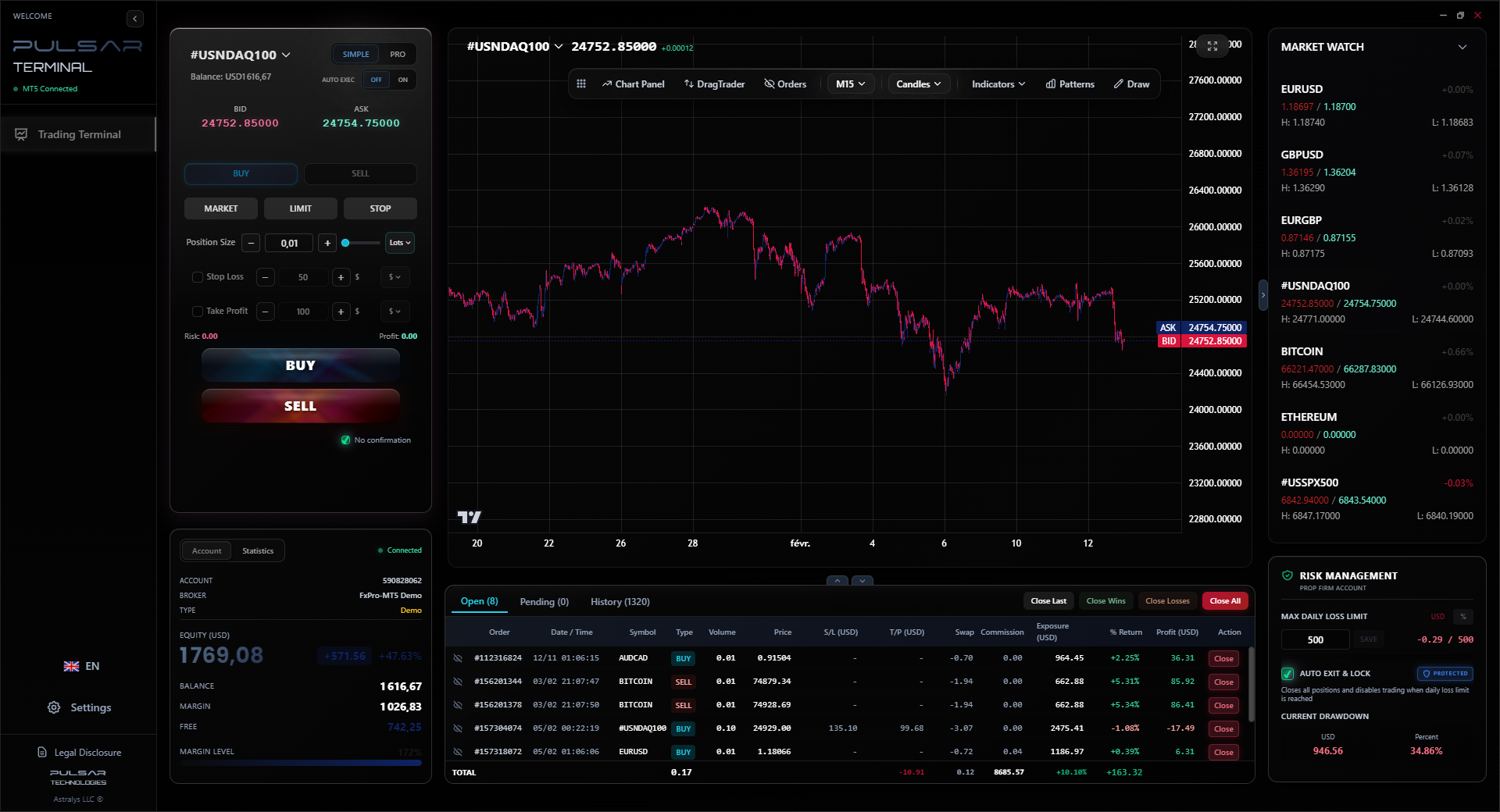
Managing multiple trades and setting precise stops during high-volume sessions is critical, which is why a tool like Pulsar Terminal that integrates directly with MT5 for drag-and-drop orders and multi-level take-profits is essential for keeping up.
Pulsar Terminal
MT5一站式工具:拖拽下单、多重止盈/止损、追踪止损、网格交易、成交量分布图和自营交易保护。每日1000+交易者使用。
Choosing a broker in Singapore isn't about who has the flashiest ads. It's about who gives you the cleanest access to that underlying volume with the fewest hidden costs.
The MAS-Licensed vs. International Broker Dilemma:
| Feature | MAS-Licensed Broker (e.g., IG, Saxo) | International Broker (e.g., IC Markets, Pepperstone) |
|---|---|---|
| use on Majors | Typically lower (e.g., 1:20 - 1:50) due to MAS guidance. | Can be high (e.g., 1:500). |
| Client Money Safety | High. Strict segregation under MAS. | Varies. Top-tier ones (ASIC, FCA) are good, but you're not MAS's priority. |
| Product Offerings | May lack copy trading, certain bonuses due to MAS rules. | Full range of retail features, bonuses, copy trading. |
| Cost Structure | Often built into spread (commission-free). Can be more expensive. | Often raw spread + commission. Can be cheaper for active traders. |
| SGD Pairs | Offered, but with sensible use. | May offer, but check their policy on SGD. |
My personal stance? For serious capital, the MAS-regulated safety is worth the lower use. It forces discipline. For smaller accounts where you're honing skills, a reputable international broker with tight raw spreads might be more cost-effective. I've used both types. I keep my main fund with a broker that has an MAS presence and my experimental/strategy-testing fund with a tight-cost international broker like the ones in our Exness review.
The Non-Negotiables:
- Transparent Pricing: Can you easily see the all-in cost (spread + commission) before you click buy?
- Reliable Execution: Do they re-quote or slip you massively during news? Test with small orders.
- Segregated Accounts: Never, ever compromise on this.
💡 Winston 小贴士
The MAS's 5% margin rule is the best risk manager you never paid for. If you're with an international broker offering 1:500, impose that 5% rule on yourself. Your account will thank you in six months.
“The MAS's 5% margin rule is the best risk manager you never paid for.”
The single biggest error I see is overconfidence bred by proximity.
Traders in Singapore hear 'third-largest FX hub' and think they have an inside track. They don't. The dealing desks, the liquidity providers, the algorithmic engines that drive that US$1.485 trillion - they're not sharing their secrets. You're not trading with the volume; you're trading in its wake.
This overconfidence manifests in two deadly ways:
1. Over-leveraging: 'The market is so liquid, I can get out anytime!' This is the siren song that leads to a margin call. Liquidity can vanish in a flash during a black swan event. In March 2020, during the COVID crash, even major pairs like GBP/JPY gapped hundreds of pips at the open. Your stop loss became a fantasy. High use in that environment guaranteed annihilation.
2. Underestimating the Competition: You're not competing against other retail traders in Singapore. You're competing against global banks, hedge funds, and their AI-driven systems that see order flow you can't imagine. Your edge must come from discipline, risk management, and patience - things algorithms can struggle with, not from speed or information.

Pro Tip: Your only sustainable edge is your psychology and your process. The market's volume doesn't care about your P&L. Build a swing trading plan that waits for high-probability, high-volume setups, then execute it with robotic discipline. Let the gamblers chase the noise.
FAQ
Q1What is Singapore's forex daily trading volume?
As of April 2025, the average daily trading volume (ADTV) in Singapore's foreign exchange market was US$1.485 trillion. This is a 60% increase from 2022 and represents 11.8% of global FX trading, cementing Singapore's position as the world's third-largest FX trading hub after the UK and US.
Q2Does high daily trading volume mean I'll get better prices?
Yes and no. The high underlying volume allows brokers to access tight spreads from liquidity providers. However, your final cost depends on the broker's model. A 'commission-free' broker might have a wider spread, making you pay more than a 'raw spread' broker that charges a commission. You must calculate the all-in cost.
Q3What is the MAS 5% margin rule for forex trading?
In October 2019, the Monetary Authority of Singapore (MAS) raised the minimum margin requirement for forex brokers domiciled in Singapore from 2% to 5%. This means for every standard lot (100,000 units) on a USD pair, you need at least $5,000 in margin, not $2,000. This rule promotes stability but reduces available use with local brokers.
Q4Why are SGD currency pairs not popular for trading?
MAS has a long-standing policy of not encouraging the internationalisation of the Singapore Dollar (SGD) to maintain control over monetary policy. This limits offshore trading of the SGD, resulting in wider spreads, lower use offerings, and less liquidity for pairs like USD/SGD compared to majors like EUR/USD.
Q5When is the best time to trade forex in Singapore?
The best liquidity and tightest spreads occur during the session overlaps. For Singapore (GMT+8), this is the London session (4pm-12am SGT) and the London/New York overlap (8pm-11pm SGT). This is when the bulk of the global daily volume trades, providing the best execution for your orders.
Q6Should I choose an MAS-regulated broker or an international one?
It's a trade-off. MAS-regulated brokers (like IG, Saxo) offer strong client money protection but have lower use and fewer 'retail-friendly' features like copy trading. International brokers (like IC Markets, Pepperstone) often offer higher use and lower costs but are regulated elsewhere. For large capital, MAS safety is prudent. For smaller, active accounts, a reputable international broker can be cost-effective.
Q7How does the high volume affect my risk of slippage?
On major currency pairs during active sessions, the high volume minimises slippage for normal-sized retail orders. However, slippage risk increases dramatically during major news events (like NFP), on low-liquidity pairs, or if you trade during thin market hours (like the late Asian session). Always use limit orders if price entry is critical.
Winston 教授的课程
要点总结:
- ✓Singapore's $1.485 trillion daily volume is 76% institutional.
- ✓Calculate all-in cost: spread + commission, not just advertised spread.
- ✓MAS 5% margin rule forces discipline; emulate it.
- ✓Peak liquidity is London session & overlap (4pm-11pm SGT).
- ✓Asian session volume is low; reduce position size by 30-50%.
这篇文章对您有用吗?
点击星星评分
每周交易洞察
免费每周分析与策略。无垃圾邮件。
关于作者
Daniel Harrington
内容总监
The Trading Mentor内容主管。资深交易者,致力于让复杂的交易概念通俗易懂。涵盖全球话题、策略和平台指南。
评论
风险提示
金融工具交易存在重大风险,可能不适合所有投资者。过往业绩不代表未来表现。本内容仅供教育目的,不构成投资建议。在交易前请务必自行研究。
您可能还喜欢

Cara Trading Forex Sukses: 7 Prinsip dari Trader Profesional
Cara trading forex sukses dengan 7 prinsip trader pro: manajemen modal, disiplin, journal trading, backtest. Data nyata, bukan janji profit palsu.
Jam Trading Forex Terbaik untuk Trader Indonesia: Panduan Lengkap dengan Tabel Waktu
Panduan jam trading forex untuk trader Indonesia. Tabel 4 sesi dunia, jam emas 20:00-00:00, sesi mana yang harus dihindari. Data akurat + tips dari trader berpengalaman.
Top 5 Sàn Forex Uy Tín Nhất 2026: Review Jujur dari Trader Indonesia
Top 5 sàn forex uy tín 2026 untuk trader Indonesia. Review jujur: spread, deposit, withdraw, dukungan lokal. Exness, XM, IC Markets & lebih.
