


Here's the biggest lie you'll hear in trading forums: 'My strategy has a maximum 10% drawdown.' It's nonsense.

David van der Merwe
新兴市场交易员 ·  South Africa
☕ 11 分钟阅读
您将学到:
- 1What Drawdown Actually Is (And What It Isn't)
- 2How to Calculate Your Drawdown in Rand and Cents
- 3Why Drawdown is the Only Metric That Truly Matters
- 4Practical Tactics to Manage and Limit Drawdown
- 5The Special Hell of Drawdown in Prop Firm Challenges
- 6How to Mentally and Financially Recover
- 7Essential Tools and Metrics Beyond the Basic Percentage
Here's the biggest lie you'll hear in trading forums: 'My strategy has a maximum 10% drawdown.' It's nonsense. In the real world, especially trading volatile pairs like USD/ZAR, drawdown is the monster under your trading bed. Most guys focus on profits and ignore the hole they're digging. I'm going to set the record straight on the real forex drawdown meaning, why it's the only metric that matters for survival, and how to handle it when your account balance starts looking as shaky as Eskom's power grid.
Let's cut through the jargon. A drawdown isn't just a 'bad week.' It's the measured drop from your account's highest point (the peak) to the lowest point before you climb back to a new high. Think of it like climbing Table Mountain. You start at the base (your deposit), hike up to a viewpoint (your equity high), then slip down a rocky section before reaching the summit. That slip? That's your drawdown.
It's expressed as a percentage of your peak capital. If your account hits R20,000 and then drops to R16,000 before recovering, you've taken a 20% drawdown (R4,000 / R20,000). Simple math, painful reality.
Where new traders get it wrong is confusing a losing trade with a drawdown. A single loss is an event. A drawdown is a series of events, a period where nothing seems to work. It's the cumulative effect of market noise, bad luck, and maybe a flawed assumption in your plan. I learned this the hard way in 2015. I was scalping EUR/USD and had a nice run up to $15,000. Got cocky, increased my lot size, and hit a streak of five losing trades in a row. That wasn't five losses. It was one relentless drawdown that wiped out $3,750. A 25% haircut because I didn't respect the difference.

Warning: Your broker's 'balance' figure is useless for calculating drawdown. You must track your equity high-water mark. Equity is your balance plus floating P/L. A string of open losing positions can create a massive drawdown that your balance screen hides until you close them and make it real.

💡 Winston 小贴士
Your maximum acceptable drawdown should be a line in the sand. Decide it before you place your first trade, and have a written plan for what you will do if you hit 80% of that limit. Hint: the plan should involve stopping.
You need to do this manually. Don't trust a broker's statement. Grab a notebook, a spreadsheet, or use a journaling app. Here's the drill.
Step 1: Identify Your Peak Equity. This is the highest value your account's total equity (balance + floating profit/loss) has ever reached. Let's say it was R50,000 on March 1st.
Step 2: Track the Subsequent Trough. After that peak, your equity dips. The lowest point it reaches before climbing back above R50,000 is the trough. Say it bottoms at R40,000 on March 15th.
Step 3: The Calculation. Drawdown (ZAR) = Peak Equity (R50,000) - Trough Equity (R40,000) = R10,000 Drawdown (%) = (R10,000 / R50,000) * 100 = 20%
That 20% is your maximum drawdown (Max DD) for that period. It's your battle scar.
Why ZAR Makes This Feel Different
When your account is in Rand, every drop feels visceral. Seeing R10,000 vanish isn't an abstract '$666'. It's a decent used car, or three months' rent for some. This psychological weight is why your risk parameters must be ironclad. A 20% drawdown on a R100,000 account means R20,000 is gone. To get back to breakeven? You don't need a 20% return. You need a 25% return on the remaining R80,000. The math gets uglier the deeper you go.

Example:
- Start: R100,000
- 20% Drawdown: Loss of R20,000
- New Balance: R80,000
- To recover R20,000 on R80,000 requires a (20,000/80,000)*100 = 25% gain. A 50% drawdown requires a 100% gain just to break even. That's the hole most traders never climb out of.
This recovery reality is why your position size calculator is your best friend. It's the tool that prevents the catastrophic drawdown in the first place.
“A drawdown isn't a bad trade; it's a period where your confidence in the market's predictability is being systematically destroyed.”
Forget about win rate for a second. I've seen traders with a 70% win rate blow up their accounts. How? Their 30% of losses were massive, uncontrolled disasters. Drawdown is the metric that exposes this.
It measures your strategy's resilience and your own psychological fortitude. A small, frequent drawdown (say, 5-8%) might indicate a tight, disciplined swing trading system. A wild, spiky drawdown that hits 30% before snapping back shows a volatile, probably stressful strategy that most people can't stick with.
For South African traders, there's an extra layer: our beloved Rand. Trading USD/ZAR or EUR/ZAR? The spreads are wider. A typical spread might be 500-800 pips on USD/ZAR, compared to 1-2 pips on EUR/USD. That means you're in a hole before the trade even moves. Your strategy needs to account for this higher friction cost, which can amplify drawdowns if you're trading frequently. A broker with a raw spread account charging a commission might be cheaper in the long run than a 'no commission' broker with a massive spread. Check our Exness review and IC Markets review for how they handle ZAR pairs.
The FSCA doesn't set drawdown limits for retail traders, but they do require brokers to warn you about the risks. The real limit is in your head. Can you sleep at night when your screen is red? I couldn't, once. In 2018, during a Turkey currency crisis that spilled over to EMs, my ZAR-focused portfolio took a 35% drawdown in two weeks. I broke every rule, doubled down on losing positions, and nearly triggered a margin call. I survived, but my confidence was shattered for months. The drawdown wasn't just financial. It was emotional. That's what it truly measures: your breaking point.
Theory is nice. Let's talk tactics. You can't avoid drawdown, but you can cage it.
1. The 2% Rule (But Make it 1% for ZAR). The old mantra is to risk no more than 2% of your account per trade. For the volatility we see in SA markets, I think that's too high. Start with 1%. On a R50,000 account, that's R500 per trade. It feels small, but it lets you survive a losing streak of 10 trades and only be down 10%. It gives you staying power.
2. Use a Drawdown Circuit Breaker. This is a hard, automated rule. Example: "If my account hits a 10% drawdown from its last peak, I stop trading for the week." Full stop. Close all positions, walk away. Re-evaluate your strategy, your mindset, the market conditions. This single rule has saved me more money than any indicator. It forces a cooling-off period.
3. Strategy Diversification (Not What You Think). I don't mean trade 20 pairs. I mean don't put all your capital into one type of trade. If you're swing trading USD/ZAR, maybe allocate a small portion to a different, non-correlated approach on a different instrument, like XAU/USD. When ZAR is getting hammered, gold might be stable. It smooths the curve.
4. Adjust Position Size Dynamically. This is advanced but critical. As your account grows, your 1% risk in Rands gets bigger. That's good. But after a drawdown, you must reduce your position size based on your new, smaller account balance. If you're down 10%, your risk per trade should be 1% of the reduced balance, not the original peak. This is the opposite of revenge trading and it protects what's left.

Pro Tip: Your trading platform's tools are your first line of defense. A trailing stop can lock in profits and prevent a winning trade from turning into a losing one, which is a major cause of drawdown expansion. Setting a breakeven stop after a trade moves in your favor by a certain amount removes the risk from the trade entirely.
💡 Winston 小贴士
When testing a strategy, the most important number isn't the total profit. It's the maximum drawdown. If you can't stomach seeing that DD on a backtest, you'll panic and abandon the strategy when it happens live.
“The real limit on your drawdown isn't set by your broker or the FSCA. It's set by your ability to look at a deep red screen without doing something stupid.”
This is where the forex drawdown meaning gets twisted into a knife. Prop firms like FTMO, The5%ers, and local SA outfits have strict drawdown rules, and they're not always what they seem.
You'll see two types:
- Balance-Based Drawdown: The most common. Your account balance cannot fall below the starting balance minus the allowed drawdown (e.g., 10% on a $100,000 challenge means your balance can't go below $90,000). Simple.
- Trailing Drawdown (The Devil's Invention): This is the killer. Your drawdown limit trails your account's highest balance. If you start at $100,000 with a 10% trailing max drawdown, your limit is $90,000. If you profit and your balance hits $102,000, your new drawdown limit is $102,000 - $10,200 = $91,800. It moves up, but it never moves down. Have a few losing trades after a profit? Your limit is still at that higher level, making it easier to violate.
I failed my first prop challenge because of this. Got a $100,000 account, traded well up to $103,500. My trailing drawdown (10%) was now $93,150. I took a few bad EUR/USD trades, equity dropped to $93,100. I was still up $3,100 from start! But I was $50 below the trailing threshold. Account failed. Gone. The psychological pressure of a trailing drawdown is immense and often leads to terrified, tiny trading that guarantees failure.
The key? Trade as if your maximum loss limit is HALF of the stated drawdown. If they give you 10%, act like you have 5%. This gives you a huge buffer for the trailing mechanic and normal market noise. It requires insane discipline, often best enforced by software that can automatically prevent you from breaking your own rules.
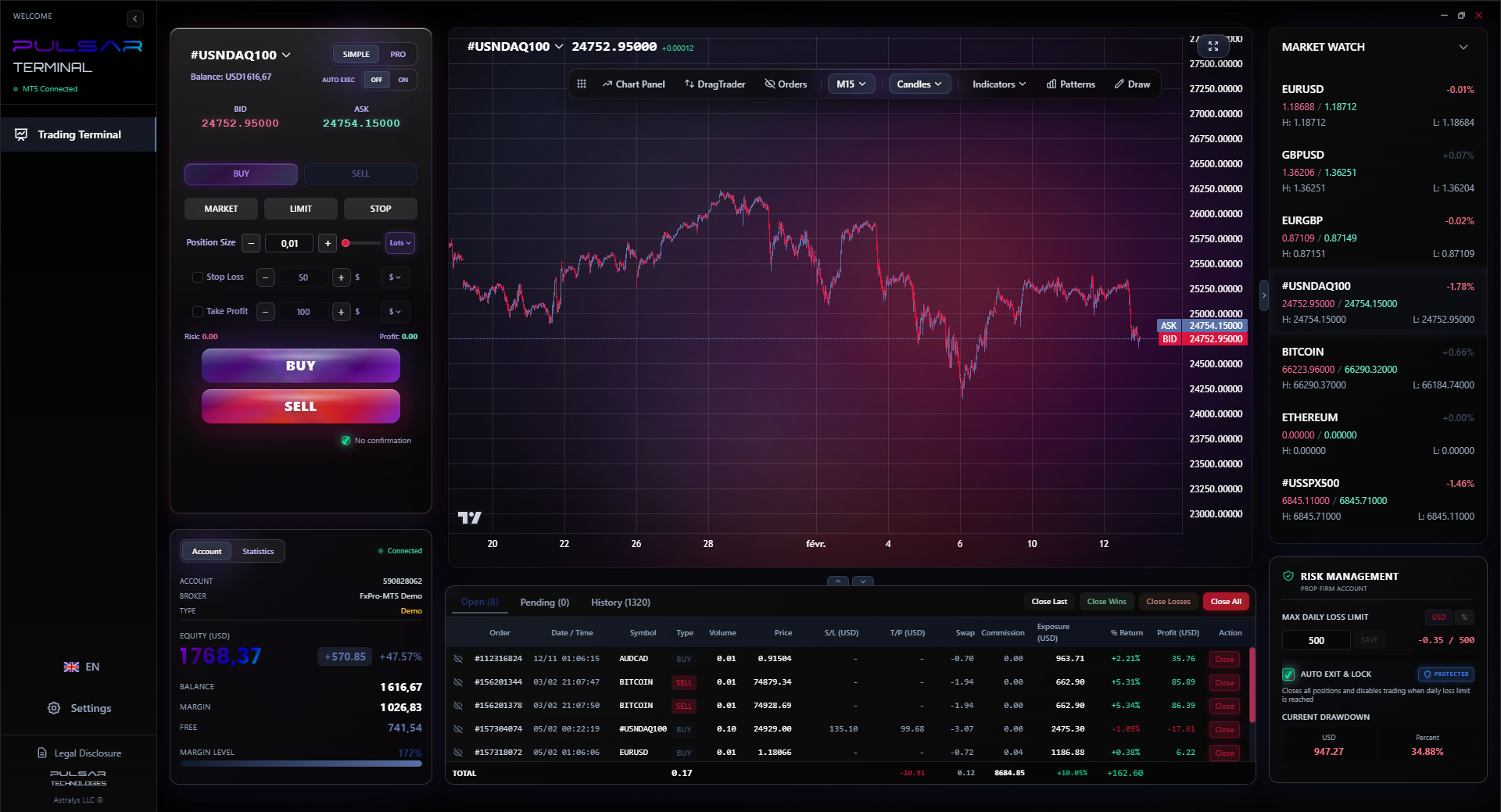
Managing prop firm drawdown rules requires robotic discipline, which is exactly why tools like Pulsar Terminal automate daily loss limits and trailing stop protocols directly on your MT5 platform.
Pulsar Terminal
MT5一站式工具:拖拽下单、多重止盈/止损、追踪止损、网格交易、成交量分布图和自营交易保护。每日1000+交易者使用。
You're in a drawdown. The screen is red. Your stomach is in knots. What now?
First, Stop Digging. I mean it. Close all positions. Hit the disconnect button on your platform. The urge to 'trade back to breakeven' is a siren song that leads to the rocks. You need to separate your self-worth from your account balance. A drawdown is a professional hazard, not a personal failure.
Analyze, Don't Catastrophize. Go to your trade journal (you have one, right?). Look at the losing trades. Was it a fundamental shift? Did the RSI indicator give a false divergence? Did you ignore a clear MACD crossover signal? Look for patterns, not excuses. In my 35% drawdown disaster, the pattern was clear: I was trading against the central bank's obvious intervention trend. I was arrogant, not wronged.
The Climb Back is a Grind. When you restart, you must do so with a reduced position size. Your goal isn't to make back the R20,000 you lost in two trades. Your goal is to execute three, five, ten perfect trades according to your original plan. The money will follow. Focus on process, not P/L.
Finally, remember this: every great trader has a drawdown story. It's your baptism by fire. If you learn from it, it makes you wiser, calmer, and more profitable. If you don't, you'll just repeat the cycle until your capital is gone. The choice is yours.
💡 Winston 小贴士
In a prop firm challenge, treat the trailing drawdown as your true enemy. Calculate your 'effective' starting balance as (Starting Balance + (Max DD/2)). This mental trick forces the ultra-conservative position sizing you need to pass.
“Recovering from a 50% drawdown requires a 100% gain. That's not a comeback. That's a miracle. Don't put yourself in a position where you need one.”
Knowing your max drawdown is step one. To really understand your risk profile, you need a few more numbers.
Calmar Ratio: This is a beauty. It's your average annual return divided by your maximum drawdown over that period. A ratio above 1.0 is generally good. It tells you how much return you're getting for the pain you're enduring. A high return with a huge drawdown gives a bad Calmar Ratio. I'd take a 15% return with a 5% drawdown (Calmar = 3) over a 30% return with a 25% drawdown (Calmar = 1.2) any day.
Profit Factor: Total Gross Profit / Total Gross Loss. You want this above 1.5. Below 1.2, you're walking a tightrope. This metric, combined with drawdown, tells the full story. A profit factor of 1.8 with a 25% max DD is a risky, volatile system. A profit factor of 1.4 with a 6% max DD might be a steady, reliable grind.
Average Drawdown Duration: How long do you typically stay in a hole? If your average drawdown lasts 2 weeks, that's manageable psychologically. If it lasts 3 months, you need the patience of a saint. This metric prepares you mentally for the marathon.
| Metric | What It Tells You | Good Benchmark for SA Traders |
|---|---|---|
| Max Drawdown | Worst-case historical pain | < 15% (Aim for <10%) |
| Calmar Ratio | Reward per unit of pain | > 1.5 |
| Profit Factor | Efficiency of your wins vs losses | > 1.5 |
| Avg. DD Duration | How long you'll be underwater | As short as possible |
You can't manage what you don't measure. These metrics are your dashboard. Ignore them at your peril.
FAQ
Q1What is a good maximum drawdown percentage for a forex trader?
There's no universal 'good' number, but for sustainable trading, you should aim to keep your maximum drawdown below 15%. Many professional money managers will blow up a strategy if it hits a 20% drawdown in testing. For your own sanity and capital preservation, targeting a max DD under 10% is a disciplined goal. Remember, a 50% drawdown requires a 100% gain just to break even.
Q2How is drawdown different from loss?
A loss is a single, closed trade that didn't work out. A drawdown is a period of decline in your overall account equity, made up of potentially multiple losing trades (and even some winning ones), from a peak to a trough. Think of a loss as a single battle. A drawdown is the entire losing campaign.
Q3What is trailing drawdown in a prop firm challenge?
Trailing drawdown is a risk rule where your maximum allowed loss limit moves up as your account balance increases, but it never moves down. If you start with $100,000 and a 10% trailing drawdown, your limit is $90,000. If you profit to $105,000, your new limit is $105,000 - $10,500 = $94,500. If you then have losses, you can breach this higher limit even if you're still in overall profit from the starting balance. It's a tough rule that requires extremely conservative trading.
Q4How do I calculate my current drawdown in real-time?
You need to know your account's highest-ever equity (peak). Subtract your current live equity (balance + floating P/L) from that peak. Then, divide that number by the peak equity and multiply by 100 to get the percentage. Formula: ((Peak Equity - Current Equity) / Peak Equity) * 100. You must track your peak equity manually or with software, as most platforms only show daily/weekly statements.
Q5Does the FSCA regulate drawdown limits for retail traders?
No, the Financial Sector Conduct Authority (FSCA) does not set specific drawdown limits for retail traders. Their role is to license and supervise brokers (like those in our XM review or Pepperstone review) to ensure fair conduct and client fund safety. Managing your drawdown is your personal responsibility as part of your risk management strategy.
Q6Can a high win rate still lead to a large drawdown?
Absolutely. This is a classic trap. If you have a 70% win rate but your average losing trade is 3 times the size of your average winning trade, you will have large, painful drawdowns. The size of your losses (risk) matters more than the frequency of your wins. This is why focusing on drawdown and profit factor is more important than obsessing over win percentage.
Winston 教授的课程
要点总结:
- ✓Define your max drawdown limit (e.g., 10%) before you trade a single ZAR.
- ✓Risk 1% or less per trade on volatile ZAR pairs.
- ✓Use a drawdown 'circuit breaker' rule to force a stop.
- ✓For prop firms, trade as if your allowed drawdown is half of what they state.
这篇文章对您有用吗?
点击星星评分
每周交易洞察
免费每周分析与策略。无垃圾邮件。
关于作者
David van der Merwe
新兴市场交易员
约翰内斯堡交易者,11年新兴市场货币经验。专注于ZAR货币对、FSCA监管交易和南非市场分析。
评论
风险提示
金融工具交易存在重大风险,可能不适合所有投资者。过往业绩不代表未来表现。本内容仅供教育目的,不构成投资建议。在交易前请务必自行研究。
您可能还喜欢

Cara Trading Forex Sukses: 7 Prinsip dari Trader Profesional
Cara trading forex sukses dengan 7 prinsip trader pro: manajemen modal, disiplin, journal trading, backtest. Data nyata, bukan janji profit palsu.
Jam Trading Forex Terbaik untuk Trader Indonesia: Panduan Lengkap dengan Tabel Waktu
Panduan jam trading forex untuk trader Indonesia. Tabel 4 sesi dunia, jam emas 20:00-00:00, sesi mana yang harus dihindari. Data akurat + tips dari trader berpengalaman.
Top 5 Sàn Forex Uy Tín Nhất 2026: Review Jujur dari Trader Indonesia
Top 5 sàn forex uy tín 2026 untuk trader Indonesia. Review jujur: spread, deposit, withdraw, dukungan lokal. Exness, XM, IC Markets & lebih.
