


I lost N150,000 in two days back in 2012.

Olumide Adeyemi
西非交易先驱 ·  Nigeria
☕ 10 分钟阅读
您将学到:
- 1What Actually Makes a Forex Education Website Worth Your Time
- 2The Free vs. Paid Content Trap
- 3Red Flags Nigerian Traders Must Spot (Before You Wire the Money)
- 4The Real Value: Community and Mentorship
- 5How to Actually Use a Website Without Getting Overwhelmed
- 6My Personal Journey: What Actually Worked (And What Didn't)
- 7Where to Look: Types of Resources, Not Specific Names
- 8The Final Verdict: Are Forex Education Websites Worth It?
I lost N150,000 in two days back in 2012. Not to the market, but to a 'forex guru' selling a 'guaranteed' system from his flashy website. The site was all Lamborghinis and private jets, the course cost a fortune, and the strategy was about as useful as a screen door on a submarine. That painful lesson taught me more about evaluating forex education websites than any winning trade ever could. In Nigeria, where everyone and their uncle seems to be selling a trading secret, knowing where to get real knowledge is half the battle.
Forget the fancy graphics and the testimonials from people you'll never meet. A solid forex education website has a backbone you can feel. It's not about promising you'll make N500k a month from a N50k account. It's about giving you the tools to not blow up your account in the first week.
First, it teaches the boring stuff. I'm talking about risk management, position sizing, and psychology. Any site that jumps straight into 'secret indicators' without spending serious time on how much to risk per trade is setting you up for failure. Your first stop should be a good position size calculator tutorial - it's that important.
Second, it's transparent about both wins and losses. A real educator shows you their losing trades and explains what went wrong. I remember one site I used early on where the trader posted his monthly statement, losses and all. He broke down a bad EUR/USD trade where he ignored his own rules and got stopped out. That humility was worth more than a hundred screenshots of perfect entries.
Third, it focuses on process, not profits. The goal isn't to copy trades. The goal is to learn a repeatable process for analyzing the market. Does the site teach you how to read price action, understand economic calendars for the Naira, or build a trading plan? That's the stuff that lasts.

💡 Winston 小贴士
If a website's main banner features a car you can't afford, the only person about to get a new car is the guy who owns the website.
Here's the dirty secret: 95% of what you need to know is available for free. Seriously. The core concepts of support/resistance, candlestick patterns, and basic risk management are plastered all over the internet. The value of a paid course or membership isn't in hidden knowledge; it's in structure, mentorship, and community.
The Free Stuff Is Your Foundation
Spend months, not days, on free content. YouTube channels (be careful, many are trash), broker education centers (like those from Exness or IC Markets), and even Wikipedia for economic terms. This is where you build your base. If a website's free content is already disorganized or full of hype, their paid stuff will be worse.
When Paid Makes Sense
You might consider paying when you're past the basics and need focused guidance. Maybe it's a specific strategy like scalping that requires precise execution, or deep dives into advanced order types. The key question: does the paid content solve a specific, advanced problem you're facing? Or is it just repackaged free info with a fancy label?

Warning: The biggest red flag is a site that withholds crucial information (like how to manage a losing trade) behind a paywall. If their free content only shows wins and the 'real method' costs N200k, run. That's a marketing funnel, not an education.
I paid $300 for a course once on auction market theory. It was worth it because the mentor provided live market analysis and answered specific questions. The value was in the interaction, not the PDFs.
“95% of what you need to know is available for free. Seriously.”
Our market is uniquely targeted. Scammers know the hunger for financial success here, and they craft their websites accordingly.
- The Naira & Kobo Mirage: Any website that frames everything in Naira profits from tiny accounts is playing you. 'Turn N30,000 into N150,000 in 30 days!' This ignores the reality of spreads, commissions, and the mathematical improbability of such returns. Real education talks in percentages, not Naira.
- The 'Prop Firm Bypass': I've seen sites selling 'methods' to easily pass prop firm challenges without real skill. They claim to have a secret trick for the daily drawdown. This is dangerous nonsense. If you're aiming for prop firms, you need rock-solid discipline, not a cheat code. Managing a daily loss limit is a core skill.
- The WhatsApp Group Premium: The education is just an entry ticket to a 'VIP signal group.' The website is a front. You're not paying for education; you're paying for the illusion of insider access. These groups often lead to margin calls as people blindly follow trades they don't understand.
- No Discussion of Liquidity or Slippage: A website that never mentions these, especially around Nigerian market hours or major news events, is theoretical. Try closing a large Gold (XAU/USD) position during thin liquidity and you'll learn about slippage the hard way. Real education prepares you for real market conditions.
This is where a good website transforms into a great one. Trading is isolating. A forum or community where you can ask dumb questions without judgment is priceless. Look for sites with active, moderated forums where members critique each other's trade ideas.
Mentorship is the gold standard, but it's rare. It's not about someone giving you trades. It's about someone reviewing your journal, pointing out that you always lose money on Fridays because you're overtrading, or that your swing trading stops are too tight. I evolved most as a trader when I found a mentor who charged by the hour to review my process, not sell me a system.

Pro Tip: The best test of a community's quality? Ask a contrarian question in their forum. Post a chart and say, 'I think this is a sell, here's why.' See if the responses are thoughtful analysis or just cheerleading for the website's preferred method. Intellectual diversity is a sign of health.
💡 Winston 小贴士
The best educational concept I ever learned was 'breakeven stop.' It costs nothing in theory but saves thousands in practice. It turns risky trades into free lottery tickets.
“The ROI wasn't in the course fee; it was in the losses it helped me avoid.”
Information overload is a career killer. You'll hop from one website's RSI strategy to another's Fibonacci method and end up confused and inconsistent.
The One-Month Test Rule: Pick one educational website or course that covers a complete strategy. Commit to studying and paper trading ONLY that method for one full month. Don't even look at other strategies. Your goal is to understand its wins, its losses, and its rhythm.
Build a Hybrid Toolkit: Take concepts, not entire systems. Maybe you love the market structure principles from one site and the specific MACD indicator divergence setup from another. Synthesize them into your own plan. Your trading plan should be a unique document, not a copy-paste from a website.
Journal with the Lessons in Mind: When you review your trades, don't just note profit/loss. Note which educational lesson applied. 'Took this trade because of the support level taught in Module 3. Exited early because I ignored the volume lesson from Module 5.' This links theory directly to your behavior.
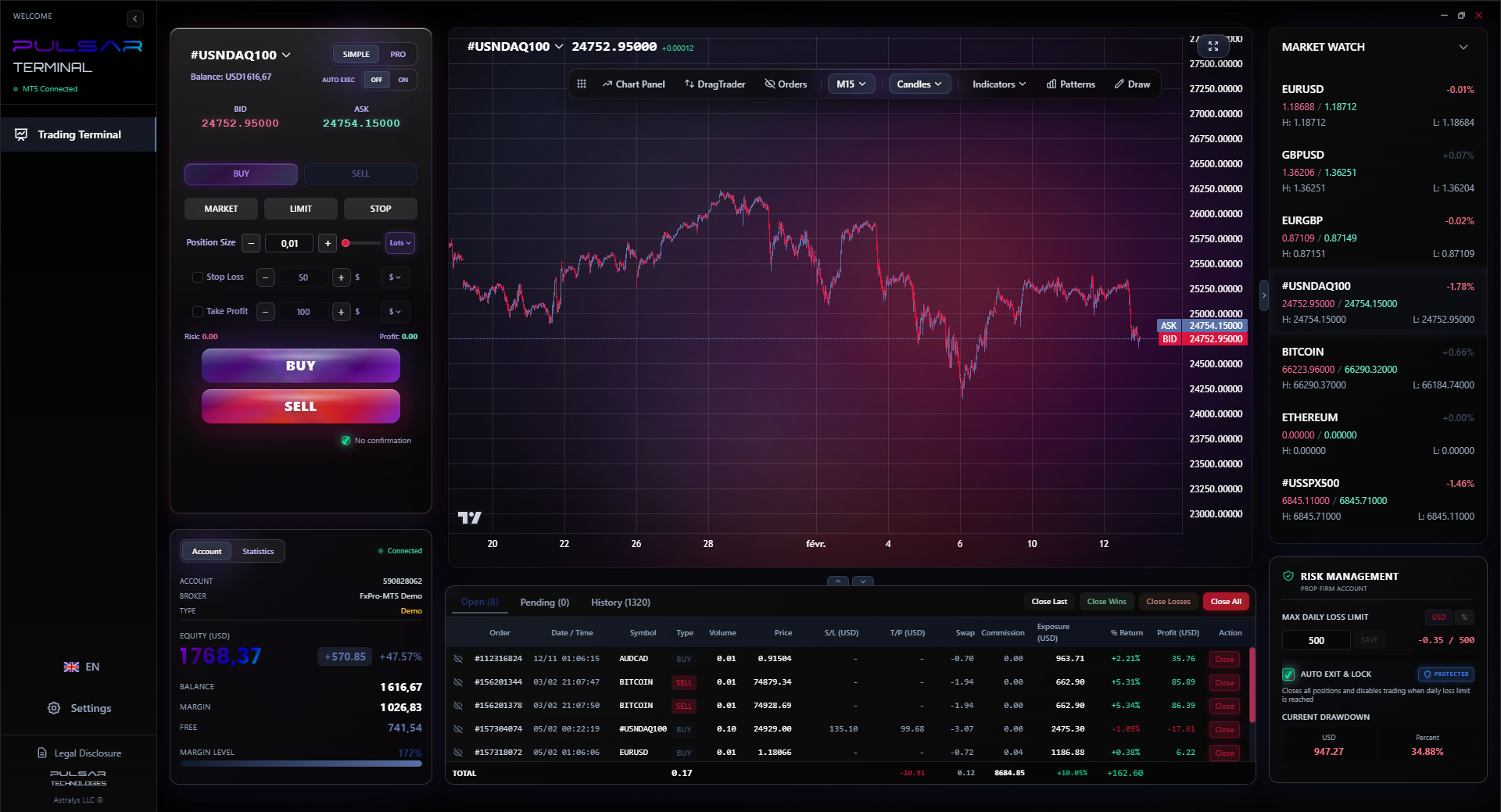
Tools that help you execute cleanly are part of your education. Learning a complex strategy is pointless if your platform makes it clumsy to place orders with multiple take-profits or a trailing stop.
Once you've learned a strategy from a good education site, you need tools that let you execute it flawlessly, like setting multiple take-profits or a trailing stop directly on your MT5 chart.
Pulsar Terminal
MT5一站式工具:拖拽下单、多重止盈/止损、追踪止损、网格交易、成交量分布图和自营交易保护。每日1000+交易者使用。
Let's get specific with numbers. These are my real turning points.
The Failure: I subscribed to a site focused on ultra-low time frame scalping. The guru made it look easy. I deposited $500 with a broker known for low spreads. In one week, I placed 87 trades. My win rate was 52%, which sounds okay. But my average loser was N4,200, and my average winner was N1,800. I was cutting profits and letting losses run - the exact opposite of the rule. I ended the week down N85,000. The website's method was too fast for my psychology. The education was technically correct but psychologically incompatible with me.
The Success: Later, I found a site dedicated purely to price action and weekly chart swing trading. It was boring. No indicators, just support/resistance and patience. I paper traded it for 3 months. Then, I took a live trade on GBP/JPY. Bought at 148.00, placed a stop at 146.90 (risking 1% of my account), and left it alone for two weeks. It crawled up to 151.50. I took half off, moved my stop to breakeven. The website's core lesson was 'set it and forget it.' That one trade made more than my entire scalping month. The education fit my temperament.
The Cost: I've probably spent over $5,000 on various websites, courses, and memberships in 12 years. About $4,200 of that was a waste. The $800 that worked was for focused, unsexy education on risk management and trading psychology. The ROI wasn't in the course fee; it was in the losses it helped me avoid.
“They are worth it as a structured supplement to your own relentless practice and screen time.”
I won't name specific sites because they change, and what worked for me might not for you. Instead, I'll give you the categories to search for.
| Resource Type | What to Look For | What to Avoid |
|---|---|---|
| Broker Education Hubs | Materials from established international brokers (e.g., XM, IC Markets). They have basics on pips, use, and platform tutorials. | Broker-specific 'strategies' that just encourage you to trade more. |
| Independent Trader Blogs | A single trader documenting their journey over years, with real statements. Look for detailed trade breakdowns. | Blogs that suddenly start pushing a paid course after 6 months of 'struggles.' |
| Market Analysis Portals | Sites that provide daily/weekly analysis (like Forex Factory). Use them to see how professionals frame market discussions. | Paying for 'premium' analysis or signals. The value is in learning the language of analysis. |
| Platform-Specific Channels | YouTube or blogs dedicated to mastering MT4/MT5 or TradingView. Learning to use your tools efficiently is underrated education. | Channels that promote '100% accurate' custom indicators for sale. |
The key is to use these as libraries, not gospels. Cross-reference. If three different sources explain the RSI indicator in the same way, that's a core concept. If one website has a 'secret' RSI setting, it's probably garbage.
💡 Winston 小贴士
Your first N100,000 should go into a trading account you expect to lose, as tuition. Your second N100,000 should go into an education that teaches you why you lost the first one.
It's a conditional yes. They are worth it as a structured supplement to your own relentless practice and screen time. They are not worth it as a magic solution, a replacement for experience, or a source of 'signals.'
Think of them like a gym membership. The membership doesn't get you fit. Showing up, doing the work, and pushing through the pain does. The website provides the equipment and maybe a basic workout plan. You still have to lift the weights.
For the Nigerian trader, the best investment is often not in a foreign guru's website, but in a stable internet connection, a reliable broker, and the patience to demo trade for longer than you think is necessary. Use forex education websites to build your framework, but remember: the final, most important lessons are the ones the market teaches you personally, usually after it takes your money. Learn those lessons well, and you won't need to buy another 'secret system' ever again.
FAQ
Q1What is the biggest mistake Nigerian traders make with forex education websites?
Paying for them too early. They see a flashy ad, wire N100k for a 'masterclass,' but haven't even mastered what a stop-loss is on a demo account. You should exhaust all high-quality free resources first. Only pay for education when you have specific, advanced questions that free content can't answer.
Q2Are YouTube forex channels a good form of education?
They can be, but you have to filter aggressively. Good channels teach concepts and show full trade cycles (entry, management, exit). Bad channels only show spectacular wins, use sensational thumbnails, and push signal services. Treat YouTube as an introductory library, not your primary school.
Q3How much should I expect to pay for a decent forex course?
Anywhere from N20,000 to N200,000+. Price is not a guarantee of quality. A N30,000 course on the fundamentals of risk management is infinitely more valuable than a N150,000 course on a 'secret algorithm.' Before paying, see if the educator offers a significant free sample (like a full module) so you can judge their teaching style.
Q4Should I join the Telegram or WhatsApp group associated with a website?
Be extremely cautious. These groups are often echo chambers for the website owner's ideas and are used to pump up signal services. If you do join, be a silent observer first. See if there's real analysis or just people posting 'Thanks sir for the profit!' That's a cult, not a community.
Q5How long should I study before trading with real money?
There's no set time, but there is a set benchmark: you must be consistently profitable on a demo account over at least 3 months, and through different market conditions (trending, ranging, volatile). That's the bare minimum. Most people jump in after 3 weeks. Most of those people lose their first deposit.
Q6Can forex education websites guarantee I will make money?
Absolutely not. Any website that implies or promises guaranteed results is a scam. They are selling education, not profits. The market guarantees nothing. A good website gives you the knowledge to manage risk and make informed decisions, which increases your odds of survival and long-term success.
Winston 教授的课程
要点总结:
- ✓Demo trade for 3+ months minimum before real money.
- ✓Risk management is 80% of the game; learn it first.
- ✓Avoid any site framing profits in Naira from tiny accounts.
- ✓Value process education over signal providers.
这篇文章对您有用吗?
点击星星评分
每周交易洞察
免费每周分析与策略。无垃圾邮件。
关于作者
Olumide Adeyemi
西非交易先驱
尼日利亚最活跃的外汇交易教育者之一。从拉各斯出发有8年交易经验。专注于低资金策略和面向非洲交易者的自营公司挑战。
评论
风险提示
金融工具交易存在重大风险,可能不适合所有投资者。过往业绩不代表未来表现。本内容仅供教育目的,不构成投资建议。在交易前请务必自行研究。
您可能还喜欢

Cara Trading Forex Sukses: 7 Prinsip dari Trader Profesional
Cara trading forex sukses dengan 7 prinsip trader pro: manajemen modal, disiplin, journal trading, backtest. Data nyata, bukan janji profit palsu.
Jam Trading Forex Terbaik untuk Trader Indonesia: Panduan Lengkap dengan Tabel Waktu
Panduan jam trading forex untuk trader Indonesia. Tabel 4 sesi dunia, jam emas 20:00-00:00, sesi mana yang harus dihindari. Data akurat + tips dari trader berpengalaman.
Top 5 Sàn Forex Uy Tín Nhất 2026: Review Jujur dari Trader Indonesia
Top 5 sàn forex uy tín 2026 untuk trader Indonesia. Review jujur: spread, deposit, withdraw, dukungan lokal. Exness, XM, IC Markets & lebih.
