


If you're a South African beginner learning forex from YouTube, you're being set up to fail.

David van der Merwe
新兴市场交易员 ·  South Africa
☕ 10 分钟阅读
您将学到:
- 1The YouTube Forex Trap: What They're Not Showing You
- 2The Real Costs of Trading in South Africa (Forget the YouTube Hype)
- 3Picking a Broker: The FSCA License is Non-Negotiable
- 4Building a Strategy, Not Copying a Setup
- 5Trading the ZAR: Volatility, Pairs, and the SARS Reality
- 6Your 90-Day Action Plan (Skip the YouTube Rabbit Hole)
If you're a South African beginner learning forex from YouTube, you're being set up to fail. The platform is a minefield of get-rich-quick fantasies, sold by influencers who've never traded a real account under FSCA rules. I've watched traders with R5,000 starter accounts get rinsed in weeks, following advice that ignores our 30:1 use limits, ZAR volatility, and SARS tax obligations. This isn't about finding the 'best' forex for beginners YouTube channel. It's about surviving the misinformation. I'll show you the real numbers, the legal traps, and how to build a strategy that works with our market, not against it.
Scroll through any 'forex for beginners YouTube' search results and you'll see the same script: Lamborghinis, screens full of green trades, and a 22-year-old guru promising 20% returns a month. It's compelling. It's also almost entirely fictional for the South African context.
These creators operate in a regulatory grey area. Most aren't FSCA-licensed financial service providers, which means they can't legally give tailored advice. Yet, they'll sell you signals, courses, and 'prop firm challenges' without mentioning the 2024 case where the FSCA fined a signals provider over R1 million and debarred him for 10 years. They're selling a dream that bypasses our reality.
Here's what never makes the thumbnail:
- use Limits: They trade with 500:1 use on offshore accounts. You're capped at 30:1 by the FSCA. Their 'risk 5%' strategy becomes a margin call for you.
- The ZAR Reality: They trade EUR/USD on a 0.1 pip spread. You want to trade USD/ZAR, where the spread can be 5-14 pips at Pepperstone. Your trade starts R70 in the hole on a standard lot.
- The Tax Man: They rarely mention taxes. Your profits are taxable income for SARS. I've seen traders have a winning year, forget to declare, and get a nasty audit letter.

Warning: If a YouTube 'guru' can't clearly explain FSCA regulation, client fund segregation, and SARB exchange controls, they don't understand your market. You're taking driving lessons from someone who's never seen a South African road.
My own early mistake was mirroring a US-based YouTuber's scalping strategy. He was taking 10-pip profits on EUR/USD. I tried it on EUR/ZAR. The spread alone was 12 pips. I was fighting the broker's fee before the market even moved. I blew R2,000 in three days trying to make a foreign strategy fit a local pair.

💡 Winston 小贴士
A demo account teaches you how buttons work. A live account with only R1,000 teaches you how you work. The fear of loss is the best teacher you'll ever have.
“YouTube sells you a dream that bypasses South Africa's 30:1 use limits and ZAR volatility.”
YouTube videos talk about 'low costs' in abstract terms. Let's get specific with rands and cents. Your profitability lives or dies by these numbers.
Broker Fees: It's More Than Just the Spread
Yes, you can find brokers like Exness or Vantage offering 0.0 pip spreads on majors. But that's often on a raw account with a commission. For a standard lot (100,000 units), a $7 round-turn commission adds 0.7 pips to your cost. On USD/ZAR, that 'low' 5-pip spread from a broker like Pepperstone is your baseline. A micro lot (1,000 units) on USD/ZAR at 5 pips costs you R0.80 to open. Doesn't sound like much? Do 50 trades a month, and that's R40 gone before you've made a cent.
The Bank Will Get Its Cut
This is the silent account killer most beginners miss. You fund your broker with your Capitec or Standard Bank account.
Let's say you deposit R5,000. According to 2025 schedules, Capitec charges R250 for an outgoing foreign payment. That's a 5% loss on your capital before you place a single trade. Standard Bank charges about R131. When you withdraw profits, there's often another fee. I once made a R1,500 profit on a trade, withdrew it, and netted only R1,150 after bank fees. It felt like a loss.
The Overnight Fee (Swap) Surprise
Holding a trade overnight? You'll pay or earn a swap rate. For ZAR pairs, this can be significant. If you're long USD/ZAR (buying USD, selling ZAR), you're typically paying the South African interest rate and receiving the US rate. With our higher rates, that often means a daily debit. It's not just a fee, it's a constant drag on your position. A swing trading hold for a week can see notable costs.

Example: Let's calculate a real trade. You buy 1 standard lot of USD/ZAR at 16.50.
- Spread Cost: 5 pips = 5 * R0.01 (approx. pip value) = R50
- Potential Bank Fee on Deposit: R250 (Capitec)
- Swap for 3 days (if negative): ~R120 Total costs to enter and hold for 3 days: R420. Your trade needs to move 42 pips in your favor just to break even on costs. That's the real game.
“A 5-pip spread on USD/ZAR means your trade starts R70 in the hole on a standard lot.”
YouTube reviews will rank brokers by use and bonuses. In South Africa, the first and only filter is the FSCA register. If they're not there, walk away. Client fund segregation isn't a nice-to-have, it's what stops your money from vanishing if the broker goes under.
Here’s a quick comparison of some FSCA-regulated options relevant for beginners:
| Broker | FSCA FSP Number | Min. Deposit (Approx. ZAR) | Key Note for Beginners |
|---|---|---|---|
| XM | 44534 | ~R90 ($5) | Ultra-low barrier to entry, but start small. |
| Exness | 51024 | ~R180 ($10) | Popular for low spreads. |
| AvaTrade | 45984 | ~R1,800 ($100) | Good fixed spreads, less cost surprise. |
| Khwezi Trade | Local SA Broker | R500 | Proudly SA, understands local context. |
Notice the minimum deposits. Yes, you can start with R90 at XM. But should you? I call this 'toy money' trading. You can't practice proper risk management with R90. A realistic starter amount that lets you breathe, make mistakes, and learn is between R1,500 and R5,000. It's enough to feel the psychological pressure (which is part of the learning) without ruining your finances.
Your broker's platform matters too. MT4 and MT5 are the standards here. Before you get dazzled by a broker's fancy tools, check if they support MT5. The familiarity and community support around these platforms in SA is huge. A platform like Pulsar Terminal (a companion for MT5) can then add advanced tools like drag-and-drop orders and trailing stops, which are crucial for managing risk.
One final check: payment methods. Does the broker offer a cheap, fast way for you to get money in and out? Local bank transfer options are best. Avoid brokers that only use international wire transfers, as your bank will charge you a fortune.
“Your goal for the first three months is not to make money. It's to execute your plan perfectly.”
This is the core failure of the 'forex for beginners YouTube' model. You're taught to recognize a 'bullish engulfing pattern' or a 'double top,' but you're not taught how to build a trading plan. It's like being taught to identify a single type of cloud but not how to forecast the weather.
A strategy has five non-negotiable parts:
- Entry Logic: This is the only part YouTube focuses on. It could be a moving average crossover, a RSI indicator reading, or a price action signal.
- Stop Loss: Where you are objectively wrong. This isn't a guess. It's based on market structure - a recent swing low/high, or a volatility measure like ATR. If your stop is 50 pips away, your position size must reflect that.
- Take Profit: Your profit target. Better yet, use multiple targets. Take 50% off at a 1:1 risk-reward ratio, move your stop to breakeven, and let the rest run. This is where psychology wins.
- Position Size: The most important calculation. Use a position size calculator. If you have a R10,000 account and risk 1% per trade (R100), with a 50-pip stop on USD/ZAR, your position size is roughly 0.02 lots. Not 1 lot because 'it feels right.'
- Market Condition: Does your setup work in a trending market or a ranging one? Most YouTube setups fail miserably when the market context changes.
I learned this the hard way. I copied a 'London Breakout' scalping strategy from a video. It worked for him. For me, trading ZAR pairs at 10 AM SA time, the volatility was completely different. I had 7 losing trades in a row. The strategy wasn't 'wrong,' it was wrong for my instrument and my session. You must test everything with your broker, on your chosen pair, in your time zone.

Pro Tip: Don't search for 'forex for beginners YouTube.' Search for 'trading psychology,' 'risk management,' and 'journaling.' Those are the videos that will save your account. The setups are the easy, flashy 10%. The boring 90% of work is managing your money and your mind.
💡 Winston 小贴士
Your first profitable month is your most dangerous. It convinces you you're smarter than the market. Double your size then, and the market will happily correct that illusion.
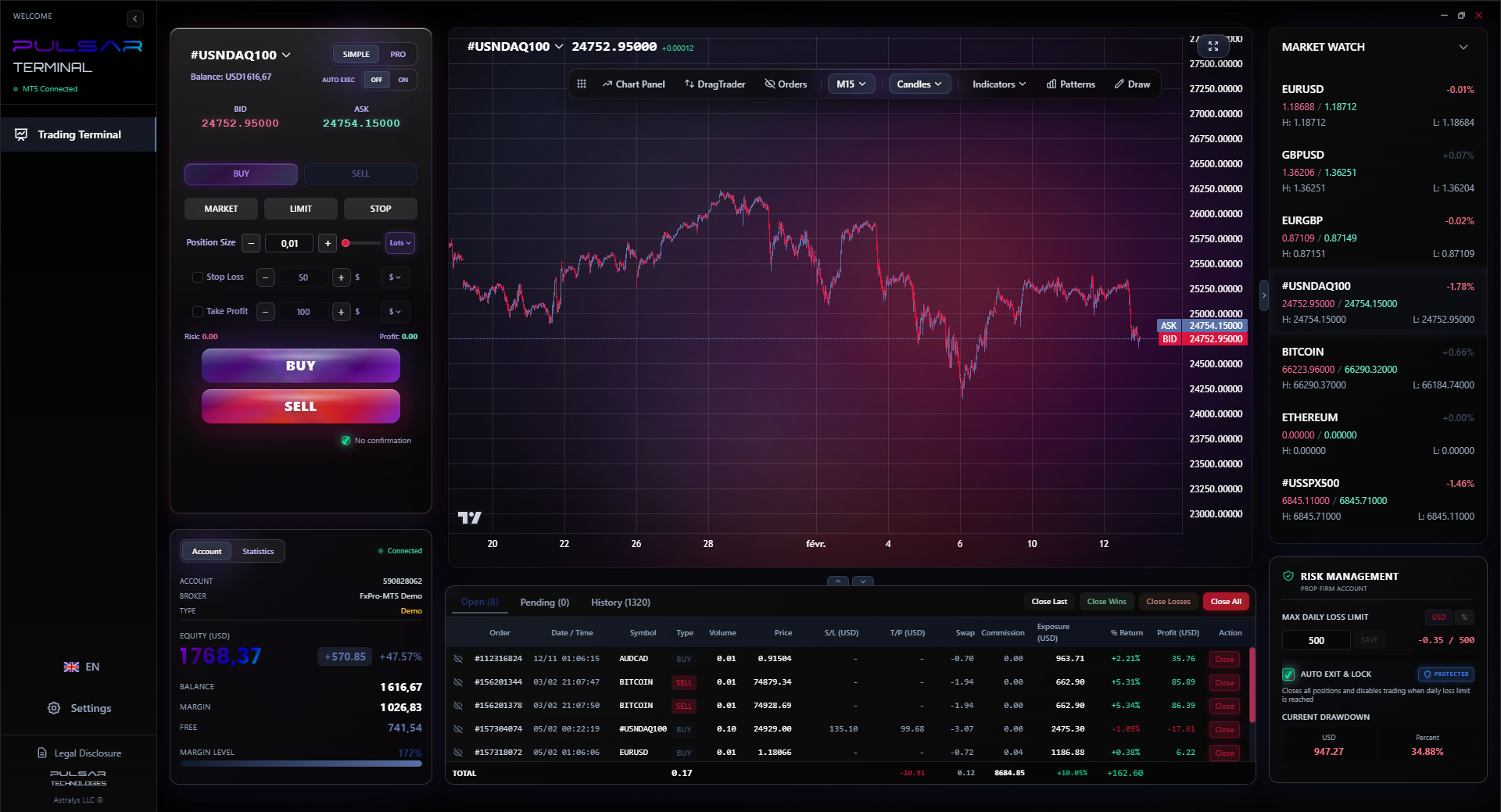
Executing a multi-target strategy with precise stop management is complex in vanilla MT5, but tools like Pulsar Terminal automate this with drag-and-drop order tools directly on your chart.
Pulsar Terminal
MT5一站式工具:拖拽下单、多重止盈/止损、追踪止损、网格交易、成交量分布图和自营交易保护。每日1000+交易者使用。
“Your goal for the first three months is not to make money. It's to execute your plan perfectly.”
As a South African, you'll naturally look at USD/ZAR, EUR/ZAR, GBP/ZAR. These are exotic pairs. They're less liquid, have wider spreads, and are more volatile than the EUR/USD you see on YouTube. This is a double-edged sword.
The volatility can create big opportunities. A 200-pip day on USD/ZAR isn't unusual. But that same move can vaporize your account if you're on the wrong side and over-leveraged. You need wider stops, which means smaller position sizes. It forces discipline.
Forget the 'pip value' you learn from generic videos. A pip on USD/ZAR with a quote of 16.50 is roughly R0.01 per micro lot (1,000 units). On a standard lot (100,000 units), it's about R10. You need to know this cold for your position size calculator.
And then there's SARS. The moment you make a net profit in a tax year, you have an obligation. Trading income is not capital gains; it's revenue. You declare it on your annual return. Keep a careful log of all trades, deposits, and withdrawals. I use a simple spreadsheet: date, pair, P&L in ZAR. When my accountant asks, it's ready. I've seen traders get a tax bill on profits they'd already spent and re-deposited, creating a cash flow nightmare.
Also, remember SARB exchange controls. You're allowed to trade forex through a licensed broker. Moving large sums offshore for 'better deals' without approval can land you in hot water. Keep it above board, use an FSCA broker, and sleep easy.
“The boring 90% of work is managing your money and your mind. The setups are the flashy 10%.”
Here's what to do instead of binge-watching trading signals.
Weeks 1-4: Education & Paper Trading
- Learn the absolute basics: what a pip is, what spread means, what a margin call is.
- Pick ONE FSCA-regulated broker from the list above. Open a demo account.
- Download MT4 or MT5. Spend a week just looking at charts. Watch price move. Don't trade.
- Learn ONE simple indicator, like the MACD indicator, inside out. What does it do in a trend? In a range?
Weeks 5-8: Building a Simple System
- On your demo, define a rule. Example: "I will only look for buys if price is above the 200-period moving average on the 1-hour chart, and the MACD histogram is turning up."
- Define your risk. "I will risk 1% of my demo balance per trade. My stop loss will be 2x the Average True Range (ATR)."
- Trade this rule, and only this rule, for 4 weeks. Log every trade in a journal. Why did you enter? Did you follow your stop? How did you feel?
Weeks 9-12: Live Trading with Micro Lots
- Fund your live account with an amount you can afford to lose. R1,500 is a good start.
- Trade only micro lots (0.01). Your goal is not to make money. Your goal is to execute your plan from Weeks 5-8 perfectly for 4 weeks, dealing with the emotion of real money.
- Review your journal weekly. Is your rule working? If not, adjust on DEMO first, never on the live account.
This process is boring. It has no Lamborghinis. But it builds a foundation. After 90 days, you'll have a real understanding, not just a collection of confusing YouTube snippets. You'll be ready to then seek out specific, advanced education, perhaps on using tools like Volume Profile in Pulsar Terminal to refine your entries, because you'll actually understand what you're looking at.
FAQ
Q1Is forex trading legal in South Africa?
Yes, it's completely legal, but you must use a broker licensed by the Financial Sector Conduct Authority (FSCA). Trading with unregulated, offshore brokers promoted on YouTube is risky and offers no local protection.
Q2What is the minimum amount I need to start forex trading in South Africa?
Technically, you can start with as little as R90 (e.g., with XM). However, for serious learning and proper risk management, a minimum of R1,500 to R5,000 is realistic. This allows you to trade micro lots and absorb costs without blowing up immediately.
Q3How much tax do I pay on forex profits in South Africa?
Forex trading profits are considered ordinary revenue (trading income) by SARS, not capital gains. You must declare your net profit (total profits minus total losses) on your annual income tax return. It's taxed at your marginal income tax rate. Keep detailed records of all trades.
Q4Why is the spread on USD/ZAR so much higher than on EUR/USD?
USD/ZAR is an exotic currency pair. It has lower trading volume and liquidity than major pairs like EUR/USD. The wider spread (often 5-14 pips vs. 0.1-1 pip) is the broker's compensation for the higher risk and cost of facilitating the trade in a less liquid market.
Q5Can I use the strategies I see on YouTube for trading the South African Rand?
You must be extremely cautious. Strategies designed for highly liquid majors (EUR/USD) often fail on volatile exotics like USD/ZAR due to wider spreads, different volatility patterns, and news sensitivity. Always test any strategy first in a demo account on your chosen ZAR pair.
Q6What is the best platform for beginners in South Africa?
MetaTrader 4 (MT4) or MetaTrader 5 (MT5) are the industry standards. They are widely supported by FSCA brokers, have a familiar interface for the local community, and offer countless free resources for learning. Start with MT4/MT5 before exploring proprietary platforms.
Q7Are there any good South African forex YouTube channels?
The best local channels focus on education and regulation, not signals or get-rich-quick schemes. Look for content that explains FSCA rules, SARB controls, ZAR pair specifics, and risk management. If a channel is pushing easy money, it's a red flag.
Winston 教授的课程
要点总结:
- ✓Verify FSCA license before depositing a single cent.
- ✓Realistic starting capital is R1,500+, not R90.
- ✓Calculate all costs: spread, commission, bank fees, swap.
- ✓Trade micro lots (0.01) for your first live month.
- ✓Declare your net profit to SARS. Keep a trade journal.
这篇文章对您有用吗?
点击星星评分
每周交易洞察
免费每周分析与策略。无垃圾邮件。
关于作者
David van der Merwe
新兴市场交易员
约翰内斯堡交易者,11年新兴市场货币经验。专注于ZAR货币对、FSCA监管交易和南非市场分析。
评论
风险提示
金融工具交易存在重大风险,可能不适合所有投资者。过往业绩不代表未来表现。本内容仅供教育目的,不构成投资建议。在交易前请务必自行研究。
您可能还喜欢

Cara Trading Forex Sukses: 7 Prinsip dari Trader Profesional
Cara trading forex sukses dengan 7 prinsip trader pro: manajemen modal, disiplin, journal trading, backtest. Data nyata, bukan janji profit palsu.
Jam Trading Forex Terbaik untuk Trader Indonesia: Panduan Lengkap dengan Tabel Waktu
Panduan jam trading forex untuk trader Indonesia. Tabel 4 sesi dunia, jam emas 20:00-00:00, sesi mana yang harus dihindari. Data akurat + tips dari trader berpengalaman.
Top 5 Sàn Forex Uy Tín Nhất 2026: Review Jujur dari Trader Indonesia
Top 5 sàn forex uy tín 2026 untuk trader Indonesia. Review jujur: spread, deposit, withdraw, dukungan lokal. Exness, XM, IC Markets & lebih.
