


You've seen the ads, haven't you? The ones promising a 'secret forex holy grail' that prints money while you sleep.

Olumide Adeyemi
西非交易先驱 ·  Nigeria
☕ 9 分钟阅读
您将学到:
You've seen the ads, haven't you? The ones promising a 'secret forex holy grail' that prints money while you sleep. Maybe a WhatsApp group is selling a 'system' for 50,000 Naira that guarantees 20% returns monthly. Here's the hard truth I've learned over 12 years: if such a thing existed, the person selling it wouldn't need your money. They'd be on a private island, not hustling on Instagram. Let's talk about why this myth is so dangerous for Nigerian traders and what you should actually be focusing on.
The fantasy of a perfect, risk-free system isn't just harmless dreaming. It actively sets you up to fail. I've seen it wipe out accounts time and again.
First, it makes you ignore the most important part of trading: risk management. Why bother with a position size calculator or worry about a margin call if your system can't lose? This mindset is a direct path to blowing your account. I learned this the hard way early on. I bought a 'signal service' promising 90% accuracy. I threw my usual rules out the window and went all in on a GBP/USD trade. The signal was wrong. I lost over $1,200 in one afternoon - a huge chunk of my capital at the time.
Second, it stops you from learning. You become a passive follower of signals or a robot, never understanding why a trade works or fails. When the inevitable losing streak hits (and it will), you have no foundation to fall back on. You just blame the 'guru' and go searching for the next grail.

Warning: Any service that uses words like 'guaranteed,' 'risk-free,' or 'secret algorithm' is almost certainly a scam. Regulated entities like the FCA or CySEC would never allow a broker to make such claims. If it sounds too good to be true in Lagos traffic, it's definitely too good to be true in the markets.

💡 Winston 小贴士
The market's only job is to prove you wrong. Your only job is to have a plan for when it does. A stop-loss isn't admitting defeat; it's confirming your intelligence.
“The fantasy of a perfect, risk-free system isn't just harmless dreaming. It actively sets you up to fail.”
Forget the grail. Consistent traders have a boring, repeatable process. It's not sexy, but it pays the bills.
The Core Pillar: Risk Management
This is your real holy grail. It's the one thing you can control completely. Every single trade I take starts with one question: 'How much am I willing to lose on this?' Not what I might win - what I can afford to lose. I risk a maximum of 1-2% of my account on any single idea. That means if I have a 200,000 Naira account, my stop-loss is set so I only lose 2,000-4,000 Naira if I'm wrong. This protects you from the one bad trade that can end your career. Tools like a good position size calculator are non-negotiable.
Having a Clear, Tested Edge
An edge isn't a crystal ball. It's just a slight statistical advantage you've identified and verified. Maybe you're good at spotting reversals using RSI indicator divergences on the 4-hour chart of XAU/USD. Perhaps you trade breakouts from key London session levels on EUR/USD. Your edge should be so clear you can write it down in one sentence.
Relentless Discipline
This is where most Nigerians fail. The market will test your plan. You'll have three losing trades in a row. Discipline is sticking to your 1% risk rule on trade number four, not doubling down to 'make it back.' It's following your exit plan even when greed is screaming at you to let the winner run longer.

Pro Tip: Your trading plan should be a physical document. Write down your rules for entry, exit, and risk. When you're in a trade and emotions are high, you don't think - you execute the plan. This simple act separates the amateurs from the professionals.
“Your trading plan should be a physical document. When emotions are high, you don't think - you execute the plan.”
Scammers know our market. They know the desire for quick financial escape is strong. Here’s how they package the fairy tale.
The Signal Seller Guru: This is the most common. A flashy individual on social media posts screenshots of winning trades (often fake or from a demo account). They charge 20,000-100,000 Naira for 'lifetime access' to their signals. The signals are usually just random entries with no risk management. When you lose, they blame you for not following instructions perfectly or point to their disclaimer: 'past performance is not indicative of future results.'
The 'Robot' or EA (Expert Advisor): 'Set it and forget it! This robot makes 5% a week automatically!' They show a beautiful backtest on historical data. What they don't say is that the robot was 'curve-fitted' - its rules were specifically designed to fit past price movements, not predict future ones. In live markets, it fails spectacularly. I once wasted $500 on a 'Gold Miner' EA. It made money for two weeks in a quiet market, then lost it all plus more in one volatile news event.
The Prop Firm 'Cheat Code': Some services claim to have a secret method to pass prop firm challenges effortlessly. They might sell you an EA or a 'funded account' for a huge fee. Reputable prop firms have sophisticated detection for such cheating. You'll fail the challenge and lose your fee.
The Educational Course That Promises Results: There are great educators out there. The red flag is when they promise specific returns. 'Take my course and you'll make 50% a month!' Real education teaches you how to fish, it doesn't promise a truckload of fish delivered to your door.
💡 Winston 小贴士
If you can't articulate your edge in one simple sentence, you don't have one. Complexity is the hiding place of the unsure trader.
“The goal of your first real account is not to get rich. The goal is to survive for 6 months without blowing up.”
So, if you can't buy a grail, what do you do? You build your own strong, realistic trading plan. Here's a framework.
1. Choose Your Timeframe and Style
Are you a scalper, in and out in minutes? Or a swing trader holding for days? This decides everything. My personality suits swing trading. I can't sit and watch a 1-minute chart all day. Be honest with yourself.
2. Define Your Entry Triggers
Be specific. Don't say 'I'll buy when it looks good.' Say: 'I will enter a long trade on USD/NGN (offered by some international brokers) only if: a) Price pulls back to the 50-period EMA on the 1-hour chart, AND b) The MACD indicator histogram shows a bullish crossover on the same timeframe.' Two or three clear conditions.
3. Define Your Exit (This is More Important)
Stop-Loss: Where are you wrong? Place it before you enter the trade. Is it below the recent swing low? Beyond a key support level? That's your stop.
Take-Profit: Where will you take profits? A common method is a 1:2 risk-to-reward ratio. If you risk 50 pips, aim for a 100-pip profit. You can use tools to set multiple targets, which is a smarter way to lock in profits.
4. Backtest and Forward Test
Don't use real money yet. Go back on your MT4/MT5 charts and look at the last 6-12 months. How would your rules have performed? Write down every simulated trade. Then, trade it on a demo account for at least a month. This proves your edge exists in reality, not just in your head.

Example: Let's say your system, over 100 demo trades, wins 55 times and loses 45 times (55% win rate). Your average winner is 80 pips, your average loser is 50 pips. That's a positive 'expectancy.' That's a real edge. A 'holy grail' scam would claim a 95% win rate.
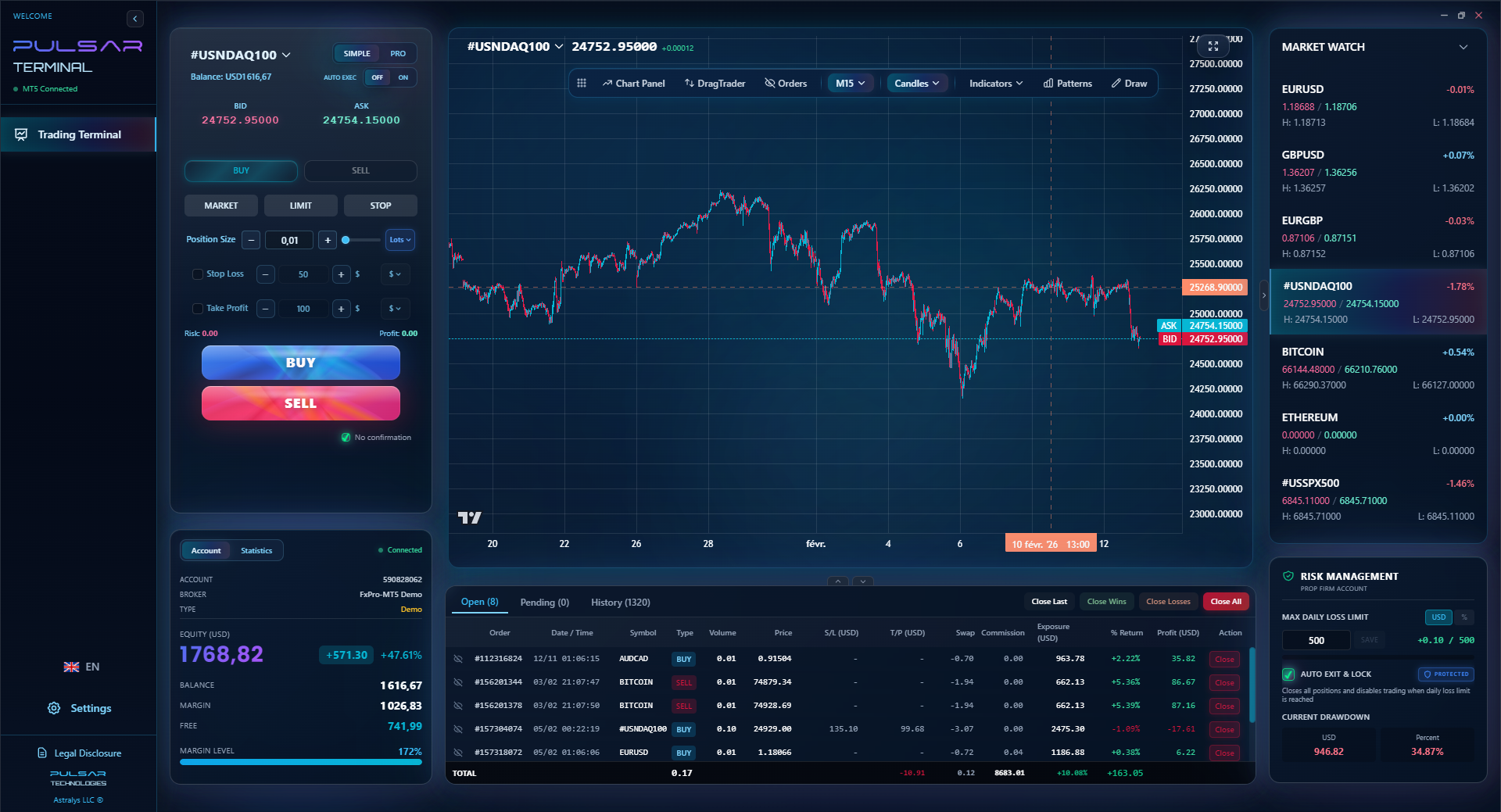
Manually moving stops and setting multiple take-profits is a hassle; Pulsar Terminal automates this with drag-and-drop orders and multi-TP/SL tools directly on your MT5 chart.
Pulsar Terminal
MT5一站式工具:拖拽下单、多重止盈/止损、追踪止损、网格交易、成交量分布图和自营交易保护。每日1000+交易者使用。
“The goal of your first real account is not to get rich. The goal is to survive for 6 months without blowing up.”
Feeling overwhelmed? Start here. This is the actual path.
- Education with a Critical Mind: Learn the basics - what a pip is, how spread works, what moves the markets. Use free resources from major brokers. But always ask: 'Is this person trying to sell me something, or teach me something?'
- Choose a Regulated Broker: This is your first major safety net. Go with brokers known for solid regulation and good service in Nigeria, like Pepperstone, IC Markets, or XM. Check their deposit/withdrawal options for Naira.
- Start a Demo Journal: Open a demo account. Trade it as if it's real money. Every day, write down: 'What was my plan? Did I follow it? What did I learn?' This journal is worth more than any signal.
- Start Tiny: When you go live, start with an amount you can afford to lose completely. I'm talking 20,000-50,000 Naira. The goal of your first real account is not to get rich. The goal is to survive for 6 months without blowing up. If you can do that, you're ahead of 80% of starters.
- Ignore the Noise: Leave WhatsApp groups full of 'to the moon!' hype. Unfollow the 'gurus.' Focus on your chart, your plan, your journal.
💡 Winston 小贴士
Your trading journal is your most important tool. A trade not reviewed is a mistake repeated. The answer to 'what should I do next?' is always in your last 20 trades.
“That discipline, that's the closest thing to a 'forex holy grail' you'll ever find.”
After all these years, I'm convinced the only edge you can truly own is a psychological one. The market is a mirror. It shows you your impatience, your greed, your fear.
I used to have a terrible habit: I'd move my stop-loss further away when a trade went against me, hoping it would come back. I was refusing to admit I was wrong. That single behavior cost me more money than any bad market call. I had to learn to love my stop-loss. It's not a failure; it's a pre-paid insurance plan that saves my account.
Another trap is revenge trading. You take a loss, you feel stupid, and you jump right back in with a bigger position to recover the loss immediately. That's a guaranteed way to turn a small loss into a catastrophic one. Now, after a loss, I close the platform. I go for a walk. I come back only when I'm emotionally neutral.
Managing these emotions - accepting losses as a cost of doing business, being patient for your setup, not getting euphoric after a win - that's the lifelong work. No robot can give you that. No guru can install it in you. That discipline, that's the closest thing to a 'forex holy grail' you'll ever find, and you have to forge it yourself through experience.
FAQ
Q1Is there really no such thing as a 100% winning forex strategy?
No, there absolutely is not. The forex market is a zero-sum game influenced by global economics, politics, and human emotion. Uncertainty is inherent. Any strategy claiming 100% wins is either lying about its past results or will fail the moment market conditions change. Focus on strategies with a proven positive expectancy over hundreds of trades, not perfect records.
Q2What's the biggest mistake Nigerian traders make looking for a holy grail?
They skip the learning phase and go straight to chasing profits. They'd rather pay for signals than spend 3 months learning how to read a price chart. This makes them permanent customers of gurus, never independent traders. They also ignore risk management, believing the 'system' will protect them. It never does.
Q3How can I tell if a forex educator is legitimate or a scammer?
Legit educators teach principles and process. They talk about risk management, psychology, and how to build your own plan. They show you their methodology, not just their profit screenshots. Scammers promise specific results, use high-pressure sales tactics ('offer expires tonight!'), and focus on the luxurious lifestyle trading will supposedly give you, not the hard work involved.
Q4I keep blowing my account. Am I just not cut out for trading?
Maybe, but not necessarily. Blowing an account is usually a symptom of bad habits: over-leveraging, no stop-loss, emotional trading. Before you quit, go back to a demo account. Trade with a strict 1% risk rule for three months. If you're profitable and disciplined there, the problem wasn't your ability - it was your risk management. If you can't be disciplined on demo, then yes, real trading might not be for you.
Q5Are prop firm challenges a scam?
Not inherently. Reputable prop firms like FTMO or The5%ers offer a legitimate path to trade larger capital. However, they are often marketed as a 'holy grail' shortcut. Passing them requires the same discipline and strong strategy as trading your own account. The 'scam' aspect comes from sellers offering 'cheat codes' to pass, or from traders themselves who see the challenge fee as a ticket to riches rather than a serious evaluation.
Q6What's a realistic monthly return for a good retail trader?
Anything between 5% and 15% per month, consistently, is considered exceptional. The 'gurus' showing 50%+ monthly returns are either lying, taking insane risk, or showing a short-term lucky streak. Aim for consistency, not moonshots. A 10% monthly return compounds your account over 120% in a year. That's life-changing growth without the fantasy.
Winston 教授的课程
要点总结:
- ✓The 'holy grail' is a marketing myth, not a trading strategy.
- ✓Real success is built on risk management, not magical entries.
- ✓Never risk more than 1-2% of your capital on a single trade.
- ✓Your psychology is 80% of the game; master your emotions.
这篇文章对您有用吗?
点击星星评分
每周交易洞察
免费每周分析与策略。无垃圾邮件。
关于作者
Olumide Adeyemi
西非交易先驱
尼日利亚最活跃的外汇交易教育者之一。从拉各斯出发有8年交易经验。专注于低资金策略和面向非洲交易者的自营公司挑战。
评论
风险提示
金融工具交易存在重大风险,可能不适合所有投资者。过往业绩不代表未来表现。本内容仅供教育目的,不构成投资建议。在交易前请务必自行研究。
您可能还喜欢

Cara Trading Forex Sukses: 7 Prinsip dari Trader Profesional
Cara trading forex sukses dengan 7 prinsip trader pro: manajemen modal, disiplin, journal trading, backtest. Data nyata, bukan janji profit palsu.
Jam Trading Forex Terbaik untuk Trader Indonesia: Panduan Lengkap dengan Tabel Waktu
Panduan jam trading forex untuk trader Indonesia. Tabel 4 sesi dunia, jam emas 20:00-00:00, sesi mana yang harus dihindari. Data akurat + tips dari trader berpengalaman.
Top 5 Sàn Forex Uy Tín Nhất 2026: Review Jujur dari Trader Indonesia
Top 5 sàn forex uy tín 2026 untuk trader Indonesia. Review jujur: spread, deposit, withdraw, dukungan lokal. Exness, XM, IC Markets & lebih.
