


I remember staring at the screen in 2018, watching the USD/ZAR spike from R13.85 to R14.20 in a matter of hours.

David van der Merwe
新兴市场交易员 ·  South Africa
☕ 11 分钟阅读
您将学到:
I remember staring at the screen in 2018, watching the USD/ZAR spike from R13.85 to R14.20 in a matter of hours. My phone was buzzing with panicked calls from clients. I wasn't just a trader that day; I was a risk manager, a client liaison, and a stressed-out human trying to explain margin calls. That moment, more than any profitable trade, taught me what a real forex job in South Africa entails. It's not just clicking buttons. It's a complex environment of roles, from the trading floor to the back office, all operating under the watchful eye of the FSCA. If you're looking for a career here, you need to know the real landscape, not the get-rich-quick fantasy.
Let's get this out of the way. When most people search for 'forex jobs in South Africa,' they're picturing themselves as independent prop traders, making fortunes from a laptop in Camps Bay. That's a career path, sure, but it's the hardest and riskiest one. It's not a 'job' in the traditional sense; it's running your own business with a 100% performance-based salary. The stats are brutal: between 51% and 89% of retail accounts lose money trading CFDs.
The professional forex world here is different. It's built on roles within regulated entities - banks, brokerages, asset managers, and fintech companies. These jobs come with salaries, benefits, and a clear regulatory framework. They require specific qualifications, and you're accountable to a boss and a compliance officer. Understanding this distinction is your first, and most important, step.
I learned this the hard way. After two years of inconsistent returns as a solo trader, I took a junior analyst role at a small JHB brokerage. The pay was modest, but the learning was exponential. Suddenly, I had access to flow data, real client sentiment, and mentors who'd been through multiple ZAR crises. That foundational experience was worth more than any single winning trade.

💡 Winston 小贴士
A job is a claim on your time. A career in trading is a claim on your psychology. Choose which currency you're willing to spend.
These are the front-line jobs, the ones closest to the markets. The pressure is high, but for the right person, it's exhilarating.
Junior/Graduate Forex Trader
This is typically an entry-point at a bank, brokerage, or proprietary trading firm. You're not given a massive book on day one. You'll start with simulated trading, analysis support for senior traders, and learning the firm's risk protocols. Expect a lot of screen time watching USD/ZAR, EUR/USD, and GBP/ZAR flows. Salaries often start between R180,000 and R300,000 per annum, with a bonus component tied to performance (yours and the team's). The key here is to be a sponge. I made the mistake early on of trying to prove I knew everything. Asking intelligent questions is far more valuable than pretending to have all the answers.
Experienced Forex Trader / Portfolio Manager
This is the goal. You're managing client capital or the firm's own book. Decisions directly impact the P&L. You need a proven track record, deep understanding of macroeconomics, and iron-clad risk management. You'll use platforms like MetaTrader 5 or institutional systems, and tools like a position size calculator are second nature. Compensation shifts heavily to performance fees. A good trader at a decent firm can easily earn R700,000+, with top performers in banks reaching into the millions. The catch? The stress is perpetual. A bad week isn't just a bad week; it's a conversation with your risk manager.
Forex Analyst / Strategist
Less about executing trades, more about providing the intelligence for them. You'll produce reports on ZAR outlook, global risk sentiment, and specific trade ideas. You need impeccable research skills and the ability to communicate complex ideas simply. This role is great if you love the markets but prefer a more structured, research-oriented approach. It's also a common path into fund management or economic commentary.
“A personal trading journal is worth more than a generic CV. Be prepared to walk through your thought process, especially on your losses.”
The trading desk can't function without these roles. They're often more stable and have clearer career progression paths.
Compliance & Risk Officer
With the FSCA's intense focus, this is a booming area. You ensure the company adheres to FAIS Act principles, FICA regulations, and specific FSCA directives like the 30:1 retail use cap. You'll monitor trades for market abuse, handle client complaints, and be the internal police. It requires a legal or regulatory mindset. A margin call isn't just a notification to you; it's a potential client dispute you need a process for.
Forex Operations & Settlements
This is the engine room. You handle the confirmation, settlement, and reconciliation of thousands of trades. It's detail-oriented, process-driven work that's critical for preventing costly errors. You'll become an expert in SWIFT messages, nostro accounts, and the intricacies of spreads and fees on the back end. It's not glamorous, but it's fundamental. A mistake here can wipe out a day's trading profits.
IT Specialist (Payments/Forex Systems)
The entire market runs on technology. These roles involve maintaining and developing the platforms that process payments, execute trades, and manage risk. If you have a tech background and an interest in finance, this is a brilliant hybrid career. You'll work on everything from bridging MT5 to bank APIs to building internal risk dashboards.

Warning: Don't underestimate these 'non-trading' roles. My first real insight into market microstructure came from befriending an ops guy who showed me how order flow actually settled. That knowledge later saved me from a nasty slippage trap on a volatile ZAR move.
This is the commercial heart of the brokerage business. Without clients, there is no trading floor.
IB (Introducing Broker) & Partnership Manager
You recruit and manage a network of introducing brokers who refer clients to the brokerage. It's a sales and relationship management role, often with a high commission structure. You need to understand the broker's offerings (like the conditions at Exness or IC Markets) inside out to support your partners.
Retention Specialist
This is a crucial role specific to the CFD/forex brokerage industry. You contact clients who are inactive or at risk of leaving, often offering education, analysis, or tailored support to keep them trading. It's a mix of psychology, customer service, and product knowledge. You see firsthand why traders fail and what actually helps them improve.
Regional Marketing Executive
For global brokers, having someone on the ground in South Africa is key. This role involves creating localized marketing campaigns, attending financial expos, and building brand awareness. You need to understand the local regulatory language (FSCA, FSP number) and cultural nuances to connect with South African traders effectively.
💡 Winston 小贴士
The most valuable tool for any aspiring professional trader isn't an indicator. It's a detailed, brutally honest trading journal. It's your CV for the markets.
“Passing a prop firm challenge is a high-stakes job interview where your trading system is the candidate.”
A passion for charts isn't enough. Here’s what hiring managers at places like Investec, Standard Bank, or Pepperstone's local office are looking for.
1. The Right Qualifications:
- Essential: A relevant degree (Finance, Economics, Accounting, BCom, STEM fields).
- Gold Standard: A postgraduate diploma in Financial Planning (to meet FAIS requirements) or a CFA/FRM charter. For compliance roles, legal qualifications are a major plus.
2. The Right Licenses: To give any form of financial advice or service, you need to be a Representative of an authorised Financial Services Provider (FSP). This means passing the Regulatory Exams (REs) set by the FSCA. The company that hires you will typically register you and guide you through this, but knowing about it shows initiative.
3. Demonstrable Skill & Passion:
- For Trading/Analysis Roles: A personal trading journal is worth more than a generic CV. Be prepared to walk through your thought process on past trades, especially your losses. Can you articulate why you took a scalping strategy on EUR/USD one day and a swing trading approach on Gold the next?
- For Support Roles: Show process understanding. In an interview for an ops role, I was asked to verbally walk through the lifecycle of a trade from client order to settlement. Knowing the steps showed I got the bigger picture.
4. Local Market Knowledge: You must understand the factors that move the ZAR: SARB decisions, political risk, commodity prices (platinum, gold), and load-shedding's impact on investor sentiment. Talk about these intelligently.

Pro Tip: Build a track record, even if it's small. Open a demo account, then a small live account with a reputable broker like XM or others. Trade consistently for 6-12 months. The P&L is less important than the documented, disciplined process you can show an employer. It proves you're serious.
Let's talk numbers. These are rough estimates based on my experience and industry chatter in Johannesburg and Cape Town (circa 2024-2025).
| Role | Base Salary Range (ZAR p.a.) | Notes |
|---|---|---|
| Junior Forex Trader/Analyst | R180,000 - R350,000 | Bonus potential 20-50%. Highly variable. |
| Experienced Trader (5+ yrs) | R500,000 - R1,500,000+ | Heavily skewed by performance bonus/P&L share. |
| Compliance/Risk Officer | R400,000 - R800,000 | High demand, stable, good progression. |
| Operations/Settlements Specialist | R250,000 - R500,000 | Steady, with incremental increases. |
| IB/Sales Manager | R300,000 - R600,000 | Can be much higher with commission; often 50/50 split base/commission. |
| Marketing Executive | R350,000 - R650,000 | Depends on brand and experience. |
Remember, these are for employed roles at established firms. The income of a successful independent trader or prop firm funded trader is unlimited but also carries the risk of zero. I once had a 3-month period as an independent where I netted over R200k, followed by a 2-month drawdown that wiped out 70% of those gains. The employed salary, while capped, provides the stability to learn without existential panic.
“The employed salary, while capped, provides the stability to learn without existential panic.”
Scatter-gunning applications on LinkedIn won't cut it.
1. Job Boards:
- LinkedIn: The #1 platform. Set alerts for keywords: "Forex," "FX," "Currency," "Trader," "Compliance (Financial Services)," "Operations (Trading)."
- CareerJunction & Indeed: Still widely used by South African companies.
- Company Career Pages: Directly target the websites of major banks (Absa, FNB, Standard Bank, Investec), international brokers with local offices (like IC Markets, Pepperstone), and asset managers.
2. Networking (It's Everything):
- Attend industry events like the Finance Indaba or trading seminars (often hosted by brokers).
- Connect with professionals on LinkedIn after you have something to say. Comment intelligently on their posts about market events before asking for anything.
3. The Application Itself:
- Tailor your CV: For a trading role, lead with market experience and risk discipline. For a compliance role, lead with regulatory knowledge and attention to detail.
- Cover Letter: Don't regurgitate your CV. Explain why you want to work at that specific firm. Mention their FSP number, their approach to client education, or a recent market commentary they published.
- Prepare for the Technical Interview: You will be tested. Be ready to:
- Calculate pip value on USD/ZAR.
- Explain what the MACD indicator divergence you see on a chart means.
- Describe how a surprise SARB rate hike typically affects the ZAR and why.
- Walk through your biggest trading loss and what you learned. (Have a real, honest answer ready).
💡 Winston 小贴士
In an interview, when asked about your biggest loss, the wrong answer is 'I haven't had one.' The right answer details the lesson learned and the rule it created.
This is the alternative 'job': becoming a funded trader. You pass a challenge from a proprietary trading firm, they give you capital, and you split the profits. It's exploded in popularity.
How it works: You pay a fee (say, $200) to take a challenge. The rules are strict: hit a profit target (e.g., 10%) without breaching a daily loss limit (e.g., 5%) or max drawdown (e.g., 10%). Pass, and you get a funded account.
The Reality: It's a brutal filter. The rules force extreme discipline, which is good. But the pressure can be immense. The key is to treat the challenge fee as a tuition cost, not a ticket to riches. Your strategy must be rock-solid, with predefined entries, exits, and iron-clad risk management.

Example: On a $100,000 challenge account with a 5% max daily loss, your risk per trade should be tiny - maybe 0.5% ($500). That means your stop-loss distance, combined with your position size, must keep you under that limit. A tool that automates this risk calculation is the difference between passing and blowing up.
This is where technology becomes a career partner. Managing multiple take-profit levels, trailing stops, and strict daily loss limits manually is nearly impossible under pressure. Using a platform that automates these rules lets you focus on analysis, not panic. Passing a prop firm challenge is a high-stakes job interview where your trading system is the candidate.
Whether you go for a traditional forex job in South Africa or the independent route, the core requirements are the same: skill, discipline, and a relentless focus on managing risk. Choose the path that fits your personality, but enter either with your eyes wide open.
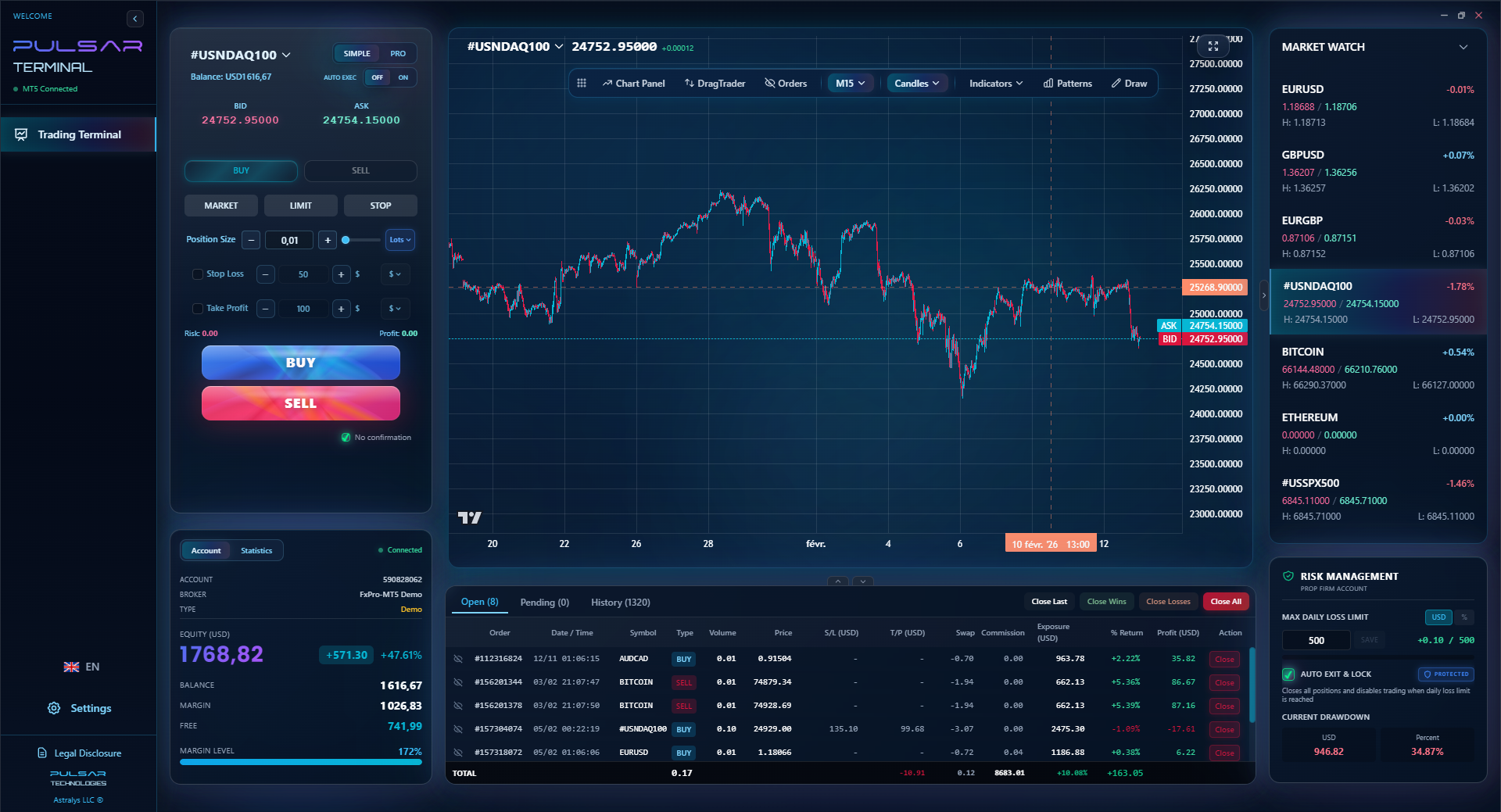
Managing the strict daily loss limits of a prop firm challenge is a precise, high-pressure task that tools like Pulsar Terminal automate, letting you focus on your strategy instead of manual calculations.
Pulsar Terminal
MT5一站式工具:拖拽下单、多重止盈/止损、追踪止损、网格交易、成交量分布图和自营交易保护。每日1000+交易者使用。
FAQ
Q1Do I need a license to get a forex job in South Africa?
You don't need your own license to be hired. However, to perform any regulated function (giving advice, dealing, etc.), your employer must register you as a Representative under their FSCA Financial Services Provider (FSP) license. You will then need to pass the FSCA's Regulatory Exams (REs). The employer usually guides you through this process.
Q2What is the average salary for a forex trader in South Africa?
There's no true 'average' as it varies wildly. A junior trader at a bank or brokerage might earn R180,000 - R350,000 base. An experienced, profitable trader can earn R500,000 to well over R1.5 million, with most of that coming from performance bonuses. Independent prop traders have no salary; their income is 100% from their trading profits.
Q3Is forex trading a good career in South Africa?
It can be, but it's not for everyone. The employed career path in banks and brokerages offers stability and structure but can be high-pressure. The independent trader path offers unlimited potential but comes with high risk, no benefits, and requires immense self-discipline. It's a good career for those genuinely passionate about markets, resilient, and numerically inclined.
Q4What qualifications are best for a forex job?
A Bachelor's degree in Finance, Economics, Financial Mathematics, or a BCom is the standard entry point. Postgraduate qualifications like a Postgrad Diploma in Financial Planning (for FAIS) or the Chartered Financial Analyst (CFA) program are highly regarded and often accelerate career progression.
Q5Can I work for an international broker from South Africa?
Yes, many global brokers like Pepperstone, IC Markets, and Exness have offices or strong operational focus in South Africa, hiring locally for sales, marketing, compliance, and support roles. Some may also hire remote analysts or support staff. Always verify the broker is FSCA regulated for roles dealing with South African clients.
Q6What's the difference between a trader at a bank and a broker?
A bank trader (e.g., at Absa or Standard Bank) typically deals with large institutional clients, corporate forex needs, and market-making. A trader at a retail brokerage might manage the firm's risk exposure from client trades or execute on behalf of high-net-worth clients. The brokerage environment is often more focused on retail CFD products and different currency pairs.
Winston 教授的课程
要点总结:
- ✓Over 80% of retail traders fail; professional roles offer a structured alternative.
- ✓FSCA compliance knowledge is a non-negotiable career asset.
- ✓Start in support roles (ops, compliance) for foundational market knowledge.
- ✓A real track record, even small, beats empty promises on a CV.
这篇文章对您有用吗?
点击星星评分
每周交易洞察
免费每周分析与策略。无垃圾邮件。
关于作者
David van der Merwe
新兴市场交易员
约翰内斯堡交易者,11年新兴市场货币经验。专注于ZAR货币对、FSCA监管交易和南非市场分析。
评论
风险提示
金融工具交易存在重大风险,可能不适合所有投资者。过往业绩不代表未来表现。本内容仅供教育目的,不构成投资建议。在交易前请务必自行研究。
您可能还喜欢

Cara Trading Forex Sukses: 7 Prinsip dari Trader Profesional
Cara trading forex sukses dengan 7 prinsip trader pro: manajemen modal, disiplin, journal trading, backtest. Data nyata, bukan janji profit palsu.
Jam Trading Forex Terbaik untuk Trader Indonesia: Panduan Lengkap dengan Tabel Waktu
Panduan jam trading forex untuk trader Indonesia. Tabel 4 sesi dunia, jam emas 20:00-00:00, sesi mana yang harus dihindari. Data akurat + tips dari trader berpengalaman.
Top 5 Sàn Forex Uy Tín Nhất 2026: Review Jujur dari Trader Indonesia
Top 5 sàn forex uy tín 2026 untuk trader Indonesia. Review jujur: spread, deposit, withdraw, dukungan lokal. Exness, XM, IC Markets & lebih.
