


You're looking at a potential trade, your broker is offering you 1:400 use, and you're wondering just how much of your capital you're really putting on the line, right? I've been there.

Olumide Adeyemi
西非交易先驱 ·  Nigeria
☕ 8 分钟阅读
您将学到:
You're looking at a potential trade, your broker is offering you 1:400 use, and you're wondering just how much of your capital you're really putting on the line, right? I've been there. That initial thrill of controlling a $40,000 position with just $100 is intoxicating, until the market moves 30 pips against you and your account is down 30%. That's the reality check a forex use calculator provides. In Nigeria, where we often trade with international brokers offering high use, this tool isn't a nice-to-have, it's a survival kit. Let me walk you through how I use it, the hard lessons I learned by ignoring it, and how you can apply it to trade smarter with your hard-earned Naira.
Forget the fancy name. A forex use calculator is just a digital safety check. You plug in your trade details, and it tells you three critical things before you click 'buy' or 'sell': the exact margin (your cash commitment), the pip value (what each tiny market move costs or earns you), and your potential profit or loss at different price points.
In simple terms, it translates broker use into real Naira and Kobo risk. Your broker might say "1:400 use available!" That sounds like free power. The calculator shows you the truth: to control a $10,000 (roughly ₦15M) position with 1:400 use, you need $25 (about ₦37,500) as margin. That also means a 25-pip move against you wipes out that entire $25. Suddenly, that 'free power' has very real consequences.
I don't rely on my broker's platform estimates alone. Early on, I assumed they were always correct. One time on Exness, I entered a gold (XAU/USD) trade. The platform's margin estimate seemed off. I ran the numbers through a standalone calculator and found a discrepancy due to the instrument's specific margin requirements. It saved me from a margin call I wouldn't have seen coming. Always double-check.

💡 Winston 小贴士
use is a loan from your broker. A forex use calculator shows you the interest rate on that loan: it's 100% of your margin if you're wrong. Would you take that bank loan?
Our trading environment has unique pressures that make pre-trade calculation essential.
First, the use Reality. Many brokers serving our market, like FXTM, cap use for Nigerian clients at 1:400. Others, like IC Markets or Pepperstone, might offer 1:500. High use is accessible, which is a double-edged sword. A calculator forces you to respect it.
Second, Currency Conversion Headaches. Our accounts are in USD, but our living costs are in Naira. You might think, "It's just a $50 loss." But when you convert that to ₦75,000 at ₦1,500/$, the sting is real. A use calculator helps you frame every trade in both currencies from the start. Seeing that a 50-pip stop-loss equals ₦37,500 on a standard lot makes you think twice about your position size.
Third, Regulatory Gray Areas. Since the SEC hasn't set specific retail forex rules yet, we're relying on international brokers' systems. Their risk warnings are generic. The calculator personalizes risk management for your specific account size. It's the discipline the market doesn't force on you, but you must force on yourself.

Warning: Never confuse high use with a recommendation to use it. 1:400 means your mistakes are amplified 400 times. The calculator shows you the cliff's edge; it's your job not to walk off it.
“Without the precise calculation, you're gambling, not trading.”
Let's break down a typical trade I might take, using a hypothetical 1:400 use scenario. Assume $1,000 account balance, trading EUR/USD.
The Trade Plan
- Currency Pair: EUR/USD
- Account Currency: USD
- Trade Size: 0.5 Standard Lots (50,000 units)
- use: 1:400
- Entry Price: 1.0850
- Stop-Loss: 1.0820 (30 pips away)
What the Calculator Tells Us
- Required Margin: (Trade Size / use) * Entry Price. So, (50,000 / 400) * 1.0850 = $135.63. This is the actual cash 'locked up' to open this trade.
- Pip Value: For a USD account with EUR/USD, 1 pip on a standard lot is $10. For 0.5 lots, it's $5 per pip.
- Risk on This Trade: Stop-loss is 30 pips away. 30 pips * $5 per pip = $150 potential loss.
The Reality Check
My account is $1,000. This single trade risks $150, or 15% of my account. That's insane for one trade. Most sane risk management caps it at 1-2%. The calculator just stopped me from making a terrible decision. I'd need to reduce my lot size to 0.07 lots to risk a more reasonable 2% ($20). The forex use calculator makes this adjustment instantaneously.

Example: Here’s how the numbers change with a safer lot size:
- New Trade Size: 0.07 Lots
- New Required Margin: ~$19
- New Pip Value: $0.70
- Risk (30 pips): $21 (2.1% of account)
See the difference? The same strategy, but now survivable.
I learned about use calculators the hard way. Here's where I got burned.
Mistake 1: Ignoring Margin on Multiple Trades. I once had three seemingly small positions open on XM: EUR/USD, GBP/JPY, and Gold. I calculated margin for each in isolation. What I missed was the total margin used. My account equity dipped, and because all positions used margin, I got a margin call faster than I expected. The calculator showed individual safety, but I failed to assess the collective danger.
Mistake 2: Forgetting Volatility Changes Everything. I calculated a safe position for EUR/USD during the London session. I then used the same lot size on GBP/JPY, a notoriously volatile pair, without recalculating. A 50-pip move in GBP/JPY costs far more than in EUR/USD. The calculator would have shown me the pip value difference instantly. I lost 8% on that trade because I was lazy.
Mistake 3: Trading Without a Calculator in a Fast Market. During a major news event, I entered a scalping trade manually, estimating the margin. In the frenzy, I mis-sized the lot. What I intended as a 1% risk trade became a 5% risk trade. I won the trade, but the lesson was scarier than any loss: without the precise calculation, you're gambling, not trading.

Pro Tip: Make the calculator part of your pre-trade checklist, like a pilot's pre-flight routine. No calculation, no trade. It's that simple.
💡 Winston 小贴士
If the number from the use calculator makes you slightly uncomfortable, it's probably correct. If it feels exciting and greedy, halve your position size immediately.
“High use is accessible, which is a double-edged sword. A calculator forces you to respect it.”
The use calculator isn't a standalone tool. It's the first input into your broader risk management system.
1. It Dictates Position Sizing. This is the biggest one. Your stop-loss distance (in pips) multiplied by the pip value (from the calculator) equals your monetary risk. You should decide your monetary risk first based on your account size (e.g., 1% = $10 on a $1,000 account). Then, use the calculator to work backward to find the lot size that makes the equation work.
2. It Informs Your use Choice. Just because you can use 1:400 doesn't mean you should. If your calculator shows that using 1:100 use gives you a comfortable margin requirement and sensible position size, use that. Lower use is a psychological cushion. I often trade major pairs with 1:50 or 1:100 now, even though 1:400 is available. It lets me sleep.
3. It Connects to Your Trading Style. A swing trading position held for days will have swap (overnight financing) costs. Some advanced calculators estimate this. A 0.5-lot position in GBP/USD might cost you $5 a night to hold. Over a week, that's $35, which can turn a winning trade into a breakeven one. Factor it in.
Using a tool like a position size calculator that incorporates use, stop-loss, and account risk is the ultimate integration. It automates the entire safety process.
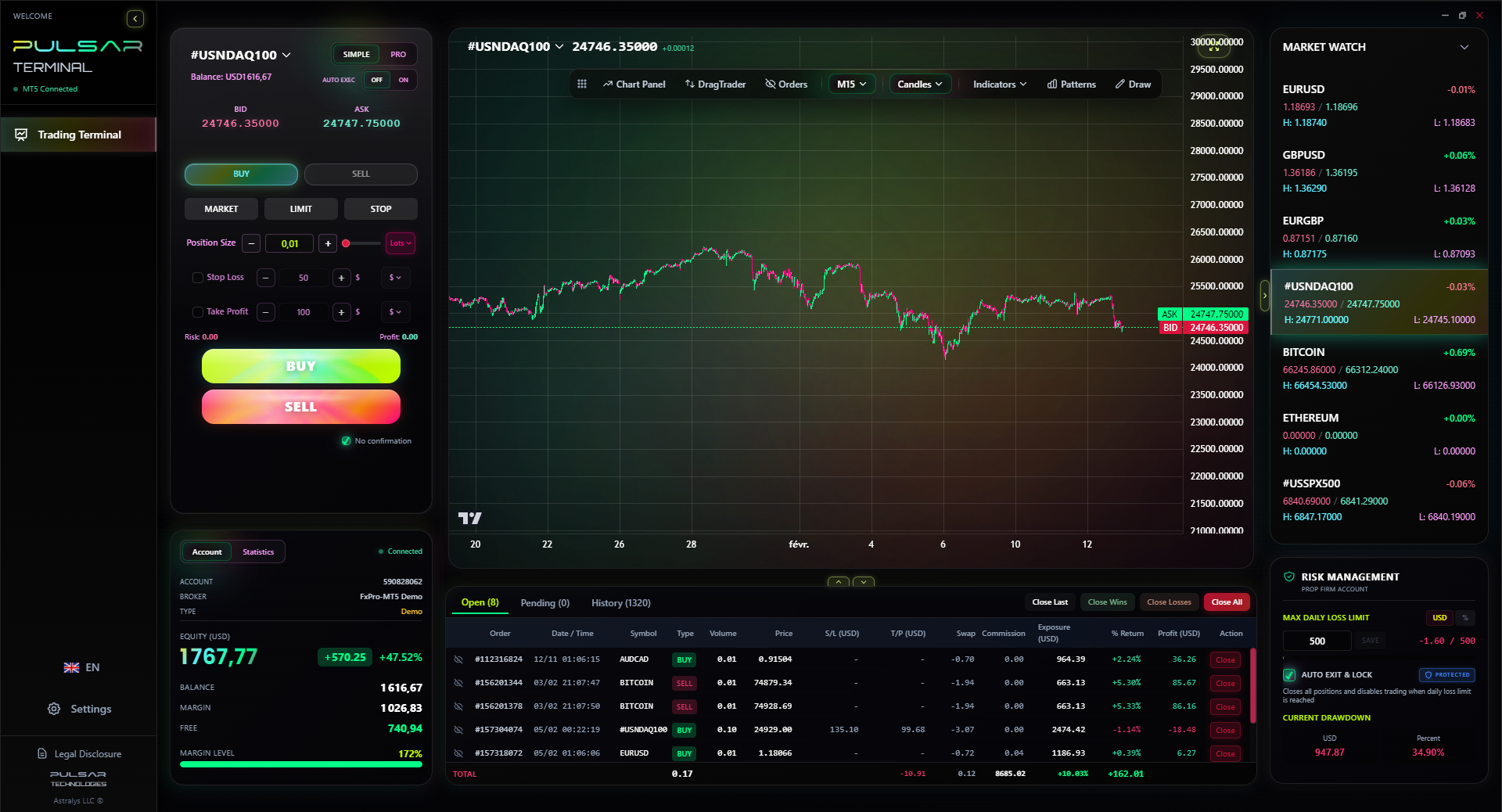
Once your leverage calculator sets your risk, tools like Pulsar Terminal can automate the execution of complex orders like multi-level take-profits directly on your MT5 chart, ensuring you stick to the plan you calculated.
Pulsar Terminal
MT5一站式工具:拖拽下单、多重止盈/止损、追踪止损、网格交易、成交量分布图和自营交易保护。每日1000+交易者使用。
Let's get down to brass tacks for our specific situation.
- Find a Good Calculator: Use one from a reputable trading education site or your broker's website. Ensure it lets you input account currency (USD), trade size in lots, and select your use ratio.
- Always Convert to Naira Mentally: After the calculator gives you a USD risk figure, do the quick Naira conversion. Is losing ₦45,000 on a single trade acceptable to you? That mental conversion is a powerful deterrent to over-leveraging.
- Beware of Naira Volatility Too: The USD/NGN rate fluctuates. The $100 you deposited might have been worth ₦140,000, but when you withdraw, it could be ₦155,000 or ₦130,000. This is an extra layer of risk/reward the calculator can't show. Consider it part of your overall financial picture.
- Test on Demo First: Before risking real money, practice your entire process on a demo account. Plan a trade, use the calculator, execute it, and see how the P&L aligns with the calculator's projection. This builds trust in the tool and your process.
- Link It to Platform Tools: Modern tools can bridge this gap. For instance, setting a multi-level take-profit or a trailing stop requires knowing your pip values precisely.
, the forex use calculator is the embodiment of the old trader's saying: "Plan your trade, and trade your plan." It turns a vague plan into specific, actionable, and safe numbers.
FAQ
Q1Is 1:400 use safe for a beginner in Nigeria?
No, it's incredibly dangerous. It's like giving a new driver a Formula 1 car. The use calculator will show you how quickly small market moves can wipe out your account. Beginners should practice with 1:10 or 1:25 use on a demo account to understand the relationship between pip movement and P&L before even considering higher levels.
Q2My broker's platform shows margin, why do I need a separate calculator?
Trust, but verify. The platform shows the broker's required margin. A separate calculator allows you to experiment with different scenarios (what if I used lower use? what if my stop-loss was wider?) without placing an order. It's a planning tool, not just a display. Discrepancies can also occur, so it's good to have a second source.
Q3How does lot size affect my calculation?
It's everything. Lot size directly determines your pip value. A standard lot (1.0) on EUR/USD = $10 per pip. A mini lot (0.1) = $1 per pip. The use calculator uses your chosen lot size to tell you exactly how much each pip movement is worth in your account currency, which is the foundation for measuring risk and reward.
Q4Can I use a use calculator for crypto or gold trading?
Yes, but you must be careful. The underlying formula is the same, but the contract sizes and pip/point definitions differ. For example, gold (XAU/USD) often trades per ounce, and a 1-point move has a different value than a 1-pip move in forex. Ensure your calculator is configured for CFDs or the specific instrument you're trading.
Q5What's the biggest mistake Nigerians make with use?
Converting the high use ratio directly into potential profit in their mind, while ignoring the equivalent risk. They see 1:400 and think "I can turn ₦50,000 into ₦20M." The use calculator forces you to see the other side: "A 25-pip move can turn my ₦50,000 into ₦0." It's a crucial perspective shift.
Q6Do I need to calculate for every single trade?
Absolutely, yes. Every trade is unique - different pair, different volatility, different stop-loss distance. Even if you trade the same pair repeatedly, your account size changes, or your risk tolerance might adjust. The 60 seconds it takes to run the numbers is the cheapest insurance you'll ever buy.
Winston 教授的课程
要点总结:
- ✓Always calculate margin and pip value before every single trade.
- ✓Risk no more than 1-2% of account equity per trade.
- ✓High use (1:400) is for risk control, not aggression.
- ✓Convert USD risk to Naira to feel the real-world impact.
这篇文章对您有用吗?
点击星星评分
每周交易洞察
免费每周分析与策略。无垃圾邮件。
关于作者
Olumide Adeyemi
西非交易先驱
尼日利亚最活跃的外汇交易教育者之一。从拉各斯出发有8年交易经验。专注于低资金策略和面向非洲交易者的自营公司挑战。
评论
风险提示
金融工具交易存在重大风险,可能不适合所有投资者。过往业绩不代表未来表现。本内容仅供教育目的,不构成投资建议。在交易前请务必自行研究。
您可能还喜欢

Cara Trading Forex Sukses: 7 Prinsip dari Trader Profesional
Cara trading forex sukses dengan 7 prinsip trader pro: manajemen modal, disiplin, journal trading, backtest. Data nyata, bukan janji profit palsu.
Jam Trading Forex Terbaik untuk Trader Indonesia: Panduan Lengkap dengan Tabel Waktu
Panduan jam trading forex untuk trader Indonesia. Tabel 4 sesi dunia, jam emas 20:00-00:00, sesi mana yang harus dihindari. Data akurat + tips dari trader berpengalaman.
Top 5 Sàn Forex Uy Tín Nhất 2026: Review Jujur dari Trader Indonesia
Top 5 sàn forex uy tín 2026 untuk trader Indonesia. Review jujur: spread, deposit, withdraw, dukungan lokal. Exness, XM, IC Markets & lebih.
