


I lost 150,000 NGN in one afternoon back in 2017.

Olumide Adeyemi
西非交易先驱 ·  Nigeria
☕ 13 分钟阅读
您将学到:
- 1What is the Forex Market? A Simple Definition
- 2How Forex Works in Nigeria: New Rules & Real Costs
- 3Getting Started: Choosing a Broker & Opening an Account
- 4Analyzing the Market: Practical Steps, Not Theory
- 5The Nigerian Trader's Mindset: Managing Risk & Psychology
- 6Common Mistakes to Avoid as a Beginner
I lost 150,000 NGN in one afternoon back in 2017. I thought I understood the forex market meaning - buy low, sell high, simple. I'd watched a few YouTube videos, opened an account with $100, and jumped on a EUR/USD trade because it 'looked' like it was going up. I didn't understand spreads, use, or that the market was closed for a bank holiday in Europe. The price barely moved, then jerked against me. My entire account was wiped out on a 30-pip move. That loss taught me the hard way that the real forex market meaning isn't about getting rich quick. It's about understanding a massive, decentralized system where your local Naira connects to the global economy. Let me walk you through what it actually is, how it works here in Nigeria, and how you can start on the right foot.
At its core, the forex market meaning is straightforward: it's where you exchange one currency for another. You do this every time you travel. If you're going to Ghana and change your Naira to Cedis at a bureau de change, you've participated in the forex market. The global online market is just a gigantic, digital version of that, operating 24 hours a day, five days a week.
The key difference for traders is intent. You're not changing money to spend on holiday. You're speculating on the future value of a currency pair, hoping to buy it at one price and sell it at a higher one (or vice versa). The entire market is built on these pairs, like EUR/USD or GBP/JPY. When you trade, you're always buying one currency while simultaneously selling the other.

Example: Let's say the USD/NGN rate is 1500. This means 1 US Dollar costs 1,500 Nigerian Naira. If you believe the Naira will strengthen (the number will go down), you'd sell the USD/NGN pair. If it drops to 1450, you've made 50 Naira per dollar traded.
It's the largest financial market on earth, with a daily turnover shaking out to over $7.5 trillion. That's more than the combined volume of all the world's stock markets. This size means liquidity is huge - orders get filled quickly. But it also means you're up against banks, hedge funds, and governments. Understanding this scale is the first step in respecting the market.
For us in Nigeria, this isn't some abstract concept. Movements in USD/NGN directly impact the cost of imported goods, from fuel to phones. Trading it, or major pairs like EUR/USD, is a way to potentially profit from these global economic shifts. But you have to know the rules of the game first, especially the new ones from our own regulators.
“The real forex market meaning isn't about getting rich quick. It's about understanding a massive, decentralized system where your local Naira connects to the global economy.”
This is the most important part for any Nigerian trader right now. The rules changed in 2025, and if you don't know them, you could be trading illegally.
The New Regulatory Landscape
For years, online retail forex trading existed in a grey area. The Securities and Exchange Commission (SEC) Nigeria basically said, 'We don't regulate this, so you're on your own.' That changed dramatically in March 2025 with the Investments and Securities Act (ISA) 2025. Now, it's an offense for any platform offering online forex trading to Nigerians to operate without being registered with the SEC. This is a big deal. It means the government is stepping in to try and clean up the space, though enforcement on international brokers is still evolving.
The Central Bank of Nigeria (CBN) handles the broader market framework. In 2023, they unified the foreign exchange windows into a single 'willing buyer, willing seller' market. This affected the official rates and banking liquidity, which indirectly influences the environment we trade in.

Warning: Just because a big international broker like Exness or IC Markets accepts you as a client doesn't mean they are SEC-registered. You are likely trading under their offshore license (e.g., Seychelles FSA). You're not breaking the law as a trader, but your protections are different. Always do your own broker due diligence.
The Real Costs of Trading (Forget the 'Zero Commission' Ads)
Brokers make money, and you need to know exactly how they make it from you.
- The Spread: This is the difference between the buy (ask) and sell (bid) price. It's your primary cost. On a standard account for EUR/USD, expect 0.6 to 0.9 pips. On a raw ECN account, it might be 0.0 pips, but then you pay a commission. A pip is the smallest price move, and its value depends on your trade size (our pip definition guide breaks this down).
- Commissions: Often $3-$7 per standard lot (100,000 units of currency).
- Swap Fees: If you hold a trade overnight, you pay or receive interest based on the difference between the two currencies' central bank rates. This can add up in swing trading.
- The Hidden Tax: Here's one many new traders miss. You are liable for a 10% Capital Gains Tax on your gross trading profits in Nigeria. It doesn't matter if your broker is in Cyprus or the Seychelles. If you make 1,000,000 Naira profit, you owe 100,000 Naira to the tax authority. Keep immaculate records.
Let me give you a real example of costs from a trade I took last month. I bought 2 standard lots of GBP/USD on an ECN account. Spread was 0.2 pips ($4 cost), commission was $7 per lot ($14 total). My entry cost was $18 before the market even moved. I needed the trade to move over 1 pip in my favor just to break even on costs. This is why understanding your broker's fee structure is non-negotiable.

💡 Winston 小贴士
The market's primary job is to transfer money from the impatient to the patient. Your first year isn't for making money; it's for not losing your capital while you learn.
“High use is a double-edged sword. It's the fastest way to a margin call. Start low (1:10 or 1:20) to learn.”
Your broker is your gateway to the market. Choosing the wrong one is like trying to drive from Lagos to Abuja with a faulty engine and no spare tyre.
Most Nigerian traders use internationally regulated brokers. Here’s a quick comparison of what you’ll typically find:
| Feature | Typical Range for Nigerian Traders | What to Watch Out For |
|---|---|---|
| Minimum Deposit | $1 - $100 | A $1 minimum is a marketing gimmick. You can't trade properly with that. I recommend starting with at least $200-$500 to withstand normal market noise. |
| use Offered | 1:500 up to 1:2000+ | This is a double-edged sword. High use (like 1:1000 from some brokers) magnifies both profits and losses. It's the fastest way to a margin call. Start low (1:10 or 1:20) to learn. |
| Platform | MT4, MT5, cTrader | MT4 is the old reliable, MT5 is more advanced. Most brokers offer them. Check if they support your preferred payment methods. |
| Deposit/Withdrawal | Bank Transfer, Cards, E-wallets (Paga, Opay) | Bank transfers can be slow (2-5 days) and cost $20-$50. E-wallets like Skrill are faster but may have fees (2-3%). Some brokers like XM offer fee-free deposits for certain methods. |
My process for choosing a broker is simple. First, I check independent reviews (like our Exness review or IC Markets review) to see what real users say about withdrawals. Withdrawal reliability is the #1 test. Second, I open a demo account with my top 2 choices. I trade on them for a full week. I check the execution speed, the spreads during volatile news events (like US Non-Farm Payrolls), and how intuitive their platform is.
Once you choose, opening an account is straightforward: email, verification (passport/National ID, utility bill), deposit, and you're in. But don't deposit real money yet. Use the demo account to practice for at least two months. I didn't do this, and it cost me that 150k Naira I mentioned.

Pro Tip: When testing a broker's demo, try to withdraw 'virtual' profits. See how many hoops they make you jump through in the demo environment. It can be a telling sign of their real withdrawal process.
“Your stop loss is your lifeline. It's an admission that you can be wrong.”
Analysis is how you form a trading idea. There are two main schools of thought, and I use a blend of both.
Technical Analysis: This is studying price charts to find patterns and trends. You're looking at what HAS happened to guess what MIGHT happen. Tools like support/resistance lines, the RSI indicator (to spot overbought/oversold conditions), and the MACD indicator (to gauge momentum) are your bread and butter.
Here's a real example. In January, I was watching Gold (XAU/USD). The price had bounced off a support level near $2015 three times. The RSI indicator was showing oversold conditions below 30. That was my signal. I went long at $2018. I set my stop loss below the support at $2009 (risking $9 per ounce). My take profit was at the next resistance level, $2045. The trade worked, netting a $27 move per ounce. The chart told the story. You can learn more about trading Gold in our XAU/USD guide.
Fundamental Analysis: This looks at the economic 'why' behind price moves. For a currency, that means interest rates (set by the CBN for Naira, the Fed for USD), inflation data, employment numbers, and political stability. When the CBN announces a rate hike, the Naira typically strengthens (in theory). When the US releases strong jobs data, the USD often rallies.
The best trades often line up both technical and fundamental factors. For instance, if EUR/USD is at a key technical support level AND the European Central Bank is sounding hawkish on inflation, the probability of a bounce is higher.
But here's my admitted mistake: I used to ignore fundamentals, thinking charts were all I needed. In 2022, I was short on GBP/USD based on a perfect chart pattern. I didn't check the economic calendar. The Bank of England surprised everyone with a massive 0.75% rate hike. The pair ripped 200 pips against me in minutes, blowing through my stop loss and turning a winning setup into a nasty loss. Now, I always check the calendar.
Example: Let's say you're trading EUR/USD. A key technical level is at 1.0850. The US Inflation data (CPI) is due at 1:30 PM Nigerian time. The smart move? Either close your trade before the news or ensure your stop loss is wide enough to survive the inevitable spike in volatility. Most of my early losses came from having stops too tight around news events.
💡 Winston 小贴士
If you can't articulate the fundamental reason for a currency's move in one sentence, you're trading noise, not a market. Always know the 'why'.
“Your stop loss is your lifeline. It's an admission that you can be wrong.”
This is where careers are made or broken. You can have the best analysis in the world, but without risk management and the right mindset, you'll lose.
Risk Management is Not Optional: Before you enter any trade, you must know three things: your entry price, your stop loss price, and your take profit price. Your stop loss is your lifeline. It's an admission that you can be wrong. I never, ever risk more than 1% of my trading capital on a single trade. On a $1,000 account, that's $10. If my stop loss is 50 pips away, I can only afford to trade a micro lot (0.01) where each pip is worth $0.10. This keeps me in the game. Use a position size calculator religiously. It's the most important tool you have.
The Psychology Battle: Trading in Nigeria comes with unique pressures. You see the Naira fluctuating, you feel the economic pressure, and there's a huge temptation to try and 'fix' it with one big trade. This is how you blow up an account. Greed and fear are your biggest enemies. Greed makes you hold a winning trade too long, hoping for more. Fear makes you cut a winning trade short or, worse, remove your stop loss on a losing trade (a guaranteed account killer).
I learned this lesson trading USD/NGN during a period of high volatility. I had a small profit, but I got greedy. I thought, 'This is it, the Naira is going to 2000!' I moved my stop loss to breakeven, then removed it entirely. The market reversed. My small profit turned into a significant loss that wiped out a week's gains. I broke my own rules because of emotion.
The market doesn't care about your rent, your bills, or your dreams. It's a machine. Your job is to build a mechanical process around your emotions. Have a written trading plan and follow it, even when every fiber of your being is screaming to do otherwise. This discipline is what separates a gambler from a trader.
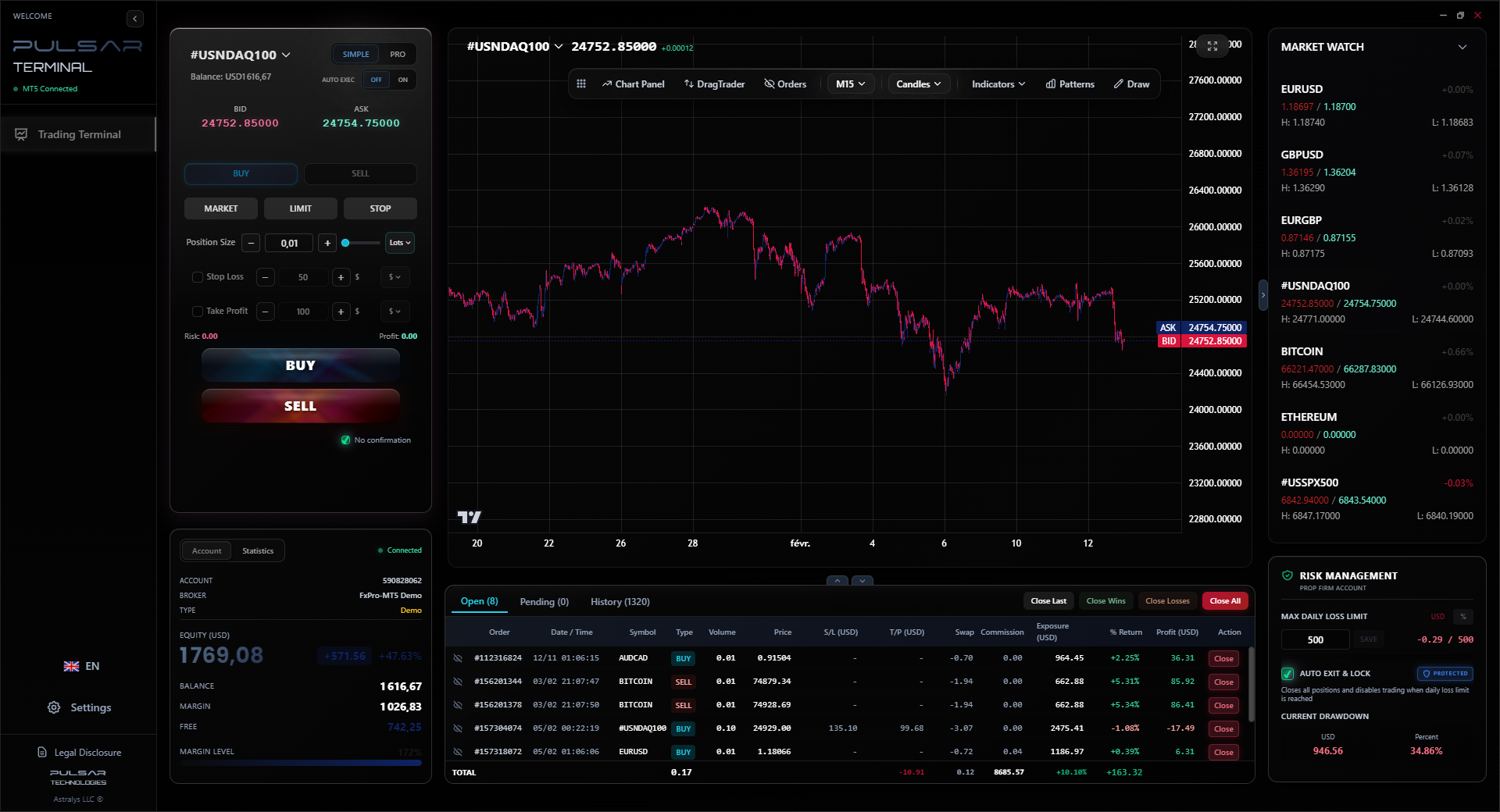
Automation can be a huge help here. Using tools that automatically move your stop loss to breakeven after a certain profit, or trail your stop to lock in gains, removes emotional decisions. It lets the trade run while you sleep.
Building a mechanical process to manage trades and emotions is key, and Pulsar Terminal automates this with features like one-click trailing stops and breakeven orders directly on your MT5 charts.
Pulsar Terminal
MT5一站式工具:拖拽下单、多重止盈/止损、追踪止损、网格交易、成交量分布图和自营交易保护。每日1000+交易者使用。
“The market doesn't care about your rent, your bills, or your dreams. It's a machine. Your job is to build a mechanical process around your emotions.”
Let's fast-track your learning by avoiding the pitfalls I and countless others have fallen into.
- Trading with Money You Can't Afford to Lose: This is rule zero. If you need that 100,000 Naira for school fees or rent, do not put it in a trading account. The psychological pressure will force you into bad decisions. Trade only with true risk capital.
- Overusing use: I see ads screaming '1:2000 use!' and I cringe. use is a tool for professionals who understand position sizing intimately. As a beginner, high use is a suicide pill. It turns a normal 20-pip move into an account-ending event. Stick to 1:10 or 1:20 max.
- Chasing Losses: You have a bad day and lose 2% of your account. The urge is to immediately jump back in with a bigger trade to 'make it back.' This is how a 2% loss becomes a 20% loss in an hour. After a loss, walk away. Close the platform. Come back tomorrow with a clear head.
- No Trading Plan: Entering a trade because you 'have a feeling' is gambling. A plan states: I will enter when X condition happens on the chart. My stop loss is Y pips away, risking Z dollars. My target is A. Without this, you're just throwing darts.
- Ignoring the Total Cost: As we discussed, remember the 10% Capital Gains Tax. Set that money aside from your profits immediately. Also, factor in all broker fees when calculating your potential profit. A trade that nets 10 pips but costs you 3 in spreads and commissions is really only a 7-pip win.
- Trading Too Many Pairs: Start with one major pair. EUR/USD is the most liquid and often has the lowest spread definition. Learn its personality. Don't jump between EUR/USD, GBP/JPY, and USD/NGN all at once. Master one market first. Our EUR/USD guide is a great place to start.
The forex market meaning, in practice, is a marathon of disciplined execution, not a sprint to riches. It's a skill you build over years. Focus on preserving your capital first. Profits will follow.
💡 Winston 小贴士
Write down every trade: entry, exit, reason, and emotional state. After 100 trades, you won't see market patterns - you'll see your own. That's the gold.
FAQ
Q1Is forex trading legal in Nigeria?
Yes, forex trading is legal for individuals in Nigeria. However, the regulatory environment changed in 2025. The new Investments and Securities Act (ISA) 2025 requires any platform offering online forex trading services to Nigerians to be registered with the SEC Nigeria. As a trader, you are not breaking the law by trading with an international broker, but you should be aware that many operate under offshore licenses, which means different investor protection rules apply.
Q2How much money do I need to start forex trading in Nigeria?
Technically, you can start with as little as $1 with some brokers, but this is not practical. To trade properly with sensible risk management (e.g., not risking more than 1-2% per trade), a more realistic starting amount is between $200 and $500. This allows you to withstand normal market volatility without being wiped out by a single small move. Remember, your starting capital is a learning fee; expect to preserve it, not double it immediately.
Q3What is the best forex trading strategy for beginners?
The best strategy is a simple one you can execute consistently. For beginners, I recommend starting with swing trading on higher timeframes (like the 4-hour or daily chart). This avoids the stress and high costs of scalping strategy. Focus on trading with the trend - buy when the price is above key moving averages in an uptrend, sell when below in a downtrend. Use the RSI to find entry points and always, always use a stop loss. Paper trade this simple method for at least 2 months before using real money.
Q4How do I pay taxes on forex trading profits in Nigeria?
Forex trading profits are subject to a 10% Capital Gains Tax in Nigeria. This is on your gross profits. You are responsible for declaring this income and paying the tax to the Federal Inland Revenue Service (FIRS), regardless of whether your broker is based in Nigeria or overseas. Keep detailed records of all your trades, deposits, and withdrawals to calculate your taxable profit accurately at the end of the year.
Q5Can I trade the Nigerian Naira (NGN) on forex platforms?
Yes, but not directly like EUR/USD. The USD/NGN pair is traded on the international forex market, but its liquidity is much lower than major pairs, and spreads are often very wide. Many international brokers do not offer it. Your exposure to the Naira's value is often through the exchange rate you get when depositing or withdrawing from your trading account. Some local platforms may offer Naira-based CFDs, but you must verify they are properly licensed under the new SEC rules.
Q6What is the difference between a demo account and a live account?
A demo account uses virtual money. It's for practicing your strategy, learning the platform, and making mistakes without financial consequence. A live account uses your real money. The critical difference is psychology. On a demo, a 100-pip loss feels like nothing. On a live account, a 10-pip loss can trigger panic. This is why you must treat your demo account seriously - trade it with the same risk rules and emotional discipline you plan to use with real capital.
Winston 教授的课程
要点总结:
- ✓Risk only 1% of capital per trade.
- ✓10% Capital Gains Tax applies to all profits.
- ✓New SEC rules require platform registration.
- ✓Master one currency pair first.
- ✓use above 1:20 is dangerous for beginners.
这篇文章对您有用吗?
点击星星评分
每周交易洞察
免费每周分析与策略。无垃圾邮件。
关于作者
Olumide Adeyemi
西非交易先驱
尼日利亚最活跃的外汇交易教育者之一。从拉各斯出发有8年交易经验。专注于低资金策略和面向非洲交易者的自营公司挑战。
评论
风险提示
金融工具交易存在重大风险,可能不适合所有投资者。过往业绩不代表未来表现。本内容仅供教育目的,不构成投资建议。在交易前请务必自行研究。
您可能还喜欢

Cara Trading Forex Sukses: 7 Prinsip dari Trader Profesional
Cara trading forex sukses dengan 7 prinsip trader pro: manajemen modal, disiplin, journal trading, backtest. Data nyata, bukan janji profit palsu.
Jam Trading Forex Terbaik untuk Trader Indonesia: Panduan Lengkap dengan Tabel Waktu
Panduan jam trading forex untuk trader Indonesia. Tabel 4 sesi dunia, jam emas 20:00-00:00, sesi mana yang harus dihindari. Data akurat + tips dari trader berpengalaman.
Top 5 Sàn Forex Uy Tín Nhất 2026: Review Jujur dari Trader Indonesia
Top 5 sàn forex uy tín 2026 untuk trader Indonesia. Review jujur: spread, deposit, withdraw, dukungan lokal. Exness, XM, IC Markets & lebih.
