


Let me guess.

David van der Merwe
新兴市场交易员 ·  South Africa
☕ 10 分钟阅读
您将学到:
- 1What Exactly Is a Forex Market Simulator? (It's Not Just a Demo)
- 2Why You, as a South African Trader, Absolutely Need One
- 3How to Choose the Right Simulator: Key Features for South Africans
- 4A Story of Failure: How I Wasted My Simulator Time (And Lost Real Money)
- 5Your 30-Day Structured Simulator Practice Plan
- 6The Scary Jump: Transitioning from Simulator to Live Trading
- 7Top Simulator Pitfalls Every South African Trader Falls Into
- 8Level Up: Advanced Simulator Techniques for the Committed Trader

Let me guess. You've heard the line: 'Just open a demo account, practice for a week, and you'll be ready to make money.' It's the biggest lie told to new traders in South Africa. A forex market simulator isn't a quick tutorial; it's your personal, zero-risk training ground. I blew up my first R5,000 account because I treated my demo like a game. This guide will show you how to use a simulator properly, with a South African mindset, so you don't make my expensive mistakes.
Most people think a forex market simulator is just a fancy name for a demo account. They're wrong. A true simulator replicates every single aspect of live trading, except the money is virtual. We're talking real-time price feeds, real spreads, real slippage on news events, and even the same emotional triggers (though the financial consequence is absent).
In South Africa, this is crucial. You need to get used to trading USD/ZAR, EUR/ZAR, and the major pairs while accounting for our market hours and liquidity. A good simulator from a broker like IC Markets review or Pepperstone review will give you that. The goal isn't to see how high you can run a fake R100,000 balance. The goal is to build habits. Your future self, trying to avoid a margin call, will thank you.

Warning: If you're not feeling frustration, boredom, or impatience on the simulator, you're not using it right. You should be treating every virtual ZAR as if it's real. That's the only way it works.
Trading from SA comes with its own set of challenges. Our internet can be shaky, load-shedding is a real threat to your open trades, and the psychological weight of trading in a volatile economy is unique. A simulator is your lab to stress-test your strategy against these local realities.
Building Discipline with Rand Denominations
It's one thing to see a 50-pip loss on USD/JPY. It feels different when it's a R1,200 loss on your simulated trade. Using a simulator with ZAR-based accounts (or at least mentally converting everything to Rand) builds a realistic sense of value. I made the mistake of practicing only in USD. When I went live, seeing losses in my home currency hit me way harder emotionally.
Testing Through Load-Shedding Schedules
Seriously, run a simulation where you pretend Stage 4 hits right after you enter a trade. What's your plan? Do you have a hard stop-loss set every single time? A simulator lets you practice this discipline without the panic. It forces you to build a system that survives our infrastructure issues.
A simulator also lets you experiment with different styles risk-free. Want to try your hand at a scalping strategy on EUR/USD during the London open? Go for it. Curious about swing trading GBP/ZAR? The simulator is your playground. You can't learn to swim by reading about water.

💡 Winston 小贴士
A simulator is a mirror, not a magic wand. It will faithfully show you who you are as a trader: disciplined or reckless. Don't blame the reflection.
“I blew up my first R5,000 account because I treated my demo like a game.”
Not all demo accounts are created equal. You need a platform that gives you a genuine experience. Here’s what to look for, especially from our perspective.
Realistic Market Conditions: The simulator must have variable spreads that widen during major news events (like SARB interest rate announcements). If the spread on USD/ZAR is always a fixed 2 pips, it's not realistic. Look for brokers known for raw spreads.
Full Platform Functionality: You need access to EVERY tool you'll use live. This includes all order types (limit, stop, market), the ability to set trailing stops, and advanced charting. If you practice on a stripped-down version, you'll be lost when you switch.
Local Currency and Deposit Options: Ideally, the demo should let you choose a ZAR account. At the very least, you should be able to simulate a realistic starting capital. Don't practice with $100,000 if you're only going to deposit R10,000 live. Start with the amount you actually have. I practiced with a simulated R20,000, which forced me to learn proper position size calculator use from day one.
| Feature | Why It Matters for SA Traders | What to Look For |
|---|---|---|
| Spreads & Slippage | ZAR pairs can be illiquid. You need to see realistic execution. | Demo accounts on ECN/RAW broker models (like Exness review or IC Markets). |
| Platform | You'll likely use MT4/MT5. Practice on the real thing. | A demo that is a full, unrestricted copy of MT5. |
| Starting Balance | Build habits relevant to your real capital. | Ability to set a custom balance (e.g., R15,000, not $50,000). |

I want to be brutally honest about my own failure, so you can skip this pain. When I first started, I opened a demo with $50,000. I treated it like a casino. No strategy, just gut feelings. I'd throw on huge positions, sometimes risking 10% of the 'account' on a single gold trade. I had a lucky streak and turned that $50k into $82k in two weeks. I felt like a genius.
I got overconfident and funded a live account with R8,000. My very first live trade was on XAU/USD guide. I saw a similar setup to my 'winning' demo trades. I entered at $1782.50, expecting a quick 15-pip pop. I didn't even set a stop-loss, because 'I could just watch it.' The price dropped $10 instantly. That was a R1,400 loss on my first trade. The virtual $82k win meant nothing. The real R1,400 loss felt like a punch.
The simulator had taught me all the wrong lessons. It rewarded my recklessness. I hadn't practiced risk management, I hadn't practiced patience, and I definitely hadn't practiced dealing with the gut-wrenching feeling of seeing real Rand disappear. I had to go back to the simulator with a new rule: treat it like a real account, with a 1% max risk rule, or don't bother. That's when real learning began.
“Start obscenely small. Your first live goal is not to make money, but to execute your plan perfectly.”
Don't just randomly trade. Follow a plan. This 30-day framework will build skill systematically.
Weeks 1 & 2: The Mechanics. Forget making profit. Your only goal is to master the platform. Practice entering and exiting trades. Set stop-loss and take-profit orders every single time. Use the position size calculator for every hypothetical trade. Pick one or two pairs, like EUR/USD guide and USD/ZAR, and just watch them. Learn what a normal spread definition looks like for each.

Example: Start with a R100,000 sim balance. Your max risk per trade is 1% (R1,000). If your stop-loss is 50 pips on USD/ZAR, your position size must be calculated so that 50 pips = R1,000. Do this calculation manually for 20 trades in a row.
Weeks 3 & 4: Strategy Testing. Now, apply a simple strategy. Maybe it's based on a MACD indicator crossover or support/resistance. Write down the rules. Enter ONLY when all rules are met. Keep a trading journal in the simulator. Note your emotional state. Were you hesitant? Did you jump in early? The goal here is consistency, not profitability.
The Final Test: A Simulated 'Live' Run. Set a concrete goal. "I will take 20 trades that follow my plan exactly, risking no more than 1% per trade." Only if you can do this consistently, with a journal to prove it, should you even consider a live account. This process turns the simulator from a toy into the most valuable training tool you have.
💡 Winston 小贴士
The most valuable data from your simulator isn't your profit/loss. It's your trading journal. Your repeated mistakes are your curriculum.
This is the moment of truth, and it's where most fail. The simulator can't replicate the full adrenaline rush of live trading, but if you've practiced correctly, you'll have a system to fall back on.
Start obscenely small. I'm talking about a live account so small that the profits and losses feel almost meaningless. Your first goal is not to make money. Your first goal is to execute your plan perfectly under real conditions. The psychological difference is real. On a simulator, a losing trade is a data point. Live, it's a critique of your ability. You need to desensitize yourself to that.
Fund a micro account with the minimum deposit at a broker like XM review. Trade the smallest possible lot size. Your mission is to make 10 trades that are perfect copies of what you did on the simulator. The same entry rules, the same stop-loss placement, the same calm exit. If you find yourself hesitating or changing the plan, stop. Go back to the simulator. You're not ready.

Pro Tip: Keep your simulator account open forever. Use it to test new ideas, new indicators like the RSI indicator, or new pairs. Never test a new strategy with real money first. The simulator is your permanent research and development lab.
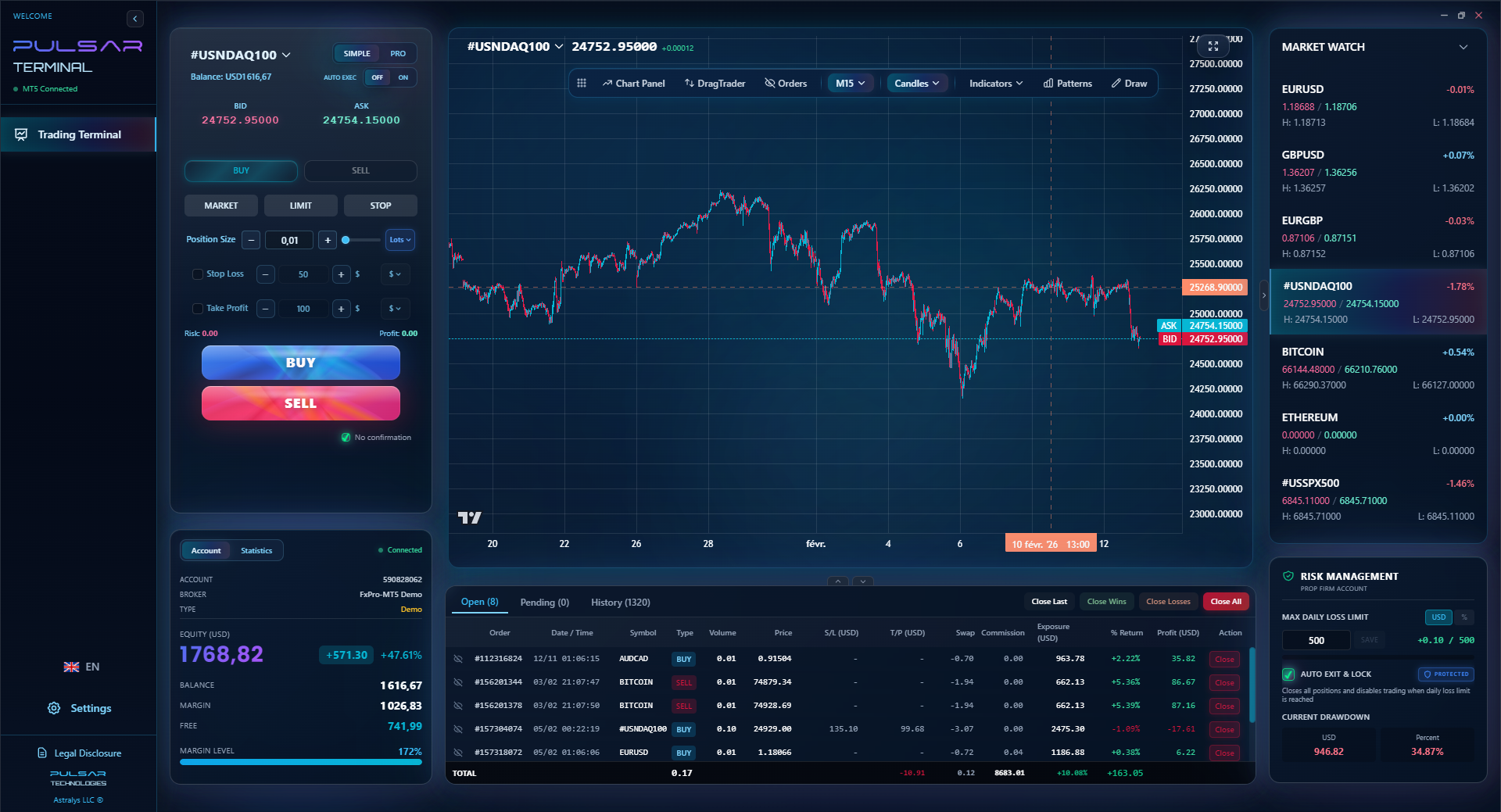
When you transition to live trading, managing multiple trades and complex orders manually is stressful; Pulsar Terminal automates this with drag-and-drop orders and multi-TP/SL tools directly on your MT5 platform.
Pulsar Terminal
MT5一站式工具:拖拽下单、多重止盈/止损、追踪止损、网格交易、成交量分布图和自营交易保护。每日1000+交易者使用。
“If you're not feeling frustration on the simulator, you're not using it right.”
Let's cut to the chase. Here are the traps, based on watching hundreds of traders (and falling into them myself).
Pitfall 1: The Unlimited Reset Mentality. You blow up your sim account? So what, just refresh it. This destroys any concept of risk management. Live accounts don't have a reset button. Practice as if you get one account, forever.
Pitfall 2: Ignoring 'Real' Costs. You take a 5-pip profit and think you're a winner. But did you account for the 3-pip spread? On a simulator, you must deduct the spread from your calculated profit to see your true net. That R200 win might only be R80 after costs.
Pitfall 3: Trading Pairs You Don't Understand. Just because USD/TRY has huge moves doesn't mean you should practice on it. Stick to the majors and the ZAR crosses you'll actually trade. Understand what moves the Rand.
Pitfall 4: No Journaling. If you're not writing down why you took each sim trade, you're not learning. You're just clicking buttons. Your journal is your feedback loop. My biggest leaps came from reviewing weeks of simulator journal entries and spotting my own stupid, repetitive mistakes.
💡 Winston 小贴士
If you can't be bored on a simulator - waiting patiently for your one perfect setup - you will be terrified and impulsive with real money.

Once you've mastered the basics, the simulator becomes a powerhouse for advanced development.
Historical Backtesting: This is a simulator's superpower. Most platforms let you replay past market data. Take a specific week, like the one with a SARB rate decision, and trade it in fast-forward. See how your strategy would have held up. Did the spread widen and trigger your stop-loss prematurely? This is useful, real-world data you can't get any other way.
Stress Testing Your Psychology: Deliberately put on a losing trade. Let it run against you to your full stop-loss. Sit there and watch the virtual loss hit. Don't look away. This sounds masochistic, but it builds tolerance for the inevitable losing streaks. The goal is to feel the emotion, acknowledge it, and see that the world doesn't end. Your plan handled it.
Scenario Planning: Create 'what-if' drills. What if I enter a trade and my internet drops? My plan is to have a stop-loss set. What if load-shedding hits for 4 hours? My plan is to never hold a trade without a stop. The simulator is the perfect, consequence-free environment to run these mental fire drills. By the time you go live, these responses should be automatic, freeing your mind to focus on analysis.
FAQ
Q1Are forex market simulators really free in South Africa?
Yes, absolutely. Every reputable international and local broker offers a free demo account (simulator) to attract clients. There is no cost. The 'cost' is your time and commitment to using it properly. Be wary of any 'simulator' software that asks for payment upfront.
Q2How long should I use a simulator before trading live with my Rand?
There's no set time, but a good benchmark is this: you should be able to follow your written trading plan for at least 50 consecutive trades on the simulator, while keeping a detailed journal. For most people, this takes a minimum of 2-3 months of consistent, daily practice. Don't rush it. The market will still be there.
Q3Can I use a simulator to pass a prop firm challenge?
A simulator is the ONLY ethical way to prepare for a prop firm challenge. These challenges have strict drawdown and profit targets. You must use the simulator to practice the exact rules of the challenge on the exact platform the firm uses. It's the ultimate test of your disciplined strategy under pressure, before you pay the challenge fee.
Q4Why do I keep making money on the simulator but lose live?
This is the classic trap. On the simulator, you're likely taking bigger risks, not accounting for slippage and real spreads, and you're emotionally detached. Live trading introduces fear and greed. Go back to the simulator and trade with a strict 1% risk rule, document every trade, and pretend the money is real. The profitability on the sim should mirror what you can realistically expect live.
Q5What's the best trading platform for a realistic simulator in SA?
MetaTrader 5 (MT5) is the industry standard for a reason. Most brokers offer full-featured MT5 demo accounts. It has all the tools you'll need for analysis and execution. Practice on MT5 so there's no learning curve when you switch to a live account with a broker like Pepperstone or IC Markets.
Q6Do simulators have unlimited virtual money?
Technically, yes, you can often reset your balance. But you must NOT do this. Set a realistic starting capital (e.g., R20,000) and stick with it. If you lose it all, your simulation is over. That's the discipline you need. Trading is about preserving capital, not hoping for a reset.
Winston 教授的课程
要点总结:
- ✓Practice with a realistic ZAR-based capital amount, not fantasy millions.
- ✓Aim for 50+ disciplined simulator trades before going live.
- ✓Never trade live without first backtesting on historical data.
- ✓Your simulator journal is more important than your virtual profit.
这篇文章对您有用吗?
点击星星评分
每周交易洞察
免费每周分析与策略。无垃圾邮件。
关于作者
David van der Merwe
新兴市场交易员
约翰内斯堡交易者,11年新兴市场货币经验。专注于ZAR货币对、FSCA监管交易和南非市场分析。
评论
风险提示
金融工具交易存在重大风险,可能不适合所有投资者。过往业绩不代表未来表现。本内容仅供教育目的,不构成投资建议。在交易前请务必自行研究。
您可能还喜欢

Cara Trading Forex Sukses: 7 Prinsip dari Trader Profesional
Cara trading forex sukses dengan 7 prinsip trader pro: manajemen modal, disiplin, journal trading, backtest. Data nyata, bukan janji profit palsu.
Jam Trading Forex Terbaik untuk Trader Indonesia: Panduan Lengkap dengan Tabel Waktu
Panduan jam trading forex untuk trader Indonesia. Tabel 4 sesi dunia, jam emas 20:00-00:00, sesi mana yang harus dihindari. Data akurat + tips dari trader berpengalaman.
Top 5 Sàn Forex Uy Tín Nhất 2026: Review Jujur dari Trader Indonesia
Top 5 sàn forex uy tín 2026 untuk trader Indonesia. Review jujur: spread, deposit, withdraw, dukungan lokal. Exness, XM, IC Markets & lebih.
