


Here's the biggest myth about forex news apps: that more information equals better trading.

David van der Merwe
新兴市场交易员 ·  South Africa
☕ 12 分钟阅读
您将学到:
- 1Why You Absolutely Need a Forex News App (And It's Not Why You Think)
- 2The Non-Negotiable Features for South African Traders
- 3Putting Apps to the Test: What Works on the Ground
- 4How to Trade the News (Not *With* the News)
- 5The Trap is Set: Common Pitfalls with News Apps
- 6Building Your SA Trading Plan Around the News
- 7The Bottom Line for South African Traders
Here's the biggest myth about forex news apps: that more information equals better trading. I've watched traders in Johannesburg and Cape Town drown in notifications, charts, and conflicting headlines until they're paralyzed. The truth is, most news apps are designed to keep you glued to the screen, not to make you money. In the South African market, where the Rand's mood swings can be brutal, knowing how to filter the signal from the noise isn't just helpful - it's the difference between profit and a margin call. Let me show you what actually works.
You don't need a forex news app to tell you the news. You need it to tell you what the market thinks about the news. That's the crucial distinction most new traders miss. In South Africa, we're trading on the fringe of the major sessions. London is winding down when we have our morning coffee, and New York is just getting started. A good app bridges that gap, giving you context you'd otherwise miss.
For ZAR pairs like USD/ZAR or EUR/ZAR, local news is king. A comment from the SARB governor, a mining output report, or political uncertainty can send the Rand reeling faster than any Fed announcement. A global app might not even mention it. I learned this the hard way in 2017. I was long USD/ZAR, focused on US data, and completely missed a headline about a major credit rating review. The pair dropped 300 pips in an hour. My stop-loss got hit, and I was out R8,000. A proper local-aware forex news app would have flagged that risk.

Warning: Don't use a news app for trade ideas. Use it for risk management. Its primary job is to warn you of impending volatility so you can adjust your position size or get out of the way. Scanning for 'opportunities' in news headlines is a surefire way to get caught in a false move.
The real value is in the economic calendar. Knowing when high-impact data (like SA CPI or US Non-Farm Payrolls) is due lets you plan. Do you close positions before the number? Do you widen your stops? Or do you avoid trading that pair altogether? This is where a good forex news app with a reliable calendar becomes part of your trading infrastructure, not just a ticker tape.

💡 Winston 小贴士
If a news headline makes you want to immediately jump into a trade, take a deep breath and wait 15 minutes. Let the amateurs panic. The real move often reveals itself after the initial chaos.
If your forex news app doesn't have these, delete it. You're wasting screen space.
First, Real-Time Alerts for ZAR Pairs. This isn't optional. The app must allow you to set custom alerts for USD/ZAR, EUR/ZAR, GBP/ZAR. Not just price alerts, but news alerts from credible South African sources like BusinessTech, Moneyweb, and the SARB's own releases. The speed here is everything. A 30-second delay can cost you 50 pips.
Second, A Filterable Economic Calendar. You need to filter by: country (South Africa, US, EU, China), currency (ZAR, USD, EUR), and impact level (High, Medium, Low). I only care about High-Impact events for the currencies I'm trading. Seeing every Polish manufacturing PMI report is just clutter. The calendar should show the forecast, the previous value, and, crucially, the time of release in SAST (South African Standard Time). Don't make me do timezone math.
Third, Sentiment Gauges & Market Heatmaps. Numbers are one thing, but how is the market positioned? Some apps show percentage of long/short positions on major pairs. If 90% of retail traders are long USD/ZAR, that's a massive red flag for a potential reversal. It's a classic contrarian indicator. I once used this on the EUR/USD guide pair; extreme long sentiment preceded a 120-pip drop. Saved me from joining the losing herd.
Fourth, Reliable Source Attribution. Where is the news coming from? Reuters? Bloomberg? A random Twitter account? The app must tell you. I ignore any headline not from a major wire service or central bank. The amount of 'fake news' and unsubstantiated rumor in forex chat rooms is staggering. A good app acts as a gatekeeper.

Pro Tip: Set your app's audio alerts for only High-Impact SA and US events. Turn every other notification off. Your phone should not be buzzing all day. That's how you develop 'alert fatigue' and miss the one that matters.
“Most news apps are designed to keep you glued to the screen, not to make you money.”
I've paid for, trialed, and grumbled at most of them. Here’s the breakdown from a SA perspective.
FXStreet: This is my daily driver. Why? Its economic calendar is superb, and its 'Top News' section is curated by humans, not algorithms. The real win for us is its coverage of emerging market currencies. You'll get analysis on ZAR alongside TRY and MXN, which most US-centric apps ignore. The live rates are reliable. The downside? The mobile app can feel cluttered. You need to spend 10 minutes turning off widgets you don't need.
Forex Factory: The old warhorse. Its calendar is the industry standard, and its forum... well, it's a zoo, but sometimes you find a gem of insight in the chaos. The mobile app is bare-bones but fast. It lacks integrated news articles, which I actually see as a benefit - it forces you to just look at the data and make your own call. Perfect for a pure scalping strategy where you just need the release times.
Bloomberg/Reuters (Eikon): The professional tier. If you're trading serious size (think R500,000+ accounts), the cost might be justified. The depth of data, including credit default swaps and forward-rate agreements for ZAR, is unmatched. For the rest of us? It's overkill. It's like using a satellite to find your local Checkers.
Broker-Integrated News (MT4/MT5): Most brokers like Exness or IC Markets pipe news feeds into MT5. These are convenient but often delayed by 5-15 minutes and heavily filtered. Don't rely on them as your primary source. Use them for a quick glance, not for decision-making.
| App | Best For | SA-Specific Coverage | Cost |
|---|---|---|---|
| FXStreet | All-round analysis & EM focus | Good | Freemium |
| Forex Factory | Raw economic calendar data | Poor | Free |
| TradingView News | Visual traders on charts | Fair | Freemium |
| Bloomberg | Institutional-level data | Excellent | Very Expensive |
The verdict? Start with FXStreet's free version. It gives you 90% of what you need. Only consider paying if you require ultra-low-latency alerts or proprietary research.
This is where I see most blow-ups happen. People try to predict the outcome of a news event and place a bet. That's gambling, not trading. Here's a safer, more professional approach.
The Pre-News Setup
- Identify the Event: Is it a SARB interest rate decision? US CPI? These are high-impact. A minor revision to German factory orders is not. Use your forex news app calendar to mark them a week in advance.
- Clear the Decks: 30 minutes before a high-impact release, I close any open positions in that currency. Why? Because the initial spike is often irrational and can whip through your stop-loss, only to reverse. I'd rather miss the first 50 pips than be stopped out on a whipsaw.
- Watch the Order Book (If You Can): Some advanced platforms show order flow. You're looking for large clusters of orders (liquidity) just above or below the current price. News often targets these areas to trigger a cascade of stops.
The Post-News Play
Don't trade the headline. Trade the market's reaction to the headline.
Here's a real example from last year. SARB hiked rates by 50bps, which was more than the 25bps forecast. Logically, ZAR should strengthen. It did, for about 90 seconds. USD/ZAR dropped 80 pips. Then, it completely reversed and rocketed up 220 pips. Why? The statement was dovish, suggesting it might be the last hike. The market sold the fact (the hike) and bought the future narrative (the pause).
My play? I waited. I let the initial panic buy and sell orders flush out. I drew a horizontal line at the pre-news price. When price, after the reversal, reclaimed that level with momentum, I entered short on ZAR strength (long USD/ZAR). Entry: 18.7250. Exit: 18.8500. A clean 1250 pips (or, in our terms, 1250 points). I used a tight stop because the move was already underway. This is a classic 'buy the rumor, sell the fact' scenario that a good swing trading plan can capitalize on.

Example: Trading USD/ZAR around SA CPI. Forecast: 5.0%. Actual: 5.3% (Higher inflation). Initial move: ZAR weakens (USD/ZAR up). But if the move fades and price falls back below the pre-news open, it signals the market doesn't care. The real trade might be fading the initial spike, not following it.
💡 Winston 小贴士
Your news app's most valuable feature is the 'Mute' button. Silence everything except central bank announcements and tier-one economic data for your specific pairs. Noise is the enemy of focus.
“You don't need a forex news app to tell you the news. You need it to tell you what the market *thinks* about the news.”
I've fallen into every one of these. Learn from my Rands.
Pitfall 1: Overtrading on Low-Impact News. Your app buzzes. 'EU Retail Sales m/m: 0.1% vs 0.3% exp.' You think you're smart and jump into a EUR trade. The market barely moves 10 pips, then drifts. You're stuck in a trade with no momentum, just paying overnight swap fees. Most news doesn't matter. Your forex news app should help you ignore 95% of it, not highlight it.
Pitfall 2: Chasing the Headline. You see 'USD/ZAR SURGES 1%' on a banner alert. By the time you see it, the move is over. Entering now is chasing. You're buying at the top, just in time for the pullback. The news is already in the price. This is how you become 'the liquidity' for smarter traders exiting their positions.
Pitfall 3: Analysis Paralysis. You have 5 apps open, each with a different analyst's view. One says 'Buy USD', another says 'ZAR rebound imminent'. You freeze. The solution? Pick one primary source for data (your forex news app) and one trusted analyst for context, if any. Then make your own decision based on price action. I lean heavily on the MACD indicator and simple support/resistance to confirm news-driven moves.
Pitfall 4: Ignoring Technicals Because of News. This is a big one. Just because a huge news event is coming doesn't mean technical levels are invalid. In fact, they become more important. Price will often spike to a key Fibonacci level or previous high/low and reverse. I always have my technical levels drawn before the news hits. The news is the catalyst; the technicals are the map.
The core mistake is letting the app dictate your actions. It's a tool, not a commander. You should feel bored looking at it most of the time, waiting for the few critical moments it lights up.
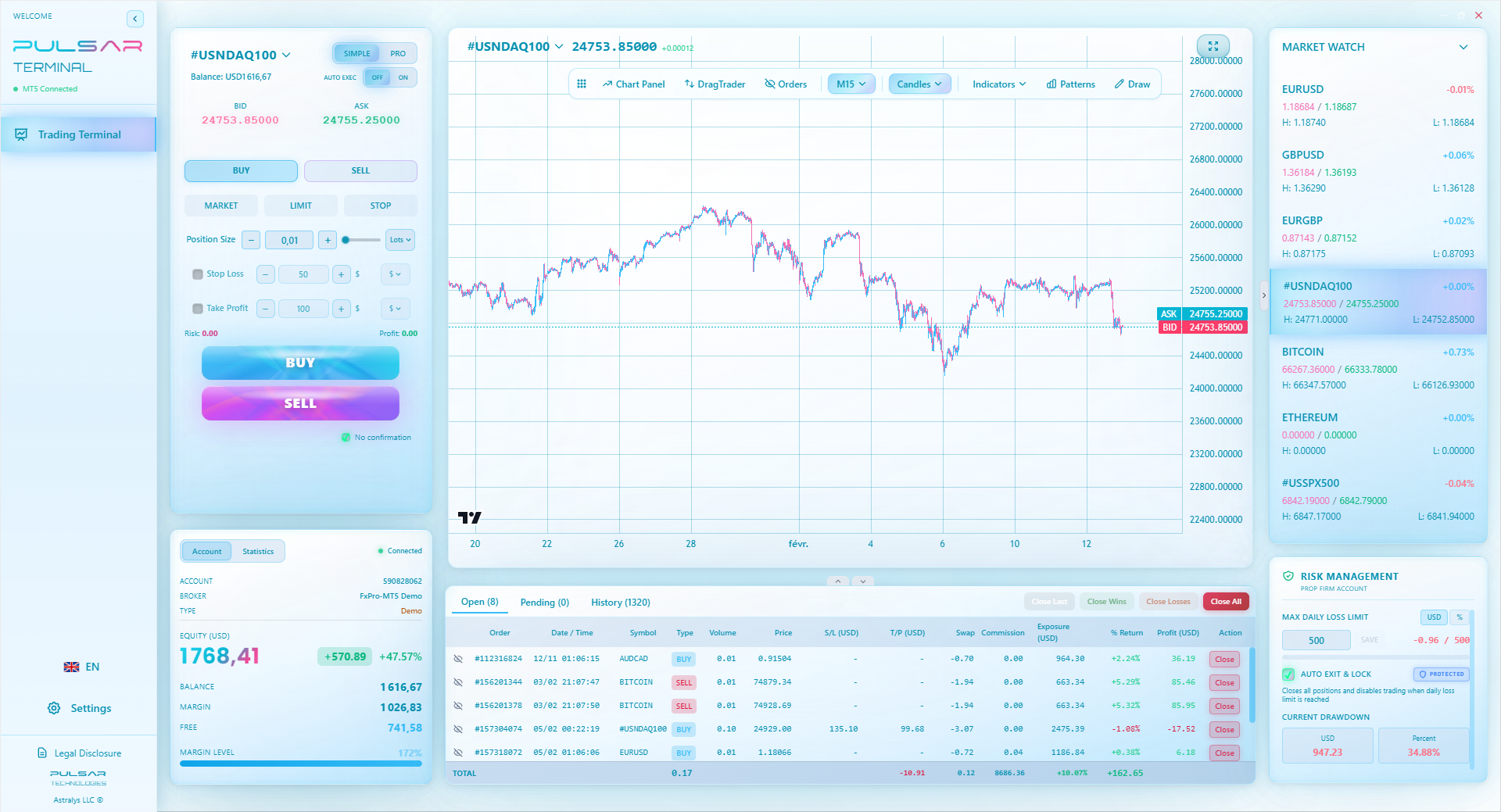
Managing trades around volatile news events requires precision tools; Pulsar Terminal's drag-and-drop orders and one-click partial closures let you adjust positions instantly on MT5 when the news hits.
Pulsar Terminal
MT5一站式工具:拖拽下单、多重止盈/止损、追踪止损、网格交易、成交量分布图和自营交易保护。每日1000+交易者使用。
Your trading plan isn't complete without a 'News Protocol'. Here's how to bake it in.
Step 1: The Sunday Night Review. Every Sunday, I open my forex news app's economic calendar. I screenshot the coming week and circle every High-Impact event for USD, ZAR, EUR (if I'm trading EUR/ZAR), and Gold (XAU/USD often moves on USD news). I write these times in my trading journal. This is my volatility map for the week.
Step 2: The Daily Check-In. Each morning, I check the app for any overnight developments and confirm the day's schedule. Is there a SARB speech at 2pm? I make a note: 'No new positions in ZAR pairs after 1:30pm.' This is non-negotiable.
Step 3: The Position Size Rule. My standard position size uses my position size calculator. But if there's a high-impact news event within the next 8 hours on my pair, I cut that size by 50%. Less capital at risk means less stress when the charts go crazy.
Step 4: The Post-Mortem. After a major news event, I review. Did the market move as expected? Did my app give me the alert in time? Was the analysis useful or misleading? This is how you refine which sources you trust.
This system turns the constant barrage of information into a scheduled, manageable process. It removes emotion and reaction. You're not a trader jumping at alerts; you're a manager executing a pre-defined plan based on informed risk assessments. That's the only way to survive the unique volatility of our market, where a load-shedding announcement can sometimes move the Rand as much as a Fed statement.
“The best trade you'll ever make is often the one you sidestepped because your news app showed you a hurricane was coming.”
So, do you need a dedicated forex news app? Yes, but with major caveats.
Think of it as your market radar. You don't stare at a radar screen for 8 hours; you glance at it periodically to ensure there are no storms on the horizon. For the South African trader, a good app is your early warning system for Rand volatility and your schedule for global risk events.
My final recommendation for most retail traders is this: Download FXStreet (free). Set up alerts only for High-Impact South African and US events. Use its economic calendar as your weekly planning bible. Ignore the opinion articles until you've formed your own technical view. And for ZAR-specific chatter, keep a browser tab open for a local financial news site to get the 'why' behind the move.
Pair this with a reliable, low-latency broker like XM or IC Markets to ensure your orders are executed when you need them to be, especially around news. Remember, the spread is your first cost of doing business; a spread definition that balloons from 3 pips to 30 pips during news can kill a trade before it starts.
The goal is to use information to reduce risk, not increase excitement. The best trade you'll ever make is often the one you sidestepped because your news app showed you a hurricane was coming. Now go set your alerts, and then go live your life. The app will tell you when it's time to work.
FAQ
Q1Is it legal to use international forex news apps in South Africa?
Absolutely. There's no restriction on accessing global financial news. The legality concern is with trading itself, which must be done through an FSCA-regulated broker or a reputable offshore one. Using Bloomberg, Reuters, or FXStreet is perfectly fine.
Q2What's the single most important news event for the South African Rand (ZAR)?
The South African Reserve Bank (SARB) interest rate decision is number one. Next is the local Consumer Price Index (CPI) inflation data. For USD/ZAR, US Non-Farm Payrolls and Federal Reserve decisions are equally critical as they drive the Dollar's strength.
Q3Why does the market sometimes move in the opposite direction of 'good' news?
This is called 'buy the rumor, sell the fact.' The market prices in expectations before the news is released. If the news is good but not as good as the market had hoped, the price falls. A forex news app shows you the raw data; your job is to gauge whether the market's reaction means it's impressed or disappointed.
Q4Should I pay for a premium forex news app?
Not when you're starting. The free versions of FXStreet or Forex Factory are more than sufficient. Consider premium only if you're trading very large sizes where a millisecond advantage on a news headline matters, or you need deeply institutional-grade data and research.
Q5How do I handle trading during major news if I have a full-time job?
You don't. That's the answer. Use your app's calendar to see when major events are scheduled. If you can't be at your screen to monitor the chaotic 5-15 minutes after the release, do not hold positions over that event. Close them beforehand. It's better to miss a move than to be stopped out unpredictably while you're in a meeting.
Q6Can I rely on the news feed built into my MT4/MT5 platform?
For timing of events, yes. For depth of analysis and speed of breaking news, no. Broker-integrated feeds are often slow and basic. Use them as a secondary convenience, not your primary source. Always cross-reference with a dedicated forex news app.
Q7What's a 'pip' in ZAR terms, and why does it matter for news?
A pip for USD/ZAR is typically 0.0010 (e.g., a move from 18.5000 to 18.5010). Because the Rand is less liquid than majors, news can cause moves of 200-500 pips very quickly. Understanding the pip definition and the monetary value of each pip in your account is crucial for managing risk around volatile news events.
Winston 教授的课程
要点总结:
- ✓Filter alerts: Only High-Impact SA & US events.
- ✓Trade the reaction, not the headline.
- ✓Cut position size by 50% before major news.
- ✓Use the calendar for planning, not live trading.
- ✓Technical levels remain valid even during news spikes.
这篇文章对您有用吗?
点击星星评分
每周交易洞察
免费每周分析与策略。无垃圾邮件。
关于作者
David van der Merwe
新兴市场交易员
约翰内斯堡交易者,11年新兴市场货币经验。专注于ZAR货币对、FSCA监管交易和南非市场分析。
评论
风险提示
金融工具交易存在重大风险,可能不适合所有投资者。过往业绩不代表未来表现。本内容仅供教育目的,不构成投资建议。在交易前请务必自行研究。
您可能还喜欢

Cara Trading Forex Sukses: 7 Prinsip dari Trader Profesional
Cara trading forex sukses dengan 7 prinsip trader pro: manajemen modal, disiplin, journal trading, backtest. Data nyata, bukan janji profit palsu.
Jam Trading Forex Terbaik untuk Trader Indonesia: Panduan Lengkap dengan Tabel Waktu
Panduan jam trading forex untuk trader Indonesia. Tabel 4 sesi dunia, jam emas 20:00-00:00, sesi mana yang harus dihindari. Data akurat + tips dari trader berpengalaman.
Top 5 Sàn Forex Uy Tín Nhất 2026: Review Jujur dari Trader Indonesia
Top 5 sàn forex uy tín 2026 untuk trader Indonesia. Review jujur: spread, deposit, withdraw, dukungan lokal. Exness, XM, IC Markets & lebih.
