


Let's start with a number that should sober you up: between 51% and 89% of retail CFD traders lose money.

David van der Merwe
新兴市场交易员 ·  South Africa
☕ 9 分钟阅读
您将学到:
Let's start with a number that should sober you up: between 51% and 89% of retail CFD traders lose money. In South Africa, with over 200,000 active traders, that's a lot of burnt capital. The 'forex profit way' here isn't about finding a magic bullet. It's about navigating a specific, regulated market with your eyes wide open. I've seen too many students blow accounts chasing get-rich-quick schemes. This guide is about building a sustainable edge, not a gambling habit.
First thing's first: trading is legal, but you're not in the wild west. The Financial Sector Conduct Authority (FSCA) runs the show. If your broker isn't on their FSP register, walk away. I don't care about their offshore 'license'. When things go south (and they can), you want the FSCA in your corner.
The rules here shape your entire game. The 30:1 use cap for retail traders? That's a blessing in disguise. It stops you from blowing up your account in five minutes like you could with the 1:1000 nonsense some offshore brokers peddle. They also enforce client fund segregation, so your money isn't funding the broker's new yacht.

Warning: Using an unregulated offshore broker might give you crazy use, but if they vanish with your deposit, the FSCA can't help you. Your money is gone. Full stop.
Then there's SARS. Forget thinking this is a casual hobby. If you're making consistent profits, SARS sees it as taxable income, not capital gains. That means it's taxed at your marginal rate, which can be up to 45%. I keep a brutal spreadsheet of every trade, deposit, and withdrawal. When tax season hits, I'm ready. You should be too. Not keeping records is an expensive mistake.
“The 30:1 use cap is a blessing in disguise. It stops you from blowing up your account in five minutes.”
You look at a broker's ad: 'Spreads from 0.0 pips!' Sounds great, right? That's just the entry fee. The real cost of doing business will eat your profits if you're not careful.
Let's break down a typical R10,000 account trading EUR/USD. On a 'standard' account with a 1.0 pip spread, you're paying R10 (ZAR) per mini lot (0.1 lot) just to get in and out. On an ECN account with a 0.1 pip spread but a $3.50 commission per lot, your cost is similar, just structured differently. The devil is in the details.
The Silent Account Killer: Swap Fees
This is where new traders get ambushed. Holding a position overnight incurs a swap fee, based on the interest rate differential. Going long on a high-yield currency against a low-yield one can earn you a small credit. Do the opposite, and you pay. I once held a long USD/JPY trade for two weeks during a quiet market. The price barely moved, but the nightly swap charges quietly carved R450 out of my account. I broke even on the trade but lost on the costs. A brutal lesson.

Example: Let's say the swap rate for holding EUR/USD long is -0.75 pips per night. On a 1-lot position (100,000 units), that's $7.50 daily. Over a month, that's $165. On a R20,000 account, that's over 1% of your capital gone just for holding.
Also, watch for dormancy fees. Some brokers will charge you R1500 or more if your account sits idle for 30-60 days. Read the fine print. Always.
Choosing a broker with ZAR accounts, like Khwezi Trade or others, can save you on conversion fees. Funding in Rands and trading a USD-denominated pair means your broker handles the conversion, often at a worse rate than your bank.

💡 Winston 小贴士
Your first R10,000 in the market is tuition, not capital. Expect to pay for your education. The goal is to keep the tuition fees as low as possible.
“Your stop-loss is your lifeline. It's not a suggestion.”
Trading from South Africa isn't just about the Rand. It's about your lifestyle, your internet, and the times you can actually watch the market.
The most active forex sessions are the London and New York overlaps. That's 10:00 AM to 5:00 PM SAST. If you have a 9-to-5 job, you're missing the prime volatility. This forces a choice: are you a scalping fiend trying to catch moves during your lunch break (a tough game), or are you a swing trader holding positions for days based on daily charts?
I've found most successful local traders I mentor lean into swing trading. It doesn't require staring at screens all day. You do your analysis in the evening, set your orders, and manage risk. The 30:1 use actually supports this style better than scalping.
Your strategy must also account for load-shedding. No joke. You need a UPS for your router and laptop. I've had a stop-loss order fail to trigger because Eskom decided it was time for stage 4. I lost R2,300 on a trade that should have been a R500 loss. Now, I always set stop-losses on the broker's server, not just on my local chart, and I have backup power.

Pro Tip: Focus on pairs that are active during your available hours. EUR/USD, GBP/USD, and USD/JPY have good volume during our afternoon. Avoid exotic pairs that are dead when you're awake; the spreads will murder you.
“Your stop-loss is your lifeline. It's not a suggestion.”
This is the core of the forex profit way. Without it, you're just donating money. I don't care how good your analysis is.
The 1% Rule is Gospel: Never risk more than 1% of your account balance on a single trade. On a R15,000 account, that's R150. Use a position size calculator every single time. Religiously. I once got cocky after three winning trades in a row. I put on a fourth trade with a 3% risk because I was 'sure'. A surprise news headline wiped out my entire week's profits plus some. It was a stupid, preventable error.
Stop-Losses are Not Optional: Your stop-loss is your lifeline. It's not a suggestion. Basing it on a solid technical level is better than an arbitrary pip amount. If you're trading XAU/USD (gold), the volatility is huge. A 1% risk might mean a $15 stop, which is nothing for gold. You need to adjust your position size down accordingly, or you'll get stopped out by noise.
use is a Tool, Not a Toy: With the FSCA's 30:1 cap, you can still get hurt. On a R10,000 account, 30:1 gives you R300,000 in buying power. That's enormous. Using it all is suicidal. For swing trading, I rarely use more than 5:1 or 10:1 effective use. It lets me breathe during drawdowns.
Ignoring these rules is the fastest path to a margin call. I've been there in my early days. It feels terrible.
💡 Winston 小贴士
If you wouldn't explain your trade setup to me in two clear sentences, you don't understand it well enough to risk money on it.
“The charts are easy. The person looking at the chart is the problem.”
Your broker is your gateway. Your platform is your cockpit. Choose poorly, and you're fighting with one hand tied behind your back.
For South Africans, an FSCA-regulated broker is the baseline. Look beyond the minimum deposit. A R500 minimum is fine to test, but real trading needs real capital. Look at the all-in cost: spread + commission + swap. A broker like Tickmill or FP Markets might have low spreads but a commission. XM or Exness might have no commission but a wider spread. Do the math for your typical trade size.
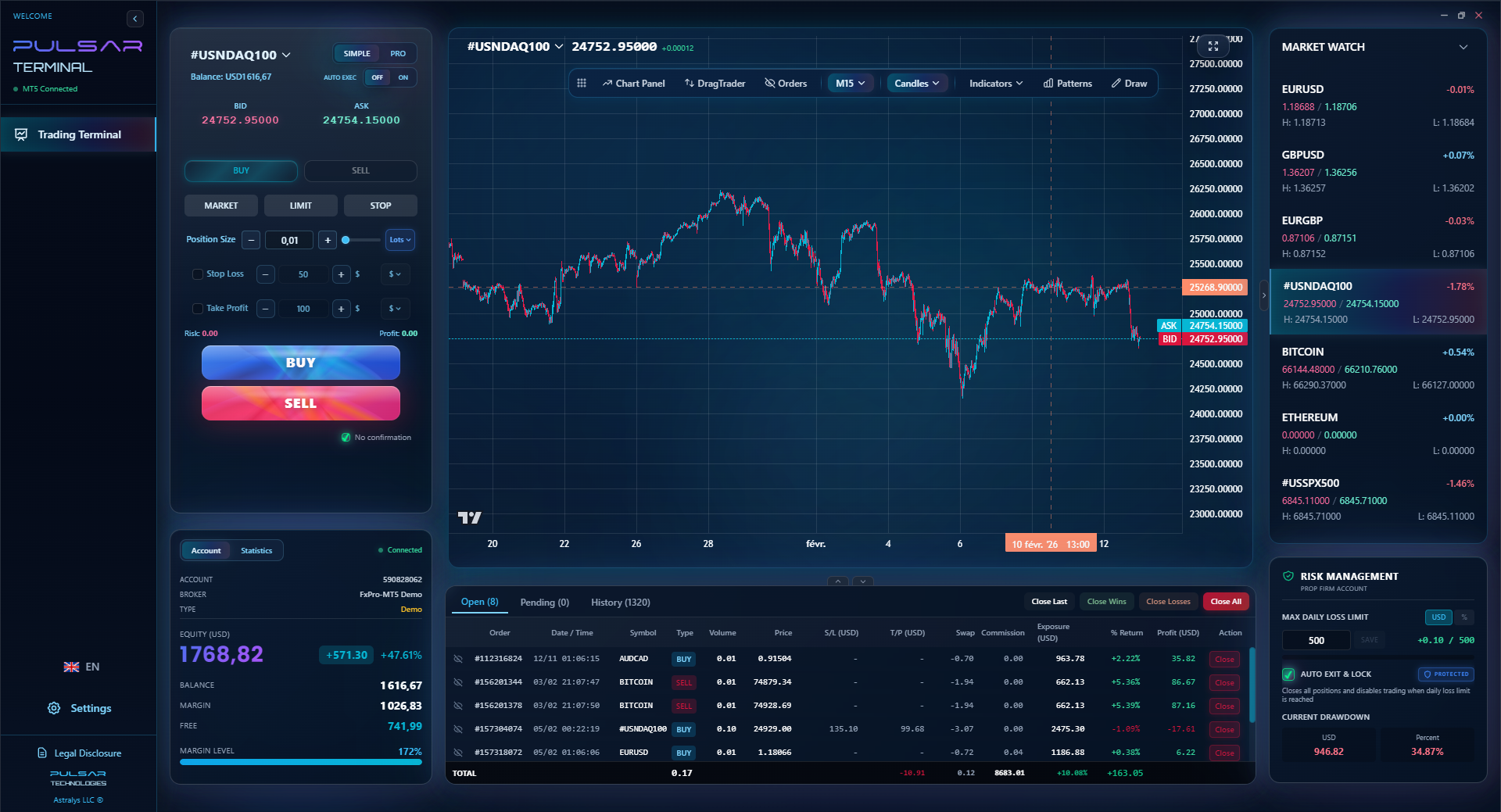
MetaTrader 4 or 5 is the industry standard for a reason. It's reliable, and everyone uses it. But the native MT5 platform is basic. This is where tools like Pulsar Terminal come in. It plugs into MT5 and adds the professional features the base platform lacks.
Most local brokers offer MT. Khwezi Trade is big on MT5. International brokers like IC Markets or Pepperstone also offer it with great execution. Test their demo accounts. See how fast your orders fill during news events. Slippage on a demo is slippage on a live account.
Manually moving stop-losses to breakeven or trailing a volatile trade is stressful and slow; Pulsar Terminal automates these risk management rules directly on your MT5 charts.
Pulsar Terminal
MT5一站式工具:拖拽下单、多重止盈/止损、追踪止损、网格交易、成交量分布图和自营交易保护。每日1000+交易者使用。
“The charts are easy. The person looking at the chart is the problem.”
The charts are easy. The person looking at the chart is the problem. Trading psychology in SA has its own flavour. There's a pressure to 'make it' quickly, to escape a tough economic reality. That desperation is poison for your account.
Chasing Losses: You lose R500. Your next thought is, 'I need to get that back now.' So you double your position size on a shakier setup. That's how a R500 loss becomes a R2,500 loss. I've done it. You have to accept the loss as the cost of business and stick to your plan.
Overconfidence After a Win: This is just as dangerous. You nail a trade, make R800. You start thinking you've cracked the code. You stop doing your full analysis because 'you're feeling it.' The market has a way of humbling that feeling very fast.
The only way through this is a trading journal. Not just 'bought here, sold there.' Write down your emotional state. 'Felt anxious after yesterday's loss, almost didn't take this valid setup.' 'Was overconfident, ignored the overbought RSI indicator signal.' Review it weekly. Your biggest patterns will stare back at you.
💡 Winston 小贴士
The market doesn't know you exist. It doesn't care about your rent, your bills, or your dreams. Trade the price, not your needs.
“The profit comes from consistency, not home runs. You're grinding out a few good trades a month.”
Let's make this concrete. Here’s what a disciplined forex profit way looks like for a swing trader with a R20,000 account.
Broker: An FSCA-regulated broker with MT5 and ZAR account funding. Trading Style: Swing trading based on daily chart MACD indicator and support/resistance. Trades held 2-10 days. Session: Analysis done after NY close (around midnight SAST). Orders set for next day.
Risk Parameters:
- Max risk per trade: 1% = R200.
- Stop-loss: Placed 50 pips away on EUR/USD.
- Position Size: R200 risk / 50 pips = R4 per pip. On EUR/USD, 1 pip on a mini lot (0.1) = ~R1.50. So position size ~2.6 mini lots (rounded down to 0.25 standard lots to be safe).
- Weekly loss limit: 5% (R1000). If hit, stop trading for the week.
Trade Example:
- Setup: EUR/USD bounces off key daily support, MACD shows bullish crossover.
- Entry: Buy at 1.0750.
- Stop Loss: 1.0700 (50 pips risk).
- Take Profit: 1.0850 (100 pips target, 2:1 reward-to-risk).
- Risk: 50 pips * R4/piр = R200.
- Potential Profit: 100 pips * R4/piр = R400.
This isn't exciting. It's mechanical. That's the point. The profit comes from consistency, not home runs. You're grinding out a few good trades a month, protecting your capital, and living to trade another day. That's the only sustainable forex profit way I know.
FAQ
Q1What is the minimum amount I need to start forex trading in South Africa?
Technically, you can start with R70 on a micro account. Realistically, if you want to practice proper risk management without getting obliterated by costs, aim for at least R1,500 to R5,000. For serious swing trading, R10,000-R20,000 is a healthier starting point.
Q2Can I trade with use higher than 30:1 in South Africa?
If you're classified as a retail client, no. The FSCA caps it at 30:1 for major pairs. Some brokers may offer higher use if you apply and qualify as a professional client, but that requires meeting specific criteria like large portfolio size and trading experience. For 99% of starters, 30:1 is your limit - and it's more than enough to get you into trouble.
Q3How are my forex trading profits taxed by SARS?
SARS typically views frequent forex trading as income, not capital gains. This means your net profits are added to your other income and taxed at your marginal tax rate (which can be up to 45%). You must keep careful records of every trade, all statements, and currency conversions. Get an accountant who understands trading.
Q4Is it better to use a South African broker or an international one?
An FSCA-regulated broker (South African or international brand with a local license) should be your first choice for protection. Some international brokers like IC Markets offer excellent conditions, but ensure they are properly regulated elsewhere if not by the FSCA. The convenience of ZAR accounts and local support with a SA broker can be valuable.
Q5What's the biggest mistake new South African traders make?
Two tied for first: ignoring risk management (especially the 1% rule) and trading with money they can't afford to lose because they're desperate for quick income. The second one destroys your psychology before you even place a trade.
Q6Can I trade the USD/ZAR pair as a South African?
You can, but be aware of SARB's exchange control regulations. Speculating against the Rand with the intent to profit from its depreciation can be a grey area. Many traders stick to major pairs like EUR/USD to avoid any potential regulatory complications. It's also extremely volatile.
Winston 教授的课程
要点总结:
- ✓FSCA regulation is your non-negotiable first filter.
- ✓Never risk more than 1% of your capital on a single trade.
- ✓SARS taxes trading profits as income, not capital gains.
- ✓Build a strategy that fits SA market hours and your life.
- ✓Your trading journal is your most important tool.
这篇文章对您有用吗?
点击星星评分
每周交易洞察
免费每周分析与策略。无垃圾邮件。
关于作者
David van der Merwe
新兴市场交易员
约翰内斯堡交易者,11年新兴市场货币经验。专注于ZAR货币对、FSCA监管交易和南非市场分析。
评论
风险提示
金融工具交易存在重大风险,可能不适合所有投资者。过往业绩不代表未来表现。本内容仅供教育目的,不构成投资建议。在交易前请务必自行研究。
您可能还喜欢

Cara Trading Forex Sukses: 7 Prinsip dari Trader Profesional
Cara trading forex sukses dengan 7 prinsip trader pro: manajemen modal, disiplin, journal trading, backtest. Data nyata, bukan janji profit palsu.
Jam Trading Forex Terbaik untuk Trader Indonesia: Panduan Lengkap dengan Tabel Waktu
Panduan jam trading forex untuk trader Indonesia. Tabel 4 sesi dunia, jam emas 20:00-00:00, sesi mana yang harus dihindari. Data akurat + tips dari trader berpengalaman.
Top 5 Sàn Forex Uy Tín Nhất 2026: Review Jujur dari Trader Indonesia
Top 5 sàn forex uy tín 2026 untuk trader Indonesia. Review jujur: spread, deposit, withdraw, dukungan lokal. Exness, XM, IC Markets & lebih.
